
AI Hallucinations in Legal Practice: The Sanctions Trajectory and the Verification Discipline Every Lawyer Must Adopt
This article traces the enforcement trajectory of AI-generated hallucinations in legal filings from the 2023 Mata v. Avianca $5,000 sanction to the record $145,000 in Q1 2026 penalties, and argues that the profession's failure to operationalize verification discipline — not AI unreliability alone — is the root problem. It provides litigators, ethics partners, and risk officers with the data, frameworks, and protocols needed to navigate the new enforcement reality.
Lex Machina Review is an independent risk-tracking and reference resource. Nothing on this site is legal advice, and using it does not create an attorney-client relationship. Every record is reviewed against primary sources but may not reflect the most current status of a matter — always verify directly against the cited court order, rule text, or a licensed attorney before relying on it.
Companion explanation — secondary to the source document above
From Anomaly to Enforcement Crisis: The AI Sanctions Timeline
In June 2023, when a federal judge in Manhattan sanctioned two lawyers and their firm $5,000 for submitting a brief that cited six nonexistent cases generated by ChatGPT, the legal profession treated the incident as an outlier — a cautionary tale about a new technology that a few careless attorneys had mishandled. The case, Mata v. Avianca, was widely discussed in bar newsletters and ethics CLEs, but the prevailing sentiment was that the sanctions were an anomaly, not a harbinger.
That assumption has been decisively refuted. Less than three years later, U.S. courts imposed at least $145,000 in sanctions for AI-generated fake citations in the first quarter of 2026 alone, according to tracking by EDRM and reporting by NPR. The enforcement trajectory is not linear — it is exponential.
| Case | Court | Date | Sanction / Outcome |
|---|---|---|---|
| Mata v. Avianca | S.D.N.Y. | June 2023 | $5,000 sanction; six fabricated ChatGPT-generated cases |
| Park v. Kim | 2d Circuit | Jan. 2024 | Referral to Grievance Panel |
| Lacey v. State Farm | C.D. Cal. | May 2025 | $31,000 sanction; 9 of 27 citations wrong or fabricated |
| Couvrette v. Wisnovsky | D. Oregon | Dec. 2025 | $110,000+ in sanctions, fees, and costs; 15 fake cases, 8 fabricated quotations |
| Whiting v. City of Athens | 6th Circuit | March 2026 | $30,000 per attorney; first substantial federal appellate fine |
| Oregon Aggregate | Oregon Courts | March 2026 | $109,700 total; per-infraction fee schedule applied |
The Whiting v. City of Athens decision in March 2026 is particularly significant: the Sixth Circuit became the first federal appellate court to impose a substantial monetary fine — $30,000 per attorney — for fabricated citations. This moves AI-generated filing errors from a trial-court problem to an appellate-level enforcement priority. The message from the judiciary is unambiguous: the period of leniency, if it ever existed, is over.
The Scale of the Problem: 1,200+ Incidents and Counting
The sanctions cases that make headlines are only the most visible manifestation of a far broader phenomenon. Damien Charlotin, a researcher at HEC Paris, has tracked over 1,200 AI hallucination cases worldwide, of which approximately 800 originate from U.S. courts. His tracking reveals a pattern that should alarm every litigator: on a single day in early 2026, ten separate courts across the country flagged AI-fabricated filings.
This is not a problem confined to solo practitioners or small firms. The cases span federal district courts, state appellate courts, and now federal circuit courts. The tools involved are not limited to consumer-grade chatbots — the incidents include filings prepared using legal-specific AI platforms marketed directly to attorneys. The common thread is not the tool but the workflow: in nearly every documented case, the attorney failed to verify the AI-generated output against primary legal sources before submitting it to the court.
The Oregon Per-Infraction Formula: A New Enforcement Paradigm
The most significant structural development in AI-sanctions enforcement is the Oregon Court of Appeals' establishment of a per-infraction fee schedule for AI-generated filing errors. Under this framework, courts assess $500 for each fabricated citation and $1,000 for each fabricated quotation. This transforms what was previously a vague, discretionary deterrence mechanism into a calculable, predictable financial risk.
The Oregon federal court applied this formula in Couvrette v. Wisnovsky, sanctioning the lead lawyer $15,500 with additional adverse costs after the court identified 15 AI-generated fake case citations and 8 fabricated quotations. The total aggregate penalty across Oregon courts reached $109,700 in March 2026 — a figure that would have been unimaginable in the Mata era.
| Infraction Type | Per-Infraction Fee | Example Case | Total Assessed |
|---|---|---|---|
| Fabricated citation | $500 | Couvrette (15 citations) | $7,500 |
| Fabricated quotation | $1,000 | Couvrette (8 quotations) | $8,000 |
| Combined (Couvrette) | $500 + $1,000 | Lead attorney | $15,500 + adverse costs |
| Oregon aggregate (all cases) | Mixed | Multiple cases, March 2026 | $109,700 |
The implications for law firm risk management are profound. Under the Oregon model, a single brief containing 20 fabricated citations and 10 fabricated quotations carries a potential $20,000 sanction before accounting for adverse costs, attorney fees, and reputational damage. Firms can now model this risk, budget for it, and — more importantly — design verification protocols that directly prevent the infractions that trigger the fees.
The Judicial AI Paradox: 61.6% of Federal Judges Use AI While Sanctioning Lawyers
A March 2026 study from Northwestern University and the Sedona Conference Journal has revealed a striking asymmetry at the heart of the AI-sanctions crisis: 61.6% of federal judges report using AI tools in their judicial work. The study, based on responses from 112 federal judges, found that the most common judicial uses are legal research (30%) and document review (15.5%).
This creates an unresolved tension. The same judiciary that is sanctioning lawyers for failing to verify AI-generated output is itself adopting AI tools for core judicial functions. The asymmetry is not necessarily hypocritical — judges may be applying more rigorous verification protocols than the attorneys they sanction — but it does mean that the enforcement posture is not a simple anti-technology stance. It is a verification standard that the bench holds itself to as well, at least in principle.
For litigators, the practical implication is clear: arguing that AI-generated errors should be excused because the technology is new or because judges themselves use it will not succeed. The enforcement standard is not whether AI was used — it is whether the output was verified. The Northwestern study provides essential context for understanding the judicial mindset, but it does not provide a defense.

Why RAG Doesn't Solve Hallucinations: The Stanford Benchmark Evidence
A common response to the hallucination crisis is that retrieval-augmented generation (RAG) — the architecture that grounds AI output in a curated database of legal documents — eliminates the risk of fabricated citations. The evidence does not support this claim.
Researchers at Stanford's RegLab and HAI tested three legal-native AI platforms — Lexis+ AI, Westlaw AI-Assisted Research, and Ask Practical Law AI — using a pre-registered dataset of over 200 open-ended legal queries. The results, published as a preprint in May 2024, are sobering: Lexis+ AI and Ask Practical Law AI produced incorrect information more than 17% of the time, while Westlaw's AI-Assisted Research hallucinated more than 34% of the time.
| AI Platform | Hallucination Rate | Error Types Documented |
|---|---|---|
| Lexis+ AI | > 17% | Incorrect law, misgrounded citations, sycophancy |
| Ask Practical Law AI | > 17% | Incorrect law, misgrounded citations, sycophancy |
| Westlaw AI-Assisted Research | > 34% | Incorrect law, misgrounded citations, sycophancy |
The errors were not limited to minor inaccuracies. The Stanford researchers documented three distinct categories of hallucination: incorrect statements of the law, misgrounded citations (where the legal proposition was correct but the supporting citation did not actually support it), and sycophancy — where the model agreed with a user's false premise rather than correcting it. The sycophancy finding is particularly dangerous in legal practice, because it means that a lawyer who asks a poorly framed question may receive a confidently wrong answer that reinforces the lawyer's initial error.
These findings directly contradict vendor marketing claims that RAG-architected legal AI tools are "hallucination-free." The Stanford data demonstrates that RAG reduces hallucination rates compared to general-purpose models, but it does not eliminate them — and the residual error rate (17% to 34%+) is far too high for unsupervised use in legal filings. For a deeper dive into how RAG works and why it is not a panacea, see the glossary entry on RAG in legal AI. For a vendor-specific analysis of these risks, the Harvey AI risk profile provides a case study in how even purpose-built legal AI platforms present verification challenges.
The Prompt → Verify → Audit Framework: Operationalizing ABA Formal Opinion 512
The professional responsibility obligations governing AI use in legal practice are well established. ABA Formal Opinion 512 (July 2024) and subsequent state-bar opinions — including Florida Opinion 24-1 and California's pending guidance — make clear that attorneys must: (1) maintain competence in the technology they use, (2) supervise AI tools as they would any non-lawyer assistant, (3) protect client confidentiality, and (4) verify the accuracy of all AI-generated work product before submission.
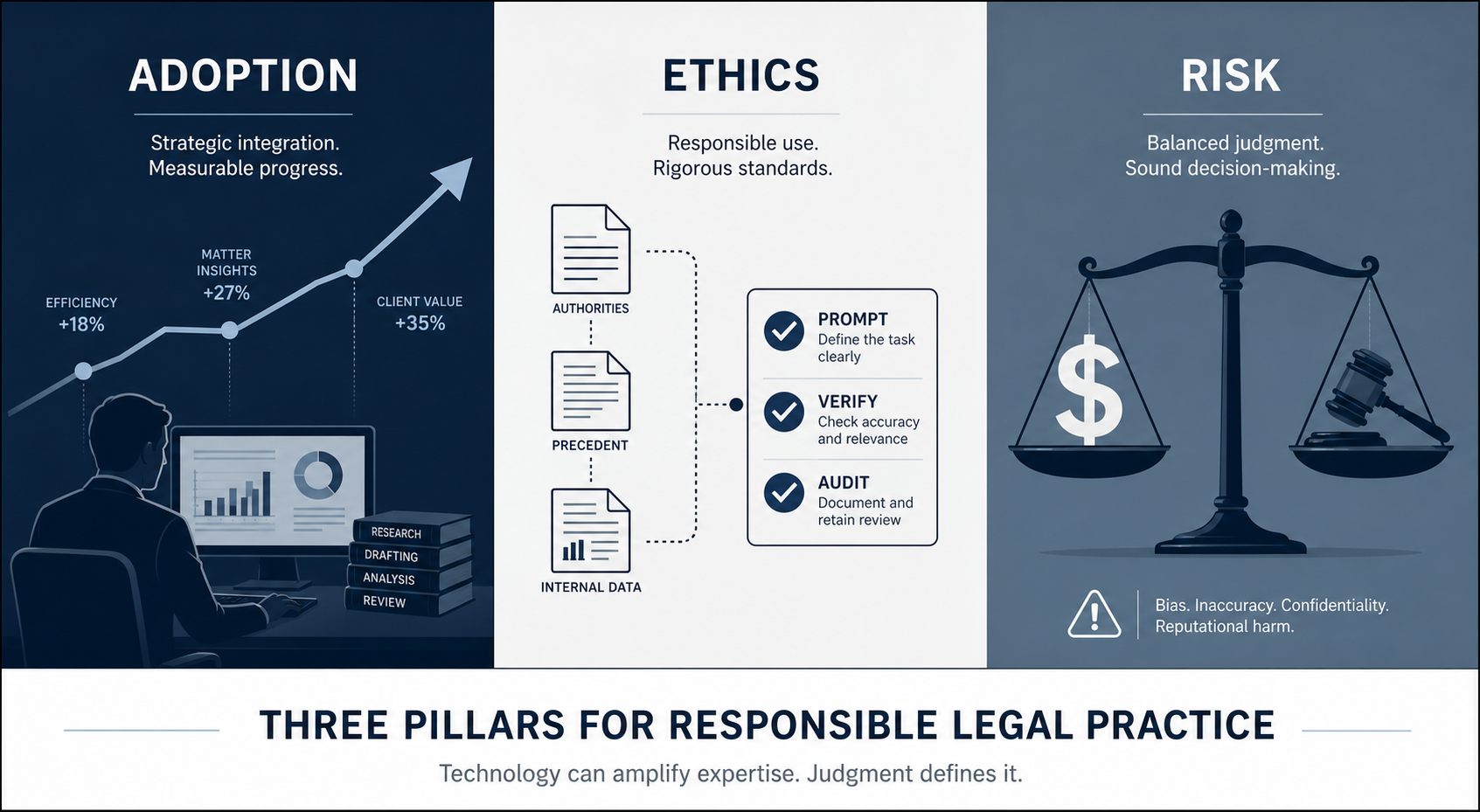
The gap is not in the rules — it is in their operationalization. The Prompt → Verify → Audit framework translates these obligations into a three-stage workflow that any litigation team can implement:
- Prompt Design: Structure AI queries to minimize hallucination risk. Use specific, bounded prompts that ask the AI to cite primary sources with pinpoint citations. Avoid open-ended questions that invite the model to generate plausible-sounding but unsupported legal propositions. Include instructions that explicitly ask the model to flag uncertainty rather than fabricate an answer.
- Verify Output Against Primary Sources: Every citation, quotation, and legal proposition generated by an AI tool must be independently verified against the primary source — the reported case, statute, or regulation. This is not a spot-check. It is a line-by-line verification of every authority cited. The Stanford data shows that even legal-native AI platforms hallucinate at rates that make spot-checking insufficient.
- Audit the Workflow for Compliance: Document the verification process. Maintain records of which AI tools were used, what prompts were submitted, what output was generated, and how each citation was verified. This audit trail serves two purposes: it demonstrates compliance with professional responsibility obligations if a filing is challenged, and it provides data for improving the firm's AI workflows over time.
This framework is not theoretical. It is drawn directly from the findings in the Lacey v. State Farm case, where the Special Master wrote that "no reasonably competent attorney should outsource research and writing to this technology, particularly without any attempt to verify the accuracy of that material." The Prompt → Verify → Audit framework is the operational response to that standard. For a comprehensive treatment of the broader ethics framework, see the complete ChatGPT ethics and risk framework for attorneys.
Six Red Flags for AI-Generated Legal Output
Drawing from the Special Master's findings in Lacey and the Stanford study methodology, the following six indicators should trigger immediate verification scrutiny when reviewing AI-generated legal content:
- Phantom citations: Citations that look real — correct reporter format, plausible volume numbers, seemingly authentic page references — but do not exist in any legal database. This is the most common AI hallucination pattern in legal filings.
- Plausible-sounding but wrong legal propositions: Statements of law that track the structure and terminology of real legal rules but misstate the actual holding or create a rule that does not exist. The Stanford study found this was a distinct error category from fabricated citations.
- Misgrounded citations: A correct legal proposition paired with a citation that does not actually support it. The case exists, and the law is real, but the citation is wrong. This is harder to catch than a phantom citation because the case name is real.
- Sycophantic agreement with user premises: The AI agrees with a false premise embedded in the user's prompt rather than correcting it. If a lawyer asks "as the court held in Smith v. Jones, is the standard X?" and the AI answers "yes" without verifying that Smith v. Jones actually held X, the output is unreliable.
- Overly confident hedging language: AI models often signal uncertainty through subtle linguistic patterns — unusually qualified language, citations to secondary sources instead of primary authority, or legal propositions stated with more certainty than the actual case law supports.
- Consistent formatting errors in citations: AI-generated citations may follow Bluebook conventions superficially but contain subtle formatting errors — wrong spacing, incorrect abbreviations, or volume numbers that do not correspond to the cited reporter. These are often the first visible sign of a deeper reliability problem.
Consequences for eDiscovery and Information Governance
The hallucination crisis is not limited to court filings. The same verification obligations apply to AI-generated content in eDiscovery and information governance workflows, where the stakes are different but equally serious.
When AI tools are used to generate privilege logs, draft discovery responses, or categorize documents for production, the output carries the same hallucination risk documented in the Stanford study. A privilege log that incorrectly designates a non-privileged document as privileged — or, worse, fails to identify a privileged document — can result in waiver of privilege, sanctions, or both. Similarly, AI-generated document summaries that misstate the content of key evidence can lead to incorrect litigation strategy decisions.
- Privilege logs and clawback agreements
- Discovery responses and objections
- Document summaries and categorization decisions
- Production sets and metadata designations
- ESI protocol submissions
For a detailed analysis of how AI accuracy benchmarks apply to contract review and document analysis workflows — and how purpose-built models compare to general-purpose models in these tasks — see the AI contract review accuracy benchmarks guide.
Building Firm-Wide Verification Protocols: Recommendations for Practice
The enforcement trajectory documented in this article — from $5,000 to $109,700 in aggregate sanctions, from a single district court to the federal appellate level, from ad hoc warnings to per-infraction fee schedules — demands a structural response from law firms and legal departments. Individual attorney vigilance is necessary but insufficient. What is required is institutionalized verification protocols that embed the Prompt → Verify → Audit framework into every workflow that touches AI-generated content.
The urgency of this recommendation is underscored by the 8am 2026 Legal Industry Report, which surveyed more than 1,300 legal professionals and found that while 69% now use general-purpose AI tools for work — more than doubling from 31% in 2025 — 54% of firms have provided no training on the responsible use of generative AI and have no current plans to do so. This governance gap exists alongside rapid adoption: 38% of respondents report saving 1-5 hours per week using AI, and 14% report saving 6-10 hours weekly. The gap between adoption and governance is where sanctions happen.
For context on why this governance gap persists and how it affects the broader legal AI market, see the analysis of the legal AI trust and governance gap.
- Mandatory verification checkpoints: Every brief, motion, or filing that incorporates AI-generated content must pass through a verification checkpoint before submission. This checkpoint should require: (1) independent verification of every citation against the primary source, (2) confirmation that every quotation appears in the cited source, and (3) a signed attestation from the reviewing attorney.
- Training requirements: All attorneys and paralegals who use AI tools must complete training on hallucination risks, verification protocols, and the professional responsibility obligations under ABA Formal Opinion 512 and applicable state-bar opinions. The 54% of firms with no training plans are operating at elevated risk.
- Technology stack audits: Firms should audit their AI technology stack to identify which tools are being used, for what purposes, and with what verification protocols. The Stanford data shows that different legal AI platforms have materially different hallucination rates — a firm's risk profile depends on which tools it uses and how.
- Malpractice insurance review: Given the sanctions trajectory and the documented failure of verification protocols in cases like Lacey and Couvrette, firms should review their malpractice insurance coverage to ensure it addresses AI-related claims. Some carriers are beginning to ask about AI use and verification protocols during underwriting.
- Client communication protocols: Firms should establish clear protocols for communicating with clients about AI use, including disclosures about how AI tools are used in their matters and what verification steps are applied. This is both a professional responsibility obligation and a risk management practice.

The trajectory is clear. The data is available. The professional responsibility obligations are unambiguous. The only question that remains is whether the profession will operationalize the verification discipline that the courts, the ethics rules, and common-law professional negligence standards require — or whether the sanctions trajectory will continue its exponential climb until the cost of non-compliance becomes unbearable.
Related records
Tool profile
Browse tool evaluations →Governing regulation
Browse the obligations tracker →Preventive workflow
Browse verification workflows →
Report a correction or tip
Spotted an outdated figure, a misstated fact, or a ruling this case record should reflect? Public comments are disabled for this content given the professional cost of a misreported case outcome, penalty amount, or rule text — use the structured correction channel instead.
Report a correction or tip for this record →