
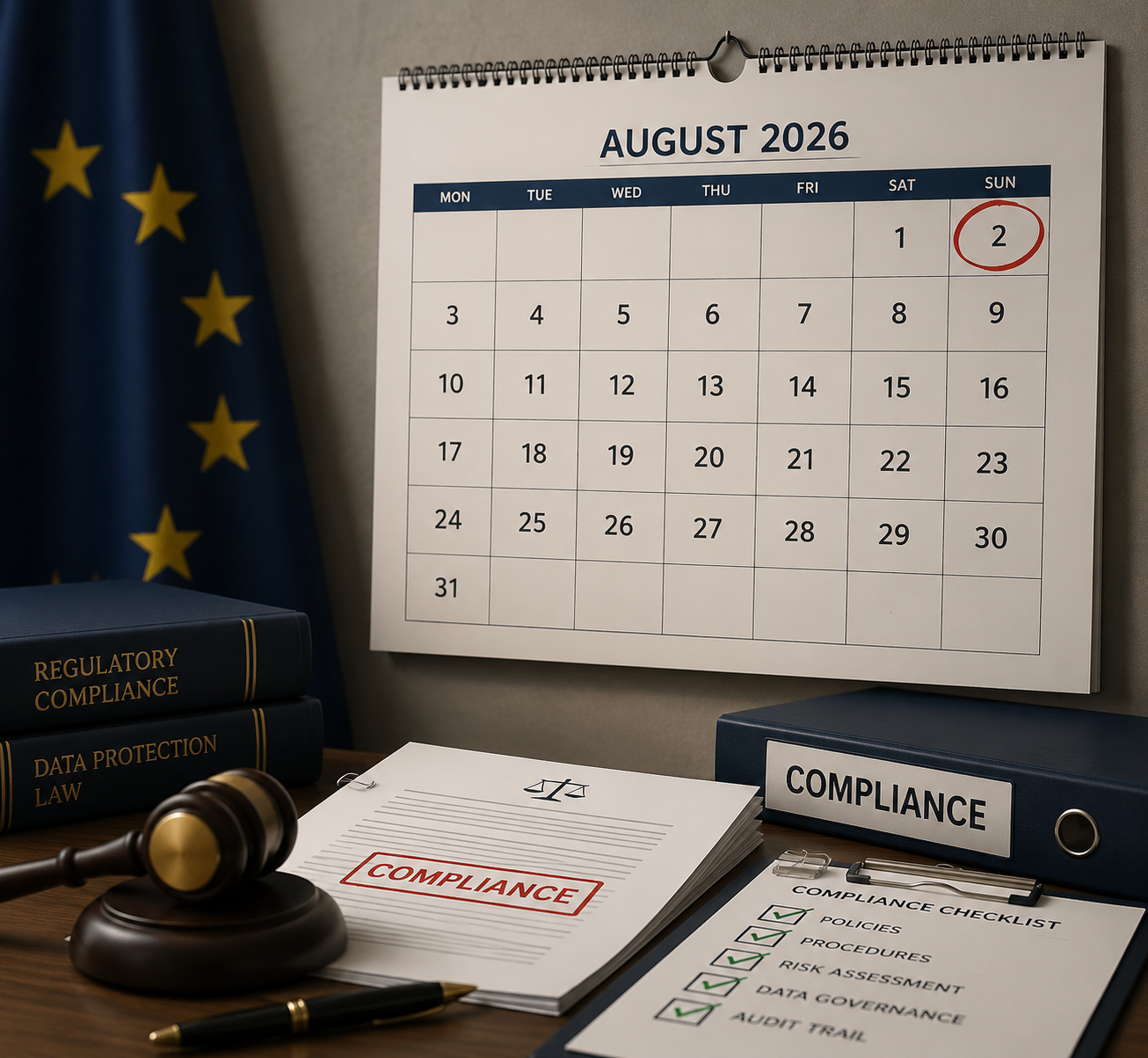
As of July 9, 2026, the EU AI Act’s August 2, 2026 deadline is less than a month away. On that date, the Act’s high-risk AI system obligations become the operational center of EU AI compliance for organizations in scope: high-risk system rules move from planning item to mandatory compliance posture, while the full penalty framework is available for enforcement. The operative deadline remains August 2, 2026 unless the law is formally amended; ongoing Digital Omnibus negotiations should not be treated as a compliance stay.
This is a regulatory-tracker briefing, not legal advice. It identifies the rule, jurisdiction, effective date, affected organizations, and source trail that legal, compliance, privacy, and legal operations teams can use for verification and planning. The immediate question is not whether AI regulation is becoming more important. It is whether a system, role, or workflow has an August 2 sign-off risk attached to it.
What August 2, 2026 Changes
The AI Act has not arrived all at once. The prohibited-practices provisions for unacceptable-risk systems took effect on February 2, 2025. General-purpose AI model obligations, including transparency, copyright compliance, and systemic-risk testing obligations for relevant models, have applied since August 2, 2025. The August 2, 2026 date is the next and more operationally demanding phase: high-risk system obligations take effect, including conformity assessment requirements for high-risk systems before they are placed on the EU market or put into service.[1]
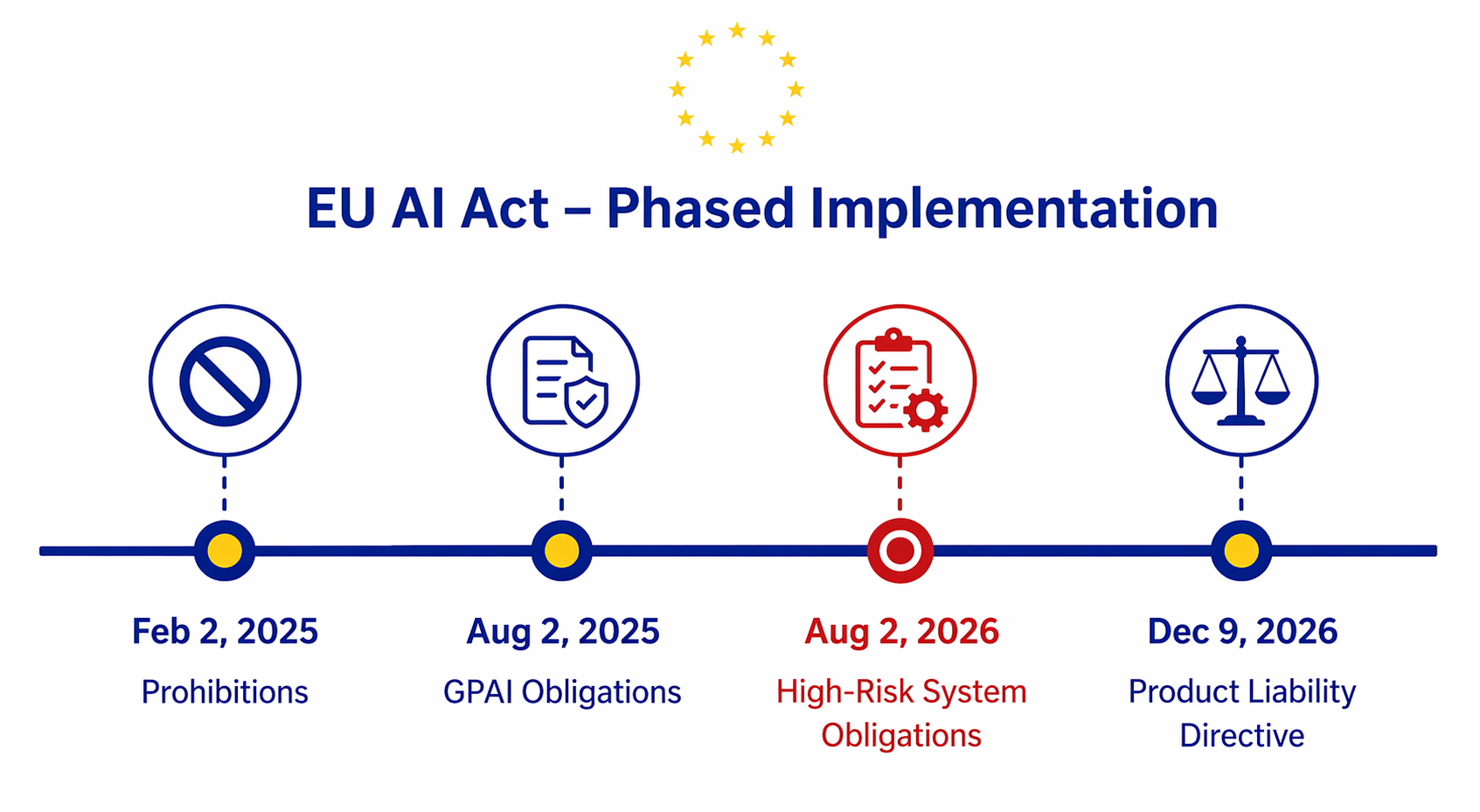
| Date | Regulatory milestone | Compliance significance |
|---|---|---|
| February 2, 2025 | Unacceptable-risk prohibitions apply | Certain AI practices are already prohibited. |
| August 2, 2025 | GPAI obligations apply | General-purpose AI model providers face transparency, copyright, and systemic-risk obligations where applicable. |
| August 2, 2026 | High-risk system obligations apply | High-risk AI systems move into the main conformity, documentation, oversight, and governance regime. |
| December 9, 2026 | Revised Product Liability Directive horizon | Products placed on the market after this date may face updated strict-liability exposure, including for software and AI systems. |
That sequencing matters because many internal calendars still collapse the AI Act into a single “2026” event. The distinction is not cosmetic. A company may already have GPAI obligations in force while also needing a separate August 2 readiness assessment for a high-risk system. Conversely, a team cannot assume that because it completed an AI literacy exercise or vendor questionnaire in 2025, it has satisfied the obligations that attach to a high-risk system in 2026.
The penalty framework gives the deadline material weight without needing melodrama. The AI Act penalty tiers include up to €35 million or 7% of worldwide annual turnover for prohibited practices, up to €15 million or 3% for violations of high-risk and other specified obligations, and up to €7.5 million or 1.5% for supplying incorrect, incomplete, or misleading information to authorities.[2]
Who Should Be Looking at This Date
The August 2 deadline is not limited to EU-headquartered companies. The Act reaches providers and deployers outside the EU where the output produced by the AI system is used in the EU, regardless of where the provider or deployer is established.[2]
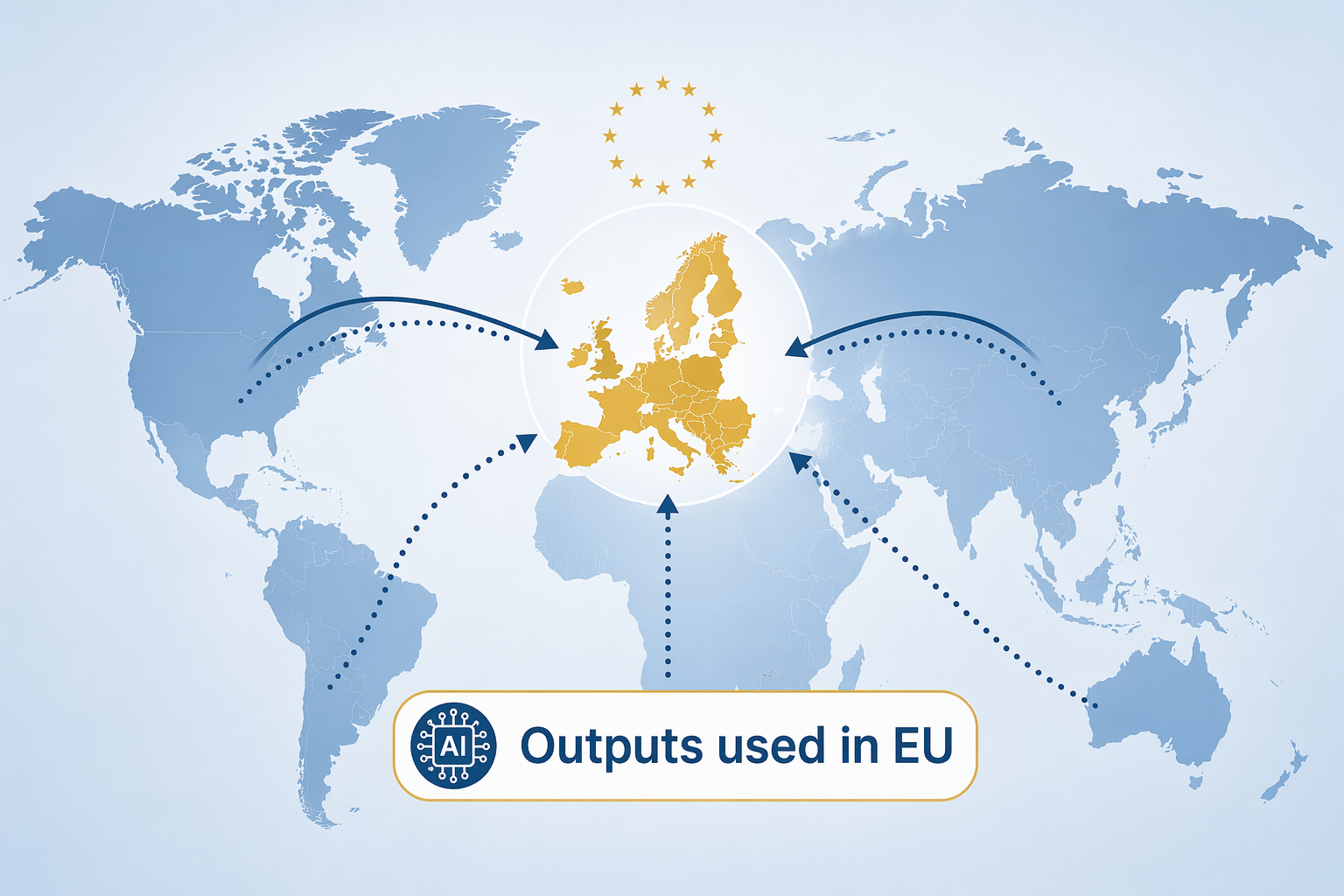
That is the sentence non-EU organizations most often need translated into work allocation. A US-headquartered vendor may have no EU engineering team, no EU data center, and no EU parent company, yet still need to analyze the Act if the system’s outputs are used by customers, employees, applicants, patients, students, or other affected persons in the EU. The relevant trigger is not only where the model is built or hosted; it is also where the output lands.
Role classification is the first practical fork. A provider, deployer, importer, distributor, authorized representative, or product manufacturer may carry different duties in the same AI workflow. A multinational group can also occupy more than one role: one entity develops or substantially modifies a system, another integrates it into a service, and a local business unit uses the output in an EU-facing decision process. The compliance file should not stop at the vendor name; it should identify the role attached to the actual use.
High-risk status requires the same discipline. The August 2 obligations are centered on high-risk AI systems, including systems identified through the Act’s Annex III categories and systems treated as high-risk in regulated product contexts. A company does not get to answer that question by labeling a tool “assistive” in a procurement record. It needs to map what the system is used for, who relies on the output, and whether the use falls into a covered high-risk area.
What High-Risk Compliance Requires in Practice
For high-risk systems, the August 2 task is not to produce a generic AI policy. The operational question is whether the organization can show that the system has been assessed, documented, monitored, and assigned to accountable owners before it is placed on the market, put into service, or used in a covered EU context. The Act’s high-risk regime includes pre-market conformity assessment for relevant systems and supporting obligations around risk management, data governance, technical documentation, recordkeeping, transparency to deployers, human oversight, accuracy, robustness, and cybersecurity.[1][2]
In-house teams should therefore be wary of a compliance record that consists only of a vendor SOC report, a model card, or a statement that the system is “human reviewed.” Those may be useful materials, but they are not the same as a role-specific AI Act assessment. The person signing the internal assurance memo needs enough evidence to answer narrower questions: what is the intended purpose, what version is being used, what EU outputs exist, what high-risk category is implicated, what conformity route applies, what post-market monitoring is in place, and what happens when the system changes.
- Inventory AI systems whose outputs are used in the EU, including systems procured from vendors and systems embedded in broader software products.
- Classify the organization’s role in each workflow: provider, deployer, importer, distributor, product manufacturer, or another relevant actor.
- Screen each use against high-risk categories and product-safety links rather than relying on internal labels such as “pilot,” “assistant,” or “decision support.”
- Confirm whether conformity assessment, technical documentation, logging, human oversight, and post-market monitoring obligations have a named owner.
- Preserve evidence of the assessment, including the reasoning for systems treated as out of scope or not high-risk.
For law-firm-specific implementation work, readers may also want to compare this deadline map with EU AI Act Compliance for Law Firms: An 8-Step Action Plan Before the August 2, 2026 Deadline. For a broader deployer/provider discussion, see The EU AI Act and Your Law Firm: A Practical Compliance Guide for Legal Practitioners.
Sandboxes Are Also an August 2 Obligation
Article 57 adds another August 2 marker that is easy to miss in company-facing summaries. Each EU Member State must establish at least one AI regulatory sandbox at national level, and those sandboxes must be operational by August 2, 2026.[3]
That does not mean every organization will use a sandbox or that a sandbox substitutes for compliance. It means regulators are expected to have an official testing and supervisory pathway available as the high-risk regime becomes fully operative. For companies developing or deploying systems in legally sensitive areas, sandbox availability may become relevant to product planning, regulator engagement, and evidence of responsible development. It should not be logged as a reason to wait.
What the Digital Omnibus Does Not Yet Do
The Digital Omnibus proposal, introduced in November 2025, may affect timing or relax certain obligations, and organizations should track it closely. But a proposal under negotiation is not the same as an amended compliance date. As of July 9, 2026, the operative high-risk deadline remains August 2, 2026 unless the relevant legal text is formally changed.[4]
This uncertainty creates a familiar compliance problem: the legal team cannot ignore a live legislative process, but it also cannot build a readiness plan on hoped-for relief. The defensible posture is to maintain the August 2 workstream, note the specific provisions that could be affected by a formal amendment, and avoid changing internal attestations until the law actually changes.
The Next Liability Horizon: December 9, 2026
The revised Product Liability Directive belongs on the same calendar, although it is not the same legal instrument. It applies to products placed on the market after December 9, 2026, and treats software and AI systems as products that may be subject to strict no-fault liability.[5]
For compliance planning, that matters because the AI Act file and the liability file will often draw from the same evidence: intended purpose, risk controls, technical documentation, change management, warnings, user instructions, monitoring, and incident handling. Passing through August 2 without a durable record may leave the organization exposed again when a later defect, harm, or product-liability inquiry asks what the company knew and what it documented.
GDPR Article 22 remains a separate checkpoint. The right not to be subject to certain solely automated decision-making continues to apply alongside the AI Act, rather than being absorbed by it.[6] A high-risk AI Act analysis therefore does not close the file for employment, credit, insurance, access-to-services, or other workflows where personal data and automated decisions are involved.
Why Global Firms May Standardize Anyway
The Brussels Effect is useful shorthand for what many global companies do after the formal scope analysis is complete: they often decide that one EU-grade compliance baseline is cheaper and safer than maintaining separate AI controls for EU and non-EU deployments. Anu Bradford’s framework describes how EU regulatory standards can become de facto global defaults when companies find broader compliance more efficient than market segmentation.[5]
That is an implementation judgment, not a scope rule. A company should not use the Brussels Effect as a substitute for determining whether a specific system is covered, whether the organization is a provider or deployer, or whether outputs are used in the EU. It may explain why a board approves a global control framework. It does not answer which entity signs the conformity file.
There is also a governance gap worth flagging without pretending it is settled. Agentic AI systems and more autonomous workflows are drawing policy attention, but the AI Act’s current risk categories and the available materials do not provide a complete answer for every emerging agentic use case. If a system can initiate actions, sequence tasks, or affect people through chained outputs, the safer near-term move is to document the actual workflow and test it against existing AI Act, GDPR, product, and sector-specific obligations rather than waiting for a single “agentic AI” rulebook.
The July 9 Compliance Position
As of July 9, 2026, organizations with AI system outputs used in the EU should treat August 2, 2026 as the controlling high-risk compliance date unless it is formally amended. The immediate work is to verify whether the organization is acting as provider, deployer, importer, distributor, product manufacturer, or another covered actor in the relevant workflow; determine whether the system is high-risk; confirm the applicable conformity, documentation, oversight, monitoring, and information duties; and cross-check the AI Act file against GDPR, Product Liability Directive exposure, and sector-specific obligations.
This briefing is source-cited for verification and planning. It is not legal advice and does not replace counsel’s fact-specific assessment of an organization’s systems, roles, markets, contracts, or regulatory obligations.
References
- Implementation Timeline | EU Artificial Intelligence Act, artificialintelligenceact.eu.
- Everything You Need to Know About the EU AI Act in 2026, Barr Advisory.
- The EU Artificial Intelligence Act | Up-to-date developments and analyses, artificialintelligenceact.eu.
- 2026 AI Laws Update: Key Regulations and Practical Guidance, Gunderson Dettmer.
- AI Governance and Regulation 2026: A Complete Guide to Global Frameworks, Hung-Yi Chen.
- Artificial Intelligence 2026 Global Practice Guide, Chambers and Partners.
Comments
Join the discussion with an anonymous comment.