
The photograph is odd before it is legally interesting. Glenn Nyberg is at the pitchside VAR monitor during Benfica v Monaco at Estádio da Luz on February 18, 2025, turned away from the field and toward the screen. Behind him, a Benfica supporter leans over the barrier and extends a fifty-euro note in his direction.[1]
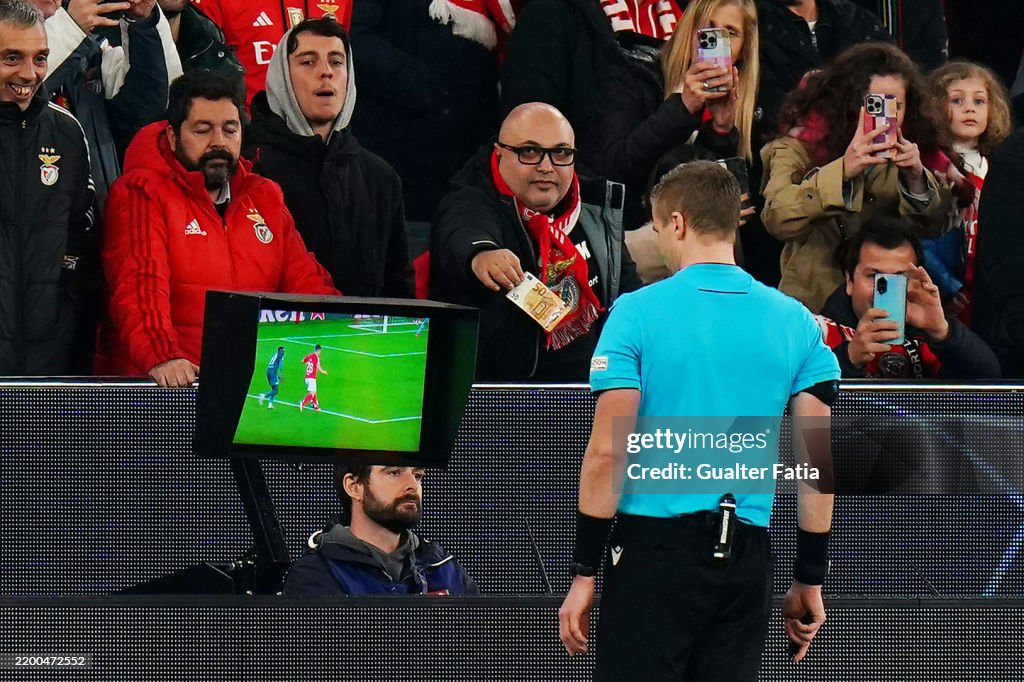
That image is the useful starting point because it keeps the legal question at the right scale. This was not, on the available facts, an allegation of a referee accepting money, a club-funded influence operation, or a concealed betting scheme. It was a spectator, a small banknote, a public gesture, and a referee who remained at work.
Those limits matter. Criminal law can treat sports bribery seriously, and in some jurisdictions very seriously. But the likely response to a spontaneous, low-value, rejected attempt by a fan is not the same response that would attach to coordinated payments, use of communications infrastructure, betting-market manipulation, or an agreement with a match official. The harder governance problem is that the conduct can be too small for prosecutors and still too direct for ordinary crowd management.
This article is informational analysis, not legal advice. The criminal answer depends on jurisdiction, venue, nationality, communications used, and the facts showing intent or coordination.
Why the VAR Monitor Changes the Setting
The incident happened at the Referee Review Area, not in the normal churn of open play. Under the IFAB VAR Protocol, when an on-field review is required, the referee makes the review signal and goes to the pitchside Referee Review Area to watch footage before making the final decision.[2]
That procedure serves an important legitimacy function: the referee remains the final decision-maker, and the review is visible rather than hidden in a control room. But it also creates a predictable pressure point. The referee becomes stationary. The screen narrows attention. The match pauses. Spectators know where the official will stand, and the surrounding emotion concentrates on one person looking at one monitor.
That is why the €50 note should not be dismissed as only a joke. It did not plausibly buy anything. It did, however, reveal a contact surface that VAR created: a formal decision site placed near the crowd, during a high-stakes pause, with the referee temporarily separated from the moving authority of match control.
The Criminal Law Question Is Narrower Than It Looks
In ordinary speech, offering money to a referee is bribery. In criminal law, that label does not end the analysis. Prosecutors still need a statute that applies to the person, place, act, and intent; evidence that the offer was meant to influence an official act or sporting contest; and a charging decision that makes sense given the seriousness of the conduct.
A spontaneous fan offer of €50 during a televised VAR review has several features that push against prosecution. The value is trivial. The act is public rather than covert. There is no acceptance. There is no apparent agreement. There is no apparent betting or club connection. There is no apparent use of a broader communication channel to execute a scheme. Those facts do not make the conduct admirable or harmless as a stadium matter; they make it a poor fit for the kind of criminal bribery case that sports-integrity statutes are usually built to reach.
The contrast with United States federal law shows the point. 18 U.S.C. §224, the federal sports bribery statute, reaches schemes in commerce to influence, by bribery, a sporting contest and provides for imprisonment of up to five years.[3] The operative word for the Benfica-style incident is not merely “bribery”; it is “scheme.” A coordinated plan to pay or offer value to influence a contest is a different prosecutorial object from one spectator theatrically waving a note at an official.
That distinction should not be overstated into a safe harbor. A small amount can still be evidence if it is part of a larger plan. A rejected offer can still matter if it proves solicitation, attempted bribery, or conspiracy under an applicable law. A fan can become legally exposed if messages, payments, betting activity, travel coordination, or repeated approaches show that the visible gesture was only the public end of a private arrangement.
The UK Bribery Act 2010 illustrates the same caution from a different angle. It is broad enough to cover bribery in sporting contexts, contains no facilitation-payment exception, and can apply to UK-based matches and to UK nationals abroad. But breadth of drafting is not the same as likelihood of prosecution. A visible, unserious-looking, one-off stadium gesture still has to pass through evidential and public-interest judgment.
Comparative anti-bribery work in sport repeatedly returns to this practical problem: sport-specific corruption can fall across criminal law, disciplinary systems, betting regulation, and private governance, and the best enforcement route depends heavily on the facts and jurisdiction.[4] A referee bribery scheme is plainly within the zone of serious integrity enforcement. A spectator’s failed pocket-money performance at the barrier is at the edge of it.
What Would Make the Same Gesture Much More Serious
The legal consequences change quickly once the facts stop looking spontaneous. The important dividing lines are not theatricality or public outrage; they are coordination, value, intent, and connection to a contest outcome.
| Fact pattern | Likely legal significance |
|---|---|
| One fan waves a €50 note during a VAR review; no acceptance; no evidence of coordination | More likely handled through removal, stadium discipline, or club-facing regulatory action than criminal prosecution |
| Several people coordinate approaches to the official before or during the match | Evidence begins to look less like disorder and more like an attempt or scheme |
| Money or benefits are offered privately to a referee or intermediary | Covert communication supports intent and makes investigation more plausible |
| The offer is linked to betting, insider information, or a requested match event | Integrity and criminal exposure increase sharply because the payment has an identifiable corrupt objective |
| A club, agent, or repeat intermediary funds or directs the approach | The matter moves away from fan misconduct and toward organized sporting corruption |
The Barcelona Negreira matter sits at that far end of the spectrum, which is why it is a poor analogy for the Benfica photograph and a useful boundary marker. The public allegations concern €7.7 million paid over 17 years, from 2001 to 2018, in a Spanish criminal proceeding about referee-related influence; Sport Resolutions described possible sentences of three to six years in its September 2023 account of the case.[5]
Whatever the final outcome of that proceeding, the scale and structure are different in kind. Long-duration payments, institutional actors, and alleged influence channels belong to the corruption architecture that criminal courts and sport-integrity bodies are designed to test. A supporter visible on camera with a €50 note belongs first to the stadium and disciplinary file, unless investigators can connect the gesture to something larger.
UEFA Has the More Plausible Enforcement Route
For the Benfica incident, the more realistic legal-administrative question is not whether a prosecutor charges the fan. It is whether the football regulator, stadium operator, or club treats the conduct as a spectator-control failure with integrity implications.
UEFA disciplinary rules can make clubs answer for supporter conduct and provide sanctions that include fines, stadium closures, and match-related consequences. That allocation is familiar in European football: the supporter may be the actor, but the club is often the regulated entity with practical control over ticketing, stewarding, barriers, and matchday operations.
That does not mean every visible breach will, or should, produce a formal UEFA sanction. Proportionality matters. The note was not taken. The referee was not shown to have been influenced. The incident appears to have been captured as an embarrassing moment rather than a completed integrity breach. On the materials reviewed for this article, as of July 20, 2026, no public UEFA disciplinary action appears to have followed the Benfica incident.
The absence of a public sanction, if it remains the record, is not proof that nothing happened operationally. A club can remove a fan, revoke access, adjust stewarding, or receive informal feedback without a widely reported disciplinary decision. But it does show the gap. Criminal law may be too heavy. Public sports discipline may be too formal. Stadium security may be the only system that actually moves, even though the conduct is aimed at the integrity of officiating rather than ordinary nuisance control.
The Referee’s Side of the Transaction
Most of the public attention in a clip like this goes to the fan. The more important compliance fact is that the official did not engage. For referees, the legal and disciplinary consequences of taking value are severe because acceptance changes the case from failed spectator misconduct into compromised decision-making.
Sports governing bodies have long treated referee corruption as career-ending misconduct. The FIFA ethics framework has supported life bans in bribery matters; the Ibrahim Chaibou case is a documented example involving a life ban and a 200,000 Swiss franc fine. That is not because every approach succeeds, but because a referee’s neutrality is the asset the competition sells to everyone else: clubs, players, broadcasters, betting markets, and supporters.
The Benfica photograph therefore shows two different risk profiles in the same frame. The supporter’s legal exposure may be limited by value, spontaneity, and lack of acceptance. The referee’s professional exposure would become existential if he solicited, accepted, concealed, or failed to report a serious approach under applicable integrity rules.
A Copycat Gesture Is Still a Governance Signal
The reported MLS incident in July 2026, in which a supporter offered a $1 bill during a VAR review, should not be inflated into precedent. On the described facts, its legal importance is de minimis. A dollar offered in public during a review is not the architecture of a bribery case.
Its relevance is operational. Once spectators understand that the referee must walk to a particular exposed location, the gesture can be imitated across competitions. It does not take a sophisticated corruption network to exploit a predictable review area; it takes a barrier close enough to reach over, a paused match, and an audience that knows the camera may find the moment amusing.
That is precisely why treating these episodes only as jokes is administratively lazy. The correct concern is not that €50 or $1 will persuade elite referees. The concern is that a technology-assisted decision process has created a recurring physical vulnerability, and the rules governing video review do not themselves solve the matchday security design around that vulnerability.
What a Sensible Response Looks Like
The first response is ordinary and immediate: remove the spectator if identified, preserve footage, record the incident, and report it through the match delegate or competition channel. That is not dramatic, but it is the difference between a clip that disappears into social media and an integrity-relevant event that can be assessed if later facts emerge.
The second response is architectural. If the Referee Review Area sits close to a low barrier, stewards should treat a review as a predictable intervention point rather than as passive dead time. The official does not need theatrical isolation; he needs enough protected space to look at the screen without hands, objects, or shouted offers entering the immediate workspace.
The third response is evidential restraint. Clubs and regulators should not describe every foolish offer as match-fixing. That language should be kept for facts that justify it. But they should also resist the opposite reflex: dismissing the incident because the amount was too small to matter. In disciplinary systems, the point is often not the market value of the bribe. It is the attempt to intrude on an official decision process.
For prosecutors, the sensible dividing line is similar. A single rejected note from a fan is unlikely to justify the machinery of a criminal sports-bribery case. Evidence of coordination, repeated approaches, betting links, communications with intermediaries, or a higher-value benefit changes the analysis. The visible act may be small; the surrounding proof may not be.
The Gray Zone Remains
There is no clean doctrinal box for the Benfica moment. Criminal liability is possible in theory and serious where a real scheme exists. Sports disciplinary authority is the more plausible route, especially through club responsibility for spectator conduct. Stadium sanctions and access bans are more realistic than prison exposure for the individual fan on the known facts.
The monitor is the part worth returning to. VAR did not create referee bribery, and a €50 note did not threaten to buy a Champions League decision. What VAR did create is a small, repeatable contact point where the official is public, stationary, and exposed at the very moment the decision carries maximum attention. Legal doctrine can punish schemes. Disciplinary rules can punish clubs. Stadium operations now have to account for the space in between.
References
- Fan of SL Benfica offers match referee Glenn Nyberg a fifty euro note during VAR review, Getty Images, February 18, 2025.
- Video Assistant Referee (VAR) protocol, IFAB.
- 18 U.S. Code § 224 - Bribery in sporting contests, Legal Information Institute.
- Legal Approaches to Tackling Bribery in Sport, UNODC/IPACS, October 2023.
- Barcelona FC under investigation for bribery in refereeing case, Sport Resolutions, September 2023.
Comments
Join the discussion with an anonymous comment.