
A senior living operator considering a humanoid robot for resident loneliness in 2026 is not asking a science-fiction question. The immediate question is plainer: if the robot falls into someone, misreads distress, deepens a resident’s dependence, records intimate conversations, or prompts staff to copy its summaries into a care file, who pays?
The pressure to deploy is real. Goldman Sachs has projected a $38 billion humanoid total addressable market by 2035, and Figure AI reportedly raised $1.75 billion at a $39 billion valuation.[1] In long-term care, the demand signal is not just investor appetite: one study protocol on humanoid robot intervention for loneliness cites loneliness affecting 42% of long-term care residents.[2] That number explains why providers may test systems such as Figure 03, Unitree R1, Grace, or similar robots before any single legal regime is ready for them.
The current answer is a map, not a rule. Federal product-liability proposals, state companion AI statutes, privacy laws, voluntary safety standards, and insurance contracts all touch the deployment. None governs the whole combined risk of an embodied machine that can move through private space, converse persuasively, adapt over time, and collect sensitive data from vulnerable users.
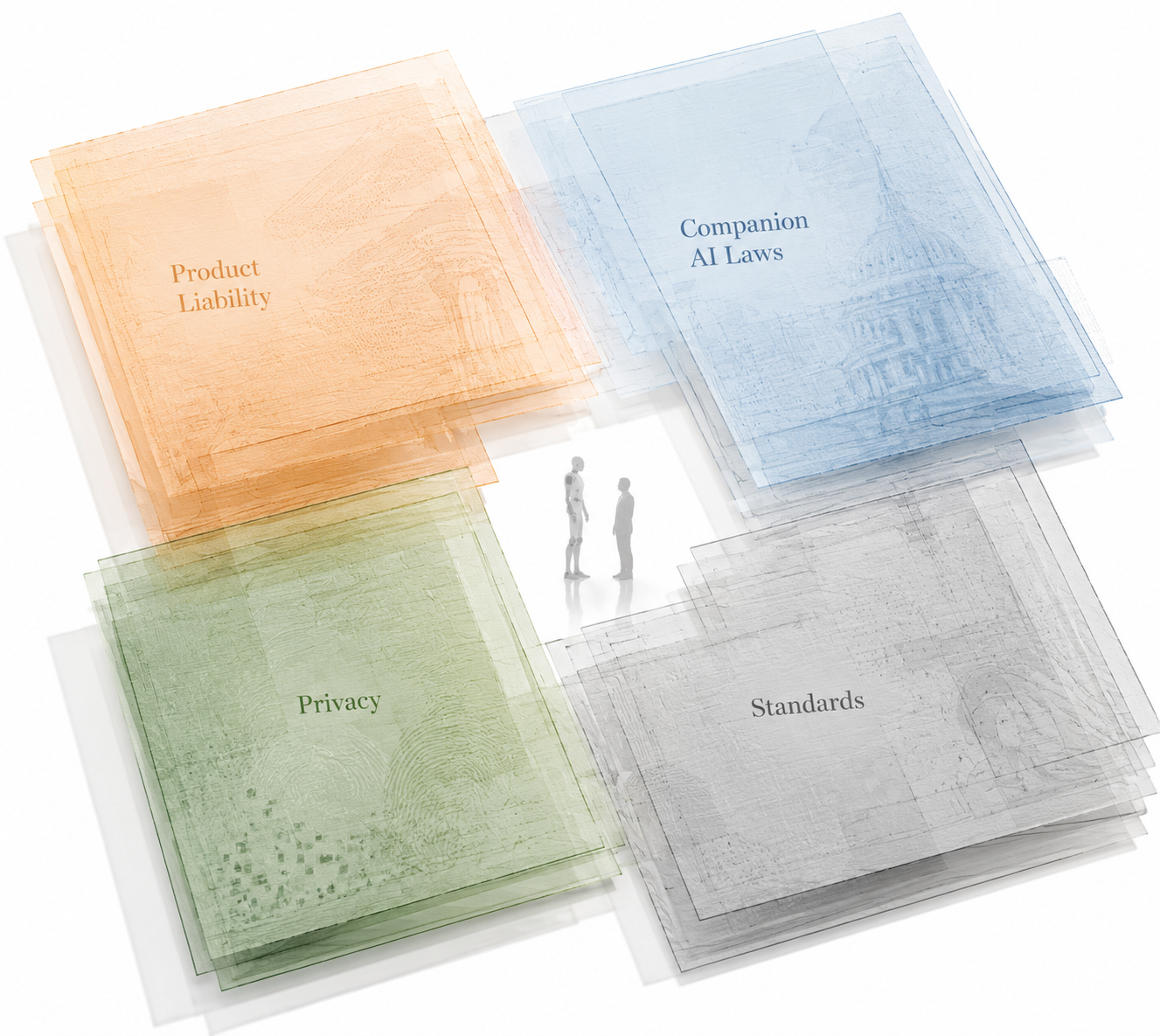
The Liability Map Is Already Crowded, But Not Complete
The useful starting point is to separate the layers. A fall injury, a deceptive emotional interaction, a biometric data claim, and a disputed insurance denial may involve the same robot, but they do not travel through the same doctrine.
| Layer | Current Status | Who It Reaches | What It Sees | What It Misses |
|---|---|---|---|---|
| Federal product liability | AI LEAD Act proposed in 2025, not current law | AI developers and product actors if enacted | Design defect, failure to warn, strict-liability theories | How to treat post-purchase learning, emotional persuasion, and mixed product-service deployments |
| State companion AI laws | New York law effective in 2025; California SB 243 effective in 2026 | Covered companion AI operators and deployers within state scope | Disclosures, crisis protocols, minors, reporting, private enforcement in California | Physical injury, facility negligence, product defect, and insurance allocation |
| Privacy statutes | Existing consumer, biometric, and health-information frameworks | Businesses, biometric data collectors, HIPAA-covered entities and business associates in some circumstances | Notice, consent, biometric identifiers, consumer data rights, protected health information edges | Always-on mobile companions in bedrooms, kitchens, and care rooms |
| Voluntary standards | Existing but not mandatory for home humanoid companions | Manufacturers and deployers using standards to show due care | Some personal-care and bipedal robot safety expectations | Foundation-model behavior, companionship, clinical-adjacent use, and continuous adaptation |
| Insurance | Policy-language dependent and largely untested for autonomous home humanoids | Homeowners, facilities, manufacturers, and vendors depending on policy terms | Defense and indemnity after a claim is tendered | Whether ordinary coverage responds to autonomous robot conduct |
That separation matters because a provider can be compliant with one layer and still exposed under another. A robot might disclose that it is an AI companion and still injure a resident. A manufacturer might cite a voluntary robotics standard and still face a data claim. A family might assume a homeowners policy will respond and learn only after the event that the insurer sees the robot as excluded autonomous equipment.
Product Liability Is the Most Familiar Door, But It Is Not Yet Built for Learning Companions
The AI LEAD Act, introduced as S.2937 in September 2025, would classify AI systems as “products” for federal liability purposes and create developer liability theories including design defect, failure to warn, and strict liability.[3] It is important for any 2026 liability tracker because it shows where federal thinking may be headed. It is equally important to say what it is not: it is proposed legislation, not current federal law.
If enacted, a product-liability frame would be attractive in the most concrete cases. A humanoid robot that knocks into a resident, fails to detect stairs, misuses force while assisting movement, or gives no adequate warning about known limitations looks like something courts already know how to discuss: design, manufacture, warnings, foreseeability, causation, comparative fault, and damages.
The hard part is that companion humanoids are not static chairs, walkers, or medical carts. They may receive software updates, learn user preferences, change conversational behavior, and operate in cluttered homes or understaffed care rooms. The Consumer Product Safety Commission’s own 2024 discussion of AI-enabled products acknowledged a core problem: products that learn after purchase can make traditional premarket testing insufficient.[1]
That limitation does not excuse manufacturers. It changes the proof fight. Plaintiffs may ask whether the unsafe behavior was foreseeable at design time, introduced by later updates, enabled by inadequate guardrails, or caused by deployer configuration. Defendants may argue that the robot was misused, that the environment was outside specifications, that a third-party model or integration caused the event, or that the deployer ignored warnings.
For facilities and home care providers, the uncomfortable point is that product liability does not keep them safely outside the frame. A provider that selected the device, marketed it as part of care, assigned it to a resident, disabled alerts, failed to train staff, or ignored early malfunction reports may face ordinary negligence theories even if the manufacturer remains the primary product defendant.
State Companion AI Laws See the Relationship, Not the Whole Robot
The state companion AI layer is more directly aimed at loneliness and emotional attachment. New York’s AI companion model law, described as taking effect in November 2025, requires recurring disclosure every three hours, crisis-response protocols, and allows civil penalties up to $15,000 per day.[4] California SB 243, effective January 2026, adds a private right of action, $1,000 per violation damages, minor-specific safeguards, and annual reporting to the Office of Suicide Prevention beginning in July 2027.[4]
Those laws matter because the robot’s value proposition is not only that it can move. It can talk, remember, reassure, redirect, and become part of a user’s routine. A disclosure rule recognizes that the person on the other side of the interaction may not always hold the system at arm’s length, especially in a home, a memory-care setting, or a long-term-care room where isolation is already the problem being treated.
But disclosure is a narrow tool. It may tell a resident or family member that the companion is artificial. It does not decide whether the robot’s gait system was defectively designed, whether a facility negligently used it in dementia care, whether a vendor stored biometric data lawfully, or whether an insurer must defend the claim. Crisis protocols can address acute self-harm scenarios, but they do not create a complete liability regime for embodied elder-care robots.
The Federal Trade Commission’s 2025–2026 probe into AI companion chatbots, including safety risks, teen impact, and data privacy, belongs in the same field of concern.[4] It signals regulator attention to companion AI relationships. It does not, by itself, answer the humanoid question: what happens when the companion is not just a chatbot, but a mobile object in a resident’s room?
Privacy Law Catches Pieces of the Home, Then Runs Out of Shape
A humanoid companion in a home or care room is a data collector before anyone calls it that. It may process voice, face, gait, room layout, daily routines, medication talk, family conflict, visitors, and distress signals. The legal problem is not that privacy law is absent. It is that the existing categories were built around different collection patterns.
The CCPA and CPRA were designed around consumer data rights and business data practices, not around a mobile companion continuously observing private domestic space. Illinois BIPA can impose $1,000 to $5,000 per violation for biometric privacy violations, but it was designed in a world of apps, kiosks, and discrete biometric capture rather than a humanoid companion moving through a bedroom or care room.[5]
HIPAA is both important and easy to overstate. A robot conversation in a private home does not become protected health information merely because it feels intimate. The sharper edge appears when a covered provider or its staff pull robot-generated conversational summaries into a health record, use them for care planning, or route them through systems connected to clinical documentation. At that point, a tool purchased for loneliness can begin touching regulated health-information workflows.[5]
This is where deployers often carry more operational risk than they expected. The manufacturer may draft the privacy policy. The facility decides whether staff read transcripts, whether summaries are saved, whether family members receive reports, whether the robot is placed in shared rooms, and whether residents with cognitive impairment can meaningfully consent. A privacy statute may attach to only one part of that chain while the most consequential decisions happen elsewhere.
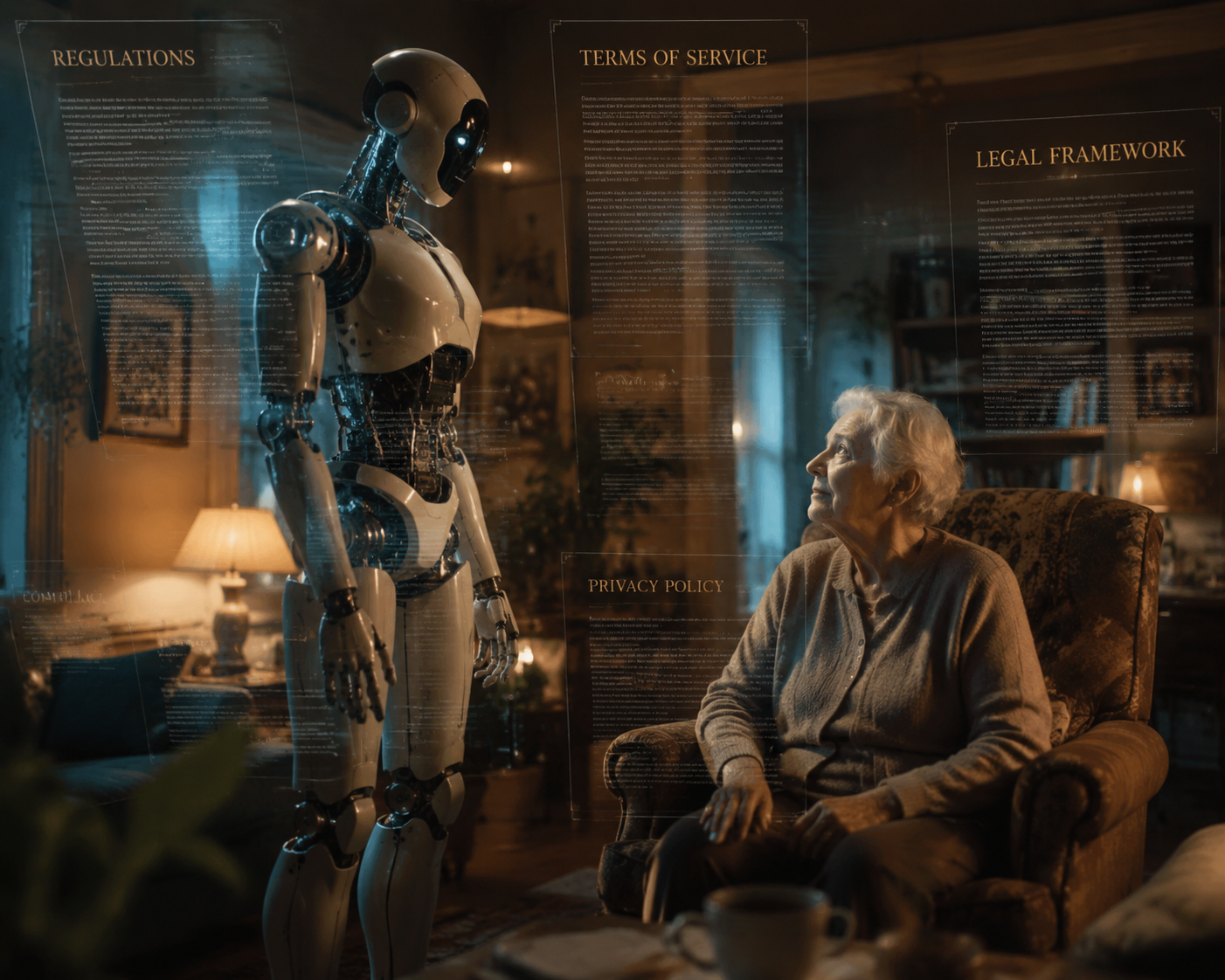
Voluntary Standards Help With Due Care, But They Do Not Close the Gap
Standards are useful in litigation because they give lawyers something concrete to compare against: design process, testing expectations, safety functions, documentation, and foreseeable use. They are less useful when treated as if they were a full substitute for regulation.
ISO 13482 addresses personal-care robots, but it predates the current foundation-model AI wave. ISO 25785-1 addresses industrial bipedal robots, not companion humanoids in homes or elder-care rooms. There is no mandatory federal safety standard for home humanoid companions.[6]
That distinction matters after an injury. A manufacturer may use conformity with voluntary standards to argue that it exercised reasonable care. A plaintiff may answer that the standard did not address the relevant behavior: a conversational model escalating dependency, an update changing interaction patterns, a perception system failing in low light, or a deployment setting involving residents with cognitive impairment. Both arguments can be true at once.
The Convergence Problem Is the Actual Liability Gap
The reason home humanoid loneliness deployments are legally unstable is not simply that robots are new. It is that the same deployment produces four different kinds of exposure at the same time.
- Physical exposure: the robot moves through real space, near people who may have limited balance, impaired vision, dementia, or slow reaction time.
- Emotional exposure: the robot may be marketed and experienced as companionship, not merely as entertainment or automation.
- Data exposure: the robot may collect voice, biometric, behavioral, and environmental data continuously.
- Vulnerable-user exposure: the people most likely to benefit may also be least able to evaluate disclosure, consent, dependency, or malfunction.
Product liability sees the fall more clearly than the attachment. Companion AI law sees disclosure and crisis protocols more clearly than premises operations. Privacy law sees the data trail more clearly than the physical object. Voluntary standards see parts of design and testing more clearly than care-setting judgment. Insurance sees the claim only after someone asks who will pay.
A dementia-care example shows why the categories do not stay separate. Suppose a facility uses a humanoid companion to reduce evening agitation. The robot learns a resident’s routines, becomes part of the resident’s emotional regulation, records interactions, and is later removed after a vendor dispute or safety concern. If the resident deteriorates, the dispute may not sound only in product defect or only in privacy. It may involve negligent deployment, failure to supervise, emotional-harm theories, documentation practices, and contract allocation between facility and vendor.
The reported Greenwood v. Memory Care Associates verdict is a cautionary signal, not a settled national rule. An industry tracking source describes an $890,000 verdict in 2024 for psychological harm after abrupt removal of a companion robot in dementia care.[7] Because that source may select for high-profile events and because appellate treatment of similar theories is not established, the case should not be inflated into a trend. Its value is narrower: it identifies the kind of emotional-injury theory that may be pleaded when companionship is the intervention.
The same caution applies to reported claim-trend numbers. The same industry source reports a 340% increase over five years in companion robot liability claims and describes a $1.2 million settlement in Yamamoto v. CareBot Systems after a fatal fall allegedly linked to a mobility robot sensor failure.[7] Those figures are useful as a smoke alarm, not as a population-level measurement. They may overrepresent severe, visible, or litigated claims and underrepresent quiet resolutions, near misses, and deployments that never generated a claim.
Contracts Will Matter, But They Will Not Keep Everyone Out of Court
The deployment contract is likely to become the first document everyone reads after an incident. It may allocate responsibility for maintenance, updates, staff training, resident selection, data retention, incident reporting, indemnity, and insurance. It may also disclaim certain uses, exclude medical reliance, or require the provider to keep the robot within stated environmental limits.
Those provisions can shape disputes between vendor and deployer. They do less to prevent an injured resident, family member, employee, or visitor from suing multiple parties. A resident who falls over a robot does not need to accept the vendor’s internal allocation of fault. A family alleging emotional harm after a companion deployment goes wrong may name the facility that selected the intervention and the company that designed the system. A privacy claimant may focus on whoever collected, controlled, disclosed, or used the data.
This is why counsel brought in after purchase often finds the same problem: the business team evaluated utility, staffing impact, resident engagement, and vendor promises, while the contract quietly became the liability architecture. In a mature regulatory environment, the contract sits inside a clearer statutory and standards framework. For home humanoid companions in 2026, it may be doing too much work.
Insurance Is the Late-Arriving Multiplier
The payment question eventually becomes an insurance question, and that is where assumptions can become expensive. Homeowners liability limits are often described in the $300,000 to $500,000 range, but an industry source warns that autonomous robot incidents may run into exclusions, including policy language tied to motorized vehicles.[7] The brief also flags that those exclusions have not yet been tested in coverage litigation for autonomous home robots.
Facilities face a different version of the same uncertainty. General liability, professional liability, cyber, technology errors and omissions, product liability, and umbrella coverage may all be implicated, depending on the allegation. A fall may look bodily-injury based. A transcript disclosure may look cyber or privacy based. A negligent loneliness intervention may be argued as professional or custodial care. A vendor update may look like a technology services problem.
The existence of a policy is therefore not the same as a clean payment path. Reservation-of-rights letters, exclusions, sublimits, additional-insured disputes, indemnity tenders, and fights over whether the robot is a product, service, vehicle-like device, care tool, or data platform may determine who funds the defense long before anyone reaches final liability.
So Who Pays?
Today, there is no single answer. Payment may depend on the injury theory, the deployment contract, state companion AI obligations, privacy facts, insurance language, and whether a court treats the robot more like a product, service, caregiver tool, data collector, emotional companion, or some combination of all five.
If the harm is a collision or fall, the center of gravity may be product defect, failure to warn, negligent deployment, or premises safety. If the harm is emotional dependency or deterioration after removal, companion AI disclosures, care-setting negligence, and proof of causation become more important. If the harm is data misuse, the case may move through consumer privacy, biometric privacy, health-record handling, or contract promises. If the dispute is about payment rather than fault, policy wording may matter as much as robotics law.
The AI LEAD Act could change the product-liability baseline if enacted, but it is not current law. New York and California companion AI laws add disclosure, safeguards, reporting, penalties, and private enforcement, but they do not create a complete home humanoid liability code. Privacy statutes catch important data practices, but not the whole embodied relationship. Voluntary standards may help show care, but they are not mandatory and do not fully address foundation-model companions in elder-care settings.
That leaves 2025–2026 humanoid loneliness deployments entering litigation before a coherent liability architecture exists. The robot may be purchased as a companionship intervention. After harm, it will be divided into doctrines that were never designed to see the whole machine at once.
References
- “The Robot in Your Living Room Has No Rulebook,” ai-frontiers.org.
- “Humanoid robot intervention vs. treatment as usual for loneliness,” PMC.
- “AI LEAD Act alert,” Barnes & Thornburg.
- “AI companion models law insight,” Morrison Foerster.
- “AI privacy playbook,” Hinshaw & Culbertson.
- “Robotics standards primer,” Kite Compliance.
- “Companion robot liability claims tracker,” humanoidliability.com.
Comments
Join the discussion with an anonymous comment.