
Instagram Teen Accounts give privacy counsel something concrete to work with. Meta’s framework auto-enrolls users under 18 into a defined package of defaults: private accounts, messaging restrictions, sensitive content controls, limits on who can tag or mention the teen, a 60-minute daily time-limit reminder, and sleep mode from 10 p.m. to 7 a.m.[1][2] For 13- to 15-year-olds, a parent must authorize changes that make the settings less protective; 16- and 17-year-olds can generally change those settings themselves unless a parent has already turned on supervision; users under 13 are treated differently because account access is tied to parental consent.[1]
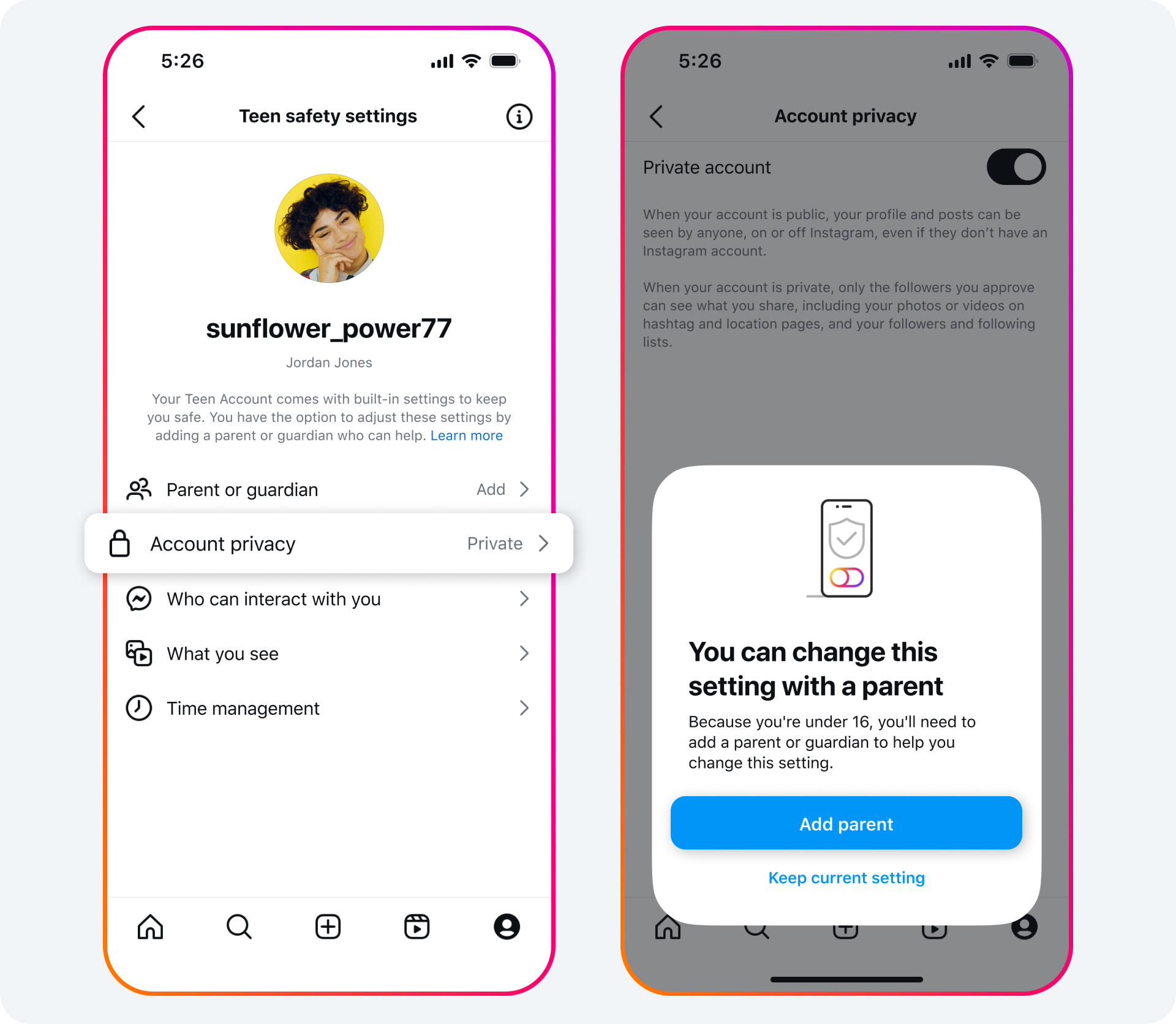
That is a serious product baseline. It is also not the same thing as a legal map. The moment the product category becomes “under 18,” the statutory questions multiply: under 13 for COPPA-style consent, under 14 for Florida’s account ban, 14 and 15 for Florida’s parental-consent rule, under 18 for New York’s algorithmic-feed consent limits, and minors more broadly for Texas parental-access and advertising restrictions.[3][4] A single teen safety architecture can reduce exposure and still leave counsel unable to say which legal obligation has been satisfied, by whom, with what proof.
The visible settings solve only the visible part
The six defaults are easy to understand because they are user-facing. A teen sees a private-account default. A parent sees a supervision prompt. A product team can point to fewer unsolicited messages, more restrictive content settings, and an overnight quiet period. Those are exactly the kinds of controls regulators have been pressing platforms to build.
But state children’s privacy laws increasingly do not stop at whether a feature exists. They ask whether the platform verified age, obtained the right kind of consent, gave parents a legally meaningful access right, avoided targeted advertising to minors, performed a data protection impact assessment, limited data retention, or assessed whether a design feature is in a child’s best interests.[3][4] Those are not all interface questions. Some are evidence questions. Some are data-governance questions. Some are litigation-risk questions because several of the laws remain under constitutional challenge.
| Legal pressure point | What Teen Accounts visibly address | What remains legally separate |
|---|---|---|
| Default privacy | Private accounts for teens by default | Whether the statute requires age verification, parental access, or additional design assessments |
| Messaging and interaction limits | Restrictions on who can message, tag, or mention teens | Whether the law restricts data use, targeted ads, addictive feeds, or profiling |
| Time and sleep controls | A 60-minute daily reminder and sleep mode from 10 p.m. to 7 a.m. | Whether the law requires parental consent for recommendations or a specific curfew mechanism |
| Age-tiered opt-outs | Different opt-out paths for younger and older teens | Whether the state uses the same age bands or requires independently verified parental consent |
The first mismatch is age
Instagram’s teen framework is organized around an under-18 product category with meaningful internal distinctions. The law is not. COPPA’s traditional structure centers on children under 13, and the 2025 COPPA updates expanded several obligations, including the definition of personal information to include biometric identifiers and new data-retention limits.[3] Florida HB 3, by contrast, is described in the state-law summaries as banning social media accounts for users under 14 and requiring parental consent for 14- and 15-year-olds, along with age verification for all users.[3][4] New York’s SAFE Act focuses on minors under 18 for addictive-feed and overnight-notification restrictions, including parental consent for algorithmically recommended content.[3][4]
Those thresholds do different work. A COPPA under-13 analysis asks whether the operator has handled child-directed or mixed-audience collection rules and verifiable parental consent. A Florida analysis asks whether an under-14 account should exist at all, and whether a 14- or 15-year-old has the required parental consent. A New York analysis asks whether a minor is receiving an addictive feed or overnight notifications without the required consent. Instagram’s 13–15 and 16–17 opt-out tiers may be sensible product tiers, but they do not track all of those statutory lines.
This is where “under 18” can become an attractive but dangerous internal shorthand. If a compliance record says only that the user is in a Teen Account, it may not answer the question a regulator is asking. Was the user 12, 13, 14, 15, 16, or 17? Was the account prohibited, permitted with consent, permitted with default protections, or permitted only if a feed or notification setting changed? The product tier is useful evidence, but it is not the statutory classification.
Consent is not just a button in the family center
Teen Accounts also expose a consent problem that is easy to miss because the parent-facing process looks familiar. Meta’s framework allows parental authorization before younger teens can make certain settings less protective.[1] But one legal analysis of Instagram’s youth privacy changes noted that Meta does not independently verify the parent-teen relationship when a parent authorizes those opt-outs for users 13 and older.[5]
That distinction matters. A product can ask for a parent’s approval and still leave open whether the consenting adult is legally the parent, guardian, or otherwise authorized person required by a statute. COPPA has long made verifiable parental consent a compliance category for children under 13, and state social-media laws such as Florida HB 3 create additional consent mechanics for older minors.[3][4] If the platform cannot document the relationship, the setting may show that someone approved a change; it may not prove that the legally required person gave consent.
The same issue appears in laws that require parental access rather than only parental permission. Texas’s SCOPE Act is described as requiring age verification, parental account access, and a ban on targeted advertising to minors.[3][4] Utah’s social-media law is likewise summarized as requiring default privacy settings, curfew features, and parent account access.[4] A teen privacy dashboard and a parent approval flow may support those obligations, but counsel still has to test the exact statutory right: what the parent may see, what the parent may control, what the platform must verify, and what records must be retained.
Algorithmic feeds and overnight quiet hours are not the same obligation
Instagram’s sleep mode is a clean example of a product feature that overlaps with, but does not necessarily satisfy, a statutory requirement. Teen Accounts place teens in sleep mode from 10 p.m. to 7 a.m.[1][2] New York’s SAFE Act is summarized as limiting overnight notifications and requiring parental consent for algorithmically recommended content for minors under 18.[3][4] A quiet-hours feature may help with the notification piece. It does not answer whether the recommendation system itself is being treated as an addictive feed requiring parental consent.
That is a recurring pattern. A setting may reduce a harm that a law is concerned about, while the law regulates a different technical layer. Message limits do not determine whether a feed is algorithmically recommended. Sensitive-content controls do not determine whether a platform uses minors’ data for targeted advertising. A time-limit reminder does not determine whether the company has performed the required assessment of a design feature.
Data-use and design-code laws ask for proof outside the interface
The California and Maryland age-appropriate design code models are the clearest reason Teen Account settings cannot be treated as a universal compliance answer. California’s Age-Appropriate Design Code Act is summarized as requiring data protection impact assessments, a best-interests-of-the-child standard, and restrictions on dark patterns.[3] Maryland’s Kids Code is described as following a similar model with DPIA requirements.[4] These obligations are not satisfied merely by showing that an account is private by default.
A design-code analysis asks how the product collects, uses, retains, and exposes children’s data across the service. It asks whether the company assessed foreseeable risks before launch and whether design choices steer children toward privacy-invasive outcomes. Some of that evidence may be reflected in the Teen Account product. Much of it will sit in internal assessments, data maps, retention schedules, ad-tech controls, and product decision records.
Connecticut’s PA 24-28 reinforces the point because it is summarized as restricting use of minors’ data for targeted advertising and requiring age-appropriate design.[4] Texas adds a targeted-advertising ban for minors.[3][4] A private account default does not by itself establish that ad targeting, recommendation ranking, measurement, or internal analytics have been constrained in the way those laws require.
The more state laws move from visible controls to data-processing obligations, the less persuasive it is to evaluate compliance from the teen’s settings screen. The screen is evidence that the product has a protective surface. It is not the data protection impact assessment, the ad-use restriction, the retention rule, or the dark-pattern review.
The broader state map is not one map
Florida, New York, Texas, California, and Maryland carry most of the structural analysis because they represent different kinds of legal pressure: account bans and consent, algorithmic-feed restrictions, parental access and advertising limits, and design-code assessments. Other enacted state laws add weight to those categories rather than creating a neat separate checklist for each jurisdiction.
Georgia, Louisiana, and Tennessee are described in the state-law summaries as adopting social-media age-verification and parental-consent requirements for minors.[4] Utah adds default privacy, curfew features, and parental access.[4] Connecticut adds targeted-advertising and age-appropriate-design restrictions.[4] Taken together, the pattern is not that every state has invented an entirely new compliance universe. It is that similar words—age verification, parental consent, minor, parent access, default privacy—do not always attach to the same age bands, proof requirements, or product functions.
That makes the compliance task operationally awkward. A product team prefers one default architecture. A privacy program needs jurisdictional switches, records showing why a user was placed in a category, and a way to update the analysis as injunctions, amendments, and agency guidance change. The state-law coverage here also has an evidentiary limit: the available research relies on law-firm summaries of the state patchwork, and the NCSL state legislation database was not directly crawlable, so 2026 session developments should be checked against primary law before any enforcement-position memo is finalized.[3][4]
Age assurance creates its own privacy problem
The hardest compliance paradox sits behind the settings screen. Meta has said it is using AI age-assurance tools to help place teens into age-appropriate experiences, including contextual analysis of profile signals such as posts, bios, and comments, and visual analysis that estimates age from indicators such as height and bone structure.[6] Meta says the approach is not facial recognition.[6] That distinction may matter technically, but it does not end the privacy-law analysis.
The 2025 COPPA updates expanded the definition of personal information to include biometric identifiers and added new data-retention limits.[3] If an age-assurance system analyzes visual characteristics to estimate age, counsel has to ask whether the inputs, templates, inferences, or retained outputs fall within biometric-identifier rules under COPPA or under state biometric privacy laws. The answer may depend on implementation details that are not visible in Meta’s public announcement: what is collected, whether anything is stored, how long signals are retained, whether the system creates a persistent identifier, and whether vendors or internal models process the data.
This is the circularity of age assurance in children’s privacy compliance. Platforms need stronger age detection because self-declared birthdays are weak. Stronger detection may require more intrusive data processing. More intrusive processing may create a new consent, notice, retention, biometric, or DPIA obligation. A regulator reviewing the system will not stop at whether the AI tool improves teen placement; the legal question is whether the enforcement layer complies with the privacy rules it is helping to enforce.
Constitutional challenges make the answer less stable, not less necessary
The state-law landscape is also unsettled because several major laws, including California’s AADC, Texas HB 18, and Florida HB 3, have faced NetChoice constitutional challenges involving First Amendment and Section 230 arguments.[3][4] That uncertainty should temper any confident claim that Instagram is currently violating every provision that appears on a state-law chart. Injunctions, narrowing constructions, amendments, and appellate decisions can change what a platform must do and when an agency or private plaintiff can enforce it.
It should not, however, make counsel ignore the mapping exercise. Product defaults can be documented now. Age-assurance flows can be assessed now. Parent-verification weaknesses can be identified now. Data-use controls and DPIAs can be aligned to the laws most likely to survive or reappear in amended form. Litigation uncertainty changes enforcement risk; it does not make the underlying statutory categories disappear from product planning.
The same caution applies to platform-liability litigation more broadly. Lawsuits and verdicts can illuminate theories of harm around youth safety, recommendation systems, and platform design, but they should not be allowed to substitute for the statutory analysis. The narrower question remains the product-law fit: what the Teen Account framework proves, and what still has to be shown elsewhere.
Where that leaves Instagram Teen Account settings
Instagram Teen Accounts are a meaningful baseline for privacy, safety, and parental visibility. The defaults are understandable, protective, and easier to audit than a vague promise to treat teens carefully. They also give product teams a common architecture for under-18 experiences across markets.
For legal compliance, though, the framework is only one input. Florida’s age bands do not match Instagram’s opt-out tiers. New York’s algorithmic-consent restrictions reach beyond sleep mode. Texas-style parental-access and targeted-advertising rules require more than private accounts. California and Maryland design-code obligations require DPIAs and data-governance proof. COPPA’s 2025 biometric and retention updates complicate the very age-assurance tools that make teen protections enforceable.[3][4][6]
A counsel could fairly credit Teen Accounts as evidence of privacy-by-design work. The same counsel should not treat them as a substitute for jurisdiction-by-jurisdiction mapping, verified consent mechanics, parent-access analysis, DPIAs, data-use restrictions, biometric review, retention controls, and monitoring of ongoing constitutional challenges.
References
- Instagram Teen Accounts, Instagram Help Center.
- Introducing Instagram Teen Accounts: Built-In Protections for Teens, Peace of Mind for Parents, Meta, September 2024.
- Protecting the Next Generation: How States and the FTC Are Holding Businesses Accountable for Children’s Online Privacy, Mayer Brown, February 2025.
- Kids and Teens Privacy 2025 Look Back and 2026 Predictions, Part II: State Privacy Patchwork, Keller and Heckman, February 2026.
- Instagram Raises Its Privacy Game As It Relates to Youth, The National Law Review.
- AI Age Assurance for Teens, Meta, May 2026.
Comments
Join the discussion with an anonymous comment.