
PJM’s data center problem stopped being a forecast problem when the capacity price hit the cap twice. The relevant sequence is narrow and uncomfortable: capacity prices rose from $28.92/MW-day for 2024-25 to $329.17/MW-day for 2026-27, a 1,038% increase across two auctions; Monitoring Analytics attributed 63% of the Q1 2026 price increase to data center load, or $9.3 billion in additional costs; and the 2027/28 auction cleared 6,625 MW short of the reliability requirement, PJM’s first capacity shortfall.[1][2]
Those numbers are not, by themselves, a legal theory. They do not prove that every megawatt of AI load should pay every dollar of new grid investment. They do explain why the argument has moved out of conference panels and into tariff sheets, Section 206 findings, state bills, and complaints filed on behalf of ratepayers.

The market monitor’s more cumulative framing is just as important for the cost-allocation fight. Monitoring Analytics has put data center-driven PJM capacity costs since 2025 at $23.1 billion, and has attributed $21.3 billion of the last three auctions’ $47.2 billion total to forecast data center load.[1][2] That is the line state advocates and consumer-facing lawyers will keep returning to: not whether data centers are useful, but whether the costs caused by their interconnection, transmission service, and capacity needs are following them.
The Federal Order Turned A Price Shock Into A Tariff Case
FERC’s December 18, 2025 order is the pivot. Acting under Federal Power Act Section 206, the Commission found PJM’s existing tariff unjust and unreasonable as applied to co-located load arrangements involving large new loads, including AI data centers, and ordered PJM to make a compliance filing on an accelerated schedule.[3]
That matters because Section 206 is not a press release about market anxiety. It is the mechanism that allows FERC to determine that an existing jurisdictional rate, term, or condition is unjust, unreasonable, unduly discriminatory, or preferential, and then require a replacement. The order did not merely observe that data centers were growing quickly. It identified the co-location rules themselves as no longer adequate for the use being made of the grid.
The immediate target was the treatment of large loads that physically sit near generation or behind a meter while still depending on the transmission system in ways that can be difficult to price under older categories. The ratepayer problem is familiar: if a data center obtains a structure that appears private or behind-the-meter, but the grid still must stand ready to serve, balance, or backstop that load, costs can migrate to customers who did not cause the need.
PJM’s later compliance filing requested a July 31, 2026 effective date for the tariff revisions, according to the available record.[3] As of July 19, 2026, that date is best treated as the compliance target and requested effective date, not as a confirmed final approval date for every tariff element.
PJM’s Compliance Filing Draws New Lines Around Large Load Service
PJM’s February 23, 2026 compliance filing is where the cost-allocation dispute becomes more concrete. As summarized by White & Case, PJM proposed a new structure for co-located data centers and other large loads that includes a 50 MW materiality threshold for behind-the-meter generation arrangements, grandfathering for certain pre-December 18 arrangements, an emergency generation exemption, three new transmission service categories, and an expedited “bring your own generation” track.[4]
The filing’s most useful feature is not that it uses data-center-specific language. It is that it separates service obligations that had been easy to blur. A large load may claim to be physically served by nearby generation. It may still need firm transmission backup. It may want non-firm access. It may be waiting on network upgrades. Each version creates a different cost-causation problem.
| PJM compliance element | Practical cost-allocation significance |
|---|---|
| 50 MW BTMG materiality threshold | Creates a size line for when behind-the-meter generation arrangements receive heightened tariff treatment. |
| Legacy grandfathering for pre-Dec. 18 arrangements | Protects certain existing arrangements while preventing the old structure from remaining the default for new large-load deals. |
| Emergency generation exemption | Avoids treating limited emergency backup as ordinary supply used to avoid transmission responsibility. |
| Firm Contract Demand | Prices service where the grid has a firm obligation to stand behind the load. |
| Non-Firm Contract Demand | Separates less-protected use from firm service, limiting the ability to obtain firm-like value without firm-like payment. |
| Interim Network Integration Transmission Service | Creates an interim path for loads awaiting full network integration rather than forcing all costs into legacy categories. |
| BYOG expedited interconnection track | Allows large loads that bring generation to move through a different interconnection pathway, while still requiring tariff treatment for remaining grid impacts. |
The three transmission service categories deserve attention because they are the legal plumbing. Firm Contract Demand makes the obligation explicit where PJM and transmission owners must plan for the load as firm. Non-Firm Contract Demand gives PJM a way to recognize service that is not entitled to the same level of grid commitment. Interim Network Integration Transmission Service addresses the awkward period when a load wants to come online before the transmission system has fully caught up.[4]
The “bring your own generation” track also has a narrow meaning. It does not make data centers disappear from the grid. It creates a path for large loads that pair with generation to seek faster treatment, while PJM still has to decide which network impacts, backup obligations, and reliability responsibilities remain with the project and which fall to the broader system.[4]
That is the real regulatory impact of the PJM data center power cost increase on AI development: the market is not simply charging more for electricity. The tariff is being rewritten so a data center’s legal status depends on how it takes service, how much firm transmission it needs, whether it brings generation, and whether its claimed behind-the-meter arrangement actually reduces the grid obligation.
DOE’s Large-Load Proposal Points In The Same Direction
The federal pressure is not limited to the PJM co-location docket. In October 2025, DOE issued an advance notice of proposed rulemaking aimed at accelerating interconnection for large loads, using a 20 MW threshold, a 60-day study timeline, and a model in which 100% of network upgrade costs would be assigned to the large load.[5]
That proposal should not be overstated. An ANOPR is not a final rule, and the 20 MW threshold is not the same as PJM’s 50 MW BTMG materiality threshold. But the direction is consistent: faster interconnection is being paired with more direct assignment of network upgrade costs. The bargain is not “come quickly and socialize the work.” It is closer to “come quickly if the project carries the upgrade burden it creates.”
The States Are Not Waiting For One Perfect Federal Rule
State responses are uneven because state authority is uneven. A legislature cannot rewrite the PJM tariff by itself. It can, however, create retail rate classes, condition tax incentives, slow construction, direct state agencies to intervene, and frame the position its utilities and consumer advocates take before FERC.
The examples already on the table show different ways of pushing the same question back toward the project. Oregon’s POWER Act, HB 3546, enacted in June 2025, created a dedicated data center rate class for facilities above 20 MW and required 10-year minimum contracts. Virginia SB 253 targeted data centers above 25 MW and was described as shifting distribution and capacity auction costs away from residential customers, with projected household savings of $5.52 per month. New York S.9144 proposed a construction moratorium. During the 2026 legislative session, more than seven states moved to restrict data center tax incentives, according to the secondary reporting available in the research record.[6]
| State tool | What it tries to prevent |
|---|---|
| Dedicated large-load or data center rate class | Ordinary retail customers paying rates designed before the new load profile existed. |
| Minimum contract term | A large load exiting before long-lived infrastructure costs are recovered. |
| Moratorium | Additional interconnection pressure before cost responsibility and reliability effects are resolved. |
| Tax-incentive rollback | Public subsidy for projects that also increase system costs borne by other customers. |
| State complaint or intervention | Transmission and capacity costs being allocated through federal or RTO mechanisms without state consumer scrutiny. |
The state bills should be read with caution. The research record for several state measures comes through secondary reporting rather than independently reviewed bill text. That does not make the measures irrelevant; it limits how much weight they can carry. Their collective importance is that states are reaching for tools that make large-load growth legible to retail ratemaking, economic development policy, and construction timing.
The Governors’ Principles Put Cost Causation On The Record
The January 2026 Joint Statement of Principles signed by all 13 PJM governors is important less for its drafting than for its litigation and settlement value. As described by White & Case and Latitude Media, the statement required data centers to bear infrastructure costs associated with their own load growth and contemplated a backstop auction with 100% cost allocation to large loads.[4][7]
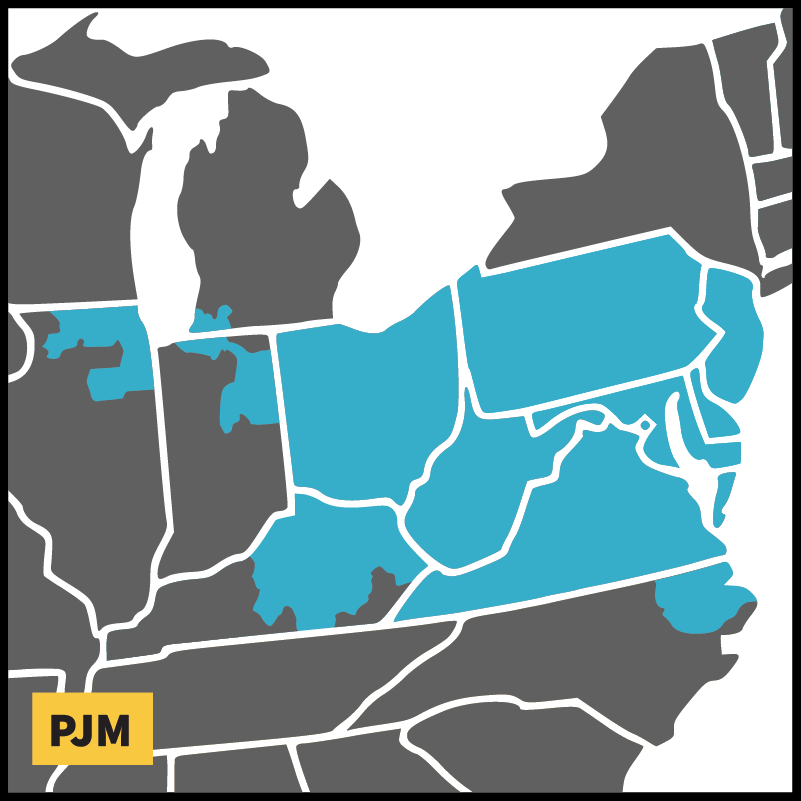
A gubernatorial statement does not amend PJM’s tariff. It does, however, give state commissions, consumer advocates, and governors’ energy offices a common position: large-load reliability fixes should not be treated as a general social obligation simply because they are located inside an RTO. In a footprint spanning all or parts of 13 states and the District of Columbia, that common position reduces the ability of any one participant to dismiss cost causation as a local political demand.
The Backstop Auction Shows How Fast The Fixes Are Being Built
PJM’s proposed reliability backstop auction is the speed case. Pexapark reported that PJM planned a 15 GW backstop structure, with a 14.9 GW target, PJM acting as administrator and counterparty, 15-year contracts, and a September 2026 timeline.[8] The purpose is to procure resources to address the reliability gap tied to rapid load growth, including data center demand.
That design raises a familiar question in a less familiar package. A backstop auction can be defended as a reliability tool if ordinary market timelines are too slow. But the cost-allocation answer matters at least as much as the procurement volume. If the auction secures resources for load that is disproportionately arriving from large data centers, the fight will be over whether the auction charges follow that load or are spread through the region as a general reliability premium.
Latitude Media’s discussion of the proposal highlighted the concern that a special auction can solve one timing problem while creating another allocation dispute, especially if the resulting obligations are not cleanly assigned to the large loads driving the procurement need.[7] That is not a reason to dismiss the backstop mechanism. It is a reason to read the allocation provisions before accepting the reliability label.
Litigation Is Following The Bill
The pending disputes are exactly where one would expect them: not over whether AI is exciting, but over which customers are charged. The Maryland Office of People’s Counsel has challenged roughly $2 billion in data center-driven transmission cost allocation to Maryland ratepayers, and Pennsylvania Governor Josh Shapiro has filed a FERC complaint tying record PJM prices to data center load growth.[6]
Those filings sit in a different posture from the FERC co-location order. The Section 206 order addresses the reasonableness of tariff treatment going forward. State consumer complaints and governor-led challenges ask whether existing or proposed allocations improperly shift identifiable costs to customers who did not drive the need. One is tariff redesign; the other is bill defense.
The distinction matters for remedies. A tariff change can create new service categories, thresholds, and interconnection tracks. A complaint can seek to unwind or reassign specific charges. A legislative rate class can protect retail customers prospectively. None of those tools is a complete substitute for the others, which is why the PJM data center power cost increase has produced a cascade rather than a single proceeding.
The Industry Counterargument Is Real, But It Does Not Answer The Tariff Question
Data center developers and allied industry groups have a response that should not be reduced to public relations. Large loads can bring tax base, jobs, contracted generation, demand flexibility, and utility revenue. Some industry-backed studies argue that data centers can generate net surplus revenue for utilities or help finance grid expansion. The present record, however, treats those claims as counterarguments reported by interested or industry-associated sources, not as an independent finding that ordinary customers are being made whole.
Even if a particular project produces local fiscal benefits, the legal question remains narrower. Which tariffed service is the project taking? Which network upgrades are needed because it arrived? Which customers are assigned the capacity and transmission costs? Which contract term protects against stranded investment? Economic development benefits may matter to a governor or county board. They do not, without more, establish just and reasonable transmission cost allocation.
What Is Actually Changing Across PJM
The regulatory change now underway is not a single anti-data-center rule. It is a layered reset of how large loads are classified, studied, priced, and challenged.
- At FERC, PJM’s co-location tariff has already been found unjust and unreasonable as applied to the new large-load reality, forcing tariff revisions rather than voluntary guidance.[3]
- At PJM, the compliance filing creates new distinctions among behind-the-meter generation, firm demand, non-firm demand, interim network integration, and BYOG arrangements.[4]
- At DOE, the large-load interconnection proposal pairs faster study timelines with direct network-upgrade cost assignment, though it remains a proposal rather than a final rule.[5]
- At the state level, legislatures and governors are using rate classes, contract terms, moratorium proposals, and tax-incentive limits to keep data center costs from defaulting to households and ordinary businesses.[6]
- In litigation, consumer advocates and state officials are contesting specific transmission and capacity allocations rather than merely objecting to high prices in the abstract.[6]
For compliance teams and counsel, the practical implication is that “large load” can no longer be treated as a generic load-forecast category. A project’s risk profile now turns on size thresholds, service firmness, co-location structure, generation pairing, interconnection timing, contract duration, tax-incentive exposure, and the likelihood that a consumer advocate will challenge any residual cost shifted to the broader class.
For ratepayer advocates, the evidentiary burden is also becoming more specific. It is not enough to point to data center growth and a higher bill. The stronger case connects a project or class of projects to a network upgrade, a capacity procurement, a service category, or a disputed allocation method. The Monitoring Analytics attribution supplies the macro record; the tariff and complaint dockets will decide which costs actually move.
The Open Dates Matter More Than The Slogans
As of July 19, 2026, the key open point is implementation, not recognition. FERC has already required action on PJM’s co-location rules. PJM has already proposed tariff machinery to distinguish large-load service obligations. States have already begun translating the same concern into retail rate design, construction timing, and incentive policy. Litigation has already attached to the bill.
The dates to watch are therefore procedural: FERC action on PJM’s requested July 31, 2026 effective date for the compliance tariff revisions; the September 2026 backstop auction timeline; the treatment of DOE’s large-load interconnection proposal; and the disposition of pending state and consumer complaints. Each will answer a different version of the same allocation question.
The PJM footprint is already in a cost-allocation reset. The open question is no longer whether AI-scale data centers will be treated differently from ordinary load. It is how much of the capacity, transmission, interconnection, and reliability bill will be made to follow the large loads that caused it.
References
- “Data Centers to Add Billions in Power Costs in 13 States,” The New York Times, July 14, 2026.
- “AI data centers trigger massive 'irreversible' 76% electricity price spike...,” Tom’s Hardware.
- “FERC Orders Action on Co-Location Issues Related to Data Centers Running AI,” Federal Energy Regulatory Commission.
- “PJM proposes to carve out new services for co-located data centers,” White & Case.
- “DOE directs FERC to accelerate interconnection of data centers,” White & Case.
- “PJM $100B Rate Shock: Data Centers vs Ratepayers,” Introl.
- “The problem with Trump's PJM data center capacity auction,” Latitude Media.
- “PJM Unveils 15 GW Plan to Address Data Center Power Squeeze,” Pexapark.
Comments
Join the discussion with an anonymous comment.