
| Maintained reference field | Current entry |
|---|---|
| Last reviewed | July 20, 2026 (UTC) |
| Jurisdiction | United States; federal law and enforcement, state athlete-eligibility laws, and major sport-governing-body rules |
| Regulation type | Title IX enforcement posture, constitutional and statutory precedent, state statutory and regulatory bans, and organizational eligibility rules |
| Primary-source posture | Executive order and official agency or governing-body sources are cited where available; Supreme Court treatment is noted with a source-status caveat because the opinion PDF could not be directly crawled for this tracker |
| Current status | As of this review date, the U.S. framework is no longer best described as a patchwork centered on individualized assessment. Across the federal executive branch, the Supreme Court’s 2026 sports ruling, state bans, and NCAA/USOPC/IOC eligibility rules, the operative baseline is a near-total prohibition on transgender women and girls participating in female sports, subject to important caveats for non-ban states, non-athletics Title IX issues, source-methodology differences, and sport-specific exceptions. |
For institutions looking for the Monday-morning answer, the first step is not to ask whether a campus prefers an inclusive or categorical rule. The first step is to map four different sources of authority: federal enforcement risk under Executive Order 14201, the Supreme Court’s June 2026 athletics decision, applicable state law, and the eligibility rules of the athletic association or sport body that controls the competition. Those sources do not have the same legal force, and they do not all answer the same question.
Current Legal Baseline
The current baseline has three features. First, federal executive policy directs agencies to treat Title IX’s sports obligation as tied to biological sex and to place federal funds at risk for contrary policies. Executive Order 14201, issued February 5, 2025, directed agencies to enforce Title IX on that basis and described the policy as “Keeping Men Out of Women’s Sports.”[1] Second, the NCAA changed its policy the next day, moving a rule that affects more than 1,100 member schools and more than 500,000 athletes from sport-by-sport participation standards to a categorical restriction on athletes assigned male at birth competing on women’s teams.[2] Third, by July 2026, 27 states had statutory bans, with two more states counted by some trackers because their restrictions operate through regulation rather than statute.[3]
The legal hinge is the Supreme Court’s June 30, 2026 ruling in the consolidated West Virginia v. B.P.J. and Little v. Hecox matters. The Court held 6-3 that states may exclude transgender women and girls from female sports under both Title IX and the Equal Protection Clause. The opinion analysis available for this tracker attributes the majority to Justice Kavanaugh, reads Title IX’s “sex” in the sports context as biological sex, applies intermediate scrutiny, accepts safety and competitive fairness as important governmental interests, and rejects a requirement that states use individualized assessment instead of categorical lines.[4]
That ruling does not answer every Title IX question involving transgender students. It is an athletics decision. It does not resolve locker-room access, pronoun disputes, harassment standards, or every sex-segregated educational program. It also does not finally decide whether transgender people are a quasi-suspect class for equal protection purposes; the Court declined to reach that broader classification issue in this sports ruling, as it had left related questions unresolved in Skrmetti in 2025.[4]
Scale matters because the institutional rule is much larger than the known NCAA participation population. NCAA President Charlie Baker testified in late 2024 that fewer than 10 of the NCAA’s more than 500,000 athletes were known to be transgender.[5] State-law effects are broader: Williams Institute estimates cited for this tracker identify about 117,400 transgender youth ages 13 to 17 in ban states and about 182,400 in non-ban states.[6] Those numbers do not measure how many students seek to play school sports; they measure the youth population living under, or outside, state-level ban regimes.

The 18-Month Shift: February 2025 to June 2026
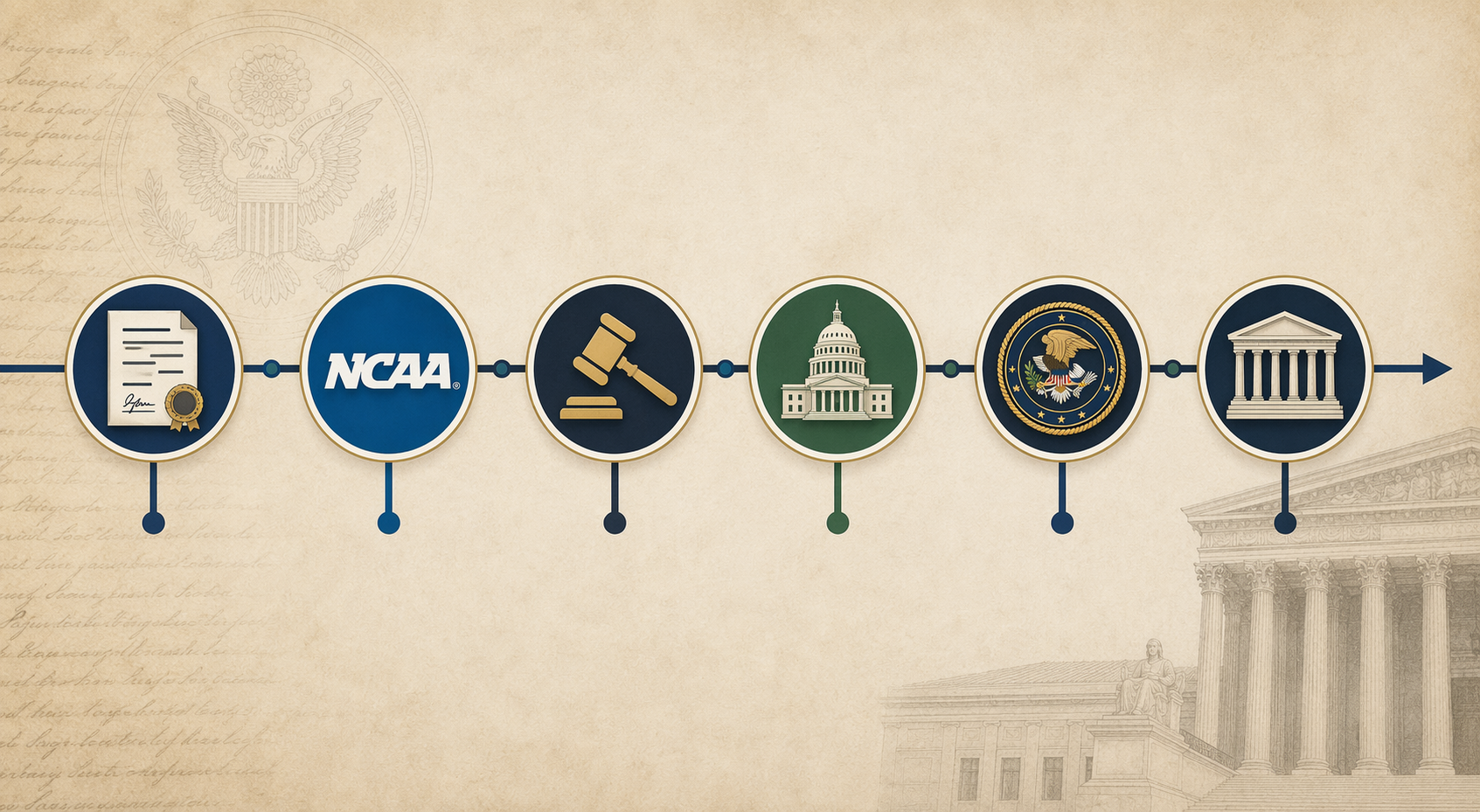
The policy transformation began with an executive order, but it did not remain an executive-branch matter. Within 18 months, the sequence moved through college athletics, federal investigations, Department of Justice litigation, state legislation, Olympic eligibility policy, and a Supreme Court decision. For compliance purposes, the order of events matters because some obligations came from enforceable government action, some from private or quasi-private competition rules, and some from litigation positions that signaled enforcement risk before the Court supplied more durable precedent.
| Date | Action | Operational significance |
|---|---|---|
| February 5, 2025 | Executive Order 14201, “Keeping Men Out of Women’s Sports” | Directed federal agencies to enforce Title IX in women’s and girls’ sports according to biological sex and put federal funding in view as an enforcement tool.[1] |
| February 6, 2025 | NCAA Board of Governors policy change | Restricted athletes assigned male at birth from women’s teams across an association covering more than 1,100 schools and more than 500,000 athletes.[2] |
| 2025 congressional session | H.R. 28, the Protection of Women and Girls in Sports Act of 2025 | Passed the House but did not become federal statute after being blocked in the Senate.[7] |
| July 8, 2025 | Department of Justice lawsuit against California | Escalated federal opposition to state inclusive participation policy after a transgender athlete competed in girls’ state track and field championships under California’s policy.[8] |
| July 21, 2025 | USOPC policy alignment | The U.S. Olympic & Paralympic Committee adopted a transgender athlete ban aligned with EO 14201 and notified national governing bodies.[8] |
| January 14 and 21, 2026 | Office for Civil Rights investigations | The Department of Education opened 18 Title IX investigations involving K-12 districts and universities with inclusive policies.[9] |
| March 26, 2026 | IOC female-category eligibility policy | The IOC announced SRY gene screening for female-category eligibility, effective for LA28, with one-time testing and CAIS/DSD exceptions.[10] |
| June 30, 2026 | Supreme Court ruling in West Virginia v. B.P.J. / Little v. Hecox | Held that states may categorically exclude transgender women and girls from female sports under Title IX and equal protection analysis.[4] |
Executive Order 14201 changed the enforcement question before it changed every legal answer
Executive Order 14201 did not itself amend Title IX. An executive order cannot rewrite a statute enacted by Congress. Its immediate significance was different: it told federal agencies how the administration would enforce Title IX in the sports context, directed a biological-sex interpretation, and placed federal funding consequences in the compliance conversation.[1] For schools and colleges, that meant any policy allowing transgender women or girls to compete in female sports had to be evaluated not only against existing state law or association rules, but also against the possibility of federal investigation and funding jeopardy.
That distinction mattered most in non-ban states. A state inclusive policy might remain lawful under state law, and a school might still have local political or contractual reasons to maintain it. But after the executive order, the federal government’s enforcement posture ran in the opposite direction. That is not the same thing as a Supreme Court holding, and it is not the same thing as a federal statute. It is still a material institutional risk when the recipient depends on federal education funds.
The NCAA moved faster than most campuses could revise their own guidance
The NCAA’s February 6, 2025 policy change compressed the timeline for colleges. It arrived one day after the executive order and applied across an association with more than 1,100 member schools and more than 500,000 athletes.[2] For athletic departments, the practical question became less abstract than a campus nondiscrimination debate: which roster, championship, scholarship, travel, and eligibility decisions must be made under the NCAA rule before the next competition cycle?
The demographic contrast is unusually sharp. A rule operating across the national college athletics infrastructure was adopted in an environment where the NCAA’s own congressional testimony identified fewer than 10 known transgender athletes among more than 500,000 athletes in late 2024.[5] That does not decide the legal question. It does identify the administrative pattern: broad categorical rules landing on a small number of identifiable students, while institutions must still implement them consistently and document why.
Federal enforcement then moved from policy statement to investigations and litigation
By mid-2025, the executive position had become litigation posture. The Department of Justice sued California on July 8, 2025, after a transgender athlete placed in girls’ state track and field championships under California’s inclusive policy.[8] The case is important for institutional planning because it shows the federal government contesting a state-level inclusive approach directly, not merely issuing guidance to federal agencies.
In January 2026, the Department of Education’s Office for Civil Rights opened 18 Title IX investigations involving K-12 districts and universities with inclusive policies.[9] An OCR investigation is not a final adjudication. It is, however, a concrete enforcement event: records must be gathered, policies defended, communications controlled, and settlement or resolution risk assessed while students and teams continue operating.
Congress signaled support but did not enact a national statute
H.R. 28, the Protection of Women and Girls in Sports Act of 2025, passed the House but was blocked in the Senate.[7] That matters because the national rule did not come from a new federal statute. The most consequential federal legal developments instead came through executive enforcement and, later, the Supreme Court’s interpretation of Title IX and equal protection in the sports context.
What the Supreme Court Decided
The Supreme Court’s June 30, 2026 ruling is the point at which the legal environment became more durable than an executive-order cycle. Based on the opinion analysis available for this tracker, the Court upheld state laws excluding transgender women and girls from female sports under both Title IX and the Equal Protection Clause.[4] For public schools, public colleges, and private recipients of federal funds, the Title IX holding is the operative piece most likely to affect immediate policy drafting.
The majority’s Title IX analysis treated “sex” in the athletics context as biological sex.[4] That is narrower than saying the Court resolved every statutory use of sex or every transgender-student dispute in education. Sports supplied the context: sex-separated teams, physical competition, safety assertions, and competitive fairness rationales. A compliance memo that extends the case beyond athletics should say exactly where the extension begins and what authority supports it.
On equal protection, the Court applied intermediate scrutiny and concluded that the state interests in safety and competitive fairness were sufficient to sustain categorical female-sports exclusions.[4] The important drafting consequence is the Court’s rejection of individualized assessment as a constitutional requirement. Before this ruling, some policies attempted to manage eligibility through athlete-specific review, hormone criteria, puberty history, or sport-by-sport assessment. After the ruling, states may use categorical biological-sex lines in this sports context without first proving that individualized assessment would fail in each case.[4]
Justice Gorsuch’s concurrence, as summarized for this tracker, added a Spending Clause analysis.[4] That matters to federally funded schools because Title IX operates through spending conditions. Spending Clause reasoning often turns on notice to funding recipients: what conditions did the recipient accept, and how clearly were they stated? The concurrence does not replace the majority’s merits analysis, but it gives school counsel another reason to separate federal-funding risk from ordinary policy preference.
Justice Sotomayor’s partial dissent agreed on the Title IX point but would have remanded the equal protection analysis for pre-pubertal transition athletes.[4] That partial dissent is not the governing rule. It does identify the category most likely to appear in future disputes about factual fit: students whose medical and athletic circumstances do not match the assumptions underlying a broad categorical ban.
The Court did not decide whether transgender people are a quasi-suspect class.[4] Institutions should not read silence on that question as a full equal protection map for every campus context. The sports holding is strong authority for categorical female-athletics exclusions; it is not a universal instruction manual for every sex, gender identity, privacy, discipline, or harassment issue that can arise in schools.
State-Law Tracker
State counts vary because trackers do not all count the same legal instruments. The primary count used here is MAP’s 27-state statutory-ban figure as of July 19, 2026, with Alaska and Virginia noted separately because their bans are regulation-based rather than statutory for this methodology.[3] For a school or athletic association, that distinction is not academic. A statute, an agency regulation, and an association rule may all restrict participation, but they have different amendment processes, enforcement routes, and litigation postures.
| State-law category | Count used in this tracker | Compliance note |
|---|---|---|
| Statutory ban states | 27 | Counted as states with enacted statutory restrictions on transgender girls or women participating in female school sports under MAP’s methodology.[3] |
| Regulation-based ban states | 2 | Alaska and Virginia are treated separately because the restriction is regulation-based rather than statutory in the methodology used here.[3] |
| Total if statutory and regulation-based bans are combined | 29 | Useful for operational screening, but should not be described as 29 statutory bans. |
| Transgender youth ages 13 to 17 in ban states | About 117,400 | A population estimate, not an estimate of students seeking athletic participation.[6] |
| Transgender youth ages 13 to 17 in non-ban states | About 182,400 | Relevant because non-ban status does not eliminate federal enforcement exposure after EO 14201 and the 2026 Supreme Court ruling.[6] |
The state-law question should be answered before the team-level question. If state law bans participation, the institution’s discretion is usually limited at the threshold. If state law permits or protects participation, the institution still has to test that permission against federal enforcement posture, the Supreme Court’s sports precedent, and governing-body eligibility rules. A non-ban state is not the same thing as a no-risk state.
Governing-Body Rules
Sport-governing-body rules are not interchangeable with statutes, but they often control the competition a student actually wants to enter. A college may be legally permitted by state law to adopt one policy and still be unable to roster an athlete for NCAA championship competition. An Olympic-pathway athlete may face a national governing body rule before ever reaching an international event.
| Body | Policy position reflected in 2025–2026 materials | Scope and caveat |
|---|---|---|
| NCAA | February 6, 2025 policy prohibits athletes assigned male at birth from women’s teams.[2] | Applies across more than 1,100 member schools and more than 500,000 athletes; institutional implementation still turns on roster, competition, scholarship, and conference mechanics.[2] |
| NAIA | Research brief identifies categorical ban adoption during the 2025–2026 transformation. | No separate source with a link was provided in the brief for citation in this body; verify current NAIA handbook language before relying on the rule for a season decision. |
| USOPC | July 21, 2025 policy alignment with EO 14201, including a transgender athlete ban and notice to national governing bodies.[8] | Important for Olympic and Paralympic pathway athletes in the United States; national governing-body implementation should be checked sport by sport. |
| IOC | March 26, 2026 announcement of SRY gene screening for female-category eligibility, effective for LA28, with one-time testing and CAIS/DSD exceptions.[10] | International eligibility rule; not a Title IX rule, and not a substitute for U.S. federal or state-law analysis. |
Non-Ban States Still Have Federal Exposure
The hardest operational category is not the state with a clear ban. It is the state that permits or protects transgender participation while federal enforcement authorities and governing bodies point in the opposite direction. California became the visible example in 2025 when the Department of Justice sued after a transgender athlete competed under the state’s inclusive policy at girls’ state track and field championships.[8] The legal issue for other non-ban states is not whether California’s facts repeat. It is whether a school can explain how its policy accounts for Title IX funding risk, OCR enforcement, association eligibility, and the Supreme Court’s sports holding.
OCR’s 18 investigations in January 2026 show the same point from the agency side.[9] An inclusive policy in a non-ban state may have state-law support, but it can still trigger federal review. After the Supreme Court ruling, that federal review occurs against a changed backdrop: categorical exclusions now have constitutional and Title IX support in the athletics context, rather than resting only on state legislative judgment or executive enforcement preference.[4]
What Remains Unsettled
Several issues should remain flagged in any maintained tracker. The Supreme Court source status should be checked against the official opinion PDF when available for direct review; this body relies on SCOTUSblog’s detailed opinion analysis and summarized characterizations identified in the research brief.[4] The state count should be labeled by methodology, because 27 statutory bans and 29 total bans including regulation-based restrictions are not the same claim.[3]
Non-athletics Title IX issues remain outside the holding described here. Locker rooms, harassment, pronouns, records, discipline, housing, and other sex-segregated or gender-identity-related school issues require their own authority map. The sports ruling will influence arguments, but it should not be treated as if it decided every transgender-student question.
The quasi-suspect-class question also remains unresolved. That matters less for a straightforward female-sports eligibility rule after the 2026 decision, but it may matter in future equal protection disputes outside the factual structure of athletics. The narrow way to state the current law is stronger than the broad way: the Court upheld categorical exclusions of transgender women and girls from female sports under Title IX and intermediate equal protection scrutiny; it did not issue a general constitutional code for all transgender classifications.[4]
Maintained-Reference Conclusion
As of July 20, 2026, institutions should treat the U.S. legal-policy baseline for transgender athletes as a near-total prohibition on transgender women and girls in female sports across the most consequential federal, judicial, state, and governing-body layers. That baseline is not produced by one source. It is produced by EO 14201, NCAA and Olympic-pathway eligibility changes, federal investigations and litigation, state statutory and regulatory bans, and the Supreme Court’s June 2026 sports ruling.
This article is a maintained reference, not legal advice. Before each season or competition cycle, re-check four items: the official Supreme Court source status, the state-count methodology, federal enforcement exposure in non-ban states, and the current eligibility rule of the governing body that controls the event.
References
- Keeping Men Out of Women’s Sports, The White House, February 5, 2025.
- NCAA Board of Governors updates transgender student-athlete participation policy, NCAA.org, February 6, 2025.
- Equality Maps: Bans on Transgender Youth Participation in Sports, Movement Advancement Project.
- Supreme Court rules states may bar transgender athletes from girls’ and women’s sports, SCOTUSblog, June 30, 2026.
- NCAA president says there are fewer than 10 transgender athletes in college sports, NCAA.org, late 2024.
- How Many Transgender Youth Live in States That Have Passed Sports Participation Bans?, Williams Institute.
- H.R.28 - Protection of Women and Girls in Sports Act of 2025, Congress.gov, 2025.
- U.S. Olympic & Paralympic Committee Bans Transgender Women From Women’s Sports, Ogletree Deakins, July 2025.
- Department of Education Launches Title IX Investigations Into Transgender Athlete Policies, Fisher Phillips, January 2026.
- IOC approves recommendations to protect the female category, Olympics.com, March 26, 2026.
Comments
Join the discussion with an anonymous comment.