
The difficult part of the 2026 VAR diving dispute is not that Miguel Almiron was punished for simulation. A dive can be obvious enough that the eventual yellow card feels like the only fair sporting answer. The problem is the route taken to get there: a referee penalized one side, VAR entered through the mistaken-identity protocol, and the review ended by changing the incident from a foul into simulation by the other player.
That route matters because the IFAB protocol approved in February 2026 permits VAR review for mistaken identity when a referee penalizes the wrong team for an offence; the reported Almiron intervention at USA vs Paraguay was the first use of that mechanism to reverse a yellow card and instead book the alleged diver. [1][2]
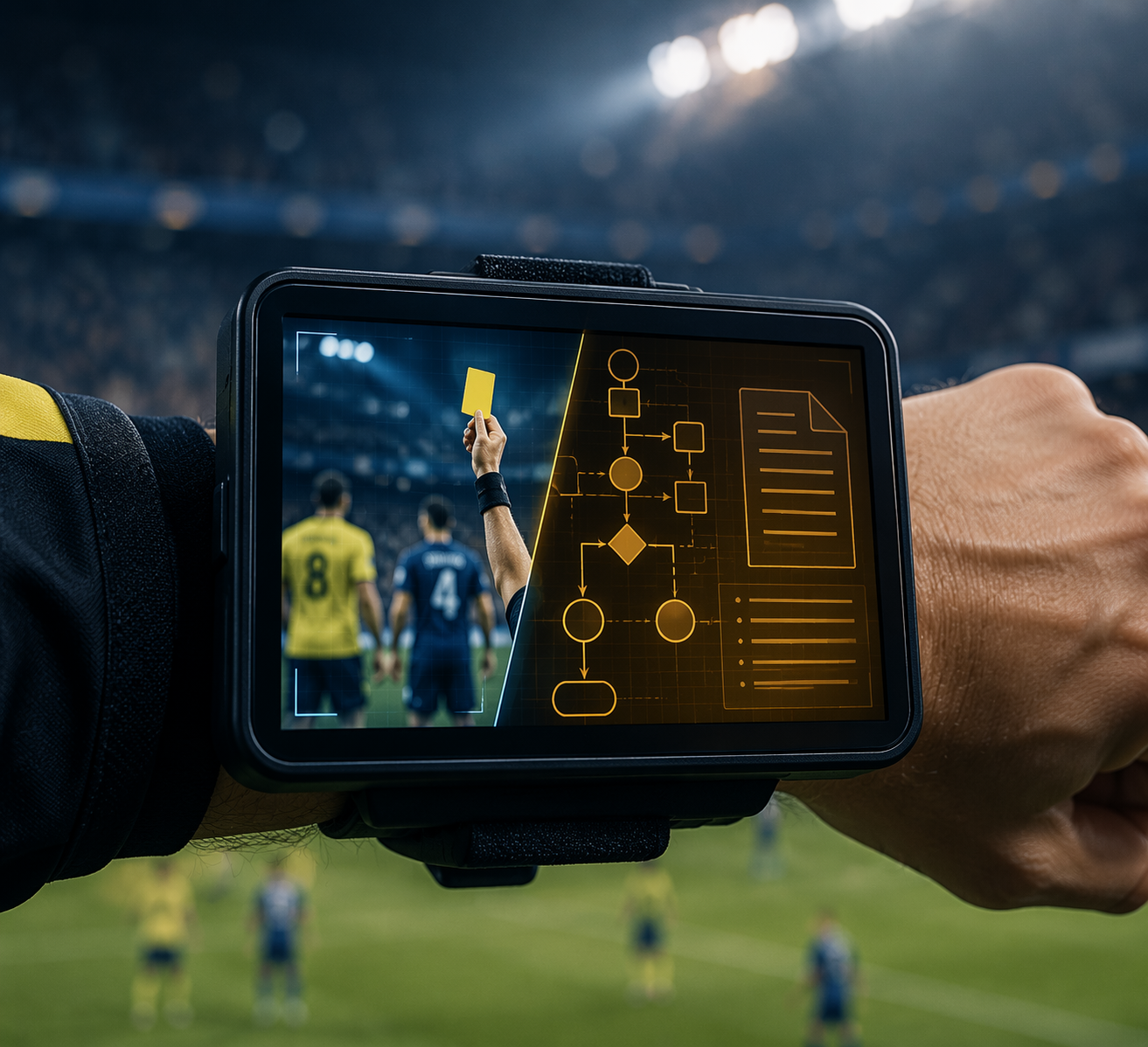
BBC Sport reported that well-placed sources described the Almiron outcome as “wrong, even if it felt right,” because the mistaken-identity gateway corrects who was sanctioned, not what offence was committed. [2]
That is the seam. A system built to correct the wrongly identified sanctioned party was used to reclassify the underlying event. Once that move is accepted, the question is no longer only whether Almiron deceived the referee. It is whether the review body had authority to reach that question at all.
The Protocol Does Not Do All the Work People Want It To Do
The IFAB VAR protocol is not a general fairness charter. It is a list of reviewable categories and procedural permissions. That is why the February 2026 mistaken-identity amendment is doing so much work here. It opened a narrow correction channel for cases where the wrong player or team is sanctioned for an offence, but the available reporting does not show that Pierluigi Collina, FIFA’s head of referees, presented it before the World Cup as a new authority to review simulation. [1]
There is a practical difference between these two review questions:
| Review Question | What VAR Is Correcting | Why It Matters |
|---|---|---|
| Was the wrong player or team sanctioned? | The identity of the sanctioned party | This fits the mistaken-identity logic: the same offence remains the basis for intervention. |
| Was the incident actually simulation rather than a foul? | The legal character of the event | This asks VAR to substitute one offence for another, which is a broader use of the review gateway. |
That distinction is not pedantry. Review systems depend on triggers. If the trigger is “wrong sanctioned party,” the reviewer checks whether the referee attached the sanction to the wrong person or side. If the trigger becomes “the referee’s foul analysis may have been wrong in a way that reveals simulation,” the system has acquired a much wider jurisdiction without saying so in the rule text.
The Embolo incident in Switzerland vs Argentina made the issue harder to dismiss as an isolated World Cup misfire. VAR again used the mistaken-identity route to penalize simulation in the penalty area, showing that FIFA’s approach had become an interpretive practice rather than a one-off operational accident. [2]
There is an understandable sporting impulse behind that practice. If a player wins a call by deception, and the technology can see it, why should the system leave the yellow card on the wrong side of the ledger? But authority questions usually look least attractive in the case where the outcome feels deserved. That is exactly when they need to be asked.
UEFA Drew the Line at Reclassification
The visible split arrived on July 17, 2026, when UEFA formally told its VARs not to treat simulation as mistaken identity. UEFA’s reported position was that changing a foul into simulation is a subjective decision rather than a factual correction, and therefore sits outside the protocol’s scope. [3]

The factual-versus-subjective distinction is useful as an audit frame, but it should be handled carefully. The available reporting does not establish that this exact distinction is an express IFAB textual test. It is better understood as UEFA’s limiting principle: identify the mistake the protocol was designed to correct, then refuse to let that gateway become a general appeal on the referee’s judgment.
FIFA has not, on the materials available, issued a formal interpretive ruling resolving the point. Nor has IFAB formally adjudicated the Almiron decision. So the split is not a neat hierarchy in which one body has conclusively won the legal argument. It is a governance problem: the same technical protocol is now being operationalized differently by major football authorities during the same summer.
Domestic leagues reportedly saw the downstream problem quickly. If simulation can enter through the mistaken-identity protocol whenever a yellow card has been shown, every yellow card becomes a candidate for a diving review. The narrower the entry point appears on paper, the messier it becomes in administration once participants learn how to plead into it. [2][3]
There is also a two-tier problem. Yellow-carded simulation could become reviewable because the card supplies the procedural hook, while non-carded simulation remains outside the same review path. The system would not be consistently policing deception; it would be policing deception only when another sanction happened to create an opening. [2][3]
A Small Football Rule Becomes a Large Governance Example
For legal professionals working with AI decision-support systems, the VAR diving dispute is useful because it is compact. It does not require abstract anxiety about machines replacing judgment. The technology is assisting a human decision process; the controversy sits in the scope of review, the definition of the trigger, and the authority of institutions to expand that trigger after deployment.
Those are the same questions that appear when an AI tool is introduced into a professionally consequential workflow. A model may flag anomalies, recommend classifications, rank cases, detect inconsistencies, or surface prior decisions. The hard governance question is rarely whether the tool can see something relevant. It is whether the system has authorized that observation to reopen a decision.
A compliance team auditing such a workflow should ask the VAR question in plainer clothes: What is the review hook? If a decision can be reopened because the wrong entity was named, can the reviewer also revisit the substantive classification? If a system flags an identity mismatch, may the human reviewer use that same intervention to reassess intent, credibility, risk level, or misconduct type?
The answer cannot be left to after-the-fact convenience. Once one jurisdiction or business unit treats a narrow correction authority as a general reconsideration authority, parallel users will ask why their adjacent case is excluded. The original protocol may still be sitting unchanged in the policy manual, but its operational meaning has already moved.
The audit questions are procedural before they are technical
- Which decisions are reviewable, and which are final absent a separate appeal route?
- Who defines the review trigger: the system designer, the regulator, the operator, or the reviewing official?
- Does the trigger permit factual correction only, or does it permit subjective reevaluation?
- Can the reviewer substitute a new classification, or only correct the original classification’s target?
- What happens when two jurisdictions deploy the same technical rule under different interpretations?
These questions are not solved by calling the tool “assistive.” VAR is assistive. It still changes the decision architecture because it creates a formal route for interrupting, reviewing, and correcting an on-field call. AI systems used in legal intake, benefits review, sanctions screening, insurance triage, employment compliance, or public-sector eligibility assessment can create the same pressure. If the system notices more than the rule permits the reviewer to consider, operators will be tempted to let usefulness substitute for authority.
Patchwork Interpretation Is Not Just a Fairness Problem
The FIFA-UEFA split also shows why fragmentation is not merely untidy. It changes incentives. Players, coaches, referees, and league administrators must adjust to the practical meaning of a protocol, not only to its published text. If the World Cup treats a disputed foul as a possible simulation review and UEFA does not, the same conduct may sit inside or outside VAR depending on the forum.
That is familiar territory for regulated organizations deploying AI across jurisdictions. A central team may write one model governance policy, but local regulators or operating units may interpret the same control differently. One jurisdiction treats an alert as a basis for reopening a classification; another treats it as an audit signal only. One permits a human reviewer to revise a subjective judgment; another limits intervention to objective data correction.
The risk is not only inconsistent outcomes. It is the loss of reviewability. A person affected by the decision cannot tell whether the intervention was authorized by the protocol, by a local interpretation, by a supervisor’s practice note, or by an unspoken belief that the tool found something too important to ignore.
Northeastern University’s July 3, 2026 analysis described the World Cup controversy as exposing structural limitations in the VAR protocol and confusion generated by FIFA’s expansive interpretation. [4]
That observation travels well outside football. A protocol does not become robust because the technology works. It becomes robust when the institution has said, in advance, what the technology is allowed to trigger, what the reviewer is allowed to change, and how conflicting interpretations will be reconciled.
What the VAR Dispute Teaches AI Governance
The transferable lesson is not that AI regulation should copy football law. It is that technology-assisted adjudication needs a disciplined standard of review before the hard case arrives. The Almiron and Embolo incidents are hard cases because the perceived deception makes intervention attractive. That is also what makes them useful. [2]
A sound review standard should separate at least three functions:
- Factual correction: fixing an objectively wrong data point, identity, timestamp, party, or input.
- Classification correction: changing the legal or policy category assigned to the event.
- Subjective reevaluation: revisiting judgment-heavy assessments such as intent, credibility, proportionality, or deception.
Those functions may all be legitimate in some systems. They should not be smuggled through the same procedural doorway. If a workflow authorizes identity correction, say whether it also authorizes classification correction. If it authorizes classification correction, say whether subjective reevaluation is included. If different jurisdictions can narrow or expand those permissions, build an alignment mechanism before launch rather than waiting for the first public controversy.
The alignment mechanism does not need to be elaborate in every case. It may be a binding interpretation register, a cross-jurisdictional escalation committee, a model-use addendum by forum, or a rule that local deviations must be published before the tool is used. What matters is that operators know whether they are correcting the sanctioned party or reopening the offence.
The World Cup dispute is ongoing as of July 20, 2026, so additional cases may sharpen or complicate the split. But the governance lesson does not depend on the next incident. A narrow review hook will not stay narrow because everyone agrees it should. It stays narrow only if the institution makes the boundary administrable, visible, and reviewable.
References
- Video Assistant Referee (VAR) protocol, IFAB.
- BBC Sport report on Almiron and Embolo mistaken-identity VAR cases, BBC Sport.
- UEFA not to treat VAR diving as mistaken identity, Yahoo Sports / BBC reporting.
- VAR technology World Cup soccer, Northeastern University, July 3, 2026.
Comments
Join the discussion with an anonymous comment.