
Advertisers Face Multilayer Liability for AI Celebrity Ads
This risk digest maps the full regulatory matrix governing AI-generated celebrity advertising: overlapping state right-of-publicity statutes, FTC rules with penalties up to $53,088 per violation, New York's first-in-nation synthetic performer disclosure law effective June 2026, and the pending NO FAKES Act creating federal voice-and-likeness protections at up to $750,000 per unauthorized work.
- Jurisdiction
- US Federal and State
- Court
- Federal Trade Commission
- AI tool named
- Generative AI
- Ruling date
- Jun 9, 2026
- Source document
- View primary court order ↗
- Last verified
- Jul 29, 2026
Lex Machina Review is an independent risk-tracking and reference resource. Nothing on this site is legal advice, and using it does not create an attorney-client relationship. Every record is reviewed against primary sources but may not reflect the most current status of a matter — always verify directly against the cited court order, rule text, or a licensed attorney before relying on it.
Companion explanation — secondary to the source document above
The campaign risk in AI-generated celebrity advertising usually arrives before anyone calls it a legal question. A concept deck shows a familiar face, a familiar voice, or a persona close enough to do the work of recognition. Someone proposes a label. Someone else says the media buy can avoid the celebrity's home state. By the time counsel sees it, the ad may already have a production calendar, platform specs, and a client who thinks the only remaining issue is wording the disclosure.
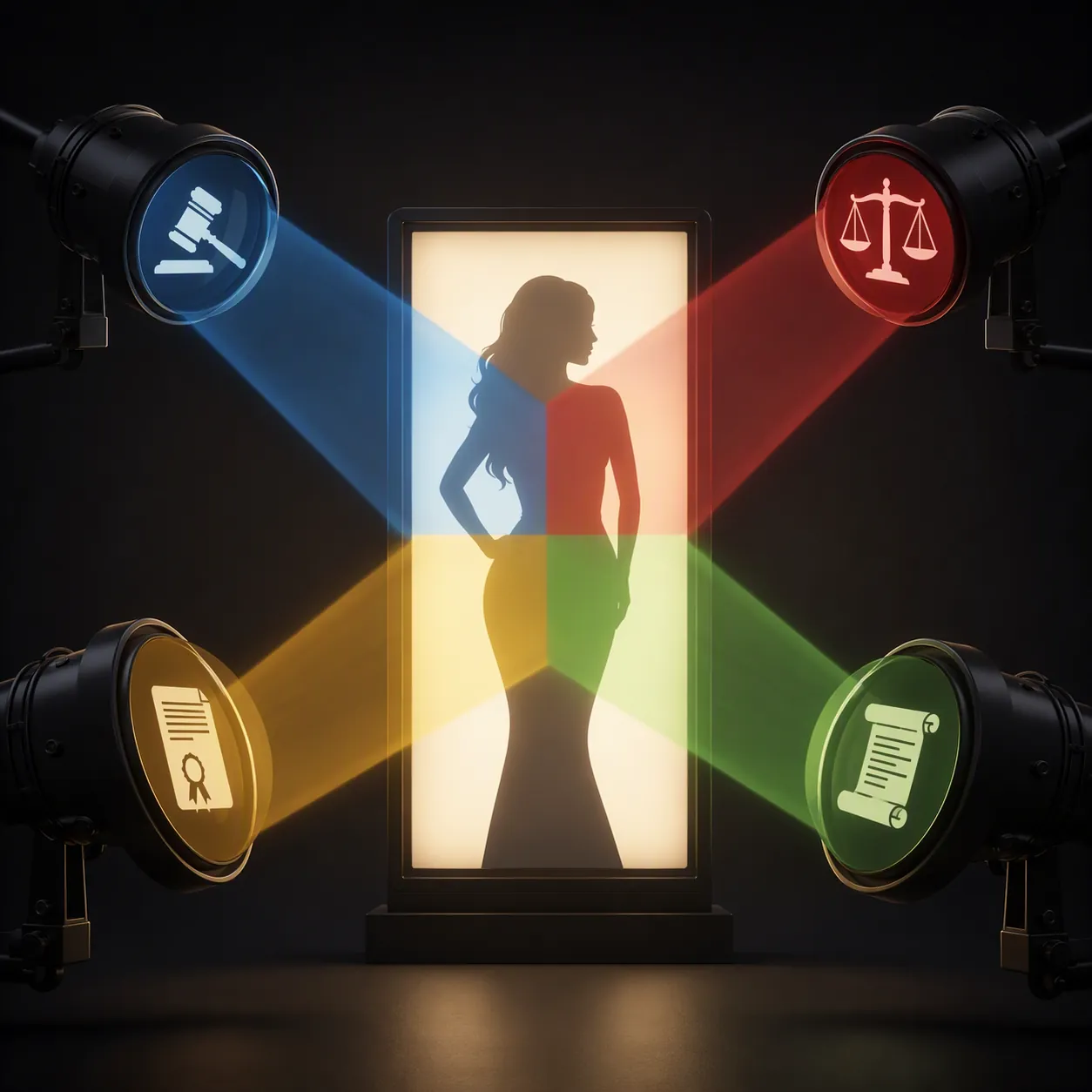
That is the wrong unit of review. A synthetic celebrity ad can implicate private publicity claims, FTC deception rules, New York's new synthetic performer disclosure law, and a pending federal digital-replica bill. Those regimes do not ask the same question, give standing to the same people, or measure exposure the same way.
| Regime | Authority | Trigger to watch | Who can act | Status in Q3 2026 | Penalty or remedy | Source confidence |
|---|---|---|---|---|---|---|
| State right of publicity | State statutes and common law, including California, New York, and Tennessee | Use of name, image, likeness, voice, or persona-like identity in a commercial setting without authorization | Usually the person whose identity is used, or their estate or assignee where state law allows | Current law, but highly state-specific | Private civil remedies vary by state; California is described as among the most comprehensive and does not require celebrity status or proof of commercial value [1] | Strong for the patchwork point; state-by-state advice still required |
| FTC fake reviews and testimonials rule | Federal Trade Commission | Creating, buying, procuring, or disseminating fake or AI-generated celebrity testimonials that misrepresent identity or experience | FTC | Final rule effective October 21, 2024 [2] | Civil penalties reported at up to $53,088 per violation in 2026 [3] | Strong for rule text and penalty scale; do not treat every synthetic celebrity ad as an FTC violation without deception analysis |
| New York synthetic performer disclosure law | New York state advertising law | Advertisement using a synthetic performer that targets New York consumers | New York enforcement authorities | Signed December 11, 2025; effective June 9, 2026 [4] | $1,000 for a first violation and $5,000 for subsequent violations [4] | Strong for enacted obligation; judicial interpretation of conspicuous disclosure is not yet available |
| NO FAKES Act | Proposed federal legislation, S.4591 | Unauthorized digital replica using voice or visual likeness | Rightsholders under the proposed federal right; platforms would face notice-and-takedown procedures | Advanced unanimously from Senate Judiciary Committee on June 18, 2026, but not enacted [5] | Would create penalties up to $750,000 per unauthorized work for certain platform-related failures [5] | Strong for bill status and proposed structure; not current law |
The table is useful only if it is read vertically. A disclosure can be relevant in more than one row, but it does not merge the rows. Publicity law asks whether an identity was appropriated. FTC law asks what the ad communicates to consumers, including by implication. New York's law asks whether a covered synthetic performer ad targeting New York consumers carries the required conspicuous disclosure. The NO FAKES Act, if enacted, would add a federal voice-and-likeness structure rather than clean up the existing state map.
Start With The Identity Clearance, Not The Label
The publicity-law problem is the first seam because it exists even when consumers understand that the asset is synthetic. If a campaign borrows a recognizable face, voice, name, or signature persona to sell a product, the disclosure may help avoid some consumer confusion, but it does not supply permission from the person whose identity is doing the commercial work.
The state map is also not a single generic "likeness law" bucket. Bloomberg Law's account of the publicity-law patchwork describes California's statute as among the most comprehensive and notes that it does not require the plaintiff to be a celebrity or to prove commercial value, while other states have less defined bodies of law [1]. That matters for AI ads because the creative target is often resemblance rather than exact copying. The campaign may avoid using a name and still depend on recognition.
California, New York, and Tennessee illustrate why clearance cannot be reduced to a single yes-or-no question. California's breadth makes it a poor jurisdiction for casual assumptions about who counts as protectable. New York now has a separate synthetic performer disclosure obligation in addition to its identity-related protections. Tennessee's ELVIS Act draws particular attention to voice protection, a point that matters for campaigns using cloned speech, soundalike narration, or music-adjacent endorsements. The same asset may therefore raise different issues depending on whether the risk comes from a face, a voice, a performance style, the audience targeted, or the commercial message wrapped around it.
For approval purposes, the practical file should answer at least four questions before the ad is trafficked: whose identity is being invoked; which elements of that identity are being used; where the ad will run or be targeted; and what consent, license, union, talent, or estate clearance supports the use. A prompt log is not a license. A vendor warranty is not the same as a rights grant. A media plan that can reach a protected jurisdiction may matter even if the creative team never says the jurisdiction's name.
FTC Exposure Turns On Net Impression
The FTC layer is narrower in one sense and sharper in another. It is not a free-floating federal publicity right. The question is deception: whether the ad misrepresents identity, experience, endorsement, or testimonial support. The FTC's final rule on fake reviews and testimonials, effective October 21, 2024, prohibits creating or promoting fake or AI-generated celebrity testimonials that misrepresent identity [2].
The penalty number changes the approval conversation. A 2026 compliance source reports civil penalties of up to $53,088 per violation, along with a dedicated FTC AI enforcement unit established in January 2026 and a 40% increase in advertising enforcement cases in 2025 [3]. The enforcement-unit and case-increase details should be treated as secondary-source reporting unless independently verified in a specific matter, but the practical signal is still plain enough: a synthetic endorsement is no longer just a reputational scenario on a slide.
The hardest version is not the obvious fake quote. It is the ad that uses a synthetic celebrity-like face beside product claims, social proof, or before-and-after language in a way that implies personal use. A small footer reading "AI-generated" may tell viewers something about production method while leaving the endorsement message intact. Courts and regulators evaluate advertising by net impression rather than by isolating a disclosure from the rest of the presentation [6].
That is why FTC review should not stop at whether the word "AI" appears. The reviewer needs to ask what the ordinary consumer takes away: that the celebrity used the product, approved the claim, appeared in the campaign, licensed the likeness, or is merely the inspiration for a synthetic scene. Those are different messages. If the campaign depends on viewers collapsing them into one impression, the disclosure is being asked to do more work than a disclosure usually can.
New York Adds A Separate Disclosure Duty
New York's synthetic performer law deserves its own line in the clearance checklist because it is current, targeted, and easy to miss. The law was signed on December 11, 2025, and became effective June 9, 2026. It requires conspicuous disclosure for advertisements using synthetic performers and applies to ads targeting New York consumers, with penalties of $1,000 for a first violation and $5,000 for subsequent violations [4].
The territorial point is the operational trap. A brand does not need to be headquartered in New York for New York consumers to be in the audience. Paid social targeting, connected-TV buys, influencer amplification, retargeting pools, and lookalike audiences can all turn a supposedly national campaign into one that reaches New York in a way the legal review has to address.
The law is also first-in-nation and not yet judicially tested. That means counsel should avoid overconfident claims about exactly what "conspicuous" will require in every format. A disclosure that is visible in a static mockup may be weak in a six-second mobile placement, audio-only execution, vertical video, or platform unit where captions are truncated. The safer question is format-specific: where will the consumer actually see or hear the disclosure, and at what point in the ad?
New York's rule does not solve the publicity or FTC questions. A campaign can disclose a synthetic performer and still lack rights to the likeness. It can disclose AI generation and still imply endorsement. It can satisfy one placement's display requirements and fail another because the media plan changed after legal approval. This is why the approval record should tie the disclosure to the regime it is meant to satisfy, not merely record that a disclosure exists.
Why The Universal Disclaimer Fails
A universal disclaimer usually fails because it answers an incomplete question. "AI-generated" says something about how the asset was made. It does not say who authorized the identity use, whether the person endorsed the product, whether the testimonial reflects actual use, whether New York disclosure standards are satisfied, or whether platform notice procedures may be triggered.
| Campaign fact | Question it raises | Why a generic AI label may not cure it |
|---|---|---|
| Synthetic face resembles a living performer | Was identity used commercially without permission? | Publicity rights focus on appropriation and authorization, not only consumer awareness |
| Voiceover sounds like a known singer or actor | Is the voice itself protected under state law or future federal law? | A production-method label does not grant voice rights |
| Ad copy says the product is the celebrity's "daily routine" | Does the ad imply personal use or endorsement? | The net impression may remain deceptive even if the image is labeled synthetic |
| Campaign targets New York consumers | Does New York's synthetic performer disclosure law apply? | The required disclosure must be conspicuous in the actual ad format |
| Ad is uploaded by an agency, affiliate, or media partner | Who can remove it, revise it, or respond to a takedown demand? | Operational control matters after launch, especially when the asset spreads across platforms |
The approval process should therefore separate rights clearance, claim substantiation, endorsement review, disclosure placement, media targeting, and platform response. These are not decorative legal categories. They decide who must approve the prompt, who signs the license, who reviews the final cut, who controls takedown credentials, and who pays if a regulator counts each impression, ad variant, or dissemination as a separate violation.
The Pending Federal Layer: NO FAKES
The NO FAKES Act is important because it would change the architecture of digital-replica liability, but it should not be treated as enacted law. As of Q3 2026, the bill has advanced unanimously from the Senate Judiciary Committee, on June 18, 2026, and would create a federal intellectual-property right in voice and visual likeness, along with DMCA-style notice-and-takedown procedures [5].
The proposed penalties are significant. Holland & Knight reports that the bill would include platform penalties up to $750,000 per unauthorized work in connection with the proposed regime [5]. For advertisers, the more immediate point is not only the number. A federal right could reduce some state-law fragmentation while adding a new clearance layer, new platform procedures, and new leverage for performers and rightsholders.
There is still legislative uncertainty. Roll Call reported the committee advancement and noted First Amendment concerns raised by senators including Mike Lee, Alex Padilla, Ted Cruz, and Eric Schmitt [7]. Those concerns could lead to amendments, delay, or failure. Treating the bill as inevitable would be sloppy; ignoring it in campaign architecture would be just as imprudent for brands planning reusable synthetic talent assets.
Platform And Enforcement Context
Platform obligations are developing alongside ad-law exposure, but they should not be used as proof that every AI celebrity ad is unlawful. The TAKE IT DOWN Act, signed as Public Law 119-12 in May 2025, requires covered platforms to establish a notice-and-removal process by May 19, 2026, with a 48-hour removal window for covered unauthorized intimate images and deepfakes [8]. That law is not a general celebrity endorsement statute, but it shows the direction of procedural regulation: platforms are being asked to receive notices, act quickly, and document removal systems.
The takedown environment is already active. 404 Media reported in January 2024 that YouTube deleted more than 1,000 videos of celebrity AI scam ads [9]. That episode is useful as enforcement context, not as a substitute for legal analysis. Scam removals do not answer whether a particular brand campaign violates publicity law, FTC rules, or New York's disclosure statute. They do show that once a synthetic celebrity asset is distributed, platform action can become part of the risk file.
For counsel reviewing a launch, the platform question is practical: who owns the account, who receives notices, who can pause paid spend, who can remove affiliate reposts, and who preserves the final approved version. The best legal theory is not much comfort if the ad stays live for a weekend because no one knows which vendor holds the credentials.
A Clearance Record That Matches The Risk
An approval record for a synthetic celebrity campaign should be built by regime, not by asset. The file should identify the person or persona invoked, the jurisdictional assumptions, the rights basis, the endorsement analysis, the substantiation for any product claims, the New York targeting determination, the disclosure language and placement by format, and the platform-response owner.
- Rights clearance: document the license, consent, agency representation, estate authority, or reason no protected identity is being used.
- FTC review: assess the ad's net impression, especially any implied personal use, endorsement, testimonial, or product-performance claim.
- New York review: determine whether the ad targets New York consumers and whether the synthetic performer disclosure is conspicuous in each format.
- Media controls: confirm where the ad will run, who can change targeting, and whether affiliates or creators can reuse the asset.
- Takedown readiness: assign the person who can pause spend, remove posts, respond to platform notices, and preserve evidence.
The record should also be dated. As of Q3 2026, New York's law is effective, the FTC rule is effective, state publicity rights remain uneven, and the NO FAKES Act is pending rather than enacted. A campaign approved under that snapshot may need a refresh if the federal bill changes, if a court interprets New York's conspicuous-disclosure standard, or if the media plan expands into new formats or jurisdictions.
The risk classification is straightforward enough: AI celebrity ads now require regime-by-regime clearance. A single disclosure review may be part of that file, but it is not the file.
References
- AI Celebrity 'Deepfakes' Clash With Web of State Publicity Laws, Bloomberg Law, Apr 2023.
- U.S. FTC's New Rule on Fake and AI-Generated Reviews and Social Media Bots, Sidley, Aug 2024.
- FTC AI-Generated Content Disclosure: 2026 Rules Explained, HumanAdsAI, Mar 2026.
- New York Enacts 'Synthetic Performer' Disclosure Law, Cooley, Jan 2026.
- Senate Committee Advances Bill to Protect Name, Image, Likeness and Voice, Holland & Knight, June 2026.
- Risks of Using AI-Generated, Implied Celebrity Endorsements in Advertising, BMD LLC, June 2026.
- AI deepfakes bill advanced by Senate Judiciary Committee, Roll Call, June 2026.
- 'Take It Down Act' Requires Online Platforms To Remove Unauthorized Intimate Images and Deepfakes, Skadden, June 2025.
- YouTube Deletes 1,000+ Videos of Celebrity AI Scam Ads, 404 Media, Jan 2024.
Related records
Tool profile
How Meta's AI Spending Reshapes Law Firm ProfitabilityGoverning regulation
Browse the obligations tracker →Preventive workflow
Browse verification workflows →
Report a correction or tip
Spotted an outdated figure, a misstated fact, or a ruling this case record should reflect? Public comments are disabled for this content given the professional cost of a misreported case outcome, penalty amount, or rule text — use the structured correction channel instead.
Report a correction or tip for this record →