
How Meta's AI Spending Reshapes Law Firm Profitability
Examines how Meta's record AI infrastructure spending is compressing law firm margins through client billing restrictions and rising technology costs, revealing a structural shift in legal pricing that demands new profitability strategies.
- Tool
- AI
- Benchmark source
- Thomson Reuters State of the US Legal Market 2026
- Hallucination rate
- Not measured / undisclosed
- Test methodology
- Survey and financial analysis
- Test date
- Jan 1, 2026
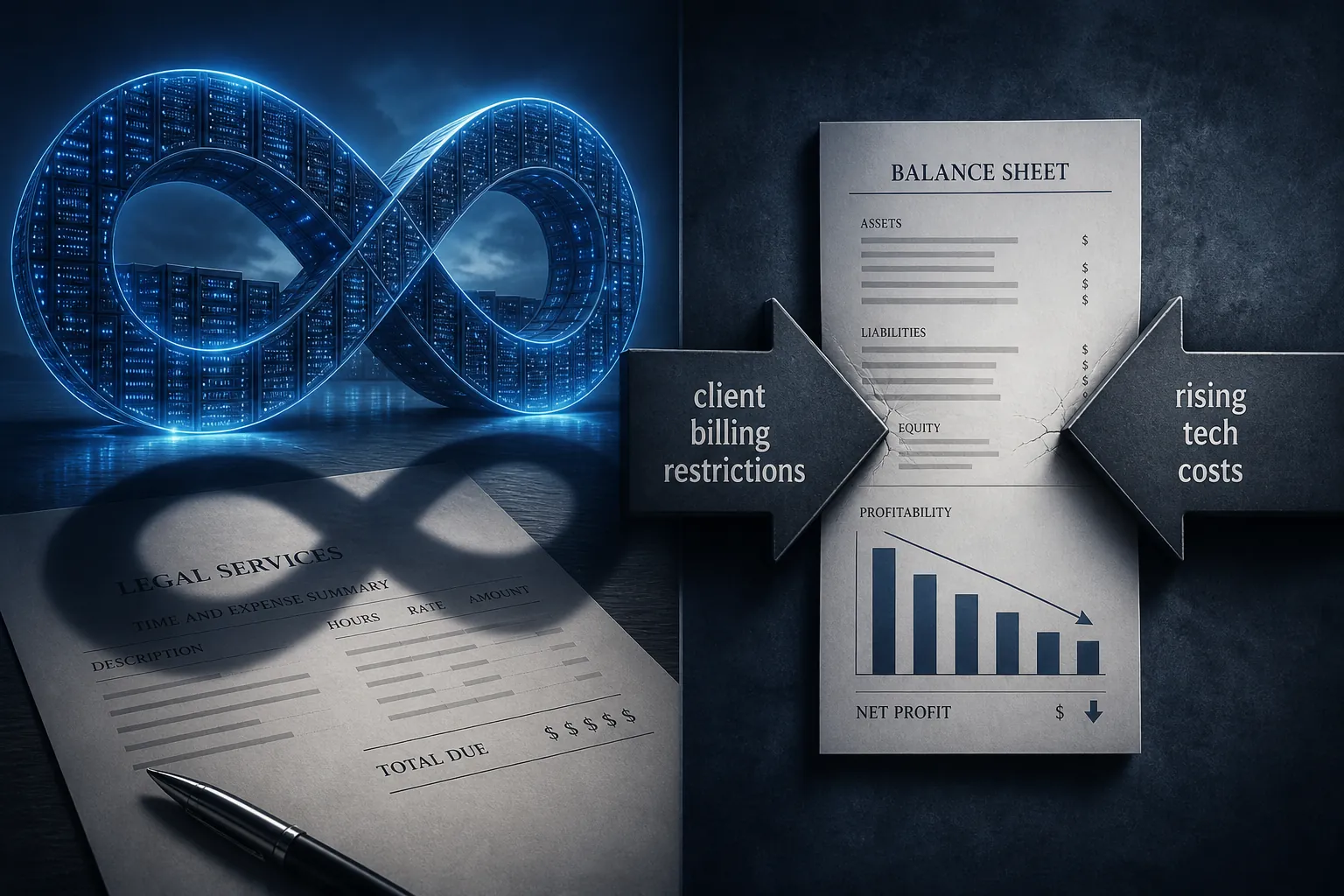
Meta’s AI spending matters to law firm profitability because it is no longer just a vendor-budget story. It is now a client-billing story. The same company planning $130 billion to $145 billion in 2026 capital expenditures for the AI buildout is also under pressure from thinner margins, legal reserves, and reduced free cash flow, and it is telling outside counsel that some work should not be billed the old way merely because a lawyer touched it.
That combination is harder to dismiss than another conference-stage prediction about the end of the billable hour. In Q2 2026, Meta reported $60.8 billion in revenue, but profit fell 14%, operating margin declined from 43% to 31%, and free cash flow dropped to $784 million from $8.55 billion a year earlier; the same quarter included $2.4 billion in legal charges.[1][2] Fortune separately reported that Meta had raised its 2026 capex forecast to as much as $145 billion for the AI boom.[3]
The legal charge is not the same thing as a litigation outcome. It is a GAAP charge, not a final judgment, and large claims in pending litigation remain claims until resolved. But it still affects the budget environment in which outside counsel invoices are reviewed. When a client is funding one of the largest AI infrastructure programs in the market while absorbing heavy legal costs, “AI efficiency” stops being an abstract innovation theme and becomes a line-by-line billing question.
The Invoice Is Where the AI Argument Becomes Real
At the 2026 CLOC Global Institute, Meta legal operations chief Mike Haven told law firms that the billable hour should become the exception within five years, and Law.com reported that Meta had updated outside-counsel billing guidelines to flag and refuse payment for AI-replaceable tasks.[4] The precise guideline language is not fully available in the public reporting, so the safest reading is narrow: Meta is not publicly proven to have banned billing for every AI-assisted activity. It is reported to be challenging payment for categories of work it believes AI should compress or replace.

That distinction matters. A client does not need to prove that AI can run a full matter to weaken a firm’s revenue capture. It only needs to identify time entries that look like commodity research, first-pass drafting, document summarization, chronology building, or other work that the client believes should take less time after the firm has bought AI tools. For more task-level context, the practical question is not whether AI can replace lawyers wholesale, but which discrete legal tasks are already being compressed by automation.
That is why Meta’s move lands directly on realization, not just rates. A firm may keep its published rates, win the matter, and staff it conventionally, then lose value later through write-downs, billing guideline rejections, appeals to the relationship partner, or quiet concessions before the invoice ever reaches the client. The economic damage is not always visible as a dramatic fee cut. It can appear as more time that never converts into collectible revenue.
The signal is also no longer confined to one unusually aggressive technology company. Law.com reported that UBS and Zscaler have issued parallel AI billing restrictions.[4] That does not make the practice universal. It does make it harder for firms to treat Meta as a one-off demand from a client with exceptional leverage.
Why Faster Work Does Not Automatically Protect Profit
In a simple version of the AI story, firms use new tools, complete work faster, and become more profitable. That version leaves out the invoice. If a task used to take eight associate hours and now takes fewer, the firm has to decide whether to bill the time actually spent, convert the work into a fixed fee, charge for the outcome, or bury the efficiency inside a traditional time entry and hope no one asks.
The last option is the vulnerable one. Sophisticated legal departments do not need perfect visibility into every prompt or workflow to push back. They can compare timekeeper mix, phase-level budgets, task descriptions, and historical matter patterns. If a firm says it uses AI but its invoice shows the same associate-heavy research load, the client has an obvious question: where did the efficiency go?
| Billing event | Old revenue logic | AI-era client challenge |
|---|---|---|
| Junior research memo | Hours demonstrate effort and train associates | Why should AI-compressible first-pass research be billed at the same volume? |
| Document review or summarization | Large teams support speed and defensibility | Which parts required lawyer judgment, and which parts were machine-assisted? |
| Drafting standard provisions or first drafts | Time reflects drafting and revision labor | Was the firm charging for legal judgment or for reusable AI-enabled production? |
| Matter management and coordination | Complex matters require partner and associate oversight | Did AI reduce coordination burden, or did the invoice simply preserve old staffing? |
None of this means the work has no value. A risky answer generated quickly still needs legal judgment, privilege discipline, factual checking, and accountability. But the value is no longer self-evident from elapsed time. When the client believes the labor component has shrunk, the firm has to show what remains: judgment, risk allocation, strategic advice, quality control, speed to decision, or a better outcome than the client could have produced internally.
The Other Side of the Squeeze: Firms Are Spending Before They Can Capture
Client billing pressure would be easier to absorb if AI investment were already dropping cleanly to the bottom line. The aggregate data do not support that comfort. Thomson Reuters reported that law firm technology spending grew 9.7% in 2025, the fastest recorded rate, while knowledge management budgets grew 10.5%.[5] Those numbers are not cosmetic. They show that firms are funding infrastructure, licenses, security review, training, KM support, and change management before they know how much of the benefit they can keep.
This is the part of the profitability conversation that tends to disappear in vendor demos. A new tool may reduce the time needed for a task, but the firm still pays for the platform, the rollout, the data governance work, the pilot time, the internal help desk burden, and the partner hours spent deciding whether the output can be trusted. If the client then refuses to pay for the hours the tool eliminated, the firm has incurred a new cost while surrendering part of the old revenue base.
The broader market entered this shift from a strong but potentially misleading position. Thomson Reuters reported that law firm profits rose 14.1% in 2025 and that margins sat above 40%, but also that 7% rate increases drove most of the profit growth, not proven efficiency capture.[6] In the same analysis, roughly 90% of legal dollars still flowed through billable-hour structures that have remained largely unchanged since the 1950s.[5]
That creates a timing problem. The market has been rewarded for raising rates faster than it has been forced to redesign pricing. AI billing restrictions attack the gap between those two facts. If profits depend heavily on rates and the client starts disallowing time for AI-replaceable tasks, the firm cannot solve the problem by pointing to its technology investment. The investment is part of the client’s argument.
The pressure is uneven. Firms with disciplined phase budgeting, matter-level profitability data, and credible alternative fee structures have a better chance of turning AI into margin. Firms that bought tools mainly to avoid looking behind the market may find that adoption creates a disclosure problem before it creates an earnings story. For a separate look at AI budget durability and vendor-side infrastructure pressure, see the discussion of why the AI chip sell-off matters for law firm AI budgets.
The Profitability Data Are Not Yet Reassuring
Survey data from Clio and BigHand sharpen the problem. Only about 31% to 32% of AI-using firms report improved profitability per matter, while 29% report a reduction in billable hours from AI.[7][8] Those are not the numbers one would expect if AI adoption, by itself, reliably expanded law firm margins.
Reduced billable hours can be good business if the firm has changed the fee architecture. A fixed fee that was priced using historical effort but delivered with a leaner workflow can improve margin, provided quality and scope are controlled. A portfolio arrangement can let the firm share efficiency gains while giving the client budget certainty. A success-based or milestone-based structure can preserve value where speed matters more than activity.
Reduced billable hours are painful when the firm has done none of that work. In that setting, AI lowers the number of hours available to bill, clients challenge the hours that remain, and the cost of the tool sits inside overhead. The pricing director is then asked to explain why a matter with fewer hours, higher technology costs, and more write-down risk should still be treated as a win.
BigHand’s finding about strategy is more useful than the usual adoption statistic: firms with a visible AI strategy are nearly four times more likely to see ROI, at 81% compared with 23%.[8] The word “visible” matters. The advantage is not simply that these firms bought software earlier. It is that someone can connect tool use to workflow design, staffing, pricing, billing language, and client communication.
Where the Staffing Pyramid Gets Exposed
The junior-associate layer is the most obvious friction point, though not the only one. Large firms have long used early-career lawyers for research, document analysis, diligence, and drafting work that also trains them. Clients have tolerated the model unevenly because it produced future expertise and because the alternatives were limited. AI changes the bargaining position. The client can now ask which parts of that training model belong on its invoice.
That question is uncomfortable but not illegitimate. If a firm wants clients to keep funding leverage, it needs a better answer than tradition. Some junior work will remain highly valuable because it develops case knowledge, spots factual inconsistencies, and supports senior judgment. Some work will be harder to defend at historical volumes. The invoice has to distinguish between those categories, because clients like Meta are beginning to do it themselves.
The Transparency Gap Is Now a Profitability Risk
The most exposed firm is not necessarily the one using AI. It is the one that cannot explain whether AI was used, how it affected the work, what controls applied, and how the economics changed. Thomson Reuters reported that 68% of corporate legal departments do not know whether outside firms use AI on their matters, and 59% see no savings from AI.[9] Thomson Reuters also reported that only 20% of law firms measure GenAI ROI at all.[5]
Those numbers describe the conditions under which billing disputes become predictable. The client suspects AI should have reduced the bill. The firm cannot quantify whether it did. The matter team can describe the legal work, but finance cannot isolate the efficiency effect, and knowledge management cannot prove consistent use across teams. By the time the invoice is challenged, the firm is negotiating from memory rather than data.
A defensible AI billing position does not require disclosing every prompt or weakening privilege protections. It does require a firm-level view of which task categories are AI-assisted, which uses are prohibited or restricted, how outputs are reviewed, how time is recorded, and when the client receives a different pricing proposal because the delivery model has changed. Without that, the firm is asking the client to accept both the promise of AI and the old economics of non-AI work.
- Matter teams need a way to tag AI-assisted phases without turning time entries into privilege-risk narratives.
- Pricing teams need historical baselines by task, phase, and staffing mix before they can claim efficiency or defend value.
- Knowledge management teams need usage data that shows whether approved tools are actually changing workflows.
- Relationship partners need client-specific language for when AI reduces fees, preserves fees, or supports a different value proposition.
What Meta Changes, and What It Does Not
Meta does not prove that the billable hour disappears in five years. It does not prove that every corporate client will adopt the same billing rules. It also does not prove that AI investment will make law firms less profitable across the board. Client bases differ, practice mixes differ, and some matters remain too bespoke, too urgent, or too risk-sensitive for crude efficiency assumptions.
It does show something narrower and more consequential for firms that serve sophisticated legal departments: major clients are beginning to price AI-replaceable work differently. That change reaches the firm at exactly the moment firms are increasing technology and KM spending, while many still depend on rate increases and billable-hour structures to protect profit.
The winners are unlikely to be the firms with the longest list of AI tools. They are more likely to be the firms that can answer four practical questions before the client asks them: which work changed, how pricing changed, how quality was controlled, and how matter profitability improved or deliberately did not. A firm that can answer those questions may use AI to strengthen client relationships and protect margin. A firm that cannot will feel the squeeze first in write-downs, billing disputes, and realization, long before any grand transformation shows up in the financial statements.
References
- “Meta Revenue Beats, But AI Spending Crushes Profit Margins” — Yahoo Finance.
- “Meta Struggles With Limited Returns on Its AI Spending, Social Media Legal Woes” — Gizmodo.
- “Meta just bumped its 2026 capex forecast up to as much as $145 billion for the AI boom—and investors flinched” — Fortune, 2026/04/29.
- “Meta Legal Ops Chief to Law Firms: It's Time to Ditch the Billable Hour—for Your Own Good” — Law.com/Corporate Counsel, 2026/05/14.
- “State of the US Legal Market 2026 analysis: Will the AI bubble burst?” — Thomson Reuters.
- “Law firms' record-breaking 2025: Why technology investment will define what comes next” — Thomson Reuters.
- “Clio 2026 Legal Trends Report” — Clio.
- “Navigating the Legal AI Productivity-Profitability Paradox” — BigHand.
- “The great AI disconnect: Law firms & legal departments are not communicating about AI usage” — Thomson Reuters.
Chronological incident history
- Anwar Raslan's Life Sentence Stands After German Appeal
- What's verified in the Max Miller House Ethics probe
- What's the Status of the Miller-Grisham Social Media Order?
- Clayton Echard–Laura Owens Lawsuit Is Not an AI-Risk Case
- What Laura Owens Actually Alleged Against Clayton Echard
- The SC 26th Amendment Absentee Voting Case Is Watson v. RNC
- Which Southwest PDX Discrimination Suit Facts Are Verified?
- Is the $750,000 California Lottery Prize Denial Verified?
- Are ECT Malpractice Lawsuits Against Psychiatrists Rare?
- Milo Yiannopoulos's Deportation Case Remains Unverified
- What's Confirmed in the Sauce Gardner Contractor Lawsuit?
- Studio City Dog Boarding Death Lawsuit Is Unconfirmed
- Supreme Court’s Mail-In Voting Stay in Trump v. California
- Which Carroll Verdict Did the Supreme Court Reject?
- The Bricen Rivers and Lauren Johansen case timeline
- What verdict options does Lindsay Clancy's jury have?
- What's verified in Milo Yiannopoulos's ICE status?
- Trump's hush money conviction appeal is still pending
- What's verified in the Yosemite land transfer controversy
- No court order revoked the Cheluget 5,800-acre Narok title
- DOJ appeal keeps Epstein unredaction ruling in force
- Why Eric Hafner Can Stay on Alaska's U.S. House Ballot
- What's Verified in the Evelyn Cheluget RSF Passport Scandal
- Who Was Charged in the Roberts Signature Forgery Case?
- Is Subhash Chandra's NCLT settlement actually final?
- Warr Receives 37 Months for South Carolina Wire Fraud
- Why Don Lemon Was Indicted Over a St. Paul Church Protest
- Wife's objection in Cher's Elijah Blue Allman conservatorship
- Francisco Paulino's pandemic fraud charges, explained
- Where do State Farm's Oklahoma roof claim lawsuits stand?
- Is AI really eliminating legal jobs?
- GEMA v. OpenAI lawsuit update: Munich ruling is on appeal
- Google AI Overviews' legal risk to publishers, case by case
- 15 State AGs Demand OpenAI Evidence in Hugging Face Hack
- Where does the NYT v. OpenAI lawsuit stand now?
- Halusinasi AI pada fakta zodiak Cina — peguam wajib semak
- Risiko kalkulator keserasian pasangan mengikut tarikh lahir
- Paano naging 'manghuhula online' ang AI sa Sandiganbayan?
- 無料の手相占いを入口にした占いサイト詐欺、逮捕まで進んだ執行の変化
- Who answers for NYT's AI-generated search summaries?
- Judge Denies Lindsay Clancy Mistrial Request
- Jed York's no-contest plea ends his disorderly conduct case
- Kai Spears wins $9.25M Alabama defamation verdict
- Who's Actually Sued in the Sofia Vergara AI Deepfake Case
- Why Is the Nolan Wells Case Evidence Sealed?
- Superpotent Thyroid Tablets Recalled? Symptoms and Rights
- Why Ghislaine Maxwell's grand jury records were unsealed
- How DMCA § 512(h) subpoenas unmask GTA 6 leakers
- AI-fabricated citation confirmed in Bianco ballot case
- USPS mail carriers face $24M check theft indictment
- Inside the Clancy trial's concession strategy
- USPS Mail Carrier Charged With Mail Theft? What Happens Next
- Jamie Komoroski settlement and sentence outcome by phase
- Every Keffe D bail hearing and why he remains jailed
- Sean Grayson's death investigation has three tracks
- The Grant–McMahon case is now in confidential arbitration
- What Emma Coronel's Docket Says About Life After Prison
- Where the Sara Duterte Impeachment Trial Stands on Day 18
- Did Mike Lindell Withhold His Minnesota Recount Payment?
- Who Can Be Sued After the Vitruvias Thyroid Recall
- Sean Grayson dies serving sentence for Sonya Massey killing
- The legal fallout of the GTA 6 leak site takedown
- Who is Rockstar's parent subpoenaing over the GTA 6 leaks?
- Why the Knox-Kercher Case Is a Legal-AI Hallucination Probe
- Water utility OT cyberattack compliance deadlines for 2026
- Summer Dress Code Rules Employers Need to Know
- Restaurant Dress Codes Under Gender Discrimination Law
- Michigan's AI SNAP Eligibility Screen Under the 2025 Changes
- What Amazon Prime Air complaints can cities act on?
- Who Is Liable in an Alabama Bad-Weather Truck Accident?
- Where Buc-ee's Trademark Policing Crosses Into Overreach
- Utah ruling keeps Kalshi's sports betting under state law
- What the Social Security 2100 Act's COLA Change Does in Law
- EPA Green Bank En Banc Ruling Leaves Forum Question Open
- New York attorney general's Kalshi lawsuit, explained
- Why the Jan. 6 Pence Tweet Was an Official Act
- DOL Cites San Antonio Bakery for Child Labor and Wages
- The legal issues with police surveillance AI, explained
- What the en banc court held in the EPA green bank clawback suit
- What legal exposure remains in the Fukuoka assembly scandal?
- What the Blanche DOJ fight means for federal AI enforcement
- The PSA Antitrust Lawsuit, Explained
- FBI agents sue Patel for firing in political retaliation
- Which SEC rules require AI capex disclosure?
- Three arrests in Santa Cruz police shooting, no charges yet
- Google Lens now feeds AI training. Privacy law is split.
- Who faces legal risk when AI fakes satellite images?
- Why Trump's IRS audit immunity was never lawful
- What courts actually decided on Medicaid work requirements
- The DOJ Rule Change Behind the NYT North Korea Subpoena
- Is mail theft of a winning lottery ticket a federal crime?
- What the FDA Compassionate Use Program Legally Requires
- Judge defers dismissal in Trump's $15B NYT defamation case
- The Verified Record of the Joe Felz Fullerton DUI Case
- How to Verify AI Answers on HOA Foreclosure Laws
- States Sue Over Tariffs Again After the Supreme Court Ruling
- What's confirmed in Aaron Farinacci's Old Trails Fire case
- Cert denial closes Trump Section 301 tariff challenge
- Three Court Tracks Now Decide Texas THC Ban's Fate
- How to read Aaron Farinacci's manslaughter conviction
- How lottery winner anonymity laws vary by state
- What South Korea's property tax increase legally changes
- Why Was Prince Harry's Privacy Lawsuit Dismissed?
- Which states are suing Trump over tariffs?
- Which AI deepfake laws has Congress passed so far?
- Belfast AI art copyright controversy is a legal misreading
- UBS Fined $125M for Money Laundering Violations
- Why Talarico's 'murdered' remark likely isn't actionable
- Four legal gates remain for Gwangju's semiconductor cluster
- Verify Kansas City Wrongful Death Lawyer's Trial Experience
- How to Verify the Maple Leaf Bacon Recall List in OR/WA
- Was F1 made by AI? The legal obligations behind the claim
- What Legal Obligations Valley Forge Owes Transfer Students?
- Why Does Diddy's Release Date Keep Changing?
- Which laws apply to the Fukuoka cash-for-post scandal?
- Brij Bhushan Sharan Singh's acquittal leaves the case open
- Legal issues behind Yerington's Monarch Data Center protest
- What Microsoft's AI spending means for legal tech buyers
- Can governments stop Microsoft's AI data center buildout?
- Investor legal considerations for the CBIZ acquisition
- Is your college on the $23 billion settlement list?
- Verify Max Miller abuse allegations against docket records
- Why the Grisham TRO Against Miller Can't Be Confirmed Yet
- Federal judge upholds EPA air standard — deadlines now bind
- Is the Sweet v. McMahon Class Action Settlement Final?
- Federal judge lets ICE agents mask up, keeps NY 287(g) ban
- Who Qualifies for the Sweet v. McMahon Settlement
- What the Clancy Duxbury jury tour reveals about view law
- A witness-by-witness recap of Lindsay Clancy trial week 2
- Why Jeanine Pirro's Reflecting Pool Case Collapsed
- What Jeanine Pirro's Reflecting Pool decision left open
Report a correction or tip
Spotted an outdated figure, a misstated fact, or a ruling this tool profile should reflect? Public comments are disabled for this content given the professional cost of a misreported case outcome, penalty amount, or rule text — use the structured correction channel instead.
Report a correction or tip for this record →