
AI Citation Hallucination Sanctions in Federal Courts: Case Patterns, Penalties, and Enforcement Principles (2023–Q1 2026)
A structured reference covering the full arc of U.S. federal court AI citation sanctions — from the 2023 watershed through Q1 2026's record $145,000 quarter — documenting verified case counts, sanction amounts, the legal authority bases courts apply, and the four enforcement principles that now give litigating attorneys a calculable risk model.
- Court
- Multiple federal courts: S.D.N.Y., D. Or., 6th Cir., W.D. Ark., N.D. Cal.
Lex Machina Review is an independent risk-tracking and reference resource. Nothing on this site is legal advice, and using it does not create an attorney-client relationship. Every record is reviewed against primary sources but may not reflect the most current status of a matter — always verify directly against the cited court order, rule text, or a licensed attorney before relying on it.
Companion explanation — secondary to the source document above
Current Scale: 505 Cases, $2.5M+, and a Record Q1 2026
As of May 2026, the legalaigovernance.com tracker documents 505 verified AI sanctions cases against attorneys in U.S. courts, with more than $2.5 million in court-imposed fees across the dataset. Q1 2026 alone produced at least $145,000 in quantified sanctions — more than any prior full year on record.
That figure requires a definitional note. The legalaigovernance.com count of 505 focuses on attorney and practitioner sanctions cases verified against dockets and court orders. The Charlotin database at HEC Paris takes a broader scope — as of May 28, 2026, it identifies 1,497 cases globally, including 1,038 in the United States, covering all court decisions where AI-generated hallucinated content was found or implied, including pro se litigants and instances involving judicial chambers. Neither count is wrong; they answer different questions. This article uses the legalaigovernance.com figures when discussing attorney sanctions specifically, and the Charlotin database when noting the broader documented universe.
| Metric | Figure | Source / Verification Date |
|---|---|---|
| Total U.S. attorney sanctions cases | 505 | legalaigovernance.com, May 2026 |
| Total court-imposed fees | $2.5M+ | legalaigovernance.com, May 2026 |
| Q1 2026 quantified sanctions | $145,000+ | EDRM / JD Supra, Q1 2026 tally |
| Total U.S. cases (all parties, incl. pro se) | 1,038 | Charlotin database, May 28, 2026 |
| Total worldwide cases | 1,497 | Charlotin database, May 28, 2026 |
| Tracker entries listing 'Unspecified generative AI' | 391 of 505 | legalaigovernance.com, May 2026 |
| Entries with ChatGPT confirmed on the record | 55 of 505 | legalaigovernance.com, May 2026 |
The tool-attribution data deserves emphasis before the analysis proceeds. Of the 505 legalaigovernance.com entries, 391 list "Unspecified generative AI" — meaning courts and parties did not identify a specific product on the record. ChatGPT is confirmed in 55 cases. Claims about any particular tool's prevalence in sanctions proceedings should be read against those proportions.
Chronological Arc: From 2023 Curiosity to 2026 Enforcement Regime
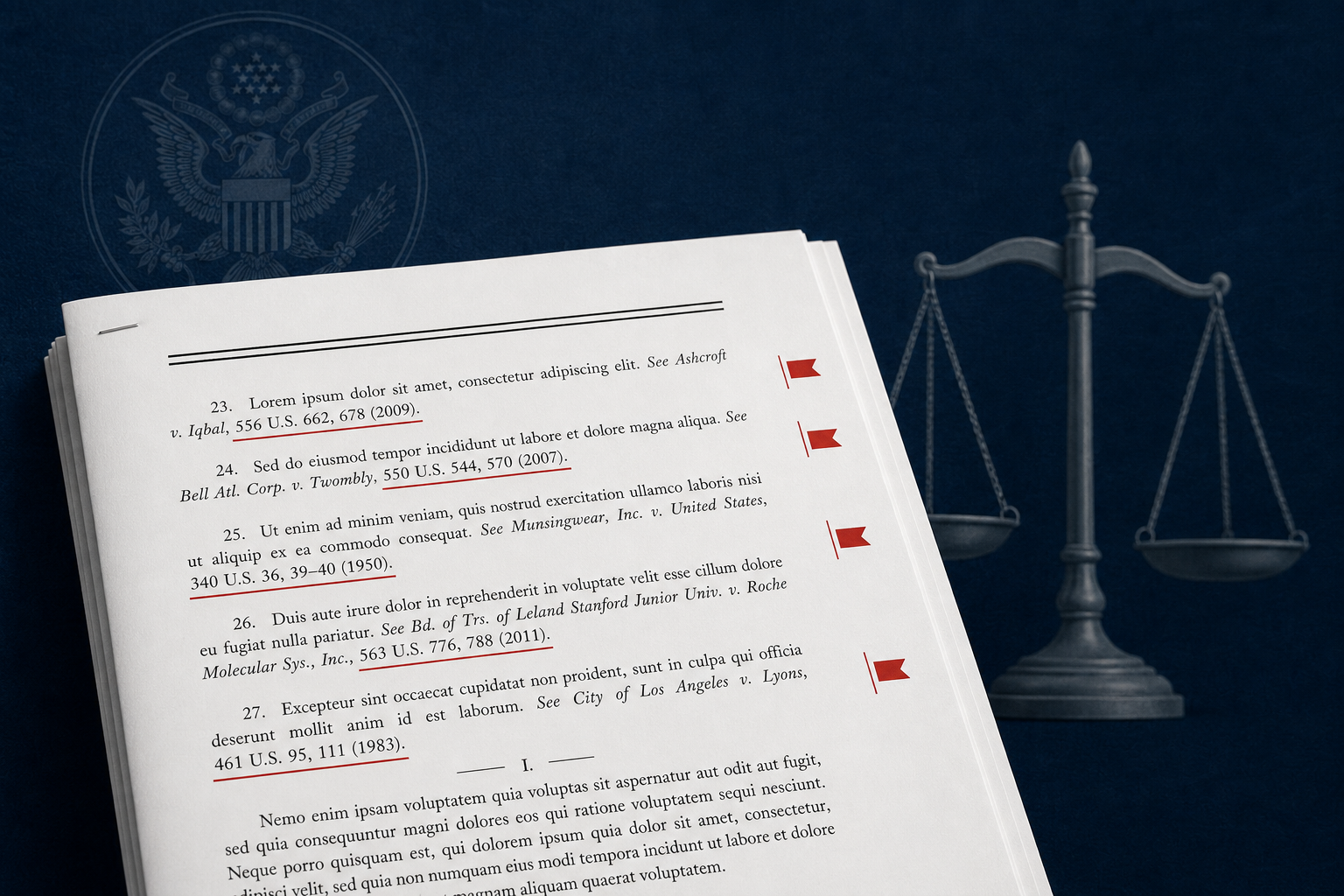
The sanctions landscape did not emerge fully formed. It developed through a recognizable escalation curve, with each year producing both higher case volumes and more consequential individual rulings.
| Year | Documented Cases | Defining Development |
|---|---|---|
| 2023 | 5 | Mata v. Avianca establishes the template; courts treating AI hallucinations as a novel problem |
| 2024 | 18 | Park v. Kim and Cohen expand the pattern; Fifth Circuit declines to promulgate new AI-specific rules |
| 2025 | 279 | Volume surge; Oregon per-infraction formula established; Couvrette and Hatfield set new penalty benchmarks |
| 2026 (through April) | 203 | Q1 alone produces $145,000+ in sanctions; Whiting sets federal appellate record |
2023: The Watershed
Mata v. Avianca (S.D.N.Y., June 2023) is the case that defined the category. Attorneys submitted a brief containing ChatGPT-generated citations to nonexistent cases, were sanctioned $5,000, and were required to provide the court with copies of the order and notify the judges whose names had been attached to fabricated opinions. The case established the template that subsequent courts would adapt: fabricated citations are a Rule 11(b) violation; the attorney's reliance on AI output without verification is not a defense; and courts have both the authority and the inclination to sanction.
With only five documented cases in 2023, the legal community's initial response was largely observational — a curiosity about what the rules would say, not yet a systematic enforcement problem.
2024: Expansion and Early Pattern-Setting
Eighteen cases in 2024 — a 260% increase over 2023 — confirmed that Mata was not an isolated event. Park v. Kim and Cohen emerged as early 2024 markers of the pattern spreading across district courts. The Fifth Circuit, in June 2024, acknowledged that existing court rules already require attorneys to check filings for accuracy and declined to promulgate a new AI-specific rule — signaling that courts viewed FRCP Rule 11 as fully adequate to the task.
ABA Formal Opinion 512, issued July 29, 2024, provided the profession's most significant non-judicial guidance of the year — classifying AI tools under the Rule 5.3 supervisory framework and warning that attorneys bear full supervisory responsibility for AI-generated output. The Opinion is persuasive but not binding authority; its adoption and weight vary by jurisdiction.
2025: The Volume Surge and Benchmark Penalties
The 2025 caseload of 279 documented sanctions cases — a fifteen-fold increase over 2024 — produced the rulings that now define the outer edges of penalty exposure. Two cases from late 2025 set the benchmarks that practitioners must understand.
Couvrette v. Wisnovsky (D. Or., Dec. 12, 2025) involved plaintiffs' briefing across three summary-judgment briefs containing 15 AI-generated fake case citations and 8 fabricated quotations. The court struck the errant briefs, dismissed plaintiffs' claims with prejudice, and fined lead counsel $15,500 using the per-infraction formula first established by the Oregon Court of Appeals in Ringo v. Colquhoun Design Studio — $500 per fabricated citation, $1,000 per fabricated quotation. The court then awarded defendants their full attorney fees, bringing the total sanction to $110,204.38 per the legalaigovernance.com tracker. The court's finding that the lead lawyer showed a "total lack of remorse" and failed to use any conventional citator drove the penalty to its maximum.
Jason M. Hatfield, P.A. v. Pirani (W.D. Ark., Dec. 2025) produced the largest single award in the tracker: $1,578,172 in attorney fees and $93,388 in costs. This figure requires careful characterization. The tracker notes that the award arose in a RICO case context, making it a fee award under litigation-specific circumstances rather than a pure Rule 11 or Rule 38 AI-sanctions order. It should not be read as the standard ceiling for AI-citation misconduct sanctions, but it represents the outer boundary of documented financial exposure when AI-related conduct intersects with high-stakes litigation.
Q1 2026: Record Quarter, Record Appellate Sanction
Whiting v. City of Athens (6th Cir., March 13, 2026) is the largest federal appellate AI sanction on record as of Q1 2026. The Sixth Circuit sanctioned two lawyers over $100,000 for citing hallucinated cases across three consolidated appeals. Both lawyers are jointly and severally liable for appellees' full attorney fees ($26,315.09), double costs, and a $45,000 punitive sanction payable to the court of appeals — combined exposure of $116,315.09. The court sanctioned under both FRAP 38 and inherent authority, and referred both lawyers to the chief judge for potential disciplinary proceedings.
The Sixth Circuit's opinion contains a passage that practitioners should treat as a judicial statement of the verification standard:
When AI is used to prepare a brief, AI hallucinations are more likely to occur when there are little to no existing authorities available that clearly satisfy the user's request — such as, for example, when a lawyer asks a generative AI tool to supply a citation for an unsupported principle of law. Any reasonable attorney should know that a case is meritless if the only authority on which he can rely is a figment of imagination.
The court deliberately declined to name any specific AI tool in its opinion — a choice that reflects the tool-agnostic verification standard discussed in the enforcement principles section below.
Legal Authority Framework: Rule 11, Rule 38, Inherent Power, and ABA Opinion 512
No AI-specific federal rule governs citation hallucination sanctions. Courts have applied three overlapping existing authorities, and the absence of a dedicated rule has not constrained their reach.
- FRCP Rule 11(b) is the primary mechanism in district court proceedings. It requires that attorneys certify, by signing a filing, that the legal contentions therein are warranted by existing law and that factual contentions have evidentiary support. Submitting fabricated citations without any inquiry into their accuracy supports a finding of subjective bad faith and enables both party-motion and sua sponte sanctions. The Fifth Circuit in June 2024 confirmed that Rule 11 already covers the conduct at issue, declining to create a new AI-specific rule.
- FRAP Rule 38 applies at the appellate level for frivolous appeals. Whiting v. City of Athens illustrates the distinction the Sixth Circuit drew between an appeal that is "frivolous as filed" and one that is "frivolous as argued" — the latter occurring when arguable issues may exist but counsel engages in misconduct, including citing nonexistent authorities, mischaracterizing case law, or misrepresenting the record. Rule 38 authorizes just damages and single or double costs.
- Courts' inherent authority to sanction bad-faith conduct supplements both Rule 11 and Rule 38 and was applied alongside FRAP 38 in Whiting. Inherent authority sanctions are available where the conduct reflects willful disobedience of court orders or intentional misrepresentation — denial in the face of evident fabrications is the most common trigger.
- State bar referrals are a fourth enforcement channel that courts have used alongside or instead of monetary sanctions. Several tracker entries reflect pending bar discipline proceedings; those outcomes are noted as unresolved in the tracker and should not be cited as concluded disciplinary actions.
ABA Formal Opinion 512, issued July 29, 2024, is the most significant professional-responsibility guidance issued to date. It classified AI tools as analogous to "nonlawyers" under the Rule 5.3 supervisory framework, activating an attorney's full supervisory obligations over AI-generated output. The Opinion also warned that boilerplate consent language in engagement letters is inadequate when attorneys use AI tools that process client information. Opinion 512 is persuasive guidance, not binding authority — its weight varies by jurisdiction and it has not been incorporated into binding court rules.
The Four Enforcement Principles Courts Have Converged On
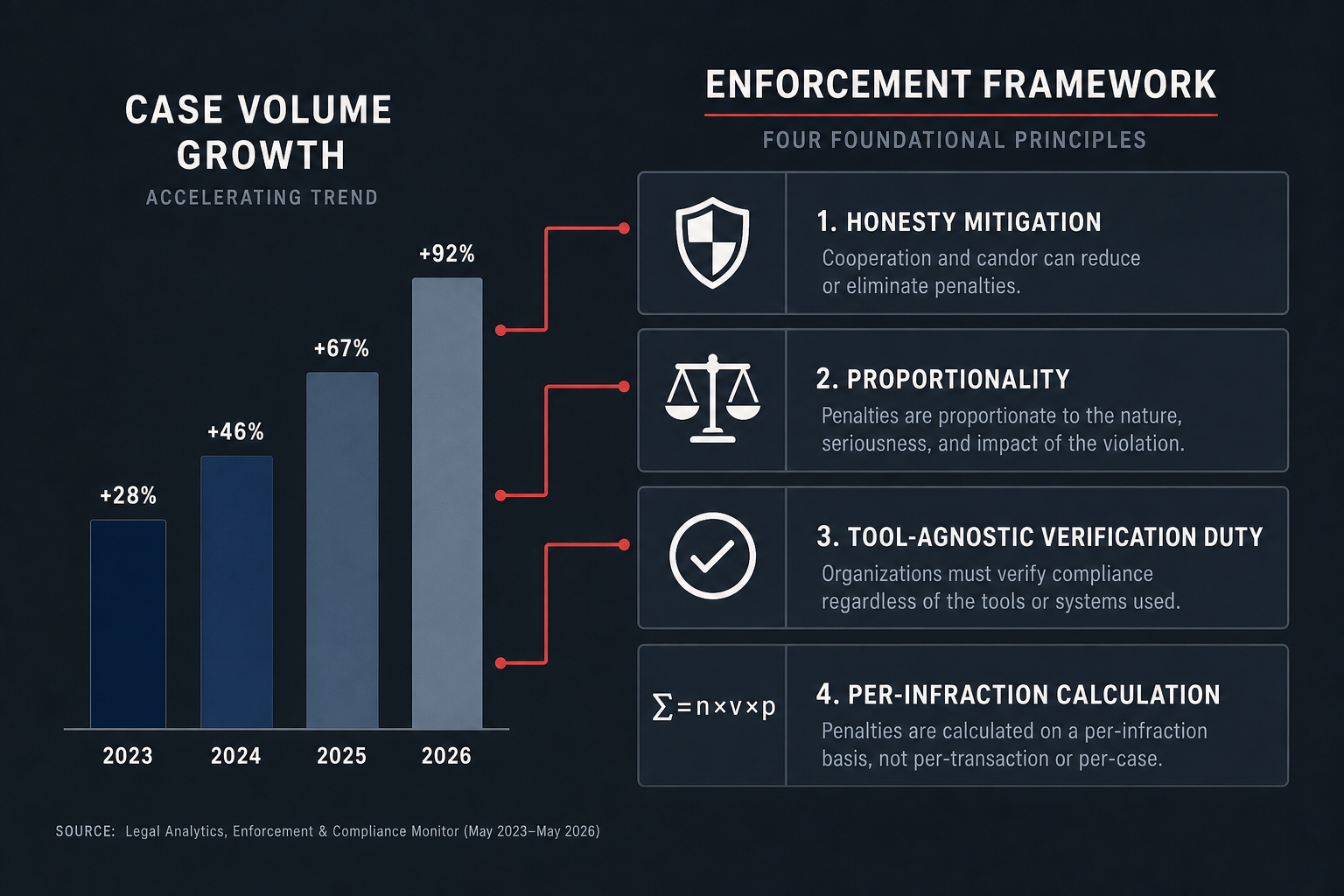
Across the 505 documented cases, four enforcement principles have emerged with enough consistency to constitute a predictive framework. These are not isolated holdings — they appear as recurring reasoning patterns across district courts, circuits, and state courts that have addressed AI citation misconduct.
Principle 1: Honesty Mitigation
Prompt disclosure and voluntary remediation consistently yield reduced or eliminated monetary sanctions. Green Building Initiative v. Peacock is the documented illustration: the court declined to impose monetary sanctions where counsel promptly acknowledged the error, apologized, and corrected the record. The contrast with Couvrette — where the court cited the lead lawyer's "total lack of remorse" as a driver of maximum penalty — makes the principle concrete.
The Okin Adams analysis of Whiting states the principle directly: the right response when errors occur is to acknowledge the mistake, apologize, and correct the record. Challenging the court's show-cause authority dramatically worsened the sanctions in that case.
Principle 2: Proportionality Scaling
More fabrications across more briefs draws higher penalties. The Sterne Kessler 2025 year-in-review identifies proportionality as one of the four consistent themes in sanctions jurisprudence: courts calibrate the sanction to the scope of the misconduct, not simply its occurrence. Couvrette involved 15 fake citations and 8 fabricated quotations across three separate briefs — the multi-brief spread contributed directly to the dismissal with prejudice and the full fee award.
Principle 3: Tool-Agnostic Verification Duty
The Sixth Circuit's deliberate choice in Whiting not to name any AI tool is the clearest statement of this principle. The sanction is anchored to the attorney's universal duty to verify citations before filing — not to the use of any particular product. This framing has significant practical implications: an attorney cannot reduce exposure by switching to a different AI tool, and cannot argue that a "more reliable" tool would have produced different results. The verification obligation applies regardless of which AI system, if any, was used.
The Charlotin database notes a related principle from the Xiong v. Wofford discharge order: AI tools should not be used to verify legal authority and citations when those same tools were used to generate or identify the citations in the first place. Independent citator verification is the required step.
Principle 4: Per-Infraction Formulas
Oregon's per-infraction arithmetic standard — $500 per fabricated citation, $1,000 per fabricated quotation — was established by the Oregon Court of Appeals in Ringo v. Colquhoun Design Studio and applied federally in Couvrette v. Wisnovsky. It is the only jurisdiction-level arithmetic standard for AI sanctions calculation currently documented in the tracker. Its federal application in Couvrette signals that district courts may adopt similar formulas as the caseload matures.
| Enforcement Principle | Operative Effect | Illustrative Case |
|---|---|---|
| Honesty mitigation | Prompt disclosure and voluntary correction reduce or eliminate monetary sanctions | Green Building Initiative v. Peacock (sanctions waived); Whiting (denial worsened outcome) |
| Proportionality scaling | Sanction magnitude scales with number of fabrications and number of briefs affected | Couvrette v. Wisnovsky (15 citations + 8 quotations across 3 briefs → dismissal + full fees) |
| Tool-agnostic verification duty | Sanction attaches to failure to verify, not to use of any specific AI product | Whiting v. City of Athens (6th Cir. declined to name any AI tool) |
| Per-infraction formulas | $500/fake citation, $1,000/fabricated quotation (Oregon standard, applied federally) | Ringo v. Colquhoun Design Studio; Couvrette v. Wisnovsky (D. Or. Dec. 2025) |
Aggravating and Mitigating Factors in Documented Cases
The difference between a waived monetary sanction and a six-figure penalty is not random. Documented cases consistently cluster around two opposing sets of conduct factors.
Factors That Have Driven Maximum Penalties
- Denial in the face of evident fabrication. Cases including Tercero v. Sacramento Logistics, Idehen v. Stoute-Phillip, and Johnson v. Dunn involved attorneys who denied AI use or denied the fabrications when confronted — a posture that courts have treated as compounding the original misconduct and supporting inherent-authority sanctions for bad faith.
- Defiance of show-cause orders. Challenging the court's authority to issue show-cause orders, rather than responding substantively, has consistently worsened outcomes. Whiting is the appellate-level illustration.
- Repeated filings across multiple briefs. Couvrette's three-brief spread was central to the court's decision to dismiss with prejudice rather than impose a fine-only sanction.
- Failure to use any citator. The Couvrette court specifically cited the lead attorney's failure to use a conventional citator as an aggravating factor. The ABA Business Law Today analysis notes that filing without any inquiry into accuracy supports a finding of subjective bad faith.
- Possible client involvement. The Couvrette court noted the possibility of client involvement in generating the fake material — a factor that supported the dismissal with prejudice rather than a remedy directed solely at counsel.
Factors That Have Reduced or Eliminated Monetary Sanctions
- Prompt acknowledgment. Green Building Initiative v. Peacock resulted in no monetary sanction where counsel acknowledged the error without delay.
- Voluntary correction and apology. Courts have consistently treated a genuine corrective response as a strong mitigating factor, particularly in first-occurrence cases.
- First-time occurrence. Absent other aggravating factors, a single instance of AI-generated citation error by an attorney with no prior sanctions history tends to produce the lightest available sanction — typically a reprimand or modest fine rather than disqualification or bar referral.
Sanctions Outcomes by Type: Monetary, Bar Referral, Disqualification, and Dismissal
The 505 tracker entries span a range of sanction types. Monetary fines are the most common documented outcome, but courts have also imposed structural sanctions — disqualification, pro hac vice revocation, case dismissal — and have referred attorneys to state bar disciplinary bodies.
| Sanction Type | Description | Representative Example |
|---|---|---|
| Monetary fine (Rule 11 / Rule 38) | Direct payment to the court or opposing party | Whiting: $45,000 punitive + $26,315.09 fees + double costs; Couvrette: $15,500 per-infraction fine + $94,704.38 fee award |
| Full attorney fee award | Opposing party's fees awarded as sanction | Couvrette v. Wisnovsky ($110,204.38 total); Hatfield v. Pirani ($1,578,172 fees + $93,388 costs, RICO context) |
| State bar referral | Referral to state disciplinary authority for potential license action | Whiting (both lawyers referred to chief judge); Buchanan v. Vuori (referral to Standing Committee on Professional Conduct). Note: several tracker entries list bar referrals as pending. |
| Disqualification from case | Counsel barred from further participation in the matter | Buchanan v. Vuori (barred from filing further settlement approval motions) |
| Pro hac vice revocation | Out-of-state admission to practice withdrawn | Documented in tracker; specific cases vary by jurisdiction |
| Case dismissal | Plaintiff's claims dismissed, with or without prejudice | Couvrette v. Wisnovsky (dismissed with prejudice) |
| Brief struck without leave to refile | Offending document removed from record | Buchanan v. Vuori (motion struck without leave to refile); Couvrette (errant briefs struck) |
The Judicial AI Paradox: Courts Sanctioning What Judges Also Use
A Northwestern University study published in the Sedona Conference Journal in March 2026 — based on December 2025 survey data — found that 61.6% of responding federal judges use AI tools in their judicial work. The study surveyed 502 federal judges and received 112 responses, a 22.3% response rate. That response rate is a material limitation on the generalizability of the finding; it should be read as directionally significant rather than statistically definitive.
The same study found that 45.5% of responding judges received no AI training. Two documented incidents give that figure operational meaning. Judge Wingate (S.D. Miss.) acknowledged that his law clerk used Perplexity to draft a temporary restraining order that misnamed parties and misquoted state law. Judge Neals (D.N.J.) acknowledged that a law school intern used ChatGPT to draft an opinion containing fictitious quotations.
These incidents create a verification asymmetry that the legal profession has not resolved: courts are imposing sanctions on attorneys for AI-assisted work product that contains hallucinations, while some judicial chambers are producing AI-assisted work product subject to no equivalent external review mechanism. The asymmetry does not diminish the attorney's verification obligation — courts have been clear that the duty to verify applies regardless of what practices others follow — but it is a structural feature of the current enforcement environment that practitioners should understand.
Practitioner Risk Quantification: The Oregon Per-Infraction Formula as a Stress Test
The Oregon per-infraction formula — $500 per fabricated citation, $1,000 per fabricated quotation — is the only jurisdiction-level arithmetic standard for AI sanctions calculation currently documented in the tracker. Established in Ringo v. Colquhoun Design Studio and applied federally in Couvrette v. Wisnovsky (D. Or., Dec. 2025), it provides the closest available proxy for a calculable minimum sanction exposure.
The formula functions as a floor, not a ceiling. Couvrette's $110,204.38 total sanction reflects the per-infraction fine ($15,500) plus the full attorney fee award — the fee award component, which scales with the opposing party's actual litigation costs, is where the largest exposure accumulates.
Illustrative Stress Test Using the Oregon Formula
| Scenario Element | Count | Per-Infraction Rate | Calculated Exposure |
|---|---|---|---|
| Fabricated citations | 5 | $500 each | $2,500 |
| Fabricated quotations | 2 | $1,000 each | $2,000 |
| Per-infraction subtotal | — | — | $4,500 |
| Opposing party attorney fees (illustrative) | — | Actual costs | Variable — could exceed $100,000 in complex litigation |
| Total minimum exposure (formula only) | — | — | $4,500 + fee award |
A brief with five fabricated citations and two fabricated quotations would generate $4,500 in per-infraction exposure under the Oregon formula. In a case with significant opposing-party litigation costs — as in Couvrette — the fee award component can multiply that figure by an order of magnitude. The Sixth Circuit's Whiting sanction, which did not use the Oregon formula, produced $116,315.09 in combined exposure across two attorneys through a different calculation path: full appellate fees plus double costs plus a $45,000 punitive fine.
The tool-agnostic verification duty established in Whiting is the universal baseline: the obligation to verify every citation against an independent citator before filing applies regardless of which AI system was used to draft the brief, regardless of how confident the AI output appeared, and regardless of whether the attorney was aware that AI was involved in the drafting process at all. The Charlotin database's note from Xiong v. Wofford makes the circularity problem explicit — using the same AI tool to verify citations it generated does not satisfy the verification obligation.
Related records
Tool profile
Browse tool evaluations →Governing regulation
Browse the obligations tracker →Preventive workflow
Browse verification workflows →
Report a correction or tip
Spotted an outdated figure, a misstated fact, or a ruling this case record should reflect? Public comments are disabled for this content given the professional cost of a misreported case outcome, penalty amount, or rule text — use the structured correction channel instead.
Report a correction or tip for this record →