
How AI facial reconstruction fails in 1982-era cold cases
AI facial evidence in cold-case work has a documented failure record — no arrests from police AI sketches, a suspect cleared on the spot, barred vendor analyses, and a 1982 cold-case acquittal — and this filterable record flags what litigators should verify in each case.
- Jurisdiction
- Hawaii, United States
- Court
- Circuit Court of the First Circuit, Hawaii
- AI tool named
- Parabon Snapshot
- Ruling date
- Jul 12, 2023
- Source document
- View primary court order ↗
- Last verified
- Aug 4, 2026
Lex Machina Review is an independent risk-tracking and reference resource. Nothing on this site is legal advice, and using it does not create an attorney-client relationship. Every record is reviewed against primary sources but may not reflect the most current status of a matter — always verify directly against the cited court order, rule text, or a licensed attorney before relying on it.
Companion explanation — secondary to the source document above
Last verified: Aug. 4, 2026, UTC. This Risk Digest entry is a litigation-risk record, not legal advice. Legal-background review was completed for issue spotting; no individual reviewer name is available for this record. The status labels below separate confirmed court outcomes, reported incidents, vendor-side claims, and material excluded because the available source does not state AI use. For the site’s status-flag approach, compare the monitoring format used in No AI tool is implicated in the Ariana Grande hacker lawsuit.
The problem with AI forensic facial reconstruction in 1982-era cold cases is not that a generated face can never help an investigation. The problem is what happens when the image leaves the lead file and starts behaving like an identification. In the 2024–2026 record, the concrete outcomes are already enough to slow the file down: no arrests from a police AI-sketch program, a man visited at home and cleared on the spot, vendor analyses barred or blocked when methodology was challenged, and a 1982 cold-case prosecution ending in a not-guilty verdict.
The 1982 anchor is the Thomas L. Garner/Kathy Hicks matter in Honolulu. WCAX reported that a jury found Garner not guilty in July 2023 in the 1982 cold-case killing; Honolulu Police Department’s cold-case page remains a separate agency record for the Hicks investigation and should be checked against court-level docket materials before anyone treats a public summary as the final procedural record.[1][2] That is not a technicality. It is the whole point of this record: the face-linked lead, the arrest narrative, and the final disposition may live in different places.
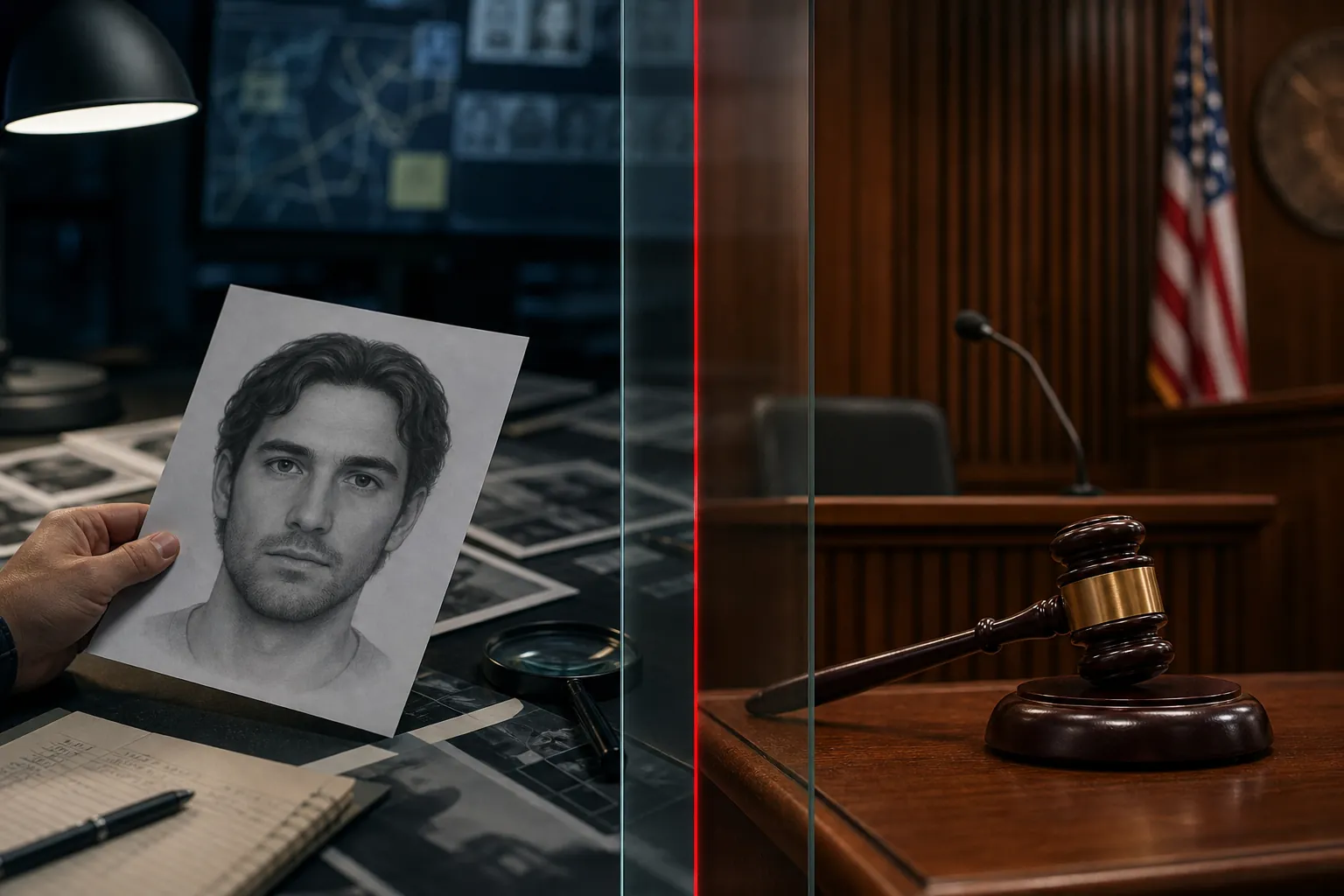
Failure record: how the facial output behaved
The useful litigation question is not whether a generated face looked persuasive. It is where it was used, who reviewed it, whether anyone disclosed the method, and what happened after the image entered the case file. The table is organized for that scan.
| Jurisdiction / date | Agency or court | Tool or output | Source type and litigation status | Disposition / risk flag |
|---|---|---|---|---|
| Goodyear, Arizona; 2025 incidents reported Dec. 4, 2025 | Goodyear Police Department | Two hand-drawn witness sketches enhanced with ChatGPT; one April attempted-kidnapping sketch and one November shooting sketch | Reported police use; images carried an “AI-generated, does not depict a real person” disclaimer | No arrest resulted from either sketch. Useful as a lead-use warning, not an identification record.[3] |
| Forsyth County, North Carolina; 2026 | Forsyth County Sheriff’s Office / district attorney public response | Victim-created AI suspect sketch circulated by law enforcement | Reported incident; no court admissibility ruling in supplied record | Deputies went to Brandon Brown’s home, cleared him on the spot, and the image was withdrawn after the DA confirmed innocent people were being looked at.[4] |
| Multi-state; reported May 3, 2024 | Courts in New York and Ohio; CyberCheck deployments across agencies | CyberCheck AI analysis, not a facial composite, included here because it supplies the strongest court-facing reliability signal in the record | Confirmed admissibility challenges reported by NBC News | CyberCheck was cited as used in nearly 8,000 cases across 40 states and about 300 agencies; a New York judge barred its evidence for reliability and acceptance failures, and an Ohio judge blocked an analysis when the founder refused to disclose methodology.[5] |
| Orange County, New York; 2023 complaint and later trial disposition | New York State Police / Megan McDonald prosecution | CyberCheck cited in complaint materials | Reported downstream charging record; prosecutor later separated charging theory from tool reliance | State police cited CyberCheck in the 2023 complaint; the special prosecutor said she had “not relied” on it, and Edward Holley was acquitted.[6] |
| Honolulu, Hawaii; 1982 cold case, verdict reported July 2023 | Honolulu Police Department / jury trial | Parabon Snapshot-linked identification in the Hicks cold-case record | Agency cold-case record plus reported jury outcome; public-source disposition conflict requires court-record verification | WCAX reported Garner was found not guilty; HPD’s public cold-case page should not be substituted for the court docket.[1][2] |
| Peer-reviewed benchmark; 2025 | Preuß et al., Applied Sciences 15(11):6086 | Digital facial reconstruction compared against three face-recognition models | Peer-reviewed methodological warning, not a criminal-case disposition | Three models could not confirm a digital facial reconstruction despite an investigator’s “striking resemblance” impression. That does not validate or invalidate any one police sketch; it shows why resemblance impressions need testing before evidentiary use.[7] |
Goodyear: a police sketch program with its own disclaimer
Goodyear is the cleanest example of a police department using generative AI to sharpen a witness-description sketch while also warning the public not to treat the result as a real face. Phoenix New Times reported that Goodyear police enhanced two hand-drawn witness sketches with ChatGPT in 2025, one connected to an April attempted kidnapping and one to a November shooting. Neither produced an arrest, and both images included the disclaimer that the image was AI-generated and did not depict a real person.[3]
That disclaimer matters more than the polish of the image. It is an agency-level admission that the face is synthetic. If the same image later appears in a warrant affidavit, lineup context, charging memo, or probable-cause narrative without that warning attached, the risk is no longer hypothetical. The generated face has changed jobs.
Forsyth County: the remedial burden landed on the person at the door
Forsyth County supplies the record this field usually lacks: a named person, a law-enforcement visit, an immediate clearance, and a withdrawn image. WGHP, republished by Yahoo News, reported that the sheriff’s office circulated a victim-created AI sketch in 2026; deputies then went to Brandon Brown’s home, cleared him on the spot, and the district attorney confirmed that “innocent people were being looked at” before the image was withdrawn.[4]
For counsel, the point is not whether the agency acted in bad faith. The risk is procedural: once a generated image circulates, the cleanup is carried by the person who must explain why a plausible-looking face is not his face. A later withdrawal does not erase the contact, the household disruption, or the possibility that the image was saved, shared, screenshotted, or folded into another investigative note.
The verification question in a Forsyth-style incident is narrow and practical: who created the image, what text instructions or source inputs were used, who approved circulation, whether the image was labeled as AI-generated at every point of distribution, and whether all downstream copies were pulled when the person was cleared.
CyberCheck: broad deployment claims met courtroom reliability objections
CyberCheck is not a facial-reconstruction product, but it belongs in this record because it shows what happens when an AI forensic output reaches court with deployment claims but without enough disclosed method to survive reliability scrutiny. NBC News reported in May 2024 that CyberCheck had been cited in nearly 8,000 cases across 40 states and about 300 agencies. In the same report, a New York judge barred CyberCheck evidence over reliability and acceptance failures, and an Ohio judge blocked an analysis after the founder refused to disclose methodology.[5]
That combination should bother both sides of the aisle. For prosecutors, a tool advertised as widely used can still become a late-stage evidentiary problem if the vendor will not disclose how it works. For defense counsel, the adoption number is not the end of the inquiry; it is the beginning of the subpoena list.
The Megan McDonald prosecution shows the next problem: downstream ambiguity. News 12 Westchester reported that New York State Police cited CyberCheck in the 2023 complaint, that the special prosecutor said she had “not relied” on it, and that Edward Holley was acquitted.[6] That sequence leaves a record question every case team should ask early: if the tool was not relied on at trial, what role did it play in arrest, charging, witness development, plea posture, or investigative confidence?
Garner/Hicks: do not let the cold-case page outrun the docket
The Hicks matter is the 1982-era warning that should travel with any DNA-phenotyping-linked face output. WCAX reported that Garner was found not guilty by a jury in July 2023 in the killing of Kathy Hicks; Honolulu Police Department’s cold-case page is a separate agency-facing record for the investigation.[1][2] The available sources flag disposition conflict in public materials, so the litigation-safe treatment is straightforward: cite the reported verdict only to the reporting source, cite the agency page only for the agency record, and verify the final disposition in Hawaii court records before using either in a motion, memo, or procurement review.
This is where vendor language needs a hard quarantine. Parabon’s Snapshot page advertises “380+ persons-of-interest,” but that is a vendor-side marketing claim, not a court finding, peer-reviewed accuracy rate, or validated admissibility result.[8] A person-of-interest count says a tool may have generated investigative attention. It does not say the generated face correctly identified a defendant, survived cross-examination, or contributed to a conviction.
The resemblance problem is methodological, not cosmetic
The Preuß benchmark is valuable because it separates human resemblance impressions from model confirmation. In the 2025 peer-reviewed paper, three face-recognition models could not confirm a digital facial reconstruction even though an investigator perceived a “striking resemblance.”[7] That is not a universal rule about every reconstruction. It is a warning against the most dangerous shortcut in this area: letting a plausible image become a match because someone in the room thinks it looks right.
That gap is especially important in cold cases, where old files often contain partial memories, degraded records, composite sketches, and renewed pressure to produce movement after years of silence. A generated face may make a file look current. It does not, by itself, supply validation.
Verification fields to attach to each AI-face record
The incidents above point to a short set of fields that should be filled before an AI-generated face, enhanced sketch, or DNA-phenotyping composite is allowed to carry weight beyond a lead.
| Field | Why it matters | Record signal from the cases |
|---|---|---|
| Peer-review status | A polished output is not a validation study. | Preuß et al. supplies a peer-reviewed warning about resemblance impressions, while the police-sketch incidents are reported uses, not validation studies.[3][4][7] |
| Methodology disclosure | A party cannot meaningfully challenge what it cannot inspect. | CyberCheck analyses were barred or blocked when reliability, acceptance, and disclosure were contested.[5] |
| Accuracy claims versus validated outcomes | Adoption counts and marketing figures measure use or claimed usefulness, not admissibility or correctness. | Parabon’s “380+ persons-of-interest” figure is vendor-side marketing and should not be treated as an independently validated success rate.[8] |
| Lead versus evidence treatment | The same face can be harmless as a tip and prejudicial as an identification cue. | Goodyear’s disclaimer said the image did not depict a real person; Forsyth County’s circulated image still sent deputies to a real person’s home.[3][4] |
| Final disposition | The litigation value of a tool cannot be assessed from arrest alone. | Garner and Holley both show why the record must be checked through verdict or dismissal, not stopped at complaint or agency summary.[1][2][6] |
One more field belongs in the file even when it is uncomfortable: source conflict. If an agency page, news report, vendor page, and court docket do not line up, the docket controls the litigation record. Public-facing summaries may be useful for leads and chronology. They are not substitutes for the disposition that a judge, jury, or clerk has actually entered.
On the present record, AI-generated facial outputs can justify investigation only at the level their support allows. They may reopen a stale file, refresh a witness lead, or help investigators decide where to look next. They do not deserve identification weight unless the proponent can show the source inputs, the disclosed method, the validation record, the lead-to-evidence path, and the final case disposition.
References
- Convicted murderer found not guilty in 1982 cold case killing in Hawaii — WCAX, July 12, 2023.
- Kathy Hicks — Honolulu Police Department.
- Experts question Goodyear police AI suspect sketches — Phoenix New Times, Dec. 4, 2025.
- Whitsett man speaks out after AI suspect sketch led deputies to his door — WGHP via Yahoo News.
- AI tool used in thousands of criminal cases is facing legal challenges — NBC News, May 3, 2024.
- Exclusive: News 12 uncovers questionable AI evidence used by state police to make arrest in Megan McDonald murder case — News 12 Westchester.
- Applied Sciences 15(11):6086 — Preuß et al., Applied Sciences, 2025.
- Snapshot DNA Phenotyping — Parabon NanoLabs.
Related records
Tool profile
Browse tool evaluations →Governing regulation
Browse the obligations tracker →Preventive workflow
Browse verification workflows →
Report a correction or tip
Spotted an outdated figure, a misstated fact, or a ruling this case record should reflect? Public comments are disabled for this content given the professional cost of a misreported case outcome, penalty amount, or rule text — use the structured correction channel instead.
Report a correction or tip for this record →