
Which AI model for stock trading regulation compliance?
This evaluation provides a regulatory-grounded framework for selecting AI models in SEC/FINRA-compliant stock trading. No single model is universally best; the defensible choice is a paired architecture with a premium reasoning model and a value model, wrapped in a governance layer that produces examinable attribution chains.
- Jurisdiction
- US-Federal
- Court
- SEC Enforcement Action
- AI tool named
- Claude Fable 5
- Ruling date
- Jul 26, 2026
- Source document
- View primary court order ↗
- Last verified
- Jul 26, 2026
Lex Machina Review is an independent risk-tracking and reference resource. Nothing on this site is legal advice, and using it does not create an attorney-client relationship. Every record is reviewed against primary sources but may not reflect the most current status of a matter — always verify directly against the cited court order, rule text, or a licensed attorney before relying on it.
Companion explanation — secondary to the source document above
The first defensible answer to the 2025 question, “Which AI model is best for stock trading regulation compliance?” is that the question is incomplete. A broker-dealer or adviser does not deploy a model into a trading workflow in the abstract. It deploys a model to summarize surveillance exceptions, draft supervisory notes, compare filings, support pre-trade review, classify communications, or assist an analyst who remains responsible for the decision. Each use has a different record, authority chain, data-access profile, and review obligation.
That distinction became harder to ignore during the 2025 to 2026 supervisory cycle. FINRA’s 2026 Regulatory Oversight Report added a GenAI section warning that AI agents may act “beyond the user’s actual or intended scope and authority,” with outcomes that can be “difficult to trace or explain, complicating auditability.” It also ties supervisory procedures under Rule 3110 to the “integrity, reliability and accuracy” of AI models used by member firms.[1] The SEC exam focus has moved in the same practical direction: evidence of governed AI data access matters more than a clean slide deck saying the firm has an AI policy.[2]
So the procurement question is not which model looks most impressive in a demo. It is which model-and-control stack can later reconstruct who asked the system to do what, what source material it touched, what answer it produced, what was accepted or rejected, and who had authority to approve the result.

The model comparison only matters after the control test
A regulated trading workflow should be tested against four control dimensions before anyone argues for Claude Fable 5, GPT-5.6 Sol, Gemini 3.1 Pro, DeepSeek V4, or a lower-cost value model.
| Control dimension | The exam-room question | What a model alone cannot solve |
|---|---|---|
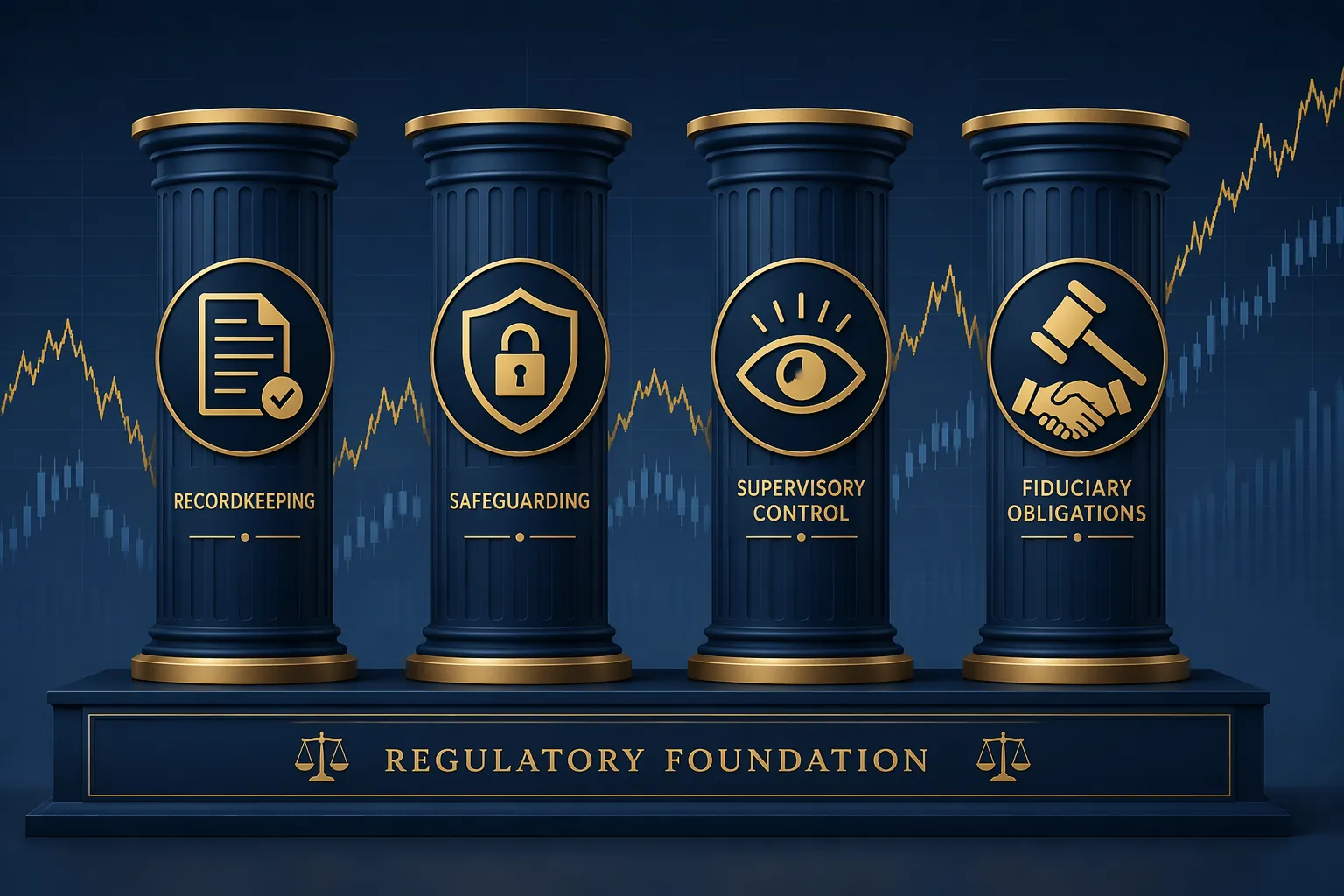
| Recordkeeping | Can the firm retain the prompt, source set, output, reviewer action, and final approved content under the applicable books-and-records regime? | The model does not decide retention scope, preserve immutable records, or attribute work to an authorized person. |
| Safeguarding | Did the system restrict client, trading, and firm data to users and tools with a permitted purpose? | The model may process what it receives, but access control belongs to the platform and integration layer. |
| Supervisory control | Can supervisors set limits, monitor exceptions, review outputs, and evidence follow-up under written procedures? | A capable answer is not the same thing as a supervised answer. |
| Fiduciary and adviser obligations | Can the firm show that AI-supported recommendations, research, or portfolio actions were reviewed for client fit, conflicts, and known model limitations? | The model’s confidence or fluency does not discharge adviser duties. |
Recordkeeping is the first hard stop. Rule 204-2 expectations for advisers and broker-dealer preservation requirements under 17a-4 are not satisfied by saving a final memo while losing the model exchange that shaped it. The compliance gap is especially immediate when AI-generated advisory content is routed through generic service accounts rather than attributable to an authorized individual.[2] If the firm cannot identify the person responsible for the prompt, the sources made available, and the output that moved forward, the model choice is already downstream of a broken control.
Safeguarding is just as concrete. Reg S-P concerns do not disappear because the interface looks like a productivity tool. A model connected to customer records, trade blotters, surveillance notes, research drafts, or communications archives needs governed access. The SEC’s FY2026 examination priorities, as summarized in compliance guidance, put weight on evidence that firms govern AI data access, not merely on written policies.[2]
Supervision is where many AI proposals become vague. FINRA Rule 3110 is not a model benchmark. It is a requirement to establish and maintain a supervisory system reasonably designed to achieve compliance with applicable securities laws and FINRA rules. In GenAI terms, that means written procedures, assigned review authority, escalation rules, testing, exception handling, and evidence that the controls operate when users are under deadline pressure.
Fiduciary and adviser obligations add a different pressure. The SEC’s January 2025 Two Sigma matter is a useful warning because it did not depend on science-fiction AI claims. The case involved known material vulnerabilities in trading models and alleged failures to implement written policies addressing those vulnerabilities; the SEC treated those failures as capable of supporting a fiduciary-duty breach.[3] For LLMs, the equivalent question is whether the firm knows where the system can fail and has procedures that prevent those failures from silently entering advice, research, or trading decisions.
Why “best model” is a poor procurement record
A procurement memo that says “we selected the best model” invites the wrong debate. Best at what? Long-context document comparison? Tool use? Low-cost classification? Coding an integration? Drafting first-pass supervisory narratives? If the intended activity is not controlled, the word “best” does very little work.
The more defensible pattern is paired. Use a premium reasoning model for high-stakes analytical outputs and a lower-cost value model for constrained bulk processing. Then place both inside a governance layer that controls identity, permissions, source retrieval, logging, supervisory review, retention, and validation. The model provides reasoning capacity; the governance layer creates the attribution chain an examiner can inspect.
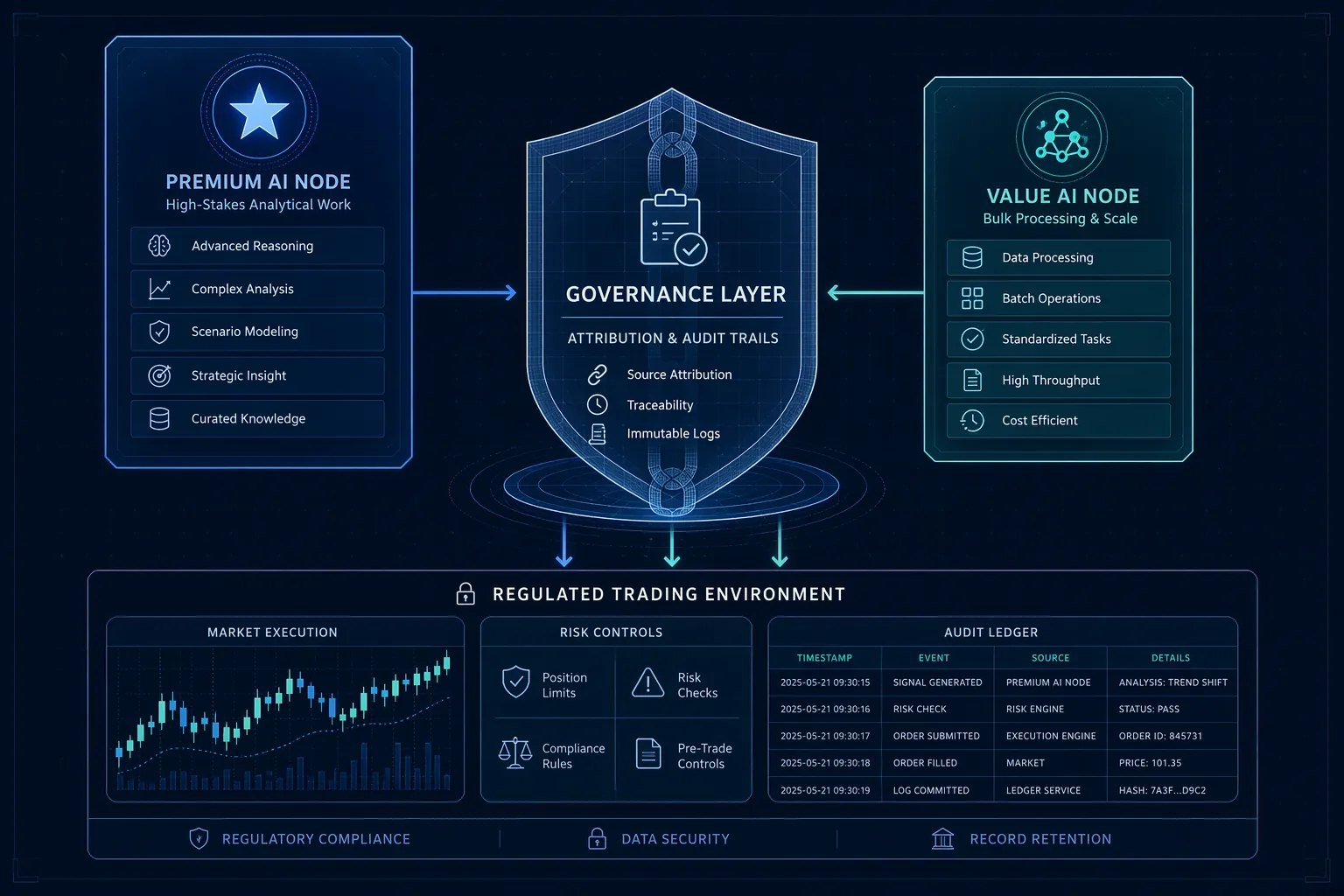
This distinction matters because vendors often describe governance as though it sits inside the model. It usually does not. A model may be better at following instructions, reasoning over long material, or declining unsafe requests. It does not by itself create a compliant archive, enforce entitlement rules across firm systems, prove that the approved source set was used, or assign responsibility to a registered principal. Those are platform, workflow, and supervisory controls.
Where Claude Fable 5 fits
Claude Fable 5 has the strongest case in the materials for high-stakes financial analysis. Aleph’s July 2026 finance-model review reports that Claude Fable 5 scored highest on the Hebbia Finance Benchmark in June 2026 and describes it as retaining the best long-context accuracy up to roughly 600,000 to 700,000 tokens.[4] That is the kind of capability that matters when the task is to compare a dense filing, a policy manual, historical supervisory notes, and exception data without reducing everything to a thin summary.
For regulated stock trading workflows, that points to permitted uses such as analyst support on complex filings, review of surveillance narratives against source documents, preparation of first-draft exception summaries, and comparison of model-risk documentation against approved procedures. These are not autonomous trading permissions. They are analytical-support uses where the firm can define the source corpus, preserve the exchange, require human review, and document the accepted output.
The long-context advantage is useful, but it is not magic. Older FinanceBench testing remains a cautionary marker for the category: GPT-4-Turbo with retrieval reportedly failed on 81% of financial questions, while long-context Claude-2 failed on 24%.[4] Those are not current rankings for 2026 front-runners. They do show why retrieval and context length should be validated as controls, not assumed to be controls.
A firm selecting Claude Fable 5 should therefore write the selection rationale narrowly: best supported in the available 2026 materials for premium long-context financial analysis, subject to workflow controls. That is a stronger record than claiming it is the best AI model for all stock trading compliance activities.
Where GPT-5.6 Sol fits
GPT-5.6 Sol is easier to understand as an ecosystem choice than as a finance-specific production proof point. Aleph’s July 2026 review describes OpenAI’s GPT-5.6 family, including Sol, Terra, and Luna, as offering the broadest tool ecosystem, while also noting a thinner production track record in finance deployments.[4]
That does not make GPT-5.6 Sol unsuitable. A broad tool ecosystem can matter when a firm needs workflow orchestration, controlled handoffs, document processing, internal application integration, or developer familiarity. But from a compliance-defense standpoint, the firm should not let tool availability substitute for validation in the specific trading workflow. The question is whether the tools are locked to approved actions, whether the agent can exceed its authority, and whether each action is traceable.
FINRA’s warning about AI agents acting beyond intended authority should sit directly in the GPT-5.6 Sol evaluation if the deployment uses tool-calling or autonomous workflow steps.[1] The more capable the integration layer, the more explicit the firm needs to be about permissions, approvals, and termination points. A model that can call many tools should be valued only where the tool boundary is supervised.
Where Gemini 3.1 Pro and DeepSeek V4 fit
The available materials do not support the same finance-specific claim for Gemini 3.1 Pro or DeepSeek V4 that they support for Claude Fable 5. That does not mean these models have no place in a defensible stack. It means their permitted use should be narrower unless the firm has its own validation evidence.
For example, a firm might use a value-oriented or secondary model for bulk classification, deduplication, document triage, translation support, extraction into predefined fields, or routing of low-risk work queues. Those uses are easier to defend when outputs are constrained, confidence thresholds are tested, and a human reviewer sees exceptions before anything becomes supervisory record, client communication, research conclusion, or trading input.
The selection record should say exactly that. It should not imply that a lower-cost model has been validated for complex financial reasoning merely because it performs well on general benchmarks, runs quickly, or reduces spend. Cost matters, but the cost argument belongs after the activity boundary has been drawn.
The paired architecture is easier to defend than a one-model standard
A single-model standard looks tidy in procurement and becomes awkward in supervision. The same model rarely needs to handle board-level analytical review, high-volume document classification, routine extraction, surveillance summarization, and ad hoc user questions under the same controls. If the firm uses the premium model for everything, costs and latency pressure users toward workarounds. If it uses the value model for everything, the highest-risk analytical tasks may depend on a system selected mainly for throughput.
The paired architecture separates the decision:
- Premium reasoning model: complex financial analysis, long-context review, exception narratives, policy-to-evidence comparison, and other outputs requiring closer supervisory review.
- Value model: bulk processing, preliminary classification, routing, extraction into controlled fields, and repetitive review tasks with narrow output formats.
- Governance layer: identity, entitlements, approved data sources, prompt and output logs, reviewer actions, retention, escalation, and validation evidence.
Aleph describes the dominant cost-optimization pattern as pairing a premium reasoning model for board-level or analytical work with a value model for bulk processing, with mixed-workload LLM infrastructure cost reductions of 60% to 80%.[4] That number should be verified against current provider pricing before it goes into a budget memo, because model pricing changes quickly. The more durable point is architectural: model tiers should map to risk tiers, not executive preference.
What the governance layer has to record
A useful governance layer produces an attribution chain without requiring heroic reconstruction after the fact. At minimum, a trading-compliance deployment should preserve the user identity, role, business unit, model used, model version if available, prompt, system instruction or template, approved source set, retrieved materials, generated output, reviewer action, final disposition, and retention category.
For agentic workflows, the record needs more than a chat transcript. It should show each tool call, each data repository accessed, each attempted action blocked by permissions, and each step requiring human approval. If an AI assistant can open a surveillance case, draft a communication, query customer data, and route an escalation, the firm needs to know which of those actions were performed, by what authority, and under which written procedure.
The access-control design should be boring in the best sense. Users should only reach the documents, customer records, and trading data they are entitled to use for the assigned task. The model should not become a side door around data segmentation. If a junior analyst cannot directly access a restricted account file, asking a model to summarize that file should not change the answer.
The review design should also recognize that not every AI output deserves the same treatment. A low-risk extraction that fills a predefined field may be sampled and exception-tested. A narrative explaining a suspicious trading pattern should require designated supervisory review. A draft that could influence advice, research, or a trading decision should carry the source set and the reviewer’s approval into the retained record.
Validation is harder when the answer can change
Traditional model validation assumes a degree of repeatability that GenAI does not always provide. Cahill’s March 2026 alert notes that model-validation concepts may need to evolve for generative AI systems because they produce outputs that are not deterministic in nature.[5] That observation is modest, but important. A test pack passed in March does not prove that every similar prompt in July will produce the same answer, especially if the retrieval set, model version, system instruction, or tool permissions have changed.
Validation therefore has to test the workflow, not just the base model. A firm should test whether the model uses only approved sources, whether it refuses out-of-scope requests, whether it cites or links back to the right materials, whether reviewers can see enough context to challenge the answer, and whether known failure modes are documented. For trading workflows, the validation set should include uncomfortable cases: stale filings, contradictory documents, missing source records, ambiguous supervisory notes, and prompts that try to push the model past its authority.
Retrieval deserves its own skepticism. A confident answer based on the wrong document is worse than a visible refusal. Long context reduces one category of pressure, but it does not eliminate source-selection failures, stale data, or incomplete permissioning. If the model’s answer cannot be traced back to authorized sources, the firm has a defensibility problem even when the answer happens to be correct.
Benchmark results should be used the same way. FinanceBench-style failures are useful because they show that high-end models can stumble on financial questions even with retrieval or long context. Current Hebbia results are useful because they give a positive signal for Claude Fable 5 in finance-heavy reasoning. Neither replaces a firm-specific validation file tied to the actual workflow, data, users, and supervisory procedures.
AI-washing cases are not marketing footnotes
The SEC’s AI-washing enforcement posture matters because deployment claims often travel faster than control evidence. Enforcement actions involving Delphia, Global Predictions, QZ Global, and Presto Automation show that unsubstantiated AI claims can trigger existing anti-fraud provisions; regulators did not need a special AI statute to challenge misleading statements.[3] Securities class actions involving AI misrepresentations increased 100% between 2023 and 2024, with no signs of abating through 2025 according to NYSBA’s January 2026 discussion of AI deception in financial markets.[6]
For a broker-dealer or adviser, the practical lesson is to keep external and internal claims narrow. If the firm says an AI system improves compliance review, it should be able to show what review step changed, what error or exception metric was tested, who supervised the result, and what limitations remain. If the firm says it uses a model for trading compliance, it should not imply autonomous regulatory judgment unless that is actually the approved and validated use.
CFTC staff advisory 24-17 points in the same operational direction for CFTC-regulated entities, giving a nonexhaustive list of AI use cases and reminding firms to update policies for risk management, recordkeeping, and customer protection.[3] The advisory is not a broker-dealer AI manual, but it reinforces the broader regulatory expectation: AI adoption should be reflected in the firm’s control environment, not treated as a technology pilot floating outside it.
A defensible model map for stock trading compliance
A practical selection record can be short if it is precise. The firm should map model choice to controlled activity, not to general intelligence.
| Workflow | Preferred model role | Required control |
|---|---|---|
| Complex filing, policy, or surveillance narrative analysis | Claude Fable 5 or another validated premium reasoning model | Approved source corpus, prompt and output retention, named reviewer, documented acceptance or rejection |
| Bulk communications or document triage | Value model or secondary model | Constrained labels, sampling, exception testing, escalation thresholds |
| Agentic workflow that calls tools or moves cases | Only a model and platform combination validated for bounded actions | Tool permissions, action logs, approval gates, blocked-action records |
| Drafting advisory, research, or trading-related analysis | Premium model for first draft only, unless separately approved | Source attribution, conflict and suitability review, supervisory approval |
| Management reporting on compliance trends | Premium or value model depending on source complexity | Data lineage, aggregation rules, human sign-off, retention category |
Under that map, Claude Fable 5 is the leading candidate in the available materials for premium financial analysis. GPT-5.6 Sol may be attractive where tool ecosystem and integration breadth are central, but the firm should compensate for the thinner finance-production record with workflow-specific testing. Gemini 3.1 Pro and DeepSeek V4 should be evaluated against bounded tasks and internal validation evidence rather than promoted into high-stakes reasoning roles by assumption. Value models belong where the output is constrained and the supervisory consequence is understood.
This is not a legal conclusion and not a permanent ranking. It is a defensible selection rule: choose the model pair that can be supervised, attributed, retained, access-controlled, and validated in a way an examiner can actually inspect.
References
- 2026 FINRA Annual Regulatory Oversight Report: Gen AI, FINRA, Dec. 2025.
- SEC AI Compliance Requirements, Kiteworks, March 2026.
- Artificial Intelligence: U.S. Financial Regulator Guidelines for Responsible Use, Sidley, Feb. 2025.
- Best LLMs for Finance Teams in 2026, Aleph, July 2026.
- AI Model Validation in Regulated Financial Firms: Supervisory Expectations and Practical Considerations, Cahill Gordon & Reindel, March 2026.
- Regulating AI Deception in Financial Markets: How the SEC Can Combat AI-Washing Through Aggressive Enforcement, NYSBA, Jan. 2026.
Related records
Tool profile
What Claude's Outage Record Means for Legal WorkGoverning regulation
Browse the obligations tracker →Preventive workflow
Browse verification workflows →
Report a correction or tip
Spotted an outdated figure, a misstated fact, or a ruling this case record should reflect? Public comments are disabled for this content given the professional cost of a misreported case outcome, penalty amount, or rule text — use the structured correction channel instead.
Report a correction or tip for this record →