
AI Nationalization: Legal Risks in Three US Ownership Plans
This comparative analysis examines the legal and constitutional barriers facing three active US proposals for government ownership of AI companies – Senator Sanders' sovereign wealth fund bill, the Trump administration's golden-share approach, and OpenAI's voluntary 5% equity offer – helping counsel assess which mechanisms are most vulnerable to constitutional challenge.
- Jurisdiction
- US Federal
- Court
- United States District Court for the Northern District of California
- AI tool named
- xAI
- Ruling date
- Mar 4, 2026
- Source document
- View primary court order ↗
- Last verified
- Jul 25, 2026
Lex Machina Review is an independent risk-tracking and reference resource. Nothing on this site is legal advice, and using it does not create an attorney-client relationship. Every record is reviewed against primary sources but may not reflect the most current status of a matter — always verify directly against the cited court order, rule text, or a licensed attorney before relying on it.
Companion explanation — secondary to the source document above
Alex Karp made “AI nationalization” searchable in June 2026 when he warned publicly that full nationalization could arrive within two years, after what reports described as months of private warnings.[1][2] That prediction is a useful entry point, but not the legal question. The legal question is which instrument would actually move ownership: a statute that demands equity as a tax, an executive-branch bargain that extracts a golden share or stake, or a company’s contractually voluntary transfer.
Those mechanisms do not fail, survive, or settle under the same doctrine. A board briefing that treats them all as “nationalization risk” will miss the thing that matters most: who is acting, under what authority, with what compensation, and whether the company had a real choice.
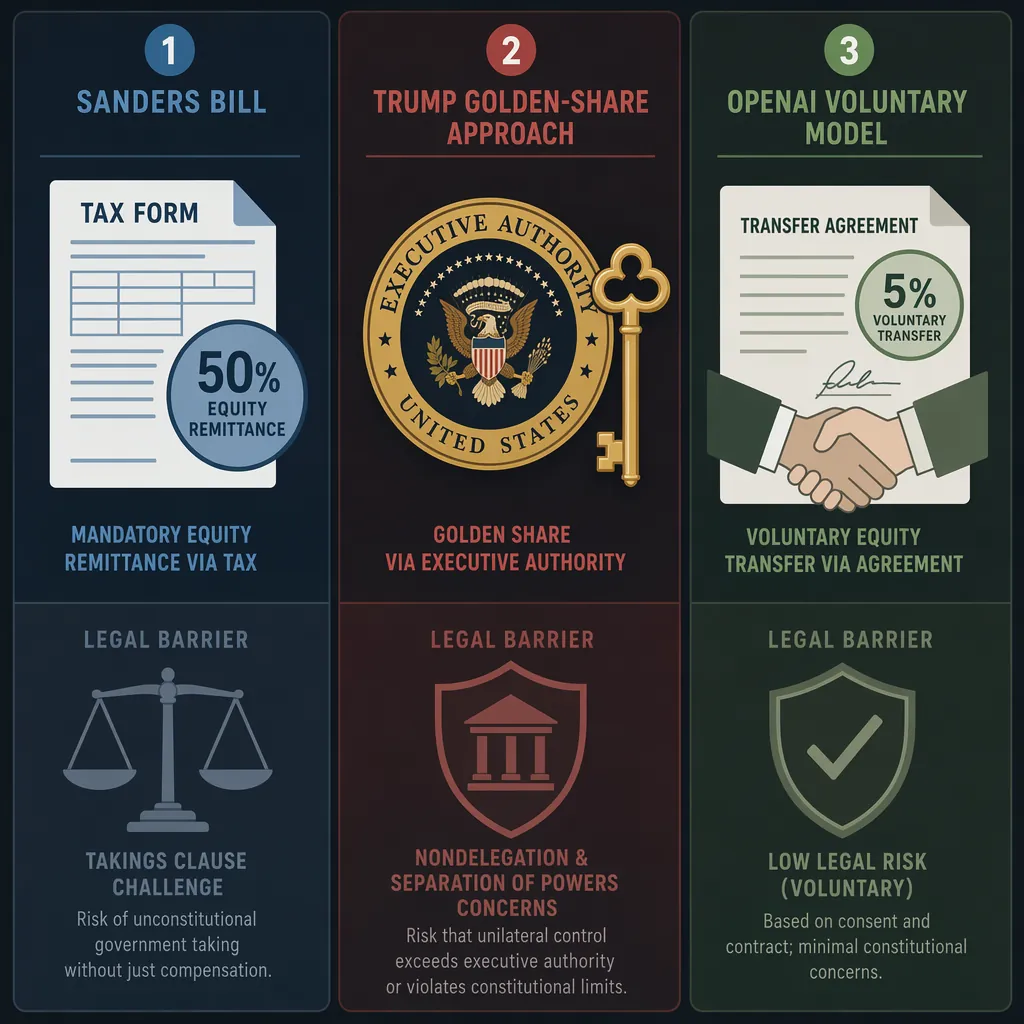
| Plan | Ownership Mechanism | Primary Legal Character | Likely Constitutional Pressure Point |
|---|---|---|---|
| Sanders American AI Sovereign Wealth Fund Act | One-time 50% remittance payable in equity by covered AI companies with more than $200 million in gross receipts | Excise-tax/equity-remittance statute | Takings Clause, trade-secret/property analogies, nondelegation and structural-separation concerns |
| Trump golden-share or stake-acquisition approach | Executive-branch acquisition or retention of ownership rights in strategically important companies | Executive leverage through transaction terms, procurement, merger review, or industrial-policy conditions | Lack of enabling legislation, due process, unconstitutional coercion, and agency authority limits |
| OpenAI voluntary 5% offer | Company-initiated contractual transfer of equity to the federal government | Voluntary private ordering unless linked to government favor or restraint | Unconstitutional conditions if approval, enforcement peace, or government access is conditioned on the transfer |

The Sanders Bill Turns a Tax Idea Into a Permanent Governance Problem
The Sanders proposal deserves the most careful treatment because it is the most law-like of the three and, for that reason, the easiest to challenge on a developed record. Public descriptions of the American AI Sovereign Wealth Fund Act say it would require covered AI companies with more than $200 million in gross receipts to make a one-time remittance equal to 50% of their stock, payable in equity, into a federal sovereign wealth fund.[3][4] Sanders’ office described the fund as potentially reaching an estimated $7 trillion, administered by a seven-member Independent Commission, with a statutory bar on selling the shares.[3]
One caveat should sit close to the analysis: the full text of S. 4825 could not be directly reviewed from the available materials. The operative details here come from Sanders’ press release, Roll Call, and available secondary reporting. That is enough to analyze the proposal’s public architecture, but not enough to resolve every drafting question.
If Congress enacted a clear equity-remittance statute, the first government argument would be straightforward: this is a tax, not a taking. Congress has broad taxing power, and a tax can be painful without becoming unconstitutional. But the remittance described here is not simply a cash assessment measured by company value. It takes voting and economic incidents of ownership from existing shareholders and places them into a permanent federal vehicle that cannot sell. That design gives challengers a cleaner property theory than a conventional excess-profits tax would.
The no-sale bar matters. If the federal government receives stock and can never divest, the obligation is not merely fiscal. It creates an enduring governance block inside the capitalization table. Counsel would need to model not only dilution but also voting rights, information rights, conflicts in later financing, fiduciary complications, and whether the federal holder has statutory duties different from an ordinary investor. A sovereign wealth fund that cannot sell is not just a revenue device; it is a permanent participant in corporate governance.
That is where Takings Clause analysis becomes uncomfortable. A statutory demand for stock can be framed as compelled transfer of identifiable property. The government will answer that taxes have always taken private value for public use, and that Congress may choose the form of payment. Companies and shareholders will answer that stock is not a neutral payment medium when it carries governance power, residual upside, and corporate-control implications. The harder the statute leans into ownership rather than revenue, the less persuasive the “it is only a tax” label becomes.
The proposal also pulls trade-secret doctrine into the frame, not because it necessarily requires source-code disclosure, but because AI-company value is heavily tied to nonpublic technical assets, training methods, weights, data practices, infrastructure arrangements, and commercialization plans. A federal equity holder may seek information as an owner. If statutory governance rights force disclosure or alter control over trade-secret-dependent assets, takings arguments will not stay confined to shares.
The live xAI v. Bonta litigation is relevant for that reason, but only with discipline. The challenge concerns California AB 2013 and whether disclosure mandates for AI training data can constitute uncompensated takings of trade secrets. The case was dismissed at the preliminary-injunction stage on March 4, 2026, and the Ninth Circuit appeal is pending as Case No. 26-1591; an amicus brief from the Knight First Amendment Institute was filed on July 22, 2026.[5][6][7] That posture is not a merits ruling that settles the issue for AI ownership statutes.
For companies tracking California AI disclosure duties, the same boundary matters in ordinary compliance work: AB 2013 may affect what firms disclose, but a preliminary dismissal in xAI v. Bonta does not yet give boards a stable national rule. The related state-law compliance map is discussed in Which State AI Laws Affect Law Firms in 2026?.
Philip Morris v. Reilly is the sharper precedent, but it should not be over-read. Lawfare’s 2026 discussion identifies it as the only appellate decision invalidating an entire statute on trade-secret takings grounds, and also emphasizes that the First Circuit’s reasoning was fractured.[5] Its value is not that it gives AI companies a universal answer. Its value is narrower: an appellate court has treated compelled exposure of trade-secret value as a constitutional property problem serious enough to invalidate a statute.
The structural concern is separate. A seven-member Independent Commission controlling a massive, non-divestable portfolio of AI-company stock would raise questions about appointment, removal, presidential control, fiduciary duties, and insulation from ordinary political accountability. The issue is not whether Congress may create funds or commissions. It is whether this particular body would exercise ownership power, policy power, and market power in a way that Congress has not cabined with sufficient process and review.
A clean statute with compensation rules, review rights, administrative procedures, conflict standards, and judicial-review provisions would be legally different from a blunt remittance command. The public descriptions, however, put the most constitutionally expensive design choices up front: a 50% equity transfer, a broad gross-receipts trigger, a very large fund estimate, independent governance, and a no-sale command. That is why this pathway carries the highest litigation risk.
The legislative architecture also overlaps with broader sovereign-wealth and redistribution proposals discussed in Legal Implications of AI Universal Basic Income Proposals, but the equity-remittance feature makes the Sanders AI fund a more direct corporate-control problem than many cash-funded models.
The Trump Golden-Share Path Depends on Authority Before It Reaches Merits
The Trump administration’s reported golden-share and stake-acquisition approach is legally different because it does not begin with a proposed tax statute. It begins with executive leverage. R Street’s July 2026 analysis described federal golden-share or ownership stakes in at least a dozen companies, including U.S. Steel and Intel, as evidence of an administration willing to use equity rights as an industrial-policy tool.[8]
That fact does not prove an AI nationalization plan is lawful or unlawful. It proves something more operationally important: government ownership leverage has moved from theoretical argument into transaction architecture. A company may encounter it in a merger condition, a financing arrangement, a procurement negotiation, a national-security review, or an informal demand framed as necessary for future cooperation.
The first question is statutory authority. Which statute authorizes the government to acquire the stake, hold it, vote it, impose transfer restrictions, appoint observers, block transactions, or demand information? A procurement statute may authorize contract terms. A national-security review statute may authorize mitigation. A rescue-financing statute may authorize warrants or equity. None of those propositions automatically authorizes a general executive practice of taking strategic stakes in AI companies.
Process follows authority. If the government obtains a stake through a negotiated agreement, the record will matter: what was requested, what alternatives existed, what agency had jurisdiction, whether conditions were tied to statutory findings, and whether the company received notice and an opportunity to contest the demand. The same term sheet can look consensual in a press release and coercive in a board file if the surrounding communications show that refusal meant blocked approval, lost contracts, or intensified enforcement.
That is the boardroom problem with executive improvisation. The government may never say “give us equity or else.” Instead, the sequence may do the work: a pending approval, an unresolved investigation, a politically salient technology, and a proposed ownership concession described as voluntary. Courts know how to look at coercion in some contexts, but companies often must decide before a court record exists.
The historical golden-share comparators are useful as governance warnings, not constitutional authorities. R Street points to Deutsche Telekom’s broadband stagnation, Airbus A380 political interference around job cuts, and Renault’s experience under the Florange Law as examples of government ownership or control rights affecting business governance.[8] Those examples come from different legal systems and cannot decide U.S. constitutional questions. They do, however, show why a “minor” golden share can become major when it carries vetoes, political signaling power, or pressure over employment and investment decisions.
For AI infrastructure suppliers, that governance risk is not abstract. A golden share could affect data-center siting, export decisions, model-access policies, cloud partnerships, chip allocation, safety disclosures, and acquisition strategy. The legal exposure does not stop with the company that signs the agreement. Suppliers, lenders, minority investors, and strategic partners may all need covenants addressing government consent rights and information flow.
This is also where securities and competition risk meet public law. A government stake can alter market expectations, financing costs, and competitive access to regulated advantages. For semiconductor and AI-infrastructure companies already facing overlapping export-control, procurement, and competition constraints, the regulatory-front analysis in How AI Regulation Creates a New Risk Category for Nvidia Stock is adjacent to the ownership question.
The Trump-style pathway is therefore less vulnerable to one clean facial attack than the Sanders bill, but more vulnerable to authority and process challenges transaction by transaction. If Congress clearly authorizes a stake program, defines eligible companies, states public purposes, funds acquisitions, and supplies review, the legal footing improves. If ownership appears as an executive condition without a statutory home, the challenge writes itself.
OpenAI’s 5% Offer Is Safest Only While It Stays Voluntary
OpenAI’s reported July 2, 2026 proposal to offer the federal government a voluntary 5% equity stake belongs in a separate category.[9] On its face, a company may decide that federal ownership is strategically useful: it may align incentives, reassure policymakers, reduce political hostility, or signal that the company accepts public obligations. A voluntary transfer is not a taking merely because the counterparty is the United States.
The legal risk changes when voluntariness becomes contaminated. If the transfer is explicitly or implicitly tied to regulatory approval, enforcement restraint, procurement access, national-security clearance, or future licensing, counsel has to analyze unconstitutional conditions. The government generally cannot condition a discretionary benefit on surrender of a constitutional right in a way that would be impermissible if imposed directly.
The practical record will matter more than the public label. Board minutes, agency meeting notes, side letters, diligence questions, and timing can all show whether the company initiated a strategic offer or responded to state pressure. A clean voluntary file should identify the business rationale, alternatives considered, independent valuation, governance terms, and the absence of linkage to pending approvals or enforcement matters.
This model is therefore the least exposed of the three, but not because 5% is legally magic. It is safer because contract law and corporate law can handle voluntary transfers. It becomes harder when the federal government receives equity in the shadow of unresolved regulatory power.
What Counsel Should Test Before Calling It Nationalization
The useful risk analysis starts by refusing the umbrella term. “Nationalization” describes the political anxiety, not the legal pathway. A compelled statutory remittance, a transaction-specific golden share, and a voluntary equity offer should be put in different columns before anyone forecasts litigation outcomes.
- Identify the actor: Congress, an agency, the White House, a procurement office, CFIUS-style reviewers, or the company itself.
- Identify the instrument: statute, regulation, contract, merger condition, procurement term, enforcement settlement, or informal demand.
- Identify the property: shares, voting rights, warrants, board rights, information rights, vetoes, trade secrets, or access to nonpublic technical systems.
- Identify the choice set: whether refusal leaves a genuine alternative or predictably triggers denial, investigation, exclusion, or loss of federal business.
- Identify the review path: administrative record, judicial review, compensation mechanism, valuation dispute process, and remedies.
On the current public record, the Sanders bill is the most constitutionally vulnerable because it combines a massive equity transfer with permanent federal ownership, independent administration, and unresolved property implications. The Trump golden-share approach is most exposed on statutory authority and due process, especially if ownership leverage appears without clear congressional authorization. The OpenAI model is safest only while the record supports genuine voluntariness.
References
- Palantir CEO Alex Karp Warns AI Companies May Be Nationalized Within Two Years, Benzinga, June 5, 2026.
- Palantir CEO Warns AI Companies Could Be Nationalized, TNW/Gizmodo, June 10, 2026.
- Sanders Introduces American AI Sovereign Wealth Fund Act, Office of Senator Bernie Sanders, 2026.
- Sanders pitches sovereign wealth fund built from AI company stock, Roll Call, June 18, 2026.
- AI Training Data Transparency and Trade Secret Takings, Lawfare, 2026.
- xAI v. Bonta preliminary injunction dismissal coverage, Fisher Phillips, March 2026.
- Brief of Amicus Curiae Knight First Amendment Institute at Columbia University in xAI v. Bonta, Knight First Amendment Institute at Columbia University, July 22, 2026.
- Golden shares are bad industrial policy, R Street Institute, July 2, 2026.
- OpenAI voluntary 5% equity proposal reporting, Thomson Reuters, July 2, 2026.
Related records
Tool profile
How Meta's AI Spending Reshapes Law Firm ProfitabilityGoverning regulation
Browse the obligations tracker →Preventive workflow
Browse verification workflows →
Report a correction or tip
Spotted an outdated figure, a misstated fact, or a ruling this case record should reflect? Public comments are disabled for this content given the professional cost of a misreported case outcome, penalty amount, or rule text — use the structured correction channel instead.
Report a correction or tip for this record →