
Legal Implications of AI Universal Basic Income Proposals
No federal AI-linked universal basic income bill has passed as of mid-2026, but pilot programs, state causation-based payment schemes, and sovereign wealth fund proposals are rapidly building a legislative architecture that legal professionals must understand before compliance obligations crystallize.
Lex Machina Review is an independent risk-tracking and reference resource. Nothing on this site is legal advice, and using it does not create an attorney-client relationship. Every record is reviewed against primary sources but may not reflect the most current status of a matter — always verify directly against the cited court order, rule text, or a licensed attorney before relying on it.
Companion explanation — secondary to the source document above
The useful starting point for analyzing the legal implications of AI-linked universal basic income proposals is still a negative one: as of Q3 2026, no federal law has created an AI-linked universal basic income entitlement in the United States. That does not make the subject legally idle. It means the relevant work is happening in bills, pilot designs, state unemployment proposals, professional licensing restrictions, and funding models that are beginning to define what a later compliance regime would have to administer.
The pressure behind those proposals is no longer only theoretical. Challenger, Gray & Christmas data reported through BIEN attributed 38,579 of 97,006 May 2026 job cuts to AI, or 40% of that month’s cuts, up from 7% in January 2026. Year to date, AI-attributed cuts reached 87,714, already above the 54,836 reported for all of 2025.[1] Those figures do not prove that every displaced worker can be cleanly classified as AI-displaced for legal purposes. They do explain why legislators are starting to draft around a category that agencies may soon be asked to verify.

The Status Question Comes First
For legal teams, the difference between an enacted benefit, an introduced bill, a stalled pilot, and a failed state proposal is not housekeeping. It determines whether there is a present duty, a monitorable legislative risk, or only a policy signal. The current landscape contains all three signals except the first one.
| Vehicle | Status described in available materials | Legal significance |
|---|---|---|
| Federal AI-linked UBI law | No enacted federal law as of Q3 2026 | No present federal entitlement or compliance duty created by such a law |
| California AB 3058 | Failed 2024 proposal | Shows how a state could tie payments to an agency finding that unemployment was caused by automation or AI |
| Guaranteed Income Pilot Program Act, H.R. 5830 | Introduced in October 2025; stalled in Ways and Means according to secondary reporting | Uses a pilot structure rather than a nationwide entitlement |
| American A.I. Sovereign Wealth Fund Act | Introduced by Senator Bernie Sanders in June 2026 | Moves from benefit eligibility toward public ownership, fund governance, and constitutional questions |
| State AI licensing and professional restrictions | Evolving across 2025 and 2026 | Regulates which work AI may perform or replace before any broad income-support framework is enacted |
That status map is deliberately unglamorous. A prediction that skips it can easily treat political momentum as legal obligation, or treat a failed bill as if it had quietly become an administrative program. Neither error is harmless when a client asks whether a reporting duty, payroll exposure, benefit classification issue, or agency audit risk exists today.
California AB 3058 Turned AI Displacement Into an Agency Question
California AB 3058 is the most legally revealing proposal in the current mix precisely because it failed. The 2024 bill would have required the Employment Development Department to determine whether an individual was “unemployed because of automation or artificial intelligence.”[2] That phrase looks simple until it is placed inside an unemployment system.

A causation-based payment scheme has to decide what evidence counts. A termination notice saying “restructuring” may hide a software substitution. A reduction in force may combine declining demand, offshoring, automation, and new AI tools. A worker may be laid off after a company adopts AI, but not necessarily because of that adoption. An employer may resist producing implementation records if those records reveal trade secrets, workforce planning, or productivity assumptions. The agency must still make a decision that can survive review.
That is the legal hinge. If the benefit depends on being unemployed because of AI, then the state needs a standard of proof, an evidentiary record, an employer-response process, appeal rights, and some theory of mixed causation. It also needs a practical answer to who bears the burden when the worker has limited access to the employer’s internal deployment history.
The existing unemployment insurance system already makes difficult eligibility determinations, but this one is different in kind. Traditional disputes often ask whether a worker left voluntarily, was discharged for misconduct, earned too much during a claim week, or remained available for work. AB 3058’s formulation would have asked the agency to classify the economic cause of job loss by reference to a technology used inside the employer’s business. That pushes the agency toward records and expertise it may not routinely collect.
A legally mature version of this model would need more than the label “AI displacement.” It would need to say whether replacement by automation must be the primary cause, a substantial contributing factor, or merely one factor among others. It would need to address whether the relevant AI use must occur at the claimant’s employer, within the employer’s supply chain, or across an industry. Without those choices, “because of automation or artificial intelligence” becomes an invitation to inconsistent adjudication.
The Federal Pilot Model Avoids Some Questions and Creates Others
H.R. 5830, the Guaranteed Income Pilot Program Act, occupies a different legal lane. According to Forbes and Tax Notes reporting, the bill was introduced in October 2025 with 11 Democratic sponsors, would create guaranteed-income payments pegged to fair market rent for a two-bedroom home in the recipient’s ZIP code, and had stalled in the House Ways and Means Committee.[3] Because the available details are from secondary reporting rather than a fully reviewed bill record here, the safest use of H.R. 5830 is as a design signal, not as evidence of imminent enactment.
A pilot model can sidestep the hardest causation problem by selecting recipients through income, location, household status, or other eligibility criteria rather than asking whether AI caused a particular job loss. That makes administration easier in one respect. It also changes the legal theory. The benefit is no longer a remedy for AI displacement in the direct sense; it is an income-support experiment operating against a background of labor-market disruption.
Pegging payments to local fair market rent also matters. It ties benefit levels to housing costs rather than to prior wages, tax contributions, job-loss cause, or a national flat amount. That may be defensible as anti-poverty design, but it is not the same as compensation for technology-driven displacement. A worker in a high-rent ZIP code and a worker in a lower-rent ZIP code would be treated differently even if the same AI system eliminated the same job function.
That distinction is not a criticism of the pilot. It is a warning against treating every guaranteed-income proposal as an AI-displacement remedy. Some proposals respond to AI politically while using eligibility rules that do not require any AI-causation finding at all.
Two Architecture Models Are Emerging
The most important split is not between supporters and opponents of UBI. It is between benefit systems that adjudicate worker status and funding systems that distribute returns from capital, taxes, or public ownership. They create different records, different disputes, and different constitutional pressure points.
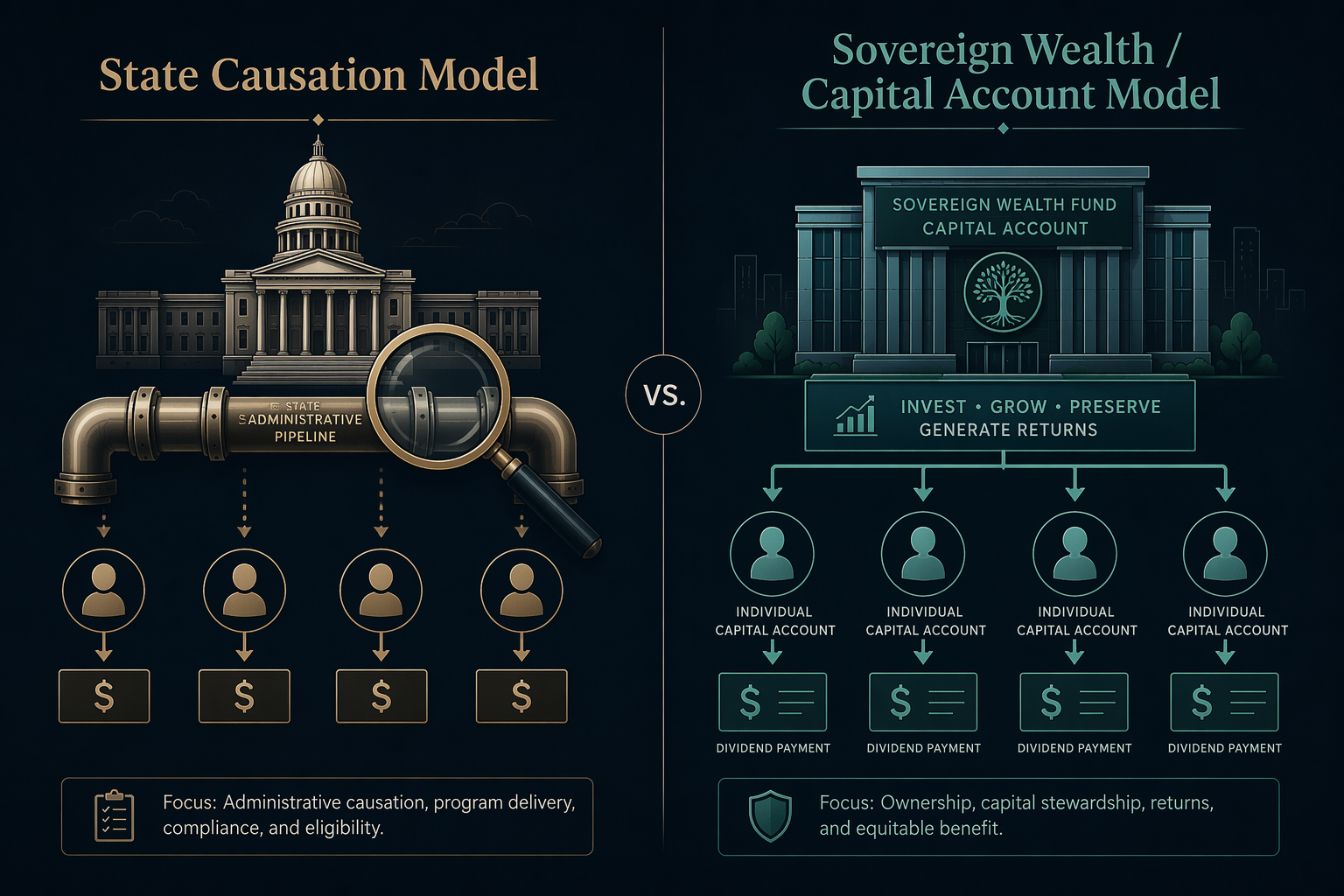
| Model | Core legal act | Likely dispute |
|---|---|---|
| State causation-based payments | Agency decides whether unemployment was caused by automation or AI | Evidence, employer records, mixed causation, appeals, administrative capacity |
| Federal guaranteed-income pilot | Government selects participants and payment formula for a limited program | Eligibility criteria, tax treatment, benefit coordination, program evaluation |
| Sovereign wealth fund | Government captures or owns part of AI-generated value and distributes proceeds | Tax authority, takings arguments, governance, appointments and removal questions |
| Capital accounts | Government funds accounts for individuals rather than making immediate UBI payments | Account ownership, vesting, permissible investments, distribution timing |
The State Causation Model
A state causation model is closest to traditional benefits administration, but it is not necessarily the easiest to operate. It asks an agency to sort claimants into AI-caused and non-AI-caused unemployment categories. That classification could affect payment eligibility, benefit amount, program priority, employer assessments, reporting duties, or future workforce grants, depending on how a legislature writes the statute.
Its attraction is political and administrative visibility. Legislators can say the program is targeted to workers displaced by automation rather than a broad income floor. Its weakness is the evidentiary file. Every targeted dollar depends on an agency’s ability to distinguish a technology-caused layoff from a layoff that merely occurred in a company using technology.
The Sovereign Wealth Fund Model
Senator Bernie Sanders’s American A.I. Sovereign Wealth Fund Act takes the argument somewhere else. The Senate HELP Committee described the June 2026 proposal as imposing a one-time 50% equity tax on frontier AI companies to create an estimated $7 trillion sovereign wealth fund.[4] That is not merely a benefits bill with a new funding source. It is a public-ownership and governance proposal.
The legal questions follow the structure. If the government takes equity in frontier AI companies, who votes the shares? Who appoints the fund’s board or managers? What fiduciary duties govern the fund? How are conflicts handled if the government is both regulator and owner? What happens when public investment goals collide with company governance, national security, competition policy, or shareholder rights?
The separation-of-powers questions are open, not settled. The research materials identify post-Humphrey’s Executor concerns after a 2026 Supreme Court ruling on removal of independent agency leaders, particularly if a fund is governed by officials insulated from presidential removal.[5] That does not mean the Sanders model is unconstitutional. It means the governance form would matter as much as the payout formula.
The constitutional conversation should not be reduced to a slogan about taxing robots or sharing AI wealth. A sovereign wealth structure forces counsel to examine taxing power, takings arguments, nondelegation claims, appointments, removal, board authority, investment mandates, and the government’s role as market participant. None of those questions is answered by saying that AI productivity gains should be broadly shared.
Capital Accounts Are Not Classic UBI
The same architecture discussion should also distinguish capital-account alternatives from recurring cash-payment models. The Atlantic’s discussion of “Trump Accounts” frames them as a conservative alternative to universal basic income: public support would flow into individual investment-style accounts rather than unconditional monthly payments.[5] That design may respond to similar anxieties about economic security, but it creates different legal questions around ownership, vesting, investment control, and distribution timing.
That difference matters for compliance. A monthly cash benefit looks like an income-support program that must be coordinated with taxes and other benefits. An account-based model looks more like a savings, trust, or investment framework. The client questions would not be the same.
Pilot Evidence Is Useful, but It Does Not Settle the Legal Case
The OpenResearch study associated with Sam Altman is relevant because it gives lawmakers something more concrete than aspiration to cite. From 2020 to 2023, the study provided $1,000 per month to 1,000 low-income individuals. The reported results showed improvements in basic needs, but no significant improvement in employment quality, education, or health.[5]
That is a mixed record, and mixed is the legally useful word. A pilot can show that cash reduces some immediate hardship without proving that a national AI-linked entitlement is administratively feasible, fiscally sustainable, or properly targeted. It can also fail to improve some measured outcomes without proving that income support is ineffective in every context. The study should discipline legal analysis, not become a proxy for it.
States Are Also Deciding Which Work AI May Replace
Income-support proposals are not the only legal response to AI labor substitution. States are also moving upstream by restricting when AI may perform work that has traditionally required licensed human judgment. Straight Arrow News reported that a New York bill would bar AI chatbots from acting as licensed professionals and would include a private right of action; the same report described Illinois limits on AI mental health decisions without clinician oversight, a similar Nevada law, and Oregon suicide-safeguard requirements.[6]
Loeb & Loeb separately reported in March 2026 that states were continuing to advance AI laws despite federal opposition, underscoring how quickly state-level AI regulation was developing across employment, consumer, and professional settings.[7] The exact status of particular state bills can change quickly, so these measures should be treated as a moving legal field rather than a settled map.
For lawyers, the professional-licensing strand is not a side issue. If a state bars an AI system from acting as a licensed professional, it may reduce or reshape the category of work that can lawfully be automated. In legal services, the same concern appears in unauthorized-practice-of-law disputes, where the relevant question is not only whether AI produces a useful answer, but whether it is performing work reserved to a licensed lawyer. That risk is already visible in cases involving AI chatbots and UPL exposure, including the issues discussed in AI chatbot UPL liability cases.
This does not make professional licensing a UBI mechanism. It means the state may regulate substitution before it regulates compensation for substitution. A legislature can decide that AI may not replace a clinician, lawyer, or other licensed professional in certain functions, while separately considering whether workers displaced in other sectors should receive income support.
The Administrative Fault Lines to Track
The legal implications become clearer when the proposals are reduced to the decisions someone will have to make. A statute that announces payments is only the beginning. The operational law appears in the eligibility screen, the funding mechanism, the review process, and the records a regulated party must keep.
- Causation: whether AI must be the sole cause, primary cause, substantial factor, or background condition in a job loss.
- Evidence: whether agencies can require employer AI deployment records, restructuring documents, productivity analyses, vendor contracts, or workforce-planning materials.
- Review: whether claimants and employers receive notice, access to records, administrative appeal rights, and judicial review.
- Funding: whether payments come from general revenue, payroll-style assessments, AI-specific taxes, equity stakes, or account contributions.
- Coordination: whether payments affect unemployment insurance, disability benefits, tax credits, housing assistance, Medicaid eligibility, or state benefit programs.
- Preemption and state variation: whether federal pilots coexist with state AI-displacement programs and state professional-licensing restrictions.
These are not speculative details in the pejorative sense. They are the details that determine whether a proposal can be administered without producing arbitrary classifications, unmanageable discovery fights, or constitutional challenges before the first meaningful distribution cycle is complete.
What Legal Teams Should Watch Before Enactment
The right posture in Q3 2026 is not compliance implementation, because no federal AI-linked UBI law has passed. It is structured monitoring. The proposals are still early enough that counsel should resist treating them as settled obligations, but concrete enough that ignoring them will leave legal teams behind when bill text begins to harden.
- Bill status: whether a proposal is introduced, stalled, failed, amended, enacted, or converted into a pilot.
- Eligibility language: especially any phrase requiring a finding that unemployment was caused by automation, artificial intelligence, or technology adoption.
- Employer obligations: reporting duties, record-retention rules, agency information requests, and penalties for incomplete disclosures.
- Funding design: general appropriations, special taxes, equity transfers, public funds, or account-based structures.
- Governance and constitutional challenges: appointments, removal, government ownership, takings claims, and limits on delegated authority.
- State licensing limits: professional rules that may restrict AI substitution before any income-support remedy applies.
AI-linked universal basic income has not become federal law, and the available evidence does not justify a prediction that it will. But the legal architecture is visible: state causation findings, federal pilot formulas, sovereign wealth fund proposals, capital-account alternatives, and state licensing limits are forming the questions that agencies, employers, and courts would have to answer if any of these ideas move from proposal to program.
References
- AI Is Speeding Up the Deadline for Basic Income, BIEN, June 2026.
- AB-3058 Employment: automation and artificial intelligence, California Legislature, 2024.
- Universal Basic Income, AI, And Tax Policy, Forbes / Tax Notes, June 16, 2026.
- NEWS: Sanders Introduces Legislation to Create $7 Trillion AI Sovereign Wealth Fund, Senate HELP Committee, June 2026.
- Universal Basic Capital, The Atlantic, July 2026.
- States look to tell AI what jobs it can’t take as UBI calls get louder, Straight Arrow News.
- States Forging Ahead With New AI Laws Despite Federal Opposition, Loeb & Loeb, March 2026.
Related records
Tool profile
Browse tool evaluations →Governing regulation
Browse the obligations tracker →Preventive workflow
Browse verification workflows →
Report a correction or tip
Spotted an outdated figure, a misstated fact, or a ruling this case record should reflect? Public comments are disabled for this content given the professional cost of a misreported case outcome, penalty amount, or rule text — use the structured correction channel instead.
Report a correction or tip for this record →