
How AI Risk Profiling Caught Italy's Cocaine Banana Shipment
This article examines how algorithmic risk analysis enabled the Guardia di Finanza and Italian Customs to intercept 770 kg of cocaine concealed in a banana shipment at Vado Ligure in July 2026, and explores the parallels—and governance caveats—for legal professionals adopting AI verification tools.
- Jurisdiction
- Italy
- Court
- Italian Customs Agency (ADM)
- AI tool named
- ADM AI risk analysis system
- Ruling date
- Jul 1, 2026
- Source document
- View primary court order ↗
- Last verified
- Jul 25, 2026
Lex Machina Review is an independent risk-tracking and reference resource. Nothing on this site is legal advice, and using it does not create an attorney-client relationship. Every record is reviewed against primary sources but may not reflect the most current status of a matter — always verify directly against the cited court order, rule text, or a licensed attorney before relying on it.
Companion explanation — secondary to the source document above
The useful part of the Vado Ligure cocaine case begins before anyone opens the container. A banana shipment from Ecuador reaches the Ligurian port system; Guardia di Finanza and Italian Customs do not treat it as just another refrigerated box in a long queue. It is selected after what Italian reporting, reflecting official enforcement language, describes as “capillary analysis and monitoring” of commercial routes between South America and Europe.[1]
That distinction matters. A random stop can produce a lucky seizure, but it does not tell lawyers, compliance teams, or public agencies much about repeatable verification. A documented risk profile does. In this case, the reported result was more than 770 kilograms of cocaine, divided into about 650 blocks, hidden in a banana shipment at Vado Ligure and valued by authorities at roughly €250 million.[1] CBS News separately reported the same broad seizure facts, including the cocaine concealed in bananas, the Italian agencies involved, and the July 2026 timing.[2]

The search phrase around this story often includes “2025,” but the documented banana-shipment case at Vado Ligure is a July 2026 event. A separate reference to a large Gioia Tauro seizure in April 2025 would need its own verification chain before it could be folded into this account. For the Vado Ligure case, the public record available as of July 25, 2026, supports a narrower statement: the seizure has been publicly reported and attributed to joint action by Guardia di Finanza and Italian Customs, but no accessible court docket, indictment, or confirmed arrest status has been made public in the materials reviewed.
The Alert Came From a Route, Not a Hunch
“Capillary analysis and monitoring” is not a magic phrase. In operational terms, it points to a familiar sequence: build a view of routes, carriers, origins, commodity types, historical patterns, and anomalies; assign attention to what departs from expected behavior; then put a human officer in front of a shorter list. The container is still opened by people. The decision to inspect still carries consequences. The system’s contribution is that it narrows the haystack before the expensive, intrusive act begins.
The Vado Ligure facts are well suited to that kind of reading because the concealment method was ordinary enough to be operationally useful. Bananas and plantains move in legitimate volume. South America-to-Europe routes are commercially normal. A system that flags every refrigerated fruit shipment is not intelligence; it is noise. The value comes from combining route-level monitoring with a documented escalation path that makes one shipment more inspectable than the many others beside it.
The broader Ligurian context supports that route-level emphasis without turning the point into a cartel chronology. TrasportoEuropa reported that, on July 2, 2026, authorities seized 340 kilograms of cocaine hidden in plantains from Colombia at the same port area, with an estimated value of €120 million.[3] The same trade-publication account also placed the later banana seizure in the Vado Ligure maritime setting, where customs control is not a one-off event but part of continuing port surveillance.[3]
There is also a public-policy backdrop. Chiara Colosimo, president of Italy’s parliamentary Anti-Mafia Commission, was reported as saying on July 16, 2026, that more than three tonnes of cocaine had been seized along Italian coasts in six months and that Liguria was “on the front line” of mafia-related trafficking.[3] That does not prove anything about the specific banana container. It does explain why route monitoring in Liguria would attract institutional attention.
What Risk Profiling Actually Does
The public sources do not disclose the model, the variables, the scoring rules, or the inspection threshold used in the Vado Ligure seizure. That absence is not a small footnote. Without those details, no one outside the agencies can say that a specific algorithm “caught” the cocaine. The supported claim is more disciplined: the shipment was detected through risk analysis and monitoring of South America-Europe commercial routes, and the inspection was carried out by Guardia di Finanza together with Italian Customs.[1]
That is still a significant claim. Risk profiling changes the work queue. It tells officers which containers deserve scarce inspection capacity. It may correlate origin, declared cargo, routing history, importer behavior, port intelligence, prior seizures, documentation anomalies, or other indicators; the public record here does not say which of those mattered. The important point is the shape of the workflow: signal first, inspection second, seizure only if the physical facts confirm the alert.
| Stage | Customs version | Verification lesson |
|---|---|---|
| Input | Trade-route, cargo, and monitoring data | A tool is only as reliable as the sources it is allowed to read |
| Flag | A shipment is selected for attention | An AI result should change priority, not end review |
| Human action | Officers inspect the container | A reviewer checks the underlying record |
| Outcome | Contraband is confirmed or the alert fails | The system needs feedback so future flags can be audited |
This is where enforcement workflows become more useful than the usual “AI found drugs” shorthand. A good alert does not eliminate judgment; it concentrates judgment. Someone still has to decide whether the basis for escalation is strong enough. Someone still bears the cost of delay, search, false positives, and missed signals. In customs, those costs fall on officers, traders, prosecutors, and defendants. In legal verification, they fall on lawyers, clients, courts, and whoever later has to explain why a cited authority did not say what the tool said it said.
ADM’s AI Plan Makes This More Than a One-Day Seizure
The Vado Ligure seizure sits inside a larger institutional direction at the Italian Customs and Monopolies Agency, known as ADM. Il Sole 24 Ore reported that ADM is pursuing a three-year artificial-intelligence deployment plan for 2026 to 2028, aimed at strengthening controls against fraud and illicit flows.[4] The same report described a recruitment drive for engineers, mathematicians, and physicists, which is the kind of staffing detail that makes an AI strategy look less like a procurement slogan and more like an operating model.[4]
ADM Director Roberto Alesse connected the strategy to “advanced data analysis techniques for identifying potential threats and preventing fraud,” according to Il Sole 24 Ore.[4] That phrasing is careful. It does not claim that AI proves guilt. It says the system helps identify potential threats and prevent fraud. In a regulated environment, that difference is not pedantic; it is the line between a triage tool and an adjudication machine.
ADM also said the deployment would be accompanied by “a gradual process of governance, oversight and accountability.”[4] That caveat deserves nearly as much attention as the seizure itself. The more an agency relies on algorithmic monitoring, the more it needs records showing what data entered the system, what rule or model produced the alert, who reviewed it, what action followed, and how errors are corrected. Otherwise, the public is asked to trust a black box at exactly the moment when enforcement power is becoming more scalable.
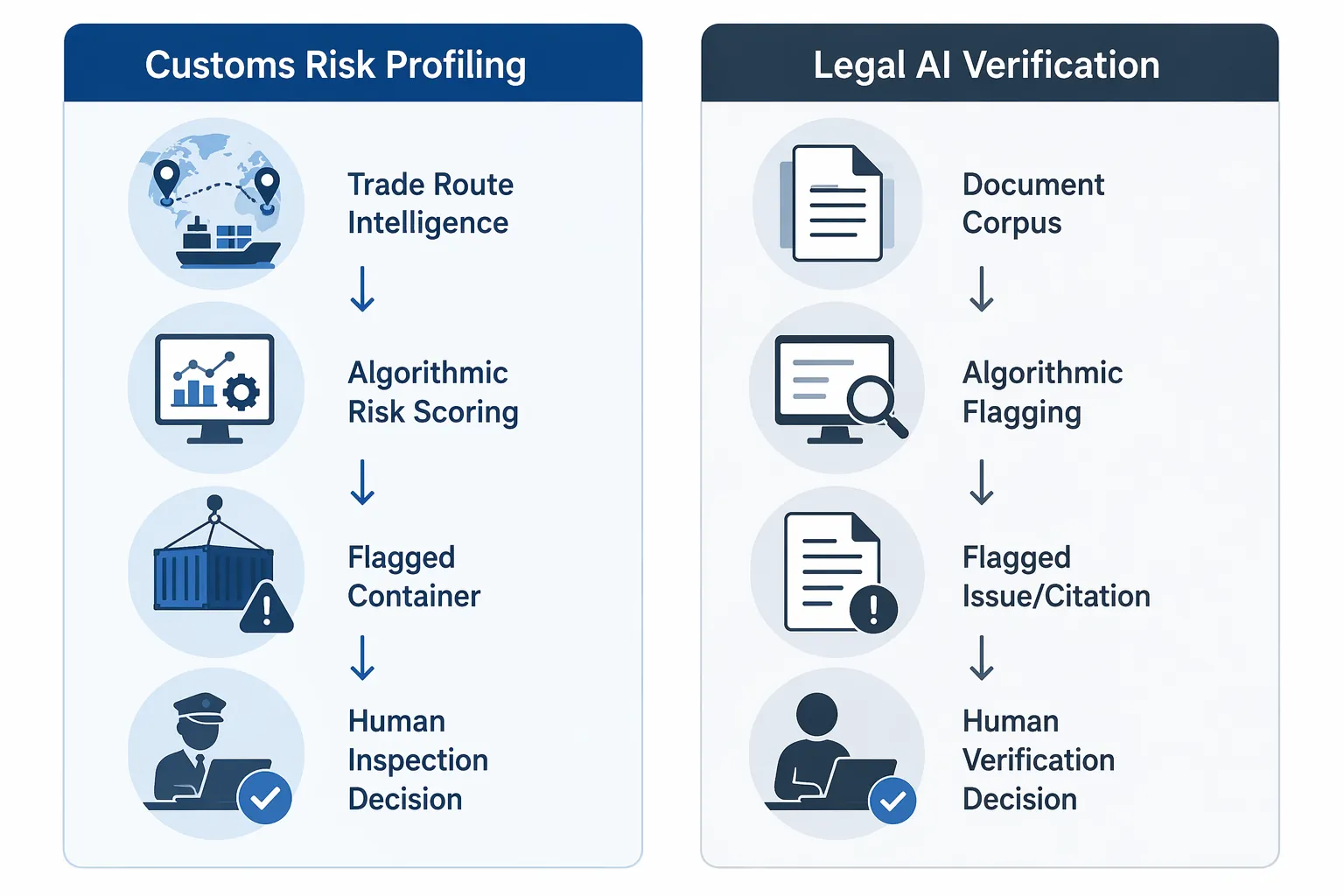
The Legal-AI Parallel Is Workflow, Not Drama
Legal AI verification tools are trying to solve a quieter version of the same queue problem. A litigation team may have thousands of documents, dozens of research threads, or a brief full of citations that need checking before filing. The tool’s first useful job is not to be brilliant. It is to rank, flag, cluster, and expose the items most likely to need human attention.
A customs officer does not need a system that says “bad container” without showing why the container moved up the queue. A lawyer does not need a verification tool that says “citation verified” without showing the source text, the proposition being checked, the jurisdictional fit, and any mismatch between the quoted language and the claimed rule. In both settings, the alert is only useful if the human can inspect the basis for it.
The analogy should not be stretched beyond its use. Drug interdiction, customs control, and legal citation verification operate under different laws, incentives, evidence standards, and harm models. But the governance question is recognizably shared: when a system compresses a large field of possibilities into a small set of recommended actions, the organization must be able to reconstruct how the compression happened.
What a legal team should be able to audit
- Inputs: which documents, cases, statutes, databases, and user instructions the tool used.
- Escalation rules: what causes a citation, clause, privilege call, or factual assertion to be flagged.
- Human review: who must approve the result before it reaches a client, court, regulator, or counterparty.
- Source verification: whether the reviewer can see the underlying authority rather than a generated paraphrase.
- Feedback: how corrected errors are logged, measured, and used to improve later review.
These are not abstract procurement preferences. They decide whether a firm can defend its reliance on the tool after a mistake. If an AI research assistant invents a case, misreads a holding, or treats dicta as controlling law, the failure is not only the model’s output. It is also the review design that allowed that output to travel too far without inspection.
A Good Flag Still Needs a Responsible Hand-Off
The Vado Ligure case is strong enough to support an operational lesson and not strong enough to support a technological victory lap. The available sources show a large July 2026 seizure, a banana shipment from Ecuador, joint action by Guardia di Finanza and Italian Customs, and detection through route analysis and monitoring.[1][2] They do not disclose the full investigative file, the scoring logic, the court posture, or the status of any suspects.
The practical lesson is not that AI caught a cocaine shipment. The better lesson is that risk tools become valuable when their inputs, escalation rules, human review points, source checks, and accountability obligations are visible enough to audit.
References
- Savona, new anti-drug operation by the Guardia di Finanza and Customs: 800 kilos of cocaine seized, Il Sole 24 Ore
- Cocaine hidden in banana shipment seized in Italy, CBS News
- Major cocaine seizure at the port of Vado Ligure, TrasportoEuropa
- Customs Agency to use artificial intelligence to combat cash smuggling, Il Sole 24 Ore
Related records
Tool profile
How Meta's AI Spending Reshapes Law Firm ProfitabilityGoverning regulation
Browse the obligations tracker →Preventive workflow
Browse verification workflows →
Report a correction or tip
Spotted an outdated figure, a misstated fact, or a ruling this case record should reflect? Public comments are disabled for this content given the professional cost of a misreported case outcome, penalty amount, or rule text — use the structured correction channel instead.
Report a correction or tip for this record →