
What AI search gets wrong about the Athens suitcase killing
AI research output on the Athens suitcase killing presents conflicting case dates, a formally corrected 'admitted killing' headline, and superseded leads as equally current. A primary-source check with a last-verified timestamp is what separates usable facts from model output on this live pre-trial case.
- Jurisdiction
- Greece
- Court
- Greek criminal courts
- AI tool named
- Unspecified AI search/summarization tool
- Ruling date
- Aug 3, 2026
- Source document
- View primary court order ↗
- Last verified
- Aug 3, 2026
Lex Machina Review is an independent risk-tracking and reference resource. Nothing on this site is legal advice, and using it does not create an attorney-client relationship. Every record is reviewed against primary sources but may not reflect the most current status of a matter — always verify directly against the cited court order, rule text, or a licensed attorney before relying on it.
Companion explanation — secondary to the source document above
Last verified: 3 Aug 2026 UTC. This article concerns a live pre-trial Greek criminal investigation and is not legal advice. For the confirmed-versus-reported case chronology, use the verified Risk Digest record: Elisabeth-Jane Ross Case Timeline, Day by Day. This companion piece is narrower: it looks at what happens when AI-assisted research output is asked to summarize the Athens suitcase killing while the record is still moving.
Suppose a lawyer types a query such as “Athens suitcase killing suspect phone evidence criminal case” into an AI search or summarization tool on 3 August. The answer may look orderly: a suspect, a body in a suitcase, dates, movements, a supposed admission, and an investigative timeline. The problem is not only that a model may invent. In this case, enough real reporting exists to create a more dangerous failure: corrected, conflicting, and superseded claims can be presented with the same confidence as verified ones.
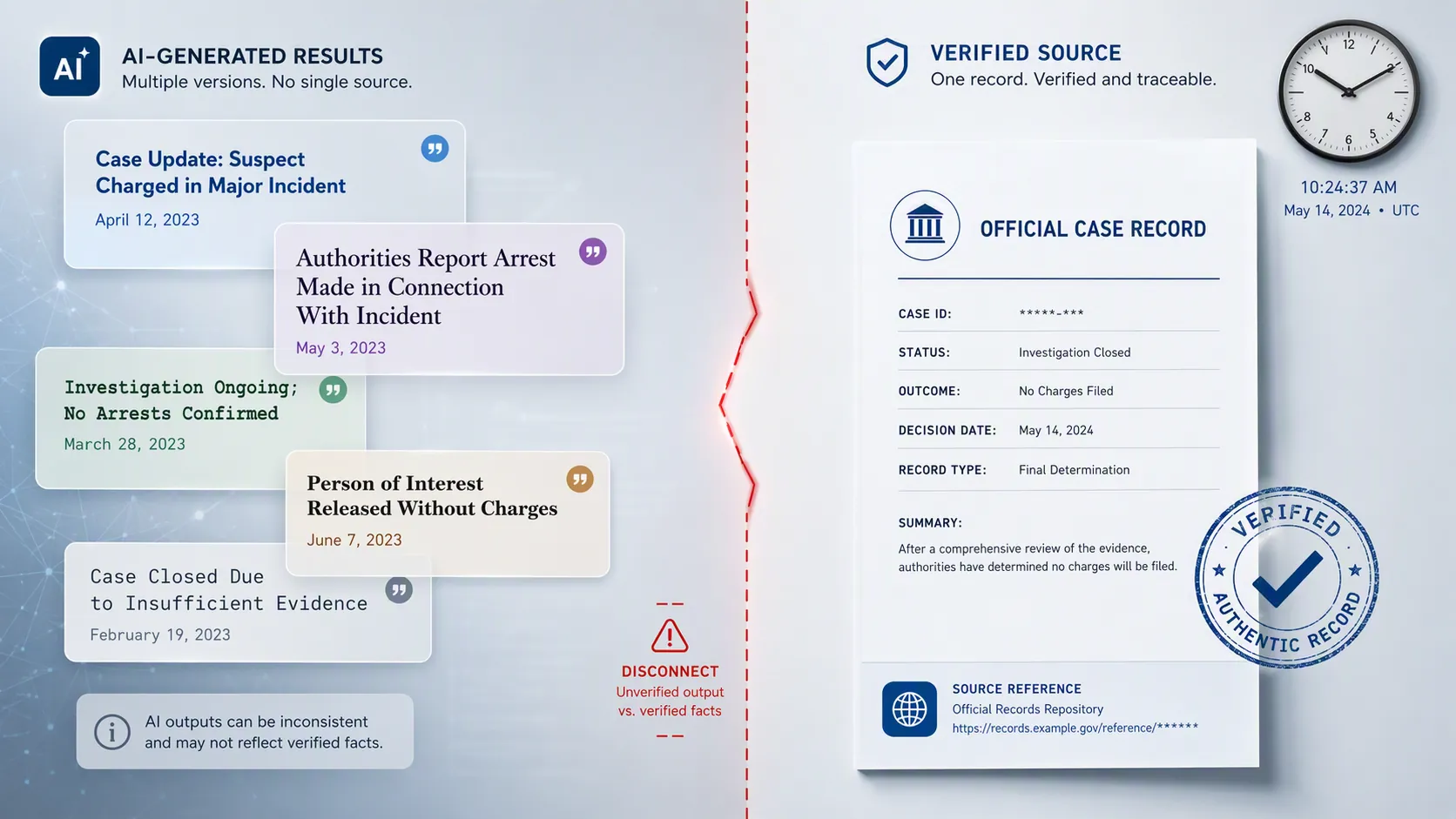
The first check is the fact-conflict table
A usable live-case note should not begin with a smooth narrative. It should begin with the facts most likely to be laundered into certainty. In the Athens suitcase killing coverage, three date-and-timing points need to be separated before any criminal-case summary is relied on.
| Fact area | Claim appearing in closer-to-primary reporting | Conflicting or stale variant in the coverage footprint | Status for legal research as of 3 Aug 2026 UTC |
|---|---|---|---|
| Arrival in Greece | 26 June arrival in Greece, attributed to a Hellenic Police statement in BBC/Yahoo and Guardian reporting. [1][2] | 29 June appears in other secondary coverage identified during review. | Use only with attribution: police-attributed reporting says 26 June. Do not merge the two dates or write a single unsupported arrival date. |
| Death window | Five to seven days before discovery appears in BBC/Yahoo reporting. [1] | About eight days appears in other coverage identified during review. | Treat as a reported estimate, not a settled pathology finding in this article. Do not convert a range into a precise date of death. |
| Keratsini exit date | 10 July exit from the Keratsini lodging is attributed to police-linked reporting. [1][2] | 15 July appears in other reporting identified during review. | Use the police-attributed date only with source and last-verified timestamp. Keep the conflict visible if briefing the matter. |
That table is not housekeeping. It is the difference between a research note and a story-shaped guess. If three AI summaries repeat 26 June, that repetition does not prove the date; it only tells the researcher which source trail to inspect. If one summary gives 29 June, the conflict does not make 26 June false. It means the date has a source status and should be carried with that status attached.
The same discipline applies to phone evidence. If a model mentions phone data, digital trails, location evidence, messages, or device analysis, the claim needs a source, a procedural status, and a last-verified time. A query that contains “phone evidence” is not permission to fill the gap with ordinary investigative assumptions.
The corrected headline is the central warning
The most legally consequential drift in the coverage is a verb. Yahoo’s BBC-sourced article now carries the headline “Man admits transporting Scottish woman's body in suitcase, Greek police say.” Its correction note states that the suspect admitted transporting the body, not the killing; the police language cited was that he had “confessed to his actions.” [1]
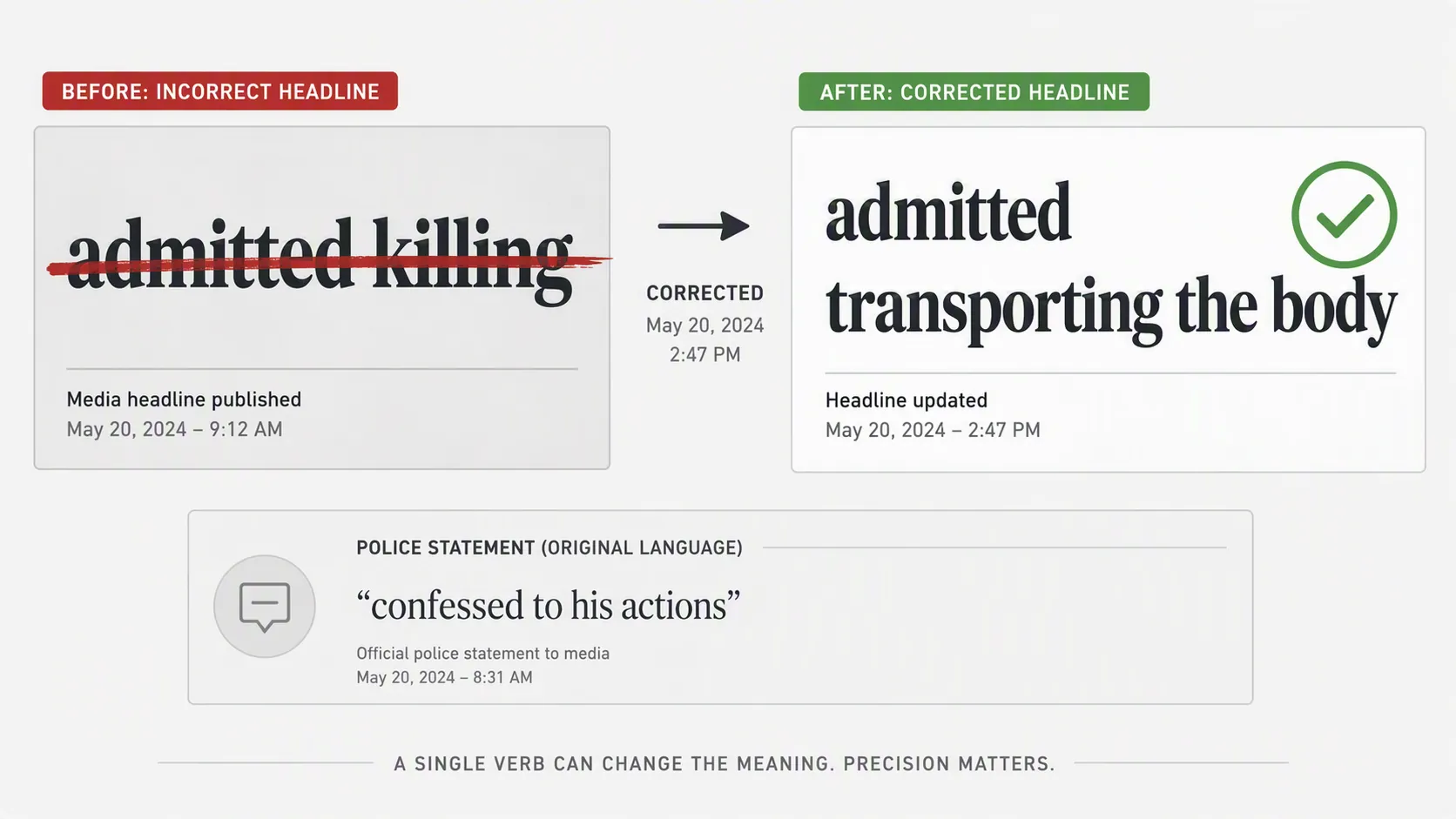
Those are not stylistic alternatives. “Admitted killing” reads as an admission to homicide. “Admitted transporting the body” is a narrower reported admission about conduct after death. “Confessed to his actions” is police-attributed wording that still needs the surrounding source language, translation context, and procedural posture before it can be used in a legal memo.
An AI tool can easily flatten all three into one sentence: the suspect confessed. That sentence is not safe. It removes the correction, changes the legal weight of the reported admission, and makes the police-linked phrasing sound like a settled court record. As of this article’s verification time, there was no basis here to treat a corrected “admitted killing” formulation as current fact.
This is the kind of error that matters more than a generic warning that models hallucinate. It is concrete, quotable, and sticky. A corrected headline can continue to circulate through search snippets, URL slugs, screenshots, social summaries, and model memory. Once it becomes compressed into “confessed,” the correction has to be actively reattached.
The “Markos” lead belongs in the superseded pile
Early reporting also produced a lead about police searching for a heavily tattooed man, with People citing The Times in a story framed around that search. [3] That item belongs in a live research file, but not as a current suspect description once later reporting changes the posture of the case.
On 2 August, the Guardian reported the arrest of a 26-year-old Afghan national in connection with the death, and DW separately reported the arrest over the death of a British woman found in a suitcase in Athens. [2][4] That does not mean every earlier detail about the search was fabricated. It means the early lead is no longer the top-line suspect frame.
A model that keeps both frames alive without labeling them can produce a briefing sentence that sounds thorough but is procedurally confused. “Police searched for Markos and arrested a 26-year-old Afghan national” may be chronologically possible as a sequence, but it is not a usable current suspect description unless the source chain explains how the lead was resolved.
Do not turn digital analysis into an AI-policing claim
The Guardian referred to digital analysis of video footage in the investigation. [2] That is not evidence that Greek police used AI tools. The AI issue in this article is about research and coverage risk: what an AI search product, summary tool, or social-news generator may do with the public record. It is not a claim about police technology in the investigation.
That distinction matters because the phrase “AI” now attaches itself to cases from several directions at once. There is the investigator’s evidence, the publisher’s headline, the social aggregator’s recap, and the researcher’s tool output. Conflating those layers creates a new unsupported fact.
Synthetic commentary is now part of the coverage footprint
The case has also picked up AI-generated or AI-framed creator material. A DailyMotion item titled around “Elisabeth-Jane Ross Kypseli suitcase: AI falls short” is one visible example of synthetic commentary attaching itself to the topic. [6] The review materials also identified AI-generated news-aggregator summaries on social platforms.
Those items should not be treated as case sources. They may be useful only as evidence of the information environment a researcher is searching through. If an AI answer appears to echo a creator recap rather than police-linked reporting, a news correction, Reuters investigation reporting, or the verified case timeline, the answer has no independent confirmation status.
A verification protocol for live criminal-case AI output
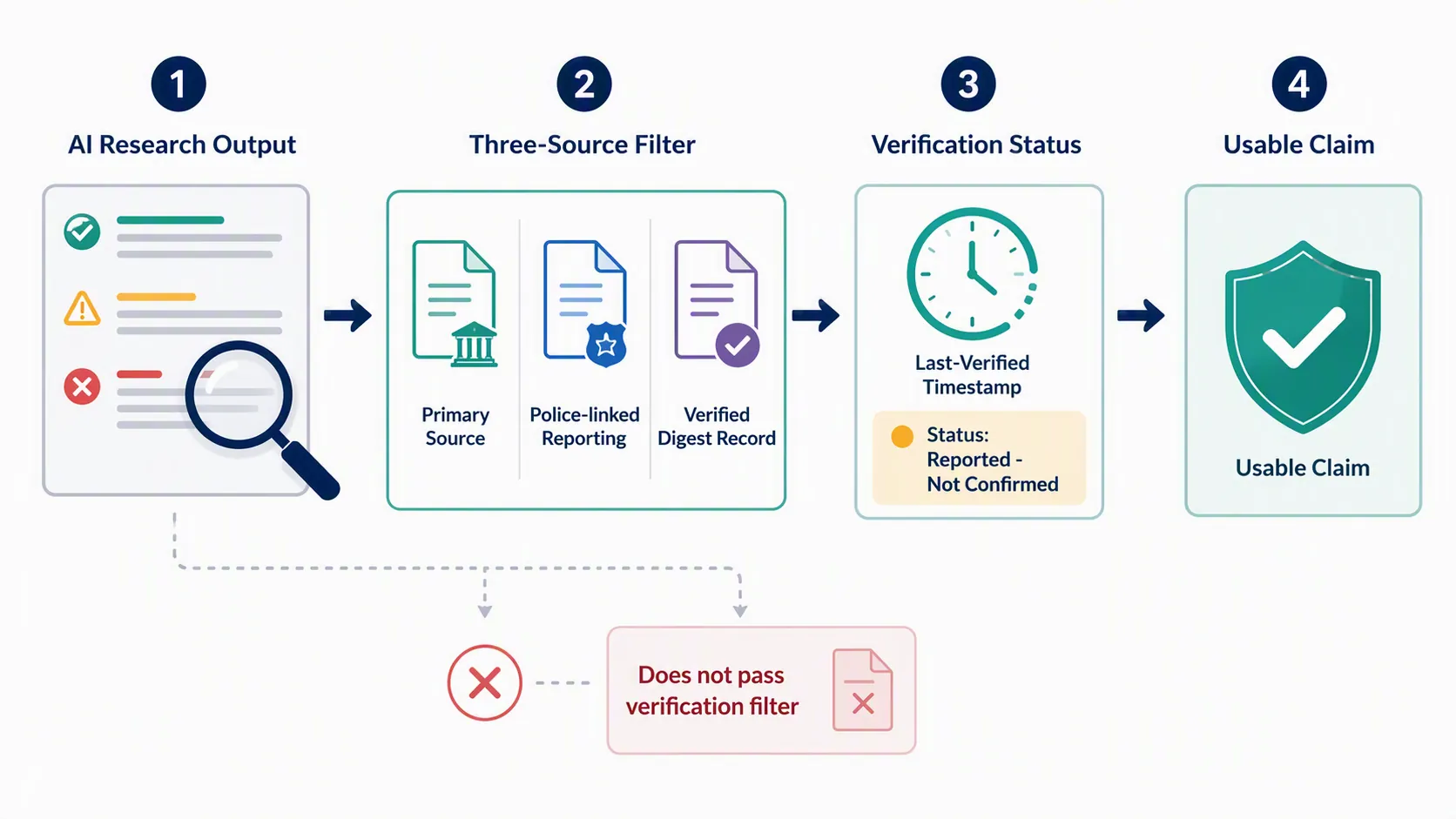
The protocol is not complicated, but it must be explicit. Reuters’ 31 July investigation report is useful here because it sits closer to the investigative posture than derivative summaries, while the later Guardian and DW reports are necessary for the 2 August arrest posture. [5][2][4] The verified Risk Digest timeline should carry the case chronology so this article does not have to rebuild it.
- Extract each factual claim from the AI output as a separate line item. Do not verify a paragraph; verify the claims inside it.
- Attach the closest available source to each claim: police statement as reported by a reputable outlet, Reuters investigation reporting, BBC/Yahoo correction, Guardian or DW arrest reporting, or the site’s verified Risk Digest record.
- Record the claim status: confirmed in the verified timeline, police-attributed reporting, reported-not-confirmed, corrected, superseded, or unsupported.
- Record the last-verified timestamp. For this article, that timestamp is 3 Aug 2026 UTC.
- Preserve corrections in the note itself. Do not write only the corrected sentence if the earlier incorrect phrasing is likely to reappear in search output.
- Do not convert translation variants, suspect accounts, or police-attributed phrasing into settled legal conclusions.
A short entry that follows this protocol may look less polished than an AI-generated narrative. It will also be less likely to turn a corrected admission into a confession to killing, an early lead into a current suspect description, or digital video analysis into an AI-policing claim.
What remains unresolved should stay unresolved
Elisabeth-Jane Ross’s death is grave, and the facts matter because of that gravity. But this is still a live pre-trial matter. This article does not take a view on guilt, charging outcomes, toxicology, Greek procedural consequences, or the final legal characterization of the alleged offense. It also does not treat English-language labels such as “intentional homicide” or “manslaughter” as interchangeable without checking the underlying source and translation.
AI-assisted research can be useful at the first stage: it can surface the articles, the correction, the stale lead, and the social material that need checking. It cannot supply confirmation status. On a live criminal case, a claim becomes usable only when a human ties it to a source, assigns its status, and records when it was last verified.
References
- Man admits transporting Scottish woman's body in suitcase, Greek police say — Yahoo News
- Man arrested over death of Scottish woman found in suitcase in Athens — The Guardian, 2026-08-02
- Police Searching for Heavily Tattooed Man After Body of Woman, 38, Is Found Inside a Suitcase in Greece — People
- Man arrested over death of British woman found in suitcase in Athens — DW
- Greek police investigate death of British woman found in suitcase — Reuters, 2026-07-31
- Elisabeth-Jane Ross Kypseli suitcase: AI falls short — DailyMotion
Related records
Tool profile
How Meta's AI Spending Reshapes Law Firm ProfitabilityGoverning regulation
Browse the obligations tracker →Preventive workflow
Browse verification workflows →
Report a correction or tip
Spotted an outdated figure, a misstated fact, or a ruling this case record should reflect? Public comments are disabled for this content given the professional cost of a misreported case outcome, penalty amount, or rule text — use the structured correction channel instead.
Report a correction or tip for this record →