
AI Class Action Surge Threatens 5G Network Stock Valuations
The H1 2026 surge in AI-related securities class actions (18 filings, already exceeding 2025's total) has produced two durable claim templates—concealed infrastructure spending and overstated AI demand—directly transferable to publicly traded 5G and AI-network infrastructure companies. This review quantifies the filing surge, maps the claim patterns, and identifies the disclosure gaps that defense counsel and D&O underwriters should audit now.
- Jurisdiction
- US-Federal
- Court
- District of New Jersey
- AI tool named
- CoreWeave
- Ruling date
- Jan 12, 2026
- Source document
- View primary court order ↗
- Last verified
- Jul 27, 2026
Lex Machina Review is an independent risk-tracking and reference resource. Nothing on this site is legal advice, and using it does not create an attorney-client relationship. Every record is reviewed against primary sources but may not reflect the most current status of a matter — always verify directly against the cited court order, rule text, or a licensed attorney before relying on it.
Companion explanation — secondary to the source document above
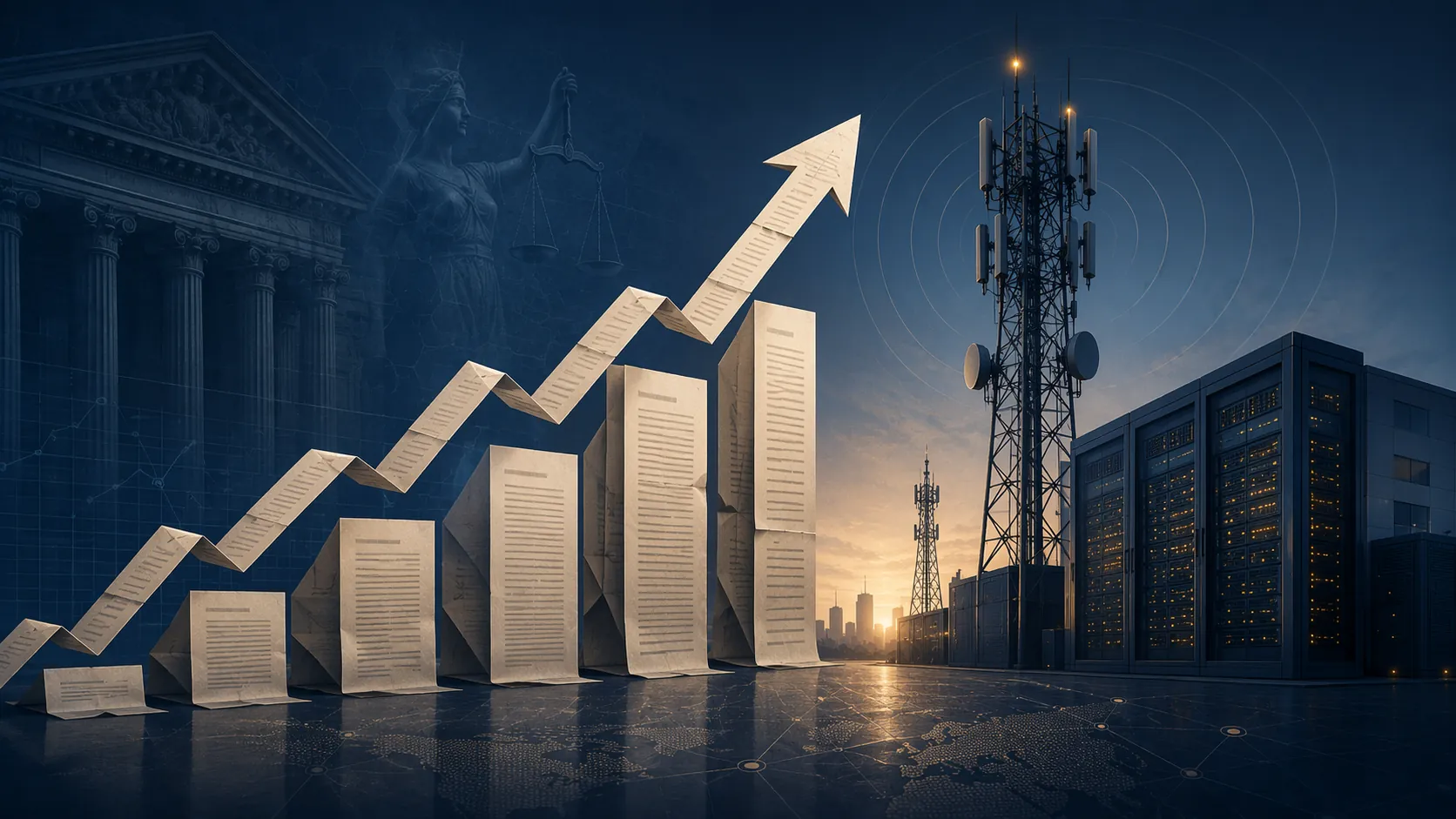
The AI securities-litigation signal is no longer a loose collection of complaints. In the first half of 2026, plaintiffs filed 18 AI-related federal securities class actions, already more than the 17 filed in all of 2025. Total federal securities class actions reached 118 in H1 2026, putting the year on pace for 236 filings; technology and health care companies accounted for 54% of H1 filings; and the Second and Ninth Circuits together drew 68% of federal filings, up from 57% in H1 2025. For 5G and AI-network stock valuation, the legal implications matter less as a trading model than as a map of where disclosure disputes are becoming pleadable. [1]
The important limitation comes early: the available filing data does not show a discrete wave of securities class actions against 5G telecom-network issuers as a category. The risk record is broader. It shows AI-related filings rising, tech-heavy defendants, concentrated federal forums, and a plaintiffs’ bar testing allegations that can travel from AI software into AI infrastructure, cloud capacity, data centers, edge networks, and 5G-adjacent buildouts.
The filing data points to transferability, not a dedicated 5G wave
A 5G or AI-network issuer does not need to be a pure AI developer to sit near the same pleading surface. The overlap appears in capex narratives, capacity reservations, cloud and edge-compute demand claims, data-center leases, vendor financing, customer-backlog language, and statements about AI-enabled network performance. Those statements are often drafted for investors as operational momentum. In a complaint, they become a timeline: what was promised, what was already committed, what was contingent, what was delayed, and what appeared only in a footnote.
| H1 2026 signal | What it measures | Why it matters for AI-network issuers |
|---|---|---|
| 18 AI-related securities class actions | AI-related federal securities class action filings in the first six months of 2026 | The half-year count already exceeded the 17 AI-related filings reported for all of 2025. [1] |
| 118 total federal securities class actions | All federal securities class action filings in H1 2026 | The annualized pace of 236 would exceed the 2023 record of 233, so AI claims are developing inside a broader active filing environment. [1] |
| 54% technology and health care | Share of H1 2026 filings involving those sectors | Network, cloud, and infrastructure issuers sit inside the technology-heavy filing mix even if 5G is not separately broken out. [1] |
| 68% in the Second and Ninth Circuits | Share of federal filings in those circuits | Forum concentration matters for issuers with headquarters, listings, investor bases, or alleged misstatements tied to those jurisdictions. [1] |
The valuation pathway is familiar but worth keeping narrow. The legal mechanism is not a discounted-cash-flow adjustment for “AI risk.” It is a disclosure gap, followed by a corrective disclosure or market realization, followed by a stock drop, followed by a complaint that converts the gap into alleged falsity, scienter, loss causation, and damages exposure. D&O underwriting then prices the same facts in a different vocabulary: sector, forum, market capitalization, volatility, disclosure controls, financing opacity, and settlement severity.
Two AI-infrastructure claim templates are doing most of the work
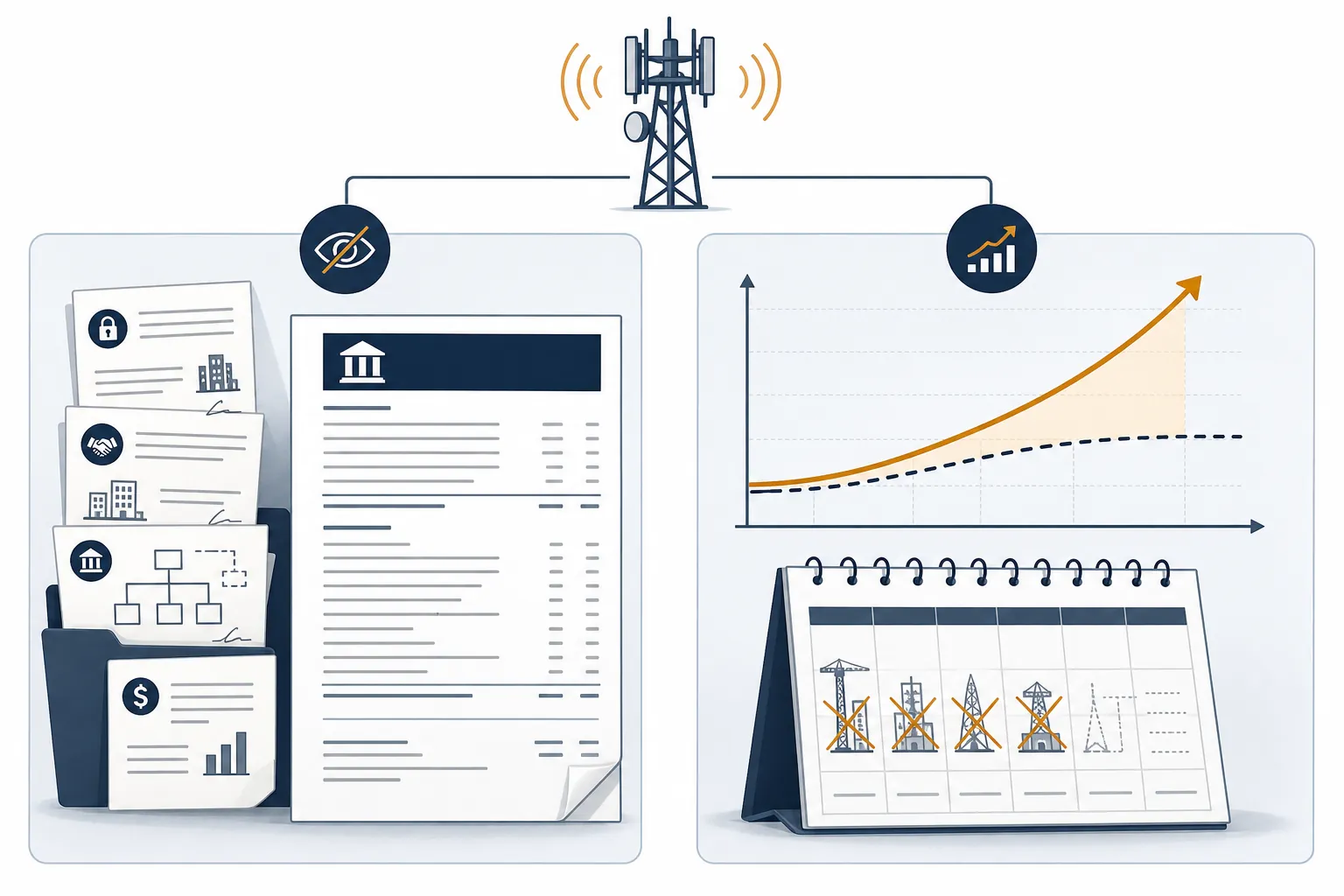
The two complaints that matter most for 5G and AI-network disclosure review are not important only because of their dollar amounts. They are important because they show reusable pleading architecture: one focused on allegedly concealed infrastructure spending commitments, the other on allegedly overstated demand and concealed execution delays.
Concealed infrastructure spending commitments
The Oracle theory is the cleaner financing template. Secondary materials describe a pending suit alleging that Oracle misrepresented the scope of its AI infrastructure borrowing plans in connection with an $18 billion bond offering. Those materials also report that Oracle’s CDS spread rose approximately 310% to a 16-year high, that total debt exceeded $130 billion, and that new lease commitments reached $248 billion. Those are allegations and market measures, not adjudicated findings. [2][3]
One verification point should not be buried: the available secondary sources contain inconsistent filing-date references for the Oracle action. That does not change the usefulness of the complaint as a pleading template, but it does mean the docket date should be verified before the case is used for chronology-sensitive analysis.
For a 5G or AI-network issuer, the portable allegation is not “large capex equals fraud.” The more dangerous version is that management allegedly gave investors a confident AI-growth or network-capacity story while the company had already entered, approved, or substantially committed to financing arrangements that changed the risk profile. The claims chart writes itself around the difference between the investor-facing description and the internal state of commitment.
- Borrowing plans described as flexible or opportunistic when proceeds were allegedly needed for identified AI infrastructure obligations.
- Lease commitments framed as ordinary operating scale when the magnitude or timing allegedly changed leverage, liquidity, or execution risk.
- Risk factors written in conditional language after the company had allegedly crossed from possible exposure into committed exposure.
- Footnote disclosures that technically mention commitments but do not align with earnings-call, investor-deck, or offering-document messaging.
That last point is where infrastructure defendants often become more vulnerable than software defendants. A model-capability claim may turn on technical nuance. A lease schedule, guarantee, borrowing use, or maturity stack is harder to soften once the pleading compares it with a financing document.
Overstated AI-driven demand and concealed delay
The CoreWeave theory is the demand-and-execution template. In Masaitis v. CoreWeave, Inc., filed in the District of New Jersey on January 12, 2026, plaintiffs alleged that CoreWeave overstated customer demand and concealed data-center construction delays; the reported stock drop on the disclosure was 16%. Skadden also notes the broader industry mismatch plaintiffs may try to invoke: AI industry revenue of $60 billion in 2025 against $400 billion in capex. Again, the complaint is pending, and the allegations are not findings. [2]
This template is immediately recognizable for network issuers. A 5G edge buildout, AI inference platform, or network-capacity expansion depends on demand forecasts that are often presented as customer pull rather than issuer push. If later disclosures show lower utilization, slower customer ramps, construction delays, permitting friction, power constraints, supply bottlenecks, or customer deferrals, plaintiffs can try to plead that earlier demand language was more concrete than the company now admits.
The distinction that matters in drafting is adoption versus monetization. A network issuer may truthfully say customers are testing AI-enabled services, requesting edge capacity, or discussing private 5G deployments. That is not the same as contracted demand, committed revenue, near-term utilization, or construction-ready deployment. The litigation risk increases when those categories collapse into a single growth narrative.
| Investor statement | Litigation-sensitive distinction | Disclosure file to compare |
|---|---|---|
| “Strong AI-driven demand” | Pilot interest, nonbinding pipeline, signed contract, take-or-pay commitment, or recognized revenue | CRM pipeline reports, backlog schedules, customer contracts, cancellation rights |
| “Rapid capacity expansion” | Announced site, permitted site, financed site, under-construction site, energized site, revenue-producing site | Board materials, construction calendars, power interconnection updates, vendor milestones |
| “Network ready for AI workloads” | Lab capability, limited deployment, customer-specific integration, commercial-scale performance | Technical validation reports, service-level commitments, customer incident logs |
| “Capex aligned with demand” | Forecasted demand, committed demand, speculative reserve capacity, or defensive buildout | Capex approvals, utilization forecasts, impairment analyses, debt and lease schedules |
Off-balance-sheet financing is an emerging pleading frontier
The financing template becomes sharper when AI infrastructure is funded through special-purpose vehicles, lease structures, guarantees, or private-credit arrangements. Quinn Emanuel’s March 2026 client alert is not a court ruling and should not be treated as one. It is still useful as an emerging-risk signal because it identifies the structures counsel should expect plaintiffs to inspect.
The alert states that technology companies moved more than $120 billion in data-center spending off balance sheets through SPVs over approximately 18 months. It also describes Meta’s $30 billion Hyperion SPV, Beignet Investor, as keeping $27 billion in loans off balance sheet while a $28 billion residual-value guarantee appeared only in footnotes. The same alert quotes Moody’s as warning that reported AI lease liabilities “may not show the full picture.” [4]
For disclosure teams, the issue is not whether SPV financing is improper. The issue is whether the total risk picture visible to investors matches the actual economic exposure retained by the issuer. A 5G or AI-network company can have technically accurate footnotes and still face a pleading theory that the front-end narrative underplayed leverage, residual-value exposure, liquidity risk, or dependency on future demand.
- Does the MD&A explain why the financing structure was used, or only where the accounting line item sits?
- Do risk factors describe actual guarantees, residual-value exposure, take-or-pay obligations, or support commitments in present-tense terms where appropriate?
- Do earnings-call remarks about balance-sheet flexibility match footnote disclosures about lease obligations and guarantees?
- Do investor decks describe AI infrastructure expansion without showing the financing dependencies that make the expansion possible?
- Have private-credit arrangements created a second disclosure perimeter around lender statements, portfolio values, or asset performance?
The same Quinn Emanuel alert notes that plaintiffs are beginning to target private-credit lenders under Rule 10b-5 for alleged misstatements about portfolio performance and asset values. That does not make every AI-infrastructure lender a defendant-in-waiting. It does mean the disclosure perimeter may extend beyond the issuer’s own 10-K and 10-Q when financing counterparties are part of the public narrative. [4]
AI-washing remains the background enforcement pressure
The securities class action story should not be confused with an SEC rulemaking story. Existing anti-fraud authority is already enough for AI-washing enforcement in the right case. In 2024, the SEC announced settled charges against Delphia and Global Predictions, with civil penalties of $225,000 and $175,000, respectively, involving allegedly false and misleading statements about the firms’ use of AI. [5]
Commentary on those first AI-washing actions emphasized the same practical lesson for public issuers: the Commission did not need a bespoke AI rule to proceed where existing anti-fraud provisions fit the alleged statement. The risk patterns include claims that companies overstated AI capabilities, exaggerated AI-driven efficiencies, rebranded legacy technology as AI, or concealed licensing and performance issues. [6][2]
The February 2026 petition for mandatory AI-governance disclosure, File No. 4-882, belongs in the same category: a forward indicator, not a current compliance obligation.
For network companies, AI-washing is usually not the whole complaint. It is the accelerant. A statement that a 5G platform is “AI-native,” “AI-optimized,” or “ready for enterprise AI workloads” may matter most when paired with undisclosed spending commitments, underutilized capacity, delayed sites, or demand statements that later look overstated.
Where a 5G or AI-network issuer should audit first
The fastest useful review is not a full rewrite of every AI reference. It is a comparison exercise against the two live templates: concealed commitments and overstated demand. The materials to compare are usually scattered across securities filings, earnings scripts, investor presentations, board decks, financing documents, customer materials, and technical roadmaps.
| Audit area | Compare | Question to answer |
|---|---|---|
| Capex and buildout language | Public growth narrative against board-approved budgets, procurement commitments, lease schedules, and construction milestones | Did the company describe future flexibility after it had already made material commitments? |
| Borrowing and liquidity disclosure | Offering documents, MD&A, covenant summaries, maturity schedules, and internal financing plans | Would investors understand whether AI or network expansion depended on new debt, refinancing, or continued capital-market access? |
| SPVs and off-balance-sheet arrangements | Footnotes, guarantees, residual-value obligations, management presentations, and investor-deck balance-sheet claims | Does the economic exposure appear only in technical accounting disclosure while the narrative implies lower risk? |
| Demand statements | Backlog, pipeline, signed contracts, customer pilots, utilization data, churn or deferral notices, and sales forecasts | Are adoption, contracted demand, revenue visibility, and utilization kept separate? |
| Construction and deployment status | Public milestone claims against permitting, power, equipment, vendor, and site-readiness reports | Were delays known before statements suggesting on-time deployment? |
| AI capability claims | Marketing language, technical validation, service-level commitments, incident reports, and product limitations | Can the company substantiate the difference between tested capability and commercial-scale performance? |
| Forum and underwriting exposure | Headquarters, exchange, investor base, challenged statement locations, and prior filing patterns | Does Second or Ninth Circuit concentration affect defense posture or D&O pricing assumptions? [1] |
The hardest documents to reconcile are often not the securities filings themselves. They are the polished investor decks and earnings-call remarks that translate a conditional infrastructure plan into a growth story. If the 10-Q footnote says lease obligations may expand materially, while the call says the company is prudently scaling to meet visible AI demand, the complaint will quote both.
Defense counsel and underwriters should also separate three timing questions. First, when did the company know the spending commitment, delay, or demand shortfall? Second, when did the public statement at issue occur? Third, when did the market allegedly learn the truth? The claim template only becomes dangerous when those dates can be made to line up.
On the present record, the spike is measurable, the pleading templates are visible, and the 5G application is plausible. What is not yet shown is a sourced filing subset proving that 5G telecom-network companies are already the direct target of a dedicated AI securities class action wave. That distinction is the difference between a defensible litigation-risk digest and an overclaimed warning. The immediate work is disclosure hygiene around spending commitments, demand claims, financing opacity, AI-capability language, and jurisdictional exposure.
References
- Securities Class Action Filings Surge in the First Half of 2026 — Alston & Bird, July 2026
- AI-Related Claims and Other Securities Litigation Trends to Watch — Skadden, 2026 Insights
- Oracle Hit with Massive AI Infrastructure-Related Securities Suit — D&O Diary, Feb. 2026
- Client Alert: Emerging Litigation Risks in Financing AI Data Centers Boom — Quinn Emanuel, Mar. 2026
- SEC Charges Two Investment Advisers with Making False and Misleading Statements About Their Use of Artificial Intelligence — U.S. Securities and Exchange Commission, 2024
- Decoding the SEC’s First ‘AI-Washing’ Enforcement Actions — Harvard Law School Forum on Corporate Governance, Apr. 2024
Related records
Tool profile
Why Nvidia's AI deal hasn't stopped CoreWeave's slideGoverning regulation
Browse the obligations tracker →Preventive workflow
Browse verification workflows →
Report a correction or tip
Spotted an outdated figure, a misstated fact, or a ruling this case record should reflect? Public comments are disabled for this content given the professional cost of a misreported case outcome, penalty amount, or rule text — use the structured correction channel instead.
Report a correction or tip for this record →