
Why Nvidia's AI deal hasn't stopped CoreWeave's slide
CoreWeave stock is down sharply from its 2026 high despite Nvidia's $2 billion investment and $6.3 billion capacity guarantee. This Q2 earnings checkpoint isolates the three numbers that will decide whether the slide continues — interest expense, FY2026 capex guidance, and backlog conversion — ahead of the August 11 report.
- Tool
- CoreWeave
- Benchmark source
- CoreWeave Q1 2026 earnings report
- Hallucination rate
- Not measured / undisclosed
- Test methodology
- Q2 2026 earnings checkpoint review of revenue guidance, interest expense, capex guidance, and backlog conversion
- Test date
- Aug 1, 2026
CoreWeave’s slide looks contradictory only if Nvidia’s role is treated as a share-price guarantee. It is not. Nvidia’s $2 billion equity investment in January 2026 strengthened the capital-access story, and the $6.3 billion capacity arrangement announced in September 2025 strengthened demand visibility, but neither one removes the market’s questions about valuation, dilution, interest expense, capex intensity, or free cash flow.[1][2]
As of August 1, 2026, Q2 results have not been reported. The August 11 print is therefore less a routine update than a clean checkpoint on why CoreWeave stock has been falling despite the Nvidia AI deal. Three numbers matter most: Q2 interest expense, FY2026 capex guidance, and backlog-to-revenue conversion.
| August 11 checkpoint | Why it matters |
|---|---|
| Q2 revenue versus the $2.45 billion-$2.6 billion guide | Tests whether the demand story is still converting into reported sales, especially after management’s late-July signal that revenue was tracking toward the high end of the range. |
| Interest expense | Shows whether financing cost is still scaling faster than the market is willing to underwrite. |
| FY2026 capex guidance | Determines whether the capacity buildout is becoming more expensive than investors expected. |
| Backlog conversion | Separates intact AI demand from the operational and financing burden of serving that demand. |
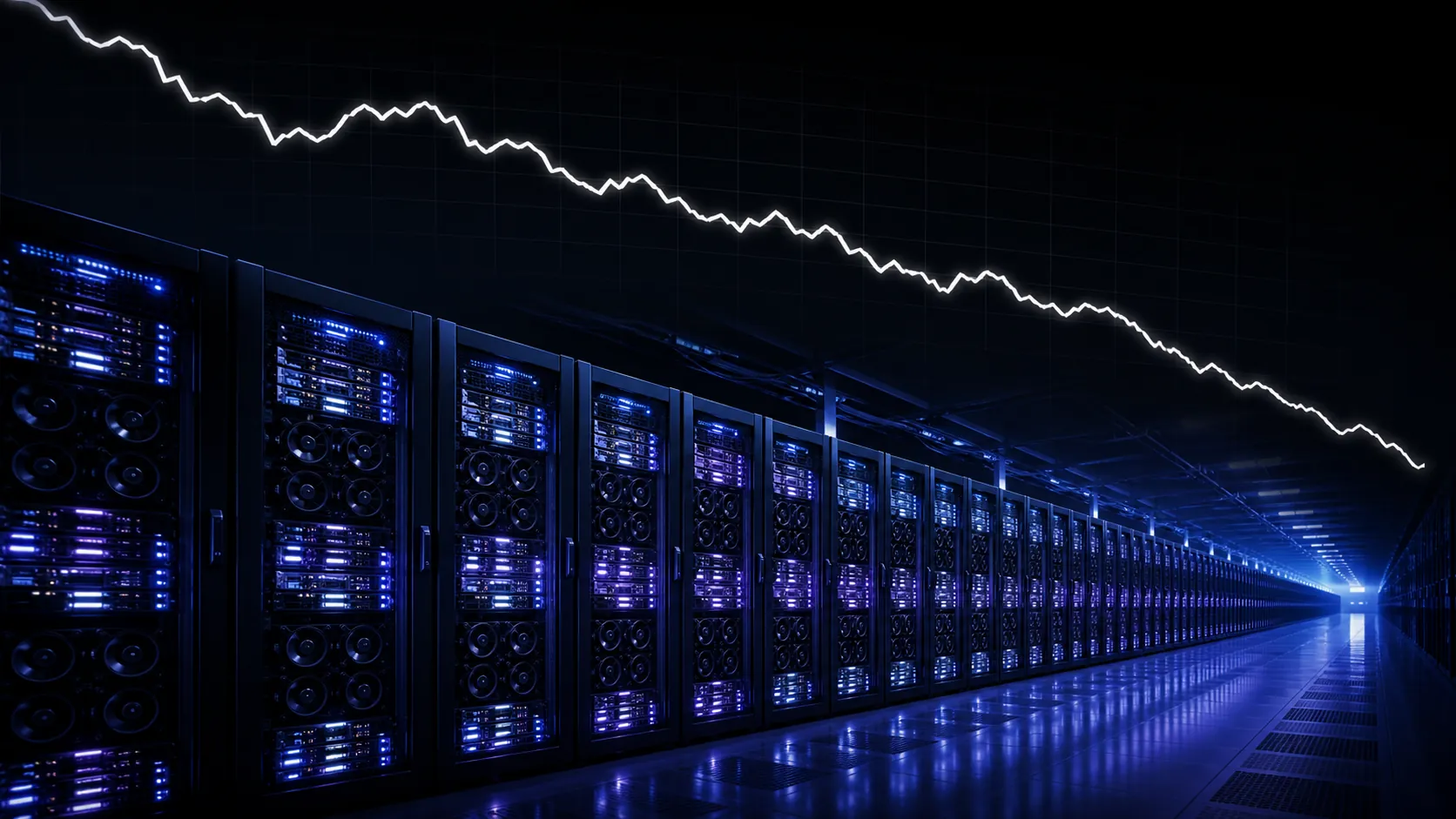
Late-July trading already complicated the simple “still falling” frame. The better-supported point is narrower: CoreWeave has traded sharply below its 2026 peak at several recent checkpoints. On July 16, Motley Fool reported that CRWV closed at $72.91, down 52% from a $153.20 52-week high.[3]
The Q1 selloff was not about disappearing AI demand
The cleanest record is CoreWeave’s Q1 2026 report. Revenue was $2.078 billion, ahead of the $1.97 billion LSEG consensus cited by CNBC. That is not what an order-collapse story looks like.[4][5]
The punishment came from the next lines down and the next quarter forward. CoreWeave guided Q2 revenue to $2.45 billion-$2.6 billion, below the $2.69 billion consensus cited at the time, and shares fell roughly 10%-11% after hours.[5]
The cost side was harder to dismiss. Interest expense was $536 million in Q1, up from $264 million a year earlier. Net loss widened to $740 million from $315 million. Weighted diluted shares were roughly 527 million, compared with roughly 249 million a year earlier. CoreWeave also lifted FY2026 capex guidance to $31 billion-$35 billion while maintaining FY2026 revenue guidance of $12 billion-$13 billion and reiterating annualized revenue of more than $30 billion by the end of 2027.[4][5]
That sequence is the center of the “why CoreWeave stock is falling despite Nvidia” analysis. The market did not reject AI infrastructure demand. It repriced the cost of turning that demand into revenue.
CoreWeave’s own Q1 materials said remaining performance obligations reached $99.4 billion. That backlog matters. It argues against the laziest bear case, which is that customers are simply walking away. But backlog is not cash flow, and it is not a guarantee that revenue can be recognized on a schedule and margin profile that equity holders like.[4]
What Nvidia solved — and what it did not
Nvidia’s January investment gave CoreWeave a powerful endorsement at a moment when GPU supply, financing relationships, and customer confidence all mattered. CNBC reported that Nvidia invested $2 billion in CoreWeave stock as part of CoreWeave’s AI data-center expansion.[1]
The September capacity agreement did something different. Nvidia said it would purchase any unsold CoreWeave cloud capacity through April 13, 2032, with the arrangement valued at up to $6.3 billion.[2]
Those are material supports. They reduce the chance that CoreWeave is building capacity into a void. They also make it easier to understand why customers, lenders, and vendors continue to take the platform seriously. For legal-AI vendors and enterprise buyers that depend indirectly on GPU cloud capacity, this is not a trivial signal. A supplier with visible demand and a strategic Nvidia relationship is not the same thing as a speculative shell.
The equity question is separate. A capacity backstop does not fix a rising interest bill. It does not cap future capex. It does not decide whether the company must raise more capital, issue more shares, or accept lower future returns to secure enough compute. Investors are not asking whether Nvidia matters. They are asking whether Nvidia’s support is enough to offset the financing model.
Interest expense is the first line to watch
The Q2 report needs to show whether the Q1 interest jump was a temporary pressure point or the visible edge of a larger earnings problem. A company can report huge revenue growth and still lose equity support if the incremental dollar of revenue requires too much debt-funded infrastructure.
In Q1, interest expense more than doubled year over year, from $264 million to $536 million.[4][5] That figure does not merely reduce net income. It changes how investors judge backlog quality. A $99.4 billion obligation pool looks different if servicing it requires capacity that is funded at a rising cost of capital.
This is where debt figures should be handled carefully. The primary Q1 balance-sheet figure cited in CoreWeave’s Q1 materials and CNBC’s coverage points to about $24.9 billion of debt.[4][5] Other public references may use higher numbers because they include leases, use different dates, or classify obligations differently. Those figures should not be mixed casually. For the August 11 readout, the cleaner question is not which headline debt number is most dramatic; it is whether the interest expense trajectory is accelerating, stabilizing, or beginning to look financeable against revenue growth.
Capex guidance is the second test
CoreWeave’s Q1 update raised FY2026 capex guidance to $31 billion-$35 billion.[4] That is not a footnote. It is the market’s central anxiety in numeric form.
AI infrastructure demand is capital-hungry by design. GPU clusters, data-center leases, power commitments, networking, and construction schedules all pull cash forward. A company serving fast-growing AI customers can therefore look strongest at the demand level precisely when its free-cash-flow profile looks weakest.
CoreWeave reported Q1 free cash flow of negative $4.7 billion.[4] That number does not prove the model is broken; early infrastructure buildouts often consume cash before the revenue base fully matures. But it does prove why Nvidia’s name alone cannot stop volatility. Equity investors still have to underwrite the bridge between current cash burn and future contracted revenue.
The August 11 capex line will matter in both directions. A reduction or stabilization in FY2026 guidance would ease one part of the bear case. A further increase would likely reopen the same question Q1 raised: how much additional capital must be absorbed before backlog turns into a more conventional earnings profile?
Backlog conversion is the third test
Backlog has become the most tempting shortcut in the CoreWeave debate. Bulls can point to $99.4 billion of remaining performance obligations and reasonably say demand is intact.[4] Bears can point to negative free cash flow and rising interest expense and reasonably say the backlog is expensive to serve.
Both claims can be true at the same time. The more useful test is conversion: how quickly contracted obligations become reported revenue, and whether that revenue arrives with a financing burden the market can tolerate.
For Q2, the first checkpoint is revenue against the $2.45 billion-$2.6 billion guide. If reported revenue lands at or above the high end, the demand-side critique weakens. If revenue disappoints despite the backlog, investors will have a cleaner reason to question execution, not just financing cost.
The more revealing case is a mixed print: strong revenue, intact backlog, and still-rising interest expense or capex guidance. That would repeat the Q1 pattern. It would say customers are still there, but the equity market is not yet comfortable with the price of serving them.
The bull case still exists, but it is not the same as a downside floor
There are credible upside cases around CoreWeave. Morningstar has described a 67% five-year revenue compound annual growth forecast, and its fair value estimate cited in the available coverage was $106. Citi and Cantor have also been associated with higher target references, including $135 and $167 respectively.[6]
But Morningstar’s framing also captures why the stock remains fragile: no moat, very high uncertainty, and no expectation of positive free cash flow or GAAP EPS over the next three years.[6] That is not an anti-AI argument. It is a warning about how much execution must go right before rapid revenue growth becomes equity durability.
The trading record around Q1 reinforces that point. Morningstar noted that CoreWeave fell more than 28% in under two weeks after the Q1 print, from $138 to below $100, before rebounding more than 29%.[6] A stock that can fall and rebound that violently is not being valued only on whether AI demand exists. It is being valued on how investors discount the financing path.
Short interest and insider-sale headlines need date stamps, not drama
Short interest can explain part of the volatility, but only if the date is attached. MarketBeat listed short interest of 64.36 million shares, or 18.97% of float, as of July 15, 2026.[7] Other figures in circulation refer to different dates or different calculations. They should not be treated as interchangeable.
Insider-sale framing requires the same discipline. Reports in early July described CEO Michael Intrator selling large blocks of stock, including sales under a prearranged plan.[8] That caveat matters. A prearranged-plan sale is not the same evidence as an opportunistic discretionary sale immediately after adverse information. It may still affect sentiment, especially in a high-volatility stock, but it should not carry the analytical weight of the Q2 income statement.
Price peaks also need attribution. Motley Fool used $153.20 as the 52-week high when calculating the July 16 decline.[3] Other market references have used different intraday or post-IPO measures. The analysis should not depend on choosing the most dramatic peak.
Why this matters beyond CRWV holders
For legal-AI buyers, CoreWeave is not just a stock ticker. It is part of the infrastructure chain behind model training, inference capacity, and vendor cost structures. A compute provider with high demand but heavy financing needs can still create downstream risk if pricing, availability, or contract terms shift under pressure.
That is why this checkpoint belongs beside the site’s prior CoreWeave stock-target analysis for legal-AI buyers, the Nvidia circular-financing securities-risk record, and the Meta cash-flow risk piece. The point is not to turn tool procurement into stock picking. It is to notice when the infrastructure economics behind a tool category are becoming harder to finance.
The same diligence habit applies across AI-infrastructure stress points, from AI hedge fund reliability lessons to substrate supply-chain strain and AI layoff signals at software vendors. Financial strain does not automatically mean service failure. It does mean buyers should ask more precise questions about capacity commitments, pass-through costs, redundancy, and vendor dependency on a small number of compute providers.
The August 11 read
The Nvidia relationship has not failed. It is simply not the variable the market has been punishing. Nvidia helps explain why CoreWeave has capital access, strategic credibility, and demand support. The Q1 selloff showed that investors were focused elsewhere: the cost of debt, the size of the capex program, and the path from backlog to cash-generating revenue.
On August 11, a strong report would need to do more than show AI demand. It would need to show that CoreWeave can convert that demand fast enough, and finance the required capacity cheaply enough, to keep the stock’s AI-growth story from being overwhelmed by interest expense and capex risk.
References
- CNBC Nvidia $2B investment, CNBC, January 26, 2026
- NVIDIA and CoreWeave Strengthen Collaboration to Accelerate Buildout of AI Factories, NVIDIA Newsroom
- Why CoreWeave Stock Keeps Falling, Motley Fool, July 18, 2026
- CoreWeave Reports Strong First Quarter 2026 Results, CoreWeave, May 7, 2026
- CoreWeave shares plunge 11% on weak forecast despite revenue beat, CNBC, May 7, 2026
- Debt-Fueled CoreWeave Surges on the AI Boom, Morningstar
- CoreWeave Short Interest, MarketBeat, July 15, 2026
- CoreWeave Stock Price Prediction: Where Analysts See CRWV Heading in 2026, 24/7 Wall St., July 7, 2026
Chronological incident history
No sanction cases have named this tool in the tracked record set to date. This does not imply the tool is safe — see Risk Digest for ongoing monitoring.
← Compare peer toolsReport a correction or tip
Spotted an outdated figure, a misstated fact, or a ruling this tool profile should reflect? Public comments are disabled for this content given the professional cost of a misreported case outcome, penalty amount, or rule text — use the structured correction channel instead.
Report a correction or tip for this record →