
How the 2026 AI Stock Selloff Is Reshaping Law Firm AI Investments
The Feb 2026 AI-driven stock selloff wiped $830B from software stocks and cut legal vendor valuations, raising urgent questions for law firms with multi-year AI platform contracts. This article examines how the selloff signals vendor concentration risk and offers a three-question framework for restructuring AI procurement decisions.
- Jurisdiction
- us-federal
- Court
- U.S. financial markets
- AI tool named
- Claude
- Ruling date
- Feb 4, 2026
- Source document
- View primary court order ↗
- Last verified
- Jul 30, 2026
Lex Machina Review is an independent risk-tracking and reference resource. Nothing on this site is legal advice, and using it does not create an attorney-client relationship. Every record is reviewed against primary sources but may not reflect the most current status of a matter — always verify directly against the cited court order, rule text, or a licensed attorney before relying on it.
Companion explanation — secondary to the source document above
For a law firm buyer, the February 2026 AI stock selloff did not feel like distant market weather. It looked uncomfortably close to the RFP table. In the span of a few trading days, the same category of legal AI tools firms were evaluating for research, drafting, and workflow support became the reported catalyst for a sharp repricing of public companies many firms treat as stable infrastructure.
Reuters reported that the Feb. 2-4 event, quickly nicknamed "software-mageddon," wiped $830 billion from software and services stocks over six trading days. Thomson Reuters fell 18% in a single day, RELX dropped 14%, and LegalZoom declined 19.7%, with Anthropic's Claude legal-tool release widely reported as the trigger for the pressure on legal and software names.[1]

That does not mean a one-day share-price drop predicts vendor failure. Public-market moves are never that clean. Macro conditions, sector rotation, crowded AI trades, algorithmic selling, and ordinary profit-taking can all magnify a move. But procurement teams do not need a perfect causal model to learn from the event. The useful question is narrower: if a legal-specific AI release can reprice major legal information and services companies within 48 hours, how much concentration, pricing, and exit risk should a law firm accept in its own AI vendor stack?
The Selloff Turned Vendor Stability Into a Procurement Question
Before February, many AI investment discussions inside law firms treated vendor volatility as an investor issue. Partners debated whether lawyers would use the tools, whether privilege and confidentiality controls were adequate, and whether a platform could be integrated into document management, knowledge systems, or legal research workflows. The vendor's market valuation sat in the background, important but rarely central unless a startup's financing looked thin.
The February selloff changed the order of those questions. It put public-market confidence, product defensibility, and vendor pricing power into the same conversation as adoption and information security. A law firm considering a multi-year AI platform commitment now has to ask whether the vendor's current economics still make sense if the market suddenly decides that a cheaper, more flexible AI layer can compete with the incumbent workflow.
The legal market has seen technology hype cycles before. What made this one different was the legal specificity of the reported catalyst. Claude legal plugins were not a general consumer AI novelty. They were positioned close enough to legal research and legal workflow that investors immediately reassessed companies with meaningful exposure to those markets.[1]
For the CFO, the issue is not whether Thomson Reuters, RELX, LegalZoom, or any other affected company remains viable tomorrow. The issue is whether the firm's spending plan assumes a stable pricing environment that may no longer exist. For the knowledge-management lead, the issue is whether the firm can support adoption if a favored product changes packaging, pricing, or roadmap priorities. For the risk manager, the issue is whether too much of the firm's AI workflow has become dependent on a small set of vendors whose own strategic position is being repriced in real time.
Why Concentration Risk Matters More Than the Headline Drop
Law firms already understand concentration risk in client portfolios and lender relationships. They are less disciplined about applying the same logic to legal technology. A platform may begin as a research tool, then become the place where lawyers save prompts, build internal playbooks, retrieve matter examples, draft first-pass work product, and train practice-specific workflows. By the time renewal arrives, the contract is no longer just a subscription. It is a dependency.
That dependency is not automatically bad. Large firms often choose major platforms precisely because they need security review, integration support, user administration, enterprise contracting, and a vendor with enough resources to serve thousands of lawyers. Am Law 100 firms can sometimes absorb volatility better than smaller firms because they have procurement leverage, internal AI teams, knowledge-management staff, and enough usage data to negotiate intelligently.
The mistake is treating scale as a substitute for flexibility. A dominant vendor can still face pressure if investors question its growth trajectory or if a new AI interface threatens the economic logic of its existing product bundle. Yahoo Finance reported that Morgan Stanley analysts said after the selloff that "most investors are overwhelmingly bearish on TRI" as legal AI tools challenged Westlaw's growth trajectory; that report should be read as reported market commentary, not as an independent review of the underlying analyst note.[2]
The procurement implication is practical. If a firm builds workflows around one vendor's research database, one AI assistant, one drafting interface, and one set of matter analytics, the firm is not merely buying convenience. It is giving that vendor leverage at renewal and creating switching costs that may be difficult to unwind when the vendor's own market conditions shift.
A vendor under pressure may respond in several ways. It may accelerate product development and improve value. It may repackage features to defend revenue. It may raise prices for enterprise AI access, narrow included usage, restrict favorable terms to larger customers, or push longer commitments to reassure its own investors. None of those responses requires financial distress. They are ordinary commercial moves in a market where incumbents are defending growth expectations.
That is why law firms should not reduce the 2026 AI stock selloff to "buy less AI." The better conclusion is that they should buy AI with a clearer view of vendor leverage. A tool that is essential, well-integrated, and demonstrably used may justify a larger commitment. A tool that is still searching for workflow fit should not receive infrastructure-level contract treatment just because peer firms are announcing platform deals.
The DeepSeek Precedent Made February Harder to Dismiss
The February selloff also landed less than two years after another AI shock. In January 2025, DeepSeek's emergence triggered a broad AI market rout, and Nvidia lost $593 billion in market value in a single day, which Reuters described as the largest single-day market-cap loss in stock-market history.[3]
That earlier event did not involve legal vendors in the same direct way. Its relevance is the pattern. AI disruption fears can move from product news to capital markets in hours. If a law firm signs a five-year platform agreement on the assumption that the vendor landscape will remain orderly, it is now making an assumption the market itself has twice challenged.
The point is not that every AI shock will damage incumbent legal vendors. It may do the opposite for some. A stronger model could make an incumbent platform more valuable if the vendor integrates it well, protects client data, and turns it into reliable legal workflow. But firms should no longer treat market stability as the default condition around long AI commitments. Stability has to be tested contractually and operationally.
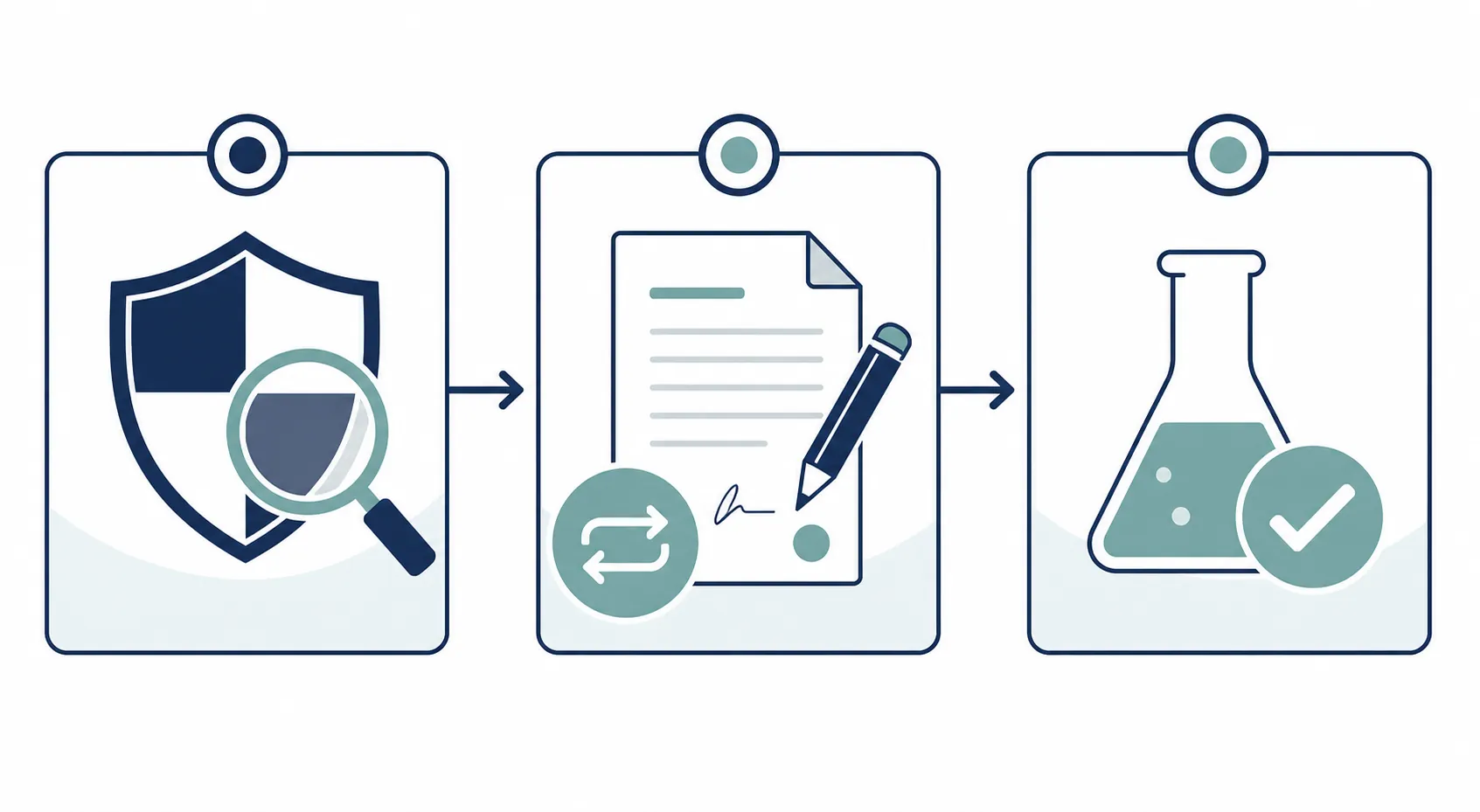
A Three-Question Test Before the Next AI Platform Commitment
The selloff gives procurement teams a useful stress test. Before signing or renewing a major AI platform deal in the second half of 2026, the firm should be able to answer three questions in writing. Not in a slide that says "strategic." In a file the CFO, KM lead, general counsel, and practice sponsors can all defend six months later.
| Procurement question | What the firm is testing | What should change in the deal |
|---|---|---|
| Is the vendor resilient enough for this use case? | Operational continuity, roadmap credibility, support capacity, and exposure to rapid AI substitution | Require vendor-risk review before treating the tool as infrastructure |
| Does the contract preserve pricing and exit flexibility? | Renewal leverage, usage caps, termination rights, data portability, and product-change protections | Avoid long commitments unless the value and switching plan are clear |
| Can the firm validate ROI through a shorter pilot? | Actual lawyer usage, matter-level value, workflow fit, and support burden | Use staged expansion instead of firmwide deployment by announcement |
1. Is the vendor resilient enough for the use case?
Vendor resilience is not the same question for every AI tool. A drafting assistant used by a small litigation team for first-pass chronology work does not need the same resilience profile as a platform embedded across research, document automation, and firmwide knowledge retrieval. Procurement should classify the use case before judging the vendor.
For a low-dependency tool, the firm may only need basic security review, acceptable terms, and a clear offboarding path. For a high-dependency platform, the review should look more like critical vendor management: financial signals, ownership structure, customer concentration where available, AI infrastructure dependencies, support commitments, product roadmap, incident history, and the vendor's ability to maintain service if its pricing model or investor expectations change.
This is where public-market data becomes useful without being overread. A stock decline does not prove operational weakness. It does, however, identify where investors see pressure on growth, margins, or defensibility. If the firm is about to rely on that vendor for a core workflow, the procurement file should explain why those market concerns do or do not matter for the firm's use case.
2. Does the contract preserve pricing and exit flexibility?
The weak point in many AI deals is not the demo. It is the renewal. A firm pilots a tool with a favorable launch price, lawyers build habits around it, practice leaders start asking for broader access, and by the time the first full renewal arrives the vendor understands exactly how painful switching would be.
Contract flexibility should therefore be negotiated before adoption creates dependency. That means price-increase caps, clear usage metrics, notice requirements for packaging changes, rights to reduce seats or modules, termination rights tied to material product changes, service-level commitments where appropriate, and data export terms that are operationally usable rather than merely promised.
AI-specific terms also matter. If the vendor changes model providers, alters retrieval behavior, modifies confidentiality controls, or introduces new data-processing flows, the firm should not learn about it through release notes after the fact. For tools touching client material, contract language should give the firm enough notice and review rights to reassess risk before the workflow changes under users' feet.
None of this requires hostile negotiation. It requires matching commitment length to evidence. If the vendor wants a multi-year enterprise contract, the firm should ask for the terms that make that commitment survivable if the market reprices the vendor, if a better AI layer emerges, or if internal usage fails to support the original business case.
3. Can ROI be validated before the firmwide commitment?
AI ROI in law firms is often discussed too abstractly. A platform is said to save time, improve quality, or make lawyers more efficient. Those may all be true in particular workflows, but they are not procurement evidence until the firm identifies who used the tool, for what task, under what supervision, with what time saved or quality improvement, and whether the saving can be captured economically.
A shorter-cycle pilot is not a symbolic trial. It should have a defined practice group, specific use cases, baseline workflow, training plan, risk controls, success measures, and a decision date. The pilot should also measure the support burden: who answers lawyer questions, who validates outputs, who updates prompts or playbooks, and who handles exceptions when the tool performs poorly.
- For research: compare the tool against existing research workflows on speed, citation reliability, missed authorities, and lawyer review time.
- For drafting: track whether the tool reduces first-draft time without increasing partner correction time.
- For knowledge retrieval: test whether lawyers can find reusable firm work product more reliably than through current systems.
- For client-facing work: confirm whether any efficiency can be billed, passed through, written off, or converted into capacity.
The last point is where many optimistic AI budgets become thin. If a tool saves associate time but the matter is fixed-fee, the value may be real and immediate. If it saves time on hourly work that clients then refuse to pay for, the firm may improve client relationships but not revenue. If it requires extensive partner review, the apparent saving may move work rather than reduce it. A pilot has to show which of those outcomes is actually happening.
Mid-Market Firms Are Already Behaving Differently
There is early evidence that the market is splitting by firm size and budget. Based on available preview text, Law.com reported in May 2026 that Second Hundred firms were investing in technology carefully, with firms piloting rather than committing to major AI platforms, while some mid-market firms were using off-the-shelf tools such as Claude, ChatGPT, and Harvey instead of proprietary builds.[4]
That evidence should be handled cautiously because the accessible material is limited. It does not prove a comprehensive market-wide shift. It does, however, fit what procurement teams would expect after the February shock: firms with less budget slack and less internal implementation capacity are less willing to turn AI enthusiasm into large platform commitments without proof of workflow value.
The Am Law 100 posture can look different for rational reasons. Larger firms may have stronger client pressure to show AI capability, more lawyers to spread enterprise costs across, more data to train or tune workflows, and more leverage to negotiate protections. A large platform deal is not automatically imprudent. It becomes imprudent when the firm cannot explain why the selected platform deserves long-term dependency now rather than staged expansion after measurable use.
Budget Discipline Matters Because Revenue Conditions May Not Hold
The selloff also arrived in a legal market already being warned against permanent-cost assumptions. The Thomson Reuters Institute and Georgetown 2026 State of the US Legal Market analysis warned that firms were "spending like current revenue conditions represent a permanent shift rather than a temporary spike" and said an AI bubble correction would "greatly strain client budgets."[5]
That warning should matter to AI procurement because technology commitments often become fixed costs faster than firms admit. A software contract may be described as innovation spending when signed, then treated as a baseline operating cost at renewal because lawyers have become dependent on it or because no one wants to unwind the implementation.
If revenue growth slows or clients push harder on AI-related billing, the firm will need to distinguish between tools that create defensible value and tools that were purchased to keep pace with a market narrative. The February selloff did not create that need. It made the timing harder to ignore.
What Should Change in 2026 AI Procurement
The practical response is not a spending freeze. A blanket pause would punish useful experimentation and leave lawyers to adopt unsupervised tools outside procurement channels. The better response is to separate exploration from infrastructure and price each accordingly.
- Use short pilots for uncertain workflows, with defined success measures and a decision date.
- Reserve multi-year commitments for tools that have passed security, adoption, workflow, and ROI review.
- Treat dominant legal research and AI platforms as concentration-risk items, not ordinary software renewals.
- Negotiate price, packaging, exit, and data-portability protections before broad rollout creates switching costs.
- Require a vendor-risk memo for platform deals that would be painful to unwind within one budget cycle.
The vendor-risk memo does not need to be theatrical. It should identify the workflow dependency, alternatives, switching effort, key contract protections, recent market or financing signals, and the internal owner responsible for monitoring the relationship. If a platform is important enough to reshape lawyer behavior, it is important enough to be monitored after signature.
Firms should also avoid letting peer announcements set their commitment length. A competitor's AI deal rarely discloses the pricing concessions, opt-outs, usage rights, pilot history, indemnities, or internal support costs behind the press release. Copying the headline without copying the protections is not strategy.
The February 2026 AI stock selloff is best read as a procurement stress signal. It justifies shorter-cycle pilots, explicit vendor-risk review, and contract flexibility for law firm AI investments. It does not rule out larger strategic deals. It raises the standard for them: the firm should be able to verify vendor resilience, prove workflow value, and absorb volatility before it turns an AI platform into infrastructure.
References
- Selloff wipes out nearly $1 trillion from software and services stocks, Reuters, Feb. 4, 2026
- Legal Software Stocks Slide After Anthropic AI Release, Yahoo Finance
- DeepSeek sparks AI stock selloff; Nvidia posts record market-cap loss, Reuters, Jan. 27, 2025
- AI On a Budget: How Second Hundred Law Firms Are Investing in Tech Carefully, Law.com, May 5, 2026
- 2026 Report on the State of the US Legal Market analysis: Will the AI bubble burst?, Thomson Reuters Institute
Related records
Tool profile
What Claude's Outage Record Means for Legal WorkGoverning regulation
Browse the obligations tracker →Preventive workflow
Browse verification workflows →
Report a correction or tip
Spotted an outdated figure, a misstated fact, or a ruling this case record should reflect? Public comments are disabled for this content given the professional cost of a misreported case outcome, penalty amount, or rule text — use the structured correction channel instead.
Report a correction or tip for this record →