
Challenging AI-Upscaled Video in Taco Bell Assault Cases
When surveillance video from a fast-food assault is AI-upscaled, the defense has a viable path to exclusion under Frye or Daubert. This article provides a step-by-step blueprint for challenging generative-AI-enhanced video evidence, from identifying the tool to cross-examining the proponent's expert.
- Jurisdiction
- Washington
- Court
- Washington State Superior Court
- AI tool named
- Topaz Video AI
- Ruling date
- Dec 15, 2025
- Source document
- View primary court order ↗
- Last verified
- Jul 25, 2026
Lex Machina Review is an independent risk-tracking and reference resource. Nothing on this site is legal advice, and using it does not create an attorney-client relationship. Every record is reviewed against primary sources but may not reflect the most current status of a matter — always verify directly against the cited court order, rule text, or a licensed attorney before relying on it.
Companion explanation — secondary to the source document above
The evidentiary fight usually starts after the arrest, not at the restaurant. In a Taco Bell employee assault case with criminal charges filed, the record may look routine on paper: a counter, a brief confrontation, a few seconds of surveillance footage, and a prosecutor who says the video shows what happened. Then discovery arrives with two versions of the same clip. One is the original: dim, compressed, blocky, perhaps barely useful. The other is labeled “enhanced,” and it looks cleaner enough that a face, hand movement, or shove seems easier to see.
That is the moment to slow the case down. If the exhibit was merely brightened, stabilized, or enlarged through a traceable forensic process, the dispute may be about weight, foundation, or whether the jury should see both versions. If the exhibit was upscaled by a generative AI tool, the posture changes. The question is no longer whether the jury is seeing a clearer copy of the camera’s recording. The question is whether the proponent is offering a machine reconstruction as if it were the recording itself.
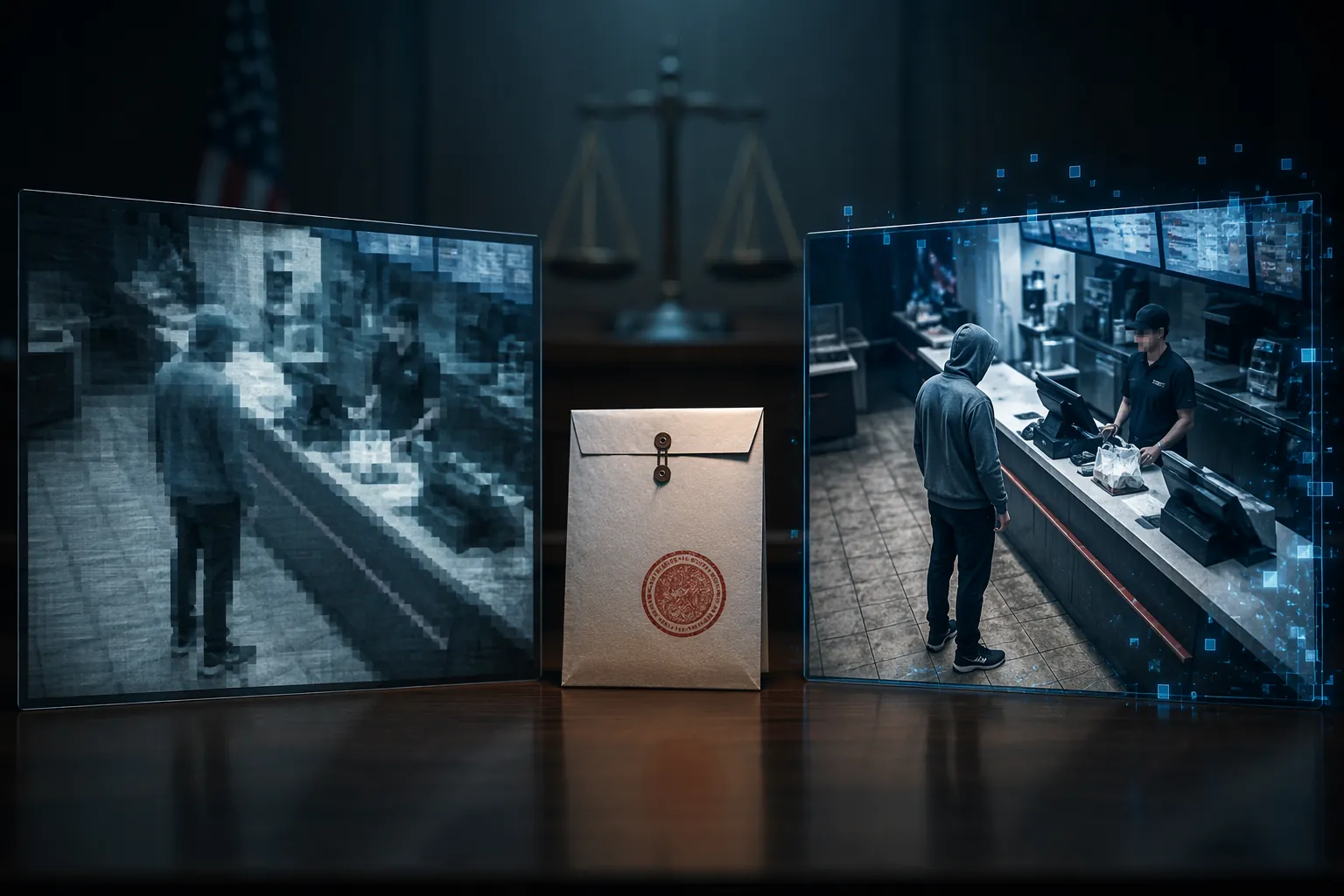
As of Q3 2026, the most useful litigation model remains State v. Puloka, a Washington trial-court ruling excluding 16x AI-upscaled surveillance video created with Topaz Video AI. The case was a triple-homicide prosecution, not a fast-food assault. But the admissibility issue travels because the court’s reasoning turned on the method used to create the exhibit, not on the type of charge. The trial court excluded the enhanced video under Frye after finding that Topaz Video AI upscaling was not generally accepted in the forensic video analysis community and that most pixels in the 16x output were generated by the system rather than captured by the camera.[1]
Start With the Exhibit the Jury Will Actually See
In a restaurant surveillance case, lawyers often talk about “the video” as though there is only one object. There may be at least three: the native file from the surveillance system, a working copy exported for investigation, and an enhanced version prepared for court. The admissibility challenge should identify which one the prosecution intends to publish to the jury and what role it is supposed to play.
That distinction matters because an assault case may turn on small visual claims: whether a person’s hand made contact, whether the accused was the person near the register, whether an employee moved first, whether a gesture was defensive or aggressive. A polished frame can quietly become the case’s most confident witness. Jurors may understand that a grainy clip has limits. They may be less alert to the limits of a frame that looks finished.
| Defense question | Why it matters |
|---|---|
| Is the proponent offering the original, a deterministic enhancement, or a generative-AI-upscaled version? | Different processes raise different foundation and reliability issues. |
| What exact software, version, model, settings, and workflow produced the exhibit? | A party cannot test or challenge an unidentified process. |
| Were pixels merely rearranged from captured data, or were new pixels synthesized? | Generated pixels support an argument that the exhibit is reconstruction, not duplication. |
| Will the jury see the original beside the enhanced version? | Side-by-side presentation can reduce the risk that the polished version substitutes for the recording. |
| Is an expert needed to explain the process? | If the output depends on specialized machine processing, reliability review becomes harder to avoid. |
The first discovery demand should therefore be practical, not abstract. Ask for the native video file, metadata, export logs, chain-of-custody records, all enhanced files, the name and version of every tool used, the operator’s notes, settings, presets, intermediate outputs, and any validation materials the proponent intends to rely on. If the answer is only “we used AI to clarify it,” the answer is not yet an evidentiary foundation.
Do Not Let Generative Upscaling Hide Inside the Word Enhancement
The word “enhancement” covers too much. Traditional forensic video work can include brightness adjustment, contrast adjustment, stabilization, deinterlacing, sharpening, or interpolation. Some of those processes are deterministic: apply the same method to the same input and the same output follows. They may still require foundation, but they do not necessarily claim to recover details never captured by the camera.
Generative AI upscaling is different in the way that matters for admissibility. The system is trained to produce plausible high-resolution output from low-resolution input. In Puloka, the 16x Topaz Video AI output contained a vast majority of pixels that were algorithmically generated rather than camera-captured.[1] That fact should be put in plain language in the motion: the exhibit is not just the original video made larger. It contains visual information supplied by the tool.
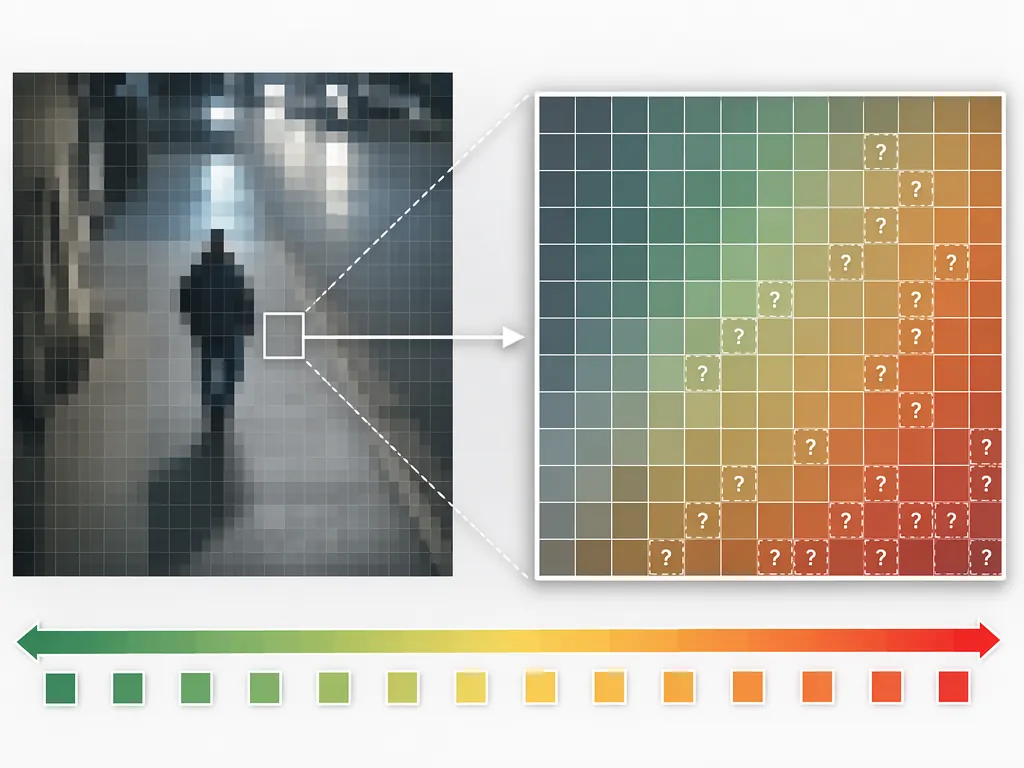
This is also where the intuitive appeal of the enhanced clip has to be confronted. The 2024 NeurIPS work discussed in the Puloka coverage identified a fundamental tradeoff: as generative restoration models improve perceptual quality, uncertainty about the true underlying scene necessarily increases.[1] In courtroom terms, a more natural-looking face or object may be easier to look at without being more reliable as proof of what the camera recorded.
That does not mean every AI-assisted image must be excluded. It means the proponent should not receive the benefit of the jury’s visual confidence without first proving what the tool did, how reliably it does it, and whether the relevant forensic community accepts that method for the purpose being offered.
Puloka Supplies the Current Working Framework
Puloka is not binding precedent for most courts, and it should not be oversold. It is a trial-court ruling. No appellate court has yet reversed it or approved comparable generative-AI-enhanced surveillance evidence.[1] Its value is more practical than precedential: it gives defense counsel a tested structure for turning a vague concern about “AI video” into specific admissibility objections.
The court focused on Topaz Video AI, the 16x upscaling process, the generated-pixel problem, and the absence of general acceptance in the forensic video analysis community.[1] Those points should be separated in briefing. The tool matters because different software may work differently. The degree of upscaling matters because a 16x output makes the generated-pixel issue difficult to minimize. General acceptance matters because Frye jurisdictions ask whether the relevant scientific community accepts the method, not whether the exhibit looks useful to a layperson.
The Scientific Working Group on Digital Evidence materials discussed in the Puloka reporting sharpen the same point. SWGDE had not endorsed generative AI upscaling tools for forensic use, and machine-learning-based interpolation was described as making it challenging to identify what processes were applied.[1] That is not a vendor-performance quibble. In criminal litigation, the ability to identify the process is part of the ability to test the evidence.
A motion modeled on Puloka should therefore avoid the lazy version of the argument: “AI is unreliable.” The stronger version is narrower. A generative upscaling method that synthesizes visual data, operates through opaque training and processing choices, has not been validated for forensic identification or action-recognition use, and lacks general acceptance should not be shown to the jury as though it were an ordinary duplicate of the restaurant’s surveillance recording.
The Admissibility Sequence
The best challenge moves in sequence. If counsel jumps straight to constitutional language or broad AI policy, the judge may treat the issue as a familiar dispute about demonstrative clarity. The cleaner route is to make the court decide what the exhibit is.
First: Object to Duplicate Treatment
Under Federal Rule of Evidence 1003, a duplicate is generally admissible to the same extent as the original unless a genuine question is raised about authenticity or it would be unfair to admit the duplicate in the circumstances. The defense argument is that a generative-AI-upscaled video is not a duplicate in the ordinary sense because it does not merely reproduce the captured file. It adds machine-generated pixels.
This objection is especially important in a fast-food assault case where the enhanced detail is the disputed detail. If the original video only shows a blur near the counter, and the enhanced version appears to show a face, fist, or object, the added clarity is doing substantive evidentiary work. The proponent should have to explain why that new visual information is reliable enough to be treated as proof.
Second: Move Under Frye or Daubert
Frye and Daubert ask different questions, but both put pressure on generative AI evidence. The Maryland State Bar Association’s discussion of AI evidence frames AI-generated outputs as the kind of material that may need expert-testimony reliability review rather than casual admission as ordinary documentary evidence.[2] That is the bridge: once the proponent needs specialized explanation to establish what the output means, the court should evaluate the reliability of that specialized method.
- In a Frye jurisdiction, focus on whether generative AI upscaling for forensic video identification or action interpretation is generally accepted by the relevant forensic video analysis community.
- In a Daubert jurisdiction, focus on testability, known or potential error rate, peer review, standards controlling the technique, and fit between the method and the purpose for which the exhibit is offered.
- In either framework, separate vendor claims about visual quality from independent forensic validation.
- If the proponent cannot identify the training data, processing steps, repeatability, or validation studies for the relevant use, say so plainly.
The three reliability defects worth pressing are training-data opacity, non-deterministic or difficult-to-reproduce output, and the absence of forensic-community validation. A glossy before-and-after demonstration does not answer any of them. It only shows that the tool can produce an image that looks better.
Third: Ask for a Limiting Ruling if Exclusion Fails
Exclusion is not automatic. A court may allow some use of the enhanced video, especially if the proponent limits it to demonstrative assistance and the original remains the primary evidence. If that happens, the defense should seek conditions: publication of the original first, side-by-side comparison, a clear instruction that the AI-upscaled version is not the original recording, disclosure of the tool and settings, and permission to cross-examine on generated pixels and validation limits.
Cross-Examination Should Make the Reconstruction Visible
The cross-examination goal is not to make the witness admit that AI is magic or fraud. It is to make the jury and the judge see the distance between captured footage and generated output. The questions should be concrete enough that a witness cannot answer with general confidence about image enhancement.
- Tool identity: What software, version, model, and settings were used? Was it Topaz Video AI or another generative upscaling product? Who selected the settings?
- Input quality: What was the original resolution, frame rate, compression level, lighting condition, and distance from the camera to the relevant person or action?
- Pixel generation: What percentage of the final image consists of pixels not captured by the surveillance camera? Can the witness identify which pixels are camera-derived and which are generated?
- Repeatability: If the same source file is processed again with the same tool, will it produce the same output? If not, what range of differences is expected?
- Validation: Has the tool been independently validated for forensic identification, facial comparison, object recognition, or action interpretation from low-quality surveillance footage?
- Community acceptance: What forensic video organizations, standards, or peer-reviewed sources endorse this specific method for this specific courtroom use?
- Disclosure: Were all intermediate files, processing settings, logs, and comparison outputs preserved and produced?
A prosecutor with a legitimate need to make poor footage intelligible may have reasonable answers to some of these questions. The point is not to pretend that bad surveillance must remain unusable. The point is to insist that the foundation match the claim. If the witness says the AI version “shows” the defendant’s face, the method has to support identification. If the witness says it merely helps the jury orient itself, the court should prevent the exhibit from being argued as recovered truth.
Disclosure Rules Are Catching Up, Unevenly
The rule landscape is still unsettled. Proposed Federal Rule of Evidence 707, discussed by Quinn Emanuel, was approved by the Judicial Conference in June 2025 and would subject certain machine-generated evidence to Rule 702-style reliability requirements.[3] Its practical limit is obvious in surveillance cases: it helps when the proponent acknowledges AI use. It does not solve the problem of undisclosed enhancement.
State disclosure rules may matter sooner in particular jurisdictions. Louisiana Act 250, effective August 1, 2025, requires attorneys to exercise reasonable diligence to verify evidence authenticity and to disclose if an exhibit was AI-generated or altered, with contempt sanctions available for non-compliance.[4] For a restaurant assault case litigated under such a rule, the first fight may be disclosure before it becomes admissibility.
These developments should not distract from the present motion. A defense lawyer does not need to wait for a perfect AI evidence rule to challenge an upscaled exhibit. Existing evidence doctrines already ask whether the item is what the proponent says it is, whether the method is reliable, and whether the jury will be misled by a polished presentation.
The Narrow Argument Is the Stronger One
In a Taco Bell or other fast-food assault prosecution, the defense does not have to argue that surveillance video is inherently suspect or that all enhancement is forbidden. The sharper argument is that generative-AI-upscaled footage should be treated as probabilistic reconstruction when it synthesizes visual information the camera did not capture. If the prosecution wants to use that reconstruction to prove identity, contact, intent, or sequence of events, it should carry the reliability burden that comes with that use.
Puloka gives that argument a concrete spine: Topaz Video AI, 16x upscaling, generated pixels, no general forensic acceptance, Frye exclusion.[1] It is not an appellate rule and it does not guarantee exclusion. But as of Q3 2026, when the proponent cannot identify the tool’s processes, validation, repeatability, and forensic acceptance, the defense has a viable and well-sourced path to keep the AI-upscaled version out—or at least to stop it from being treated as the camera’s own testimony.
References
- When AI Invents the Pixels: Challenging AI-Enhanced Video Evidence in Criminal Cases, Criminal Legal News, Dec. 15, 2025.
- Applying Daubert and Frye to AI Evidence, Maryland State Bar Association, Oct. 2024.
- Adapting the Rules of Evidence for the Age of AI, Quinn Emanuel, Nov. 2025.
- AI Meets the Courtroom: Louisiana Sets Ground Rules for Artificial Evidence, Deutsch Kerrigan.
Related records
Tool profile
How Meta's AI Spending Reshapes Law Firm ProfitabilityGoverning regulation
Browse the obligations tracker →Preventive workflow
Browse verification workflows →
Report a correction or tip
Spotted an outdated figure, a misstated fact, or a ruling this case record should reflect? Public comments are disabled for this content given the professional cost of a misreported case outcome, penalty amount, or rule text — use the structured correction channel instead.
Report a correction or tip for this record →