
AI Verification Is the Career Skill Gen Z Lawyers Need Most
As AI-related sanctions surge, disciplined citation verification grounded in ABA Formal Opinion 512 gives junior attorneys a measurable career advantage while protecting them from becoming the next sanction case.
- Jurisdiction
- United States
- Court
- U.S. Court of Appeals for the Sixth Circuit
- AI tool named
- Generative AI
- Ruling date
- Mar 31, 2026
- Source document
- View primary court order ↗
- Last verified
- Jul 25, 2026
Lex Machina Review is an independent risk-tracking and reference resource. Nothing on this site is legal advice, and using it does not create an attorney-client relationship. Every record is reviewed against primary sources but may not reflect the most current status of a matter — always verify directly against the cited court order, rule text, or a licensed attorney before relying on it.
Companion explanation — secondary to the source document above
“AI proficiency” is too vague to be useful career advice for a Gen Z lawyer in 2026. Courts are not sanctioning lawyers because they failed to sound excited about technology. They are sanctioning filings that carried fake citations, unsupported quotations, and authorities that nobody checked before the document left the firm.
That distinction matters because the professional market is pulling in the opposite direction at the same time. Firms want juniors who can work with AI. Courts want lawyers who can prove that AI did not smuggle fiction into the record. The career advantage sits in the narrow space between those pressures: citation-level verification that a supervising attorney can review, a court can tolerate, and a client can understand after something goes wrong.
The sanction environment is no longer hypothetical. In Q1 2026 alone, publicly reported U.S. court orders reflected at least $145,000 in sanctions tied to AI-generated fake citations, including an Oregon penalty exceeding $109,000 with a per-infraction fee schedule and a $30,000 Sixth Circuit fine; the reported total likely understates the true amount because sealed or unreported matters are not captured the same way. [1]
For a junior lawyer, the lesson is not “avoid AI.” That is too blunt and, in many offices, unrealistic. The lesson is that the part of the work product most likely to become sanctionable is also the part a disciplined associate can learn to control: the authority chain.
The governing frame is supervision, not vibes
ABA Formal Opinion 512, issued in July 2024, treats generative AI tools as “nonlawyers” for Model Rule 5.3 purposes, which means lawyers must supervise their use rather than outsource judgment to them; Florida Bar Opinion 24-1 reinforces the same basic point. [2]
That framing is useful because it removes the mystique. If a paralegal handed you a memo with five cases, you would not paste those cases into a brief without checking them. If a chatbot hands you five cases, the obligation does not become lighter because the answer arrived faster or sounded more confident.
Formal Opinion 512 is advisory, and state rules can add or vary requirements. A junior lawyer still needs jurisdiction-specific guidance, which is why firm policies and local ethics opinions matter. But the practical baseline is already clear enough for daily work: AI output is not authority. It is a lead that must be supervised.
For a broader ethics map, the site’s AI ethics guide for legal practice in 2026 covers the sanctions trend and the duties that sit behind it. The narrower point here is career strategy: the junior who can show how the AI work was supervised becomes safer to delegate to.
Prompt → Verify → Audit
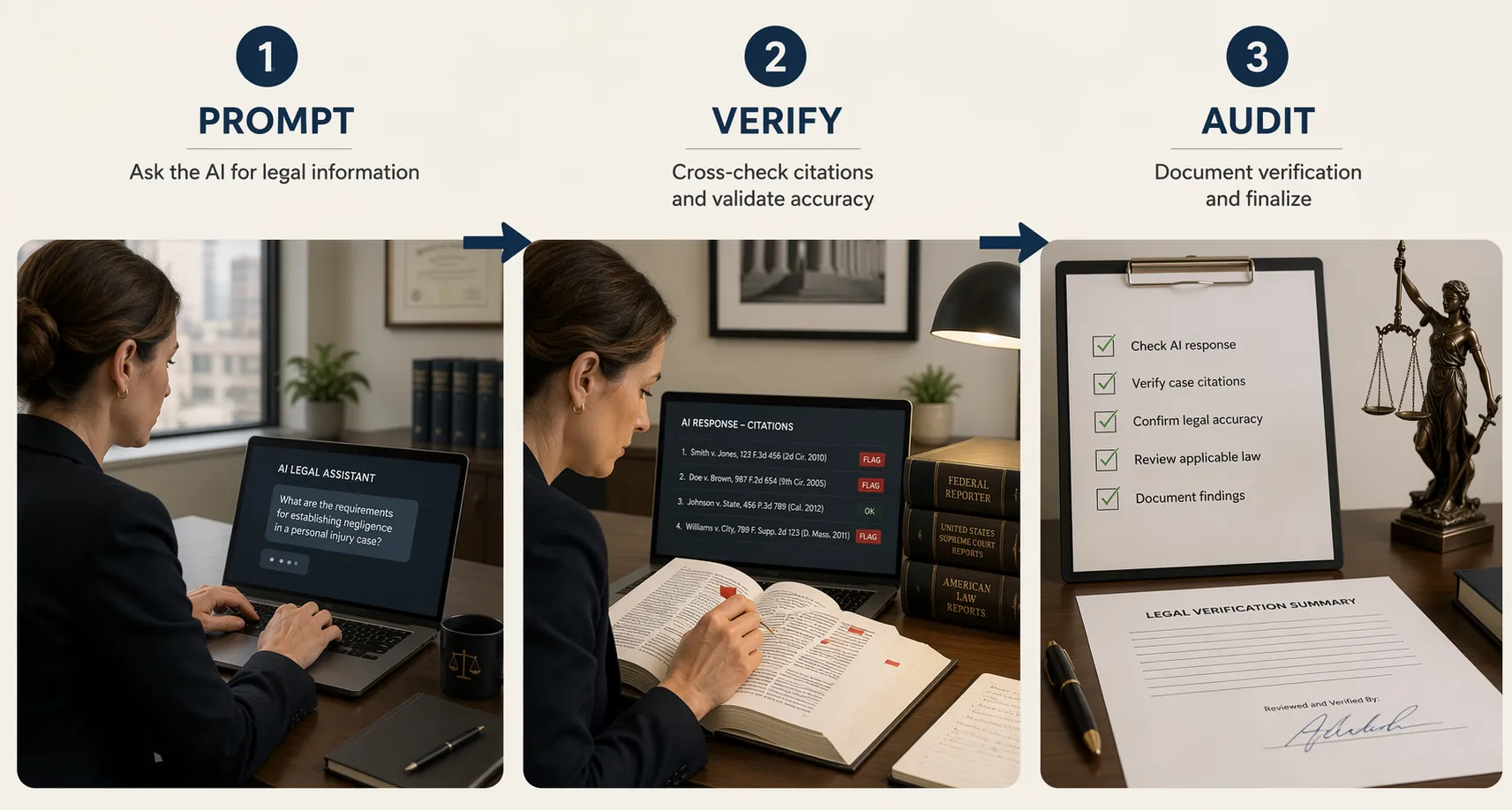
A defensible AI research workflow does not begin and end with a clever prompt. It has three parts: Prompt, Verify, and Audit. The GC AI Level 110 checklist operationalizes that structure and includes red-flag checks for AI legal output. [2]
| Stage | What the junior lawyer does | What the supervising lawyer should be able to see |
|---|---|---|
| Prompt | Frames the task, jurisdiction, time period, procedural posture, and requested output limits. | The question asked was legally bounded, not a vague request for an answer. |
| Verify | Checks each cited source in a reliable database or primary source, then confirms the proposition, quotation, and procedural posture. | Every authority in the draft exists and supports the sentence it is attached to. |
| Audit | Records what was checked, where it was checked, what changed, and what remains uncertain. | The work can be reconstructed if a partner, client, court, or insurer asks what happened. |
The prompt stage is where many AI users feel sophisticated. It is also the easiest stage to overvalue. A good prompt can reduce noise, but it cannot turn an unverified answer into legal research. The prompt should make the tool easier to supervise: specify the jurisdiction, ask for authorities separately from analysis, require caveats where the tool is uncertain, and avoid asking the model to “prove” a conclusion you have already decided to reach.
The verification stage is where the career skill lives.
Verification means checking the sentence, not just the case name
A junior lawyer who verifies AI output is not merely confirming that a case exists. Existence is the floor. The real work is confirming that the cited authority supports the exact proposition in the draft, in the relevant jurisdiction, at the relevant time, with the right procedural posture.
A useful source-by-source check starts with a simple sequence. Open the cited authority outside the AI tool. Confirm the case name, court, date, reporter or database citation, and current treatment. Then read the cited passage and the surrounding context. Only after that should the sentence in the draft survive.
- If the case cannot be found in the cited reporter, database, or court source, treat it as unusable until independently located.
- If the quoted language does not appear in the authority, remove the quotation and recheck the proposition.
- If the case exists but comes from the wrong jurisdiction, mark it as persuasive at most and decide whether it belongs in the filing.
- If the procedural posture differs from the draft’s use, revise the sentence so it does not overclaim.
- If later treatment weakens the authority, flag it instead of hoping nobody notices.
The red flags are not exotic. They are the ordinary things careful lawyers have always checked, made more urgent because generative tools can produce polished-looking errors at filing speed. A hallucinated citation often arrives with the same surface features as a real one: caption, court, year, parenthetical, and a confident explanatory sentence. That is why “it looked right” is not a workflow.
For research memos, verification should happen before the answer is dressed up. A clean memo built on weak authorities is harder to fix because everyone starts reacting to the prose instead of the sources. The better habit is to separate the authority table from the analysis: citation, proposition, source checked, treatment checked, and status. Only authorities that survive that table belong in the polished version.
For briefs, the check should be even less forgiving. Every citation attached to a legal proposition should be traceable. Pinpoint citations should be read against the sentence they support. Parentheticals should not be copied from the AI output unless the lawyer has confirmed that the parenthetical fairly describes the holding or reasoning. If the AI gave a string cite, do not assume the cases all stand for the same point; string cites are where weak checking hides.
The site’s AI legal research hallucination protocol goes deeper on persistent error patterns. The operational point for a new lawyer is simpler: do not let any AI-generated authority move into a filing unless you can say where you checked it and what it supports.
A verification note should be short enough that people actually use it
The audit trail does not need to become a second memo. In many matters, a compact note is more useful because it survives deadline pressure. The point is to make the checking visible.
| Item | Verification entry |
|---|---|
| AI tool used | Name of tool, date used, and whether client or confidential information was entered under firm policy. |
| Task | Research lead generation, draft outline, issue spotting, or cite check. |
| Sources checked | Database or primary source used to confirm each authority. |
| Changes made | Citations removed, propositions narrowed, quotations corrected, or authorities replaced. |
| Open issues | Questions requiring partner judgment, local counsel input, or further research. |
That last row matters. A junior lawyer is not expected to know everything. A junior lawyer is expected to know the difference between checked, unchecked, and uncertain. Supervisors can work with uncertainty. They cannot safely work with confidence that has no paper trail.
The readiness paradox is an opening, not a free pass
There is a real workplace opening for Gen Z lawyers here, although it should be handled carefully. A General Assembly survey conducted from February 12 to 25, 2026, reported that 54% of law firm partners were seen as least prepared to use AI effectively, while 54% of legal firms said associates and analysts were the most prepared; the same survey reported that 71% of law firm leaders expected junior roles to change significantly and 83% planned to hire or train for new AI-centric roles in the next 12 months. [3]
Those numbers should not be overstated. The survey covered 258 leaders across consulting, accounting, and legal firms in the U.K. and U.S., and the law-firm subset and margins of error were not fully disclosed in the materials summarized. [3] It is still a useful signal: some firms believe juniors and analysts are closer to the tools than partners are.
Being closer to the tools is not the same as being safer with them. A self-taught associate who can generate a plausible answer in two minutes may look efficient until someone asks for the authority. The associate who can generate, verify, correct, and document the answer is the one who becomes useful beyond novelty.
This is the practical career advice Gen Z lawyers need in an AI-disrupted legal profession: do not build your identity around being the office AI person. Build your reputation around being the person whose AI-assisted work can be filed after review.
This also answers the anxiety that AI will flatten junior learning. Thomson Reuters reported that 48% of legal professionals are concerned about AI’s impact on independent judgment development. [4] That concern is credible when juniors use tools to skip the friction that used to teach judgment: reading the case, noticing the limiting fact, seeing how one court distinguishes another.
Verification gives that friction back. It forces the junior lawyer to ask why a case matters, whether the proposition is too broad, whether the law is current, and whether the draft is making the court do more work than the authority can bear. That is not clerical checking. It is judgment practice with consequences.
What to practice this quarter
A new lawyer does not need a grand theory of AI to start building this skill in Q3 2026. The practice can be narrow and repeatable.
- Take one AI-generated research answer and create an authority table before drafting any analysis.
- Check each authority in a primary source or trusted legal database, not inside the same AI tool that produced it.
- Rewrite every proposition so it says only what the verified authority supports.
- Keep a short audit note showing the tool used, sources checked, changes made, and unresolved questions.
- Ask the supervising lawyer how they want AI use disclosed internally before the work product circulates.
The disclosure point is not cosmetic. Different matters, clients, courts, and jurisdictions may impose different expectations. Firm policy also matters. A lawyer who knows how to check citations but ignores confidentiality, client instructions, or local rules has only solved part of the problem. For a jurisdiction-aware overview, see the lawyer’s guide to ChatGPT and ethics compliance.
If your firm has no policy, do not fill the silence with improvisation. Ask what tools are approved, what information may be entered, whether client consent is required, how outputs should be labeled, and what audit trail should accompany AI-assisted work. Firms building that infrastructure can use an AI acceptable use policy template as a starting point, but a junior lawyer should not wait for perfect infrastructure before adopting a personal verification habit.
Career advantage has to survive review
There is a compensation and hiring angle, but it should not be mistaken for a shortcut. TruLegal and Law.com predictions for the 2026 legal job market state that legal professionals with AI skills see disproportionately higher raises and that AI-enabled talent commands a hiring premium at the point of hire. [5]
The safest way for a junior lawyer to claim that premium is to define the skill precisely. “I use AI” is weak. “I use approved AI tools for first-pass issue spotting and research leads, then verify every authority against primary sources and maintain an audit note” is much stronger. It tells the interviewer, partner, or client what risk you understand and what step you take to control it.
It also changes the delegation conversation. A partner deciding who should help with a brief is not only asking who can move quickly. She is asking whose work will create the fewest surprises at 11 p.m. the night before filing. The associate with a verification table is easier to trust than the associate with a beautiful draft and no source trail.
This is where Gen Z lawyers can turn an awkward office assumption into actual leverage. Being young may make people assume you are comfortable with tools. It does not prove you are careful with legal consequences. Verification proves something better: that you can absorb a new workflow without abandoning the old professional duty to check the law.
The profession does not need juniors who out-hype AI, and it does not need juniors who perform suspicion of it. It needs lawyers whose AI-assisted work product can be traced, checked, corrected, and safely filed.
References
- The AI Sanction Wave: $145K in Q1 Penalties Signals Courts Have Lost Patience with GenAI Filing Failures, ComplexDiscovery/EDRM, April 2026.
- AI Legal Ethics, GC AI.
- AI Set To Transform Junior Lawyer Roles, Survey Finds, Law360 Pulse.
- How AI Is Transforming the Legal Profession, Thomson Reuters.
- Ten Predictions for the Legal Job Market in 2026, TruLegal/Law.com.
Related records
Tool profile
How Meta's AI Spending Reshapes Law Firm ProfitabilityGoverning regulation
Browse the obligations tracker →Preventive workflow
Browse verification workflows →
Report a correction or tip
Spotted an outdated figure, a misstated fact, or a ruling this case record should reflect? Public comments are disabled for this content given the professional cost of a misreported case outcome, penalty amount, or rule text — use the structured correction channel instead.
Report a correction or tip for this record →