
Air Force One Overrun and the Billion Dollar Boondoggle Act
The VC-25B program's $3.1B cost overrun and four-year delay place it squarely within the thresholds of the proposed Billion Dollar Boondoggle Act, creating a new legislative transparency risk for defense contractors beyond traditional FAR and Tucker Act remedies.
- Jurisdiction
- US Federal
- Court
- U.S. Congress
- AI tool named
- No AI tool implicated
- Ruling date
- Jul 28, 2026
- Source document
- View primary court order ↗
- Last verified
- Jul 29, 2026
Lex Machina Review is an independent risk-tracking and reference resource. Nothing on this site is legal advice, and using it does not create an attorney-client relationship. Every record is reviewed against primary sources but may not reflect the most current status of a matter — always verify directly against the cited court order, rule text, or a licensed attorney before relying on it.
Companion explanation — secondary to the source document above
The legal significance of the Boeing Air Force One cost overrun starts with a threshold test, not with the blue-and-white aircraft. The Billion Dollar Boondoggle Act of 2025, introduced in the Senate as S.766 in the 119th Congress, with House counterpart H.R.1722, would require the Office of Management and Budget to collect and publish annual information on federal projects that are more than $1 billion over budget or more than five years behind schedule.[1] The VC-25B replacement program is now reported at more than $3.1 billion over budget, with delivery pushed from the originally expected 2024 window to at least 2028.[2][3]
That combination matters because the bill is written in the language oversight offices can use: named projects, public reports, dollar thresholds, schedule thresholds, and an annual cadence. It would not reopen Boeing’s contract by itself. It would not create a damages action for taxpayers. It would not decide whether the Air Force should terminate, renegotiate, audit, or continue. But it would make very large failure easier to list, compare, and defend in public.
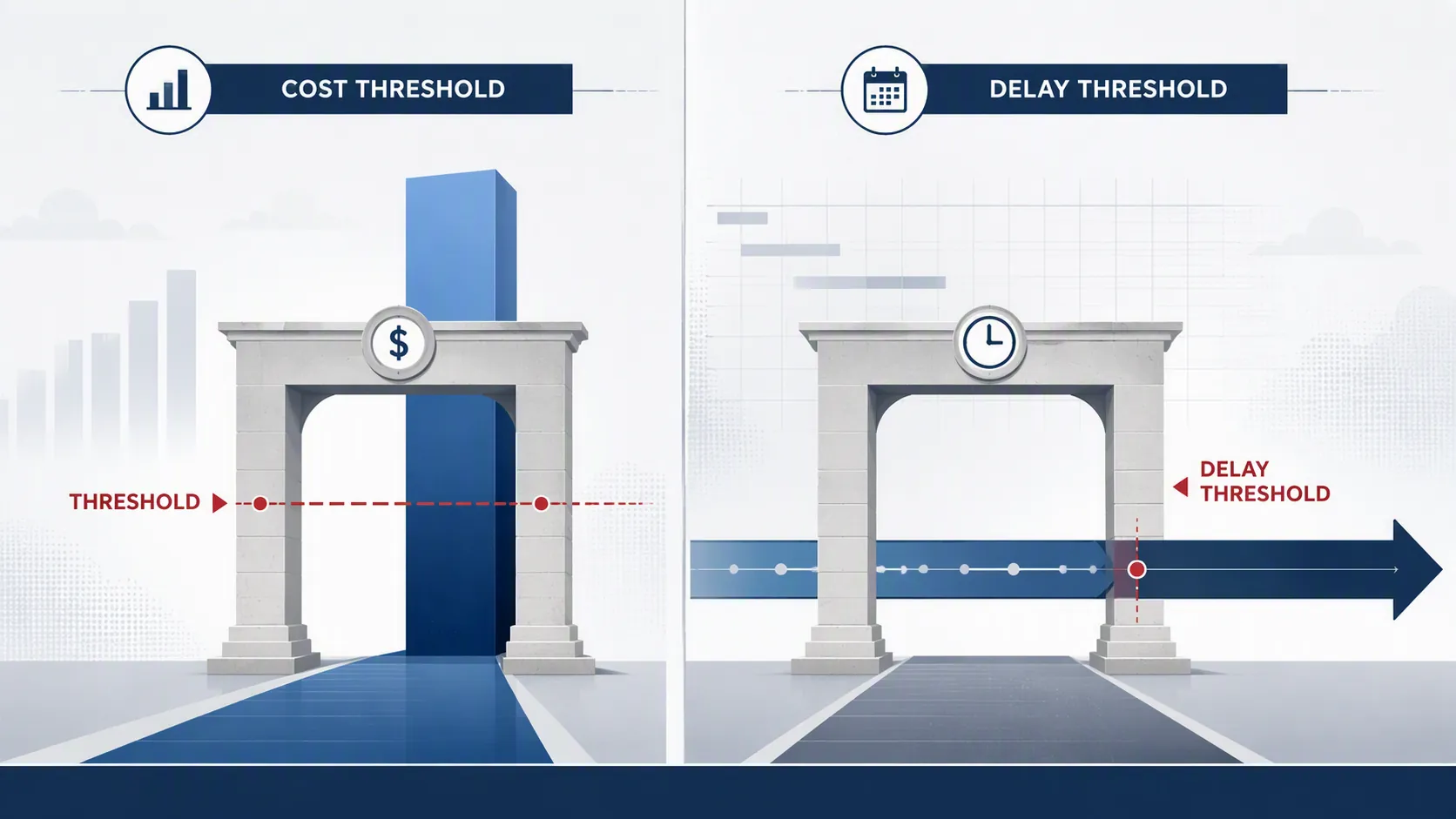
| Proposed reporting trigger | VC-25B public metric | Why it matters |
|---|---|---|
| More than $1 billion over budget | CNN reported more than $3.1 billion in cost overruns in July 2026 | The program clears the cost trigger on the public figures alone |
| More than five years behind schedule | Public reporting describes delivery moving from 2024 to at least 2028 | The cited dates show a major schedule slip; whether the statutory delay trigger is met would depend on the baseline OMB applies |
| Annual OMB collection and publication | A named defense aircraft program with public overrun and delay metrics | The risk is visibility, not a new contractor damages remedy |
What S.766 Would Actually Do
S.766 is not a procurement-law rewrite. Its operative move is disclosure. The bill would require OMB to gather annual information from federal agencies on projects meeting either of two conditions: more than $1 billion over budget or more than five years behind schedule.[1] It was introduced by Sen. Joni Ernst, with a House counterpart associated with Rep. Mariannette Miller-Meeks.[1]
That design is narrower than much of the rhetoric around “boondoggles” suggests. A public-reporting law does not automatically change the Federal Acquisition Regulation clause in a contract. It does not convert a fixed-price development loss into a reimbursable cost. It does not give a disappointed contractor a Tucker Act theory it did not already have. For the contract-level question of why Boeing absorbs fixed-price development pain under FAR 16.202, the companion analysis on Air Force One’s fixed-price contract loss is still the place to start.
But disclosure statutes have their own force. A project that appears in an annual OMB list can become a hearing exhibit without much additional staff work. It can be attached to a letter demanding explanations from the agency. It can be used in a press release, a budget justification exchange, or a future source-selection caution. The contractor may still win the legal argument that the government cannot simply make the contract less fixed-price after the fact. That is a different question from whether the program has become a durable oversight label.
Why VC-25B Is the Obvious Test Case
Sen. Ernst’s office has already connected the proposed Act to the presidential aircraft program. In comments reported by Newsweek in 2025, Ernst said the VC-25B program “could fall under” the Billion Dollar Boondoggle Act.[4] That phrasing is careful. It does not say the bill is law. It does not say OMB has made a statutory determination. It does say the program is the kind of public procurement failure the bill is meant to capture.
The cost side is the cleaner fit. CNN reported on July 28, 2026, that the Air Force One replacement program is more than $3.1 billion over budget.[2] Forbes, citing an Aviation Week estimate, reported the same day that Boeing had taken about $2.8 billion in cumulative charges on the program.[5] Those figures should not be blended as if they measure the same ledger line. One speaks to total program overrun; the other to Boeing’s recognized charges. For S.766’s public reporting threshold, however, the legal exposure point is the same: both figures are far above $1 billion.
The schedule side requires more discipline. Breaking Defense reported in July 2026 that the program’s original delivery date was 2024 and that the current estimate is 2028.[3] On those dates alone, the public record shows a roughly four-year movement from the originally expected delivery window. Because S.766 uses a more-than-five-years-late trigger, a formal reporting conclusion would depend on the baseline and milestone OMB used. The bill’s cost trigger is written as an “or,” not an “and,” so that uncertainty does not rescue the program from the proposed reporting regime if the cost overrun figure is accepted.[1]
That distinction is not a technicality. A lawyer advising a board should not say, loosely, that the known 2024-to-2028 delivery movement itself proves a five-year statutory delay. The better advice is sharper: the cost threshold appears plainly crossed; the schedule record deepens the oversight narrative; and if an agency baseline shows a longer delay than the public delivery comparison, the program may face both triggers.
The 2018 Savings Claim Now Cuts the Other Way
The political paper trail did not begin with the 2026 overrun reports. In 2018, the Air Force announced a $3.9 billion fixed-price contract for two new presidential aircraft, and the White House framed the deal as “saving the taxpayers over $1.4 billion.”[6] That sentence now does work its authors almost certainly did not intend.
Savings claims are attractive at award because they are legible. They give principals a number to repeat and procurement officials a disciplined-contracting story to tell. When the program later carries multibillion-dollar overruns and years of delay, the same legibility becomes a liability. The public record already contains the contrast: the government claimed large savings up front; the program later became a candidate for a statutory list of billion-dollar failures.
That is why the legal implications of the Air Force One cost overrun are not limited to claims, clauses, and equitable adjustment theories. The fixed-price bargain answers one set of questions: who bears excess cost under the contract, what remedies are available, and how much room the contractor has to seek relief. The proposed Act raises another: whether a failed fixed-price development program becomes a recurring public accountability item even after the contractor has absorbed charges on its own books.
Disclosure Risk Sits Beside Contract Risk
Defense contractors tend to separate legal risk into familiar buckets: bid protest risk, performance risk, claims risk, audit risk, suspension and debarment risk, and congressional investigation risk. S.766 belongs closest to the last two, but it is not identical to either. It would create a structured public inventory of very large federal project failures. Once a program is placed in that inventory, the next question is not simply whether the contractor has breached. It is why the agency awarded, monitored, modified, defended, or continued the program in the way it did.
That can matter in the next procurement cycle. A company that explains a fixed-price development overrun only as “we priced the technical risk and took the loss” may be answering the wrong audience. Procurement lawyers may care whether the contract allocated risk. Appropriators and authorizers may care whether the same pricing model, management team, production plan, or agency oversight posture is being carried into the next multibillion-dollar program.
The Pentagon’s current posture does not make that easier for contractors. Steve Grundman, a defense industrial policy expert, told Defense News in January 2024 that “The Pentagon is going to give no quarter” on repricing fixed-price development contracts.[7] If that remains the acquisition-side message, contractors face pressure from both directions: limited appetite for repricing from the buying agency, and increased appetite for public naming from Congress when overruns become large enough.
What Counsel Should Change in the Bid Conversation
The immediate lesson is not that fixed-price development contracts are impossible. That conclusion is too broad and, in any event, not what S.766 proves. The better lesson is that megaproject thresholds now need to be modeled as external accountability events. A program does not have to bankrupt a contractor, trigger default, or produce a successful claim to become a congressional risk item.
- At bid review, counsel should ask whether a plausible downside case crosses a $1 billion overrun threshold, not only whether the contractor can carry the accounting loss.
- Program teams should identify which delivery milestone would be used if Congress, OMB, or an inspector general later measures schedule delay.
- Government affairs staff should preserve the award-stage public statements that may later frame oversight scrutiny.
- Executives should treat “we accepted fixed-price risk” as an incomplete answer when the failed program may later appear in an annual public list.
None of those steps requires pretending that the Billion Dollar Boondoggle Act is already binding. As of July 2026, it was proposed legislation, not enacted law.[1] That status matters. A contractor cannot be penalized today under a reporting statute that Congress has not passed. Nor should a company describe the Act internally as a new procurement remedy or a hidden contract clause.
Still, a bill can be legally relevant before it is enforceable. It can identify the number Congress considers intolerable. It can give staff a ready-made classification for future letters and hearings. It can tell agencies which programs are likely to be used as examples when appropriations subcommittees ask why a fixed-price strategy was selected. For VC-25B, the cost figure has already moved from corporate charge to public oversight metric.
That is the narrower, durable point. The Air Force One replacement program may continue to be fought in contract terms, accounting terms, and engineering terms. But once a defense development program crosses billion-dollar cost territory, and once Congress writes a public-reporting bill around that kind of failure, the contractor’s risk file no longer ends with FAR allocation and claims remedies. It also includes the chance that the program will be named, published, compared, and carried into the next oversight cycle.
References
- S.766 - Billion Dollar Boondoggle Act of 2025, Congress.gov.
- Air Force One replacement program cost overrun report, CNN, July 28, 2026.
- VC-25B delivery estimate report, Breaking Defense, July 2026.
- Air Force One: Trump's Billion Dollar Boondoggle Explained, Newsweek, 2025.
- Boeing's Air Force One charges report, Forbes, July 28, 2026.
- Air Force awards contract for two new Air Force One aircraft, U.S. Air Force, 2018.
- Pentagon fixed-price development contract report, Defense News, January 2024.
Related records
Tool profile
How Meta's AI Spending Reshapes Law Firm ProfitabilityGoverning regulation
Browse the obligations tracker →Preventive workflow
Browse verification workflows →
Report a correction or tip
Spotted an outdated figure, a misstated fact, or a ruling this case record should reflect? Public comments are disabled for this content given the professional cost of a misreported case outcome, penalty amount, or rule text — use the structured correction channel instead.
Report a correction or tip for this record →