
Why Alaska Airlines Can Deny Boarding Without Paying Cash
When Alaska Airlines denies boarding due to a document-verification glitch rather than an oversale, federal law does not require cash compensation. This article examines the Missoula incident and the regulatory gap under 14 CFR Part 250, explaining why the DOT withdrew a proposed rule that would have changed this.
- Jurisdiction
- US Federal
- Court
- Not a court case
- AI tool named
- No AI tool implicated
- Ruling date
- Jul 25, 2026
- Source document
- View primary court order ↗
- Last verified
- Jul 27, 2026
Lex Machina Review is an independent risk-tracking and reference resource. Nothing on this site is legal advice, and using it does not create an attorney-client relationship. Every record is reviewed against primary sources but may not reflect the most current status of a matter — always verify directly against the cited court order, rule text, or a licensed attorney before relying on it.
Companion explanation — secondary to the source document above
Non-advice risk record, verified July 27, 2026 UTC: this article addresses whether current U.S. federal law requires cash compensation when Alaska Airlines refuses boarding for a reason other than overselling a flight. It does not assess whether a specific passenger should file a DOT complaint, bring a contract claim, or pursue state-law remedies. Those questions require counsel and the complete travel record.
The hard question in the Missoula incident is not whether the family’s experience was acceptable. On the reported facts, four lawful permanent residents with valid green cards were stopped twice after Alaska’s document-verification process treated their cards as invalid, forcing them to buy replacement airfare. The narrower legal question is whether that mistake triggered the federal cash-compensation rule for denied boarding.
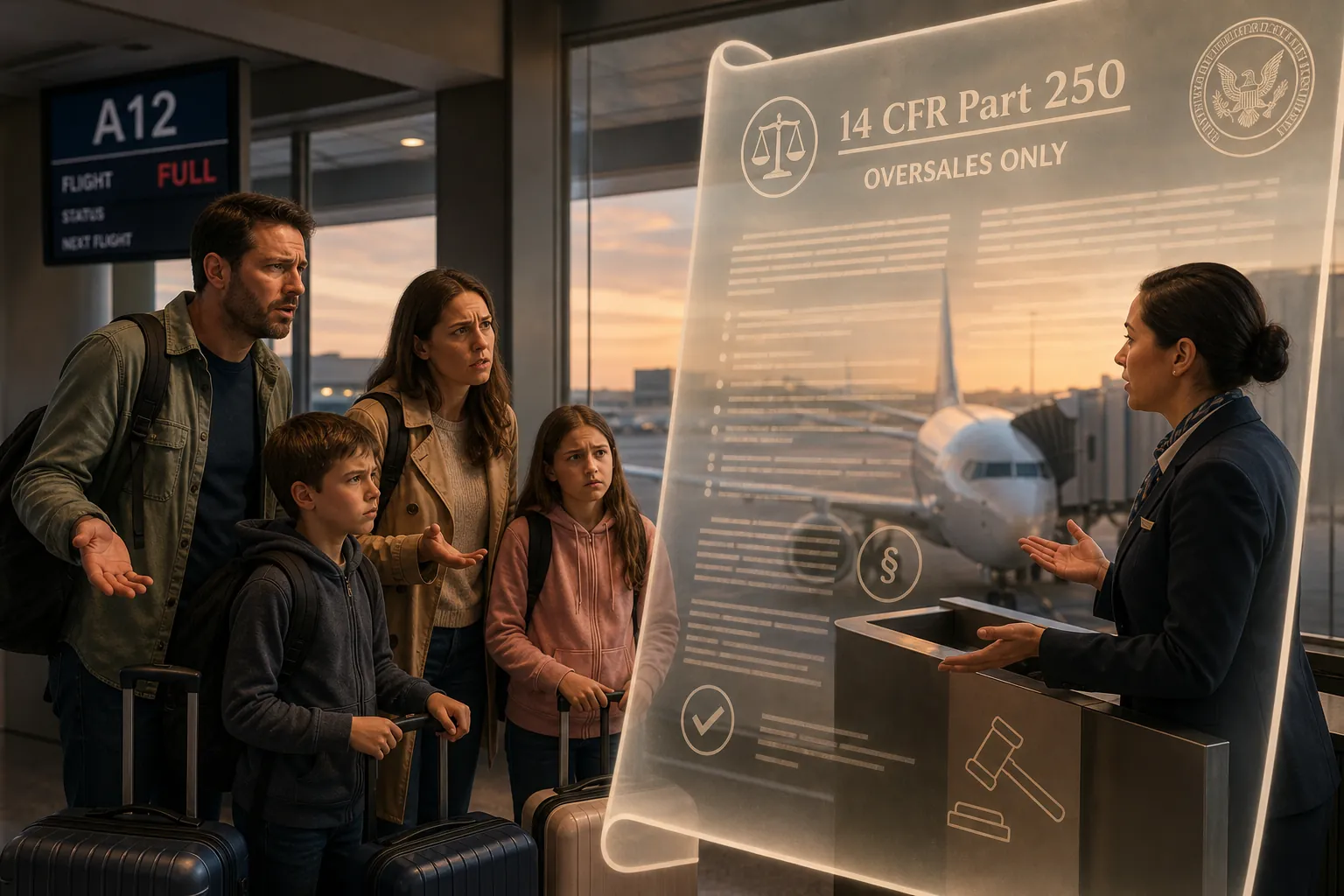
In the Missoula matter, the family reportedly incurred $2,538 in replacement airfare after being denied boarding twice. Alaska later offered $630 for fare differential and $1,600 described as goodwill, for a total of $2,230. Its July 25, 2026 response drew the operative legal line plainly: DOT denied-boarding compensation rules are “specific to oversales situations,” and Alaska said this event resulted from “operational difficulties associated with processing travel documentation, not because the flight was oversold.” [1]
That letter is more useful than a generalized passenger-rights summary because it identifies the disputed hinge. The family was unable to travel on the Alaska itinerary. They were wrongly stopped, based on the materials reported. But under the federal denied-boarding compensation regulation, the question is not simply whether boarding was refused. It is whether the refusal was caused by an oversale.
The legal trigger is narrower than the passenger experience
Ordinary language treats “denied boarding” as any event where a passenger with a ticket is not allowed onto the aircraft. Part 250 does not use the category that broadly. Its compensation rule is built around oversales: the airline accepted more passengers than the aircraft could carry, asked for volunteers, and then refused transport to one or more passengers without their consent because there were not enough seats.
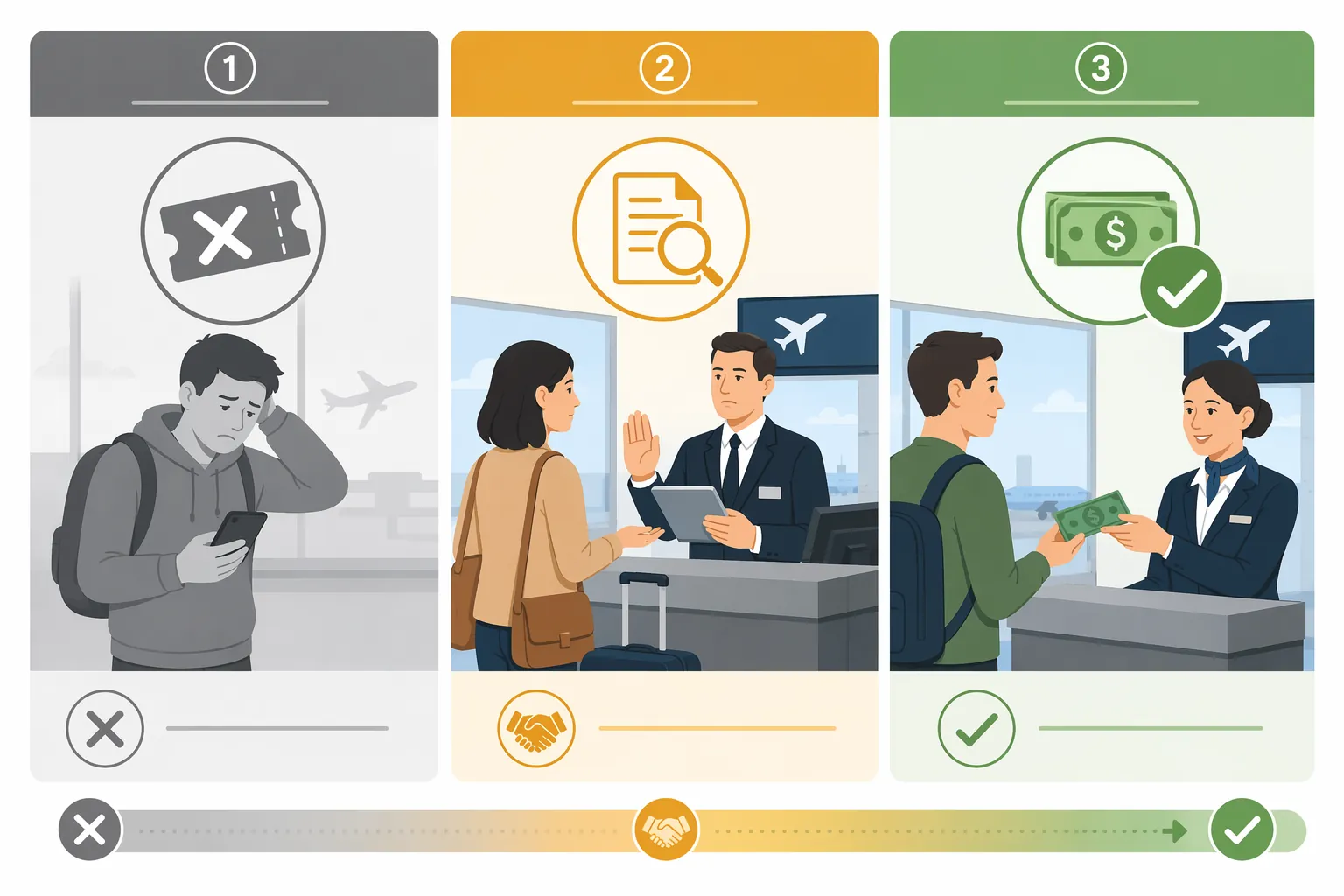
That distinction produces three different records, even if the passenger’s practical loss looks similar:
| Event | What matters legally under current U.S. federal cash-compensation rules | Missoula fit |
|---|---|---|
| Unable to travel | A passenger does not reach the destination on the booked itinerary. | Yes, based on the reported replacement airfare. |
| Denied boarding for a non-oversale reason | The airline refuses boarding because of documentation, system processing, crew judgment, security, operational handling, or another non-oversale cause. | Yes, according to Alaska’s stated reason. |
| Denied boarding because of an oversale | The flight was oversold and the carrier could not accommodate a confirmed passenger. | Not shown in the reported record; Alaska expressly denied this was the cause. |
Part 250’s cash schedule is real, and it can be substantial when the oversales trigger is met. For domestic transportation, the current rule provides compensation at 200% of the one-way fare, capped at $1,075, when substitute transportation is scheduled to arrive more than one hour but less than two hours after the original arrival time; for longer domestic delays, the amount rises to 400% of the one-way fare, capped at $2,150. The same section also sets the rule structure and exceptions for when no denied-boarding compensation is owed. [2]
The Department of Transportation’s public guidance describes the same consumer-facing rule in plainer terms: bumping compensation applies when an airline oversells a flight and denies boarding to passengers involuntarily, subject to the regulation’s conditions and exceptions. [3]
The exceptions are not the center of the Missoula case, but they matter because they show how specifically the rule is drafted. Compensation can be zeroed out for listed circumstances such as certain aircraft substitutions for operational or safety reasons, weight-and-balance limits on smaller aircraft, cabin downgrades, charter flights, small-aircraft operations, and flights departing foreign locations. [2] Those carveouts operate after the regulation’s framework is reached. A document-verification failure reaches a different problem: it does not appear to enter the Part 250 cash-compensation framework at all unless it is tied to an oversale.
Why Alaska’s “goodwill” label matters
Calling $1,600 “goodwill” may sound evasive to a stranded passenger who had to pay new airfare after a carrier-side document failure. Legally, however, the label is doing work. Alaska was not merely saying it preferred to be generous rather than fully compensate the family. It was saying the mandatory federal cash rule did not apply because the denial was not caused by oversales.
On the reported Missoula facts, the passengers have obvious practical arguments: they held valid permanent-resident documentation, the carrier’s process allegedly failed them twice, and the eventual offer did not fully match the reported replacement-airfare cost. Those facts may support a complaint narrative, reputational pressure, a contract argument depending on the carrier’s terms and the full record, or a request for additional discretionary payment. They do not, by themselves, supply the missing federal trigger.
This is where broad “passenger rights” framing can mislead. The phrase “denied boarding” describes the injury. Part 250 asks for the cause. If the cause is oversales, the cash schedule becomes relevant. If the cause is a document-processing glitch, the passenger may still have been treated badly, but the federal denied-boarding compensation rule is not the obvious statutory remedy.
DOT considered a broader rule, then withdrew it
The current gap is not simply the result of consumers overlooking an existing DOT remedy. DOT opened a rulemaking record that would have moved federal compensation closer to the kind of carrier-controlled-disruption rule passengers often assume already exists. Docket DOT-OST-2024-0062 concerned airline passenger rights and would have addressed cash compensation for certain carrier-controlled disruptions, including IT outages. On November 17, 2025, DOT withdrew the proceeding. [4]
The withdrawal notice matters for legal-risk assessment because DOT did not announce that passengers already had a federal cash-compensation right for these failures. It said the advance notice of proposed rulemaking was withdrawn under Executive Orders 14192 and 14219 and that the proposal was “not based on the best reading of the underlying statutory authority.” The record also included an Airlines for America estimate that the proposal could cost the industry $5 billion annually. [4]
That is a firmer boundary than many consumer-facing summaries acknowledge. As of Q3 2026, DOT has not completed a rule that converts carrier-controlled IT outages, document-processing errors, or comparable operational failures into mandatory cash compensation events. The agency considered expanding the regime and then stepped back on statutory-authority grounds.
For counsel evaluating the Missoula facts, the withdrawn rulemaking is not a side note. It explains why Alaska’s position is plausible under federal law even though the customer-service outcome is poor. The federal rule Congress and DOT have in force today is still the oversales rule, not a general airline-fault compensation code.
Other Alaska and system-failure examples point to the same trap
The Missoula incident is not the only reported Alaska fact pattern where the passenger’s loss and the federal cash-compensation trigger diverged. In a November 2024 Prescott matter, The Points Guy reported that a family was removed after boarding because of a ticket-cancellation error. Alaska initially did not classify the matter as a denied-boarding compensation event because the flight was not oversold, and the reported offer was $150 in flight credits before media attention led to a full refund. [5]
That Prescott record should not be overstated. It is a reported customer-service dispute, not a binding interpretation of Part 250. But it is useful pattern evidence: where the carrier-side failure is not an oversale, the airline has strong incentives to frame the remedy as refund, credit, fare adjustment, goodwill, or customer-relations resolution rather than statutory denied-boarding compensation.
The same structure appears outside Alaska. A companion analysis of United Airlines’ August 2025 system failure reaches the same U.S. law problem: system failure may strand passengers, but it does not become mandatory Part 250 cash compensation unless the denial is caused by an oversale.
Canada and the EU show the U.S. choice, not the U.S. rule
Comparative law is useful here only because it prevents the U.S. rule from looking inevitable. Other regimes can define compensable denied boarding more broadly. The TechTimes report on the Missoula dispute described Canada’s Air Passenger Protection Regulations as using a wider denied-boarding concept tied to reasons within the carrier’s control, while also noting that Alaska contested application of that framework in the Missoula case and that Canada’s transport regulator had acknowledged in December 2024 that the current definition “limits the intended scope.” [6]
The same report contrasted the European Union’s EC 261 framework, where denied-boarding compensation can apply more broadly and amounts are described in the €250 to €600 range. [6] That comparison helps identify what U.S. law lacks. It does not supply a U.S. federal claim against Alaska for the Missoula incident.
There is also a record limitation on the Canadian point. The status and effect of proposed Canadian amendments are supported here through secondary reporting, not an independently reviewed final text in force as of this writing. For a U.S.-law assessment, that uncertainty does not change the result. The controlling question remains whether Part 250’s oversales condition was met.
The claim posture under current U.S. law
A careful Alaska denied-boarding file should separate at least four possible theories before assigning value to the claim: regulatory compensation under Part 250, refund or fare-difference issues, contract-of-carriage arguments, and discretionary customer-service relief. Only the first category carries the federal cash-compensation schedule discussed above, and only when the denial was caused by an oversale. Alaska’s Contract of Carriage was not directly reviewed for this record, so any contract theory would need the operative terms.
The available Missoula record is strong on inconvenience and carrier-side processing failure. It is weak, or negative, on the one fact Part 250 requires: oversales. Alaska’s own letter says the flight was not oversold, and the public materials identified here do not establish the contrary. Without that causal link, the mandatory cash-compensation argument under current federal law is poor.
That does not mean the passengers had no leverage. DOT complaints can still create a record of alleged unfair or mishandled carrier conduct. Media attention can change settlement posture. A contract claim may turn on terms and facts not fully available in the public record. The carrier may decide that goodwill should cover more of the documented loss. Those are different tools from Part 250 cash compensation.
The narrow conclusion is the one that matters for counsel and risk managers: under current U.S. federal law, an Alaska Airlines denial caused by a document-verification glitch, IT failure, ticketing error, or similar non-oversale operational problem does not trigger mandatory Part 250 cash compensation. The answer changes only if the denial was caused by an oversale, Congress amends the statute, or DOT begins and completes a new rulemaking with sufficient authority to cover carrier-controlled disruptions.
References
- Alaska Airlines Family Flight Saga Conclusion, One Mile at a Time, July 25, 2026.
- 14 CFR § 250.5, Legal Information Institute.
- Bumping & Oversales, U.S. Department of Transportation.
- Airline Passenger Rights Withdrawal, Federal Register, November 17, 2025.
- Involuntary Denied Boarding Help, The Points Guy, November 19, 2024.
- Alaska Airlines Document Glitch Denied Boarding Twice: Why US Passenger Rules Fell Short, TechTimes, July 26, 2026.
Related records
Tool profile
How Meta's AI Spending Reshapes Law Firm ProfitabilityGoverning regulation
Browse the obligations tracker →Preventive workflow
Browse verification workflows →
Report a correction or tip
Spotted an outdated figure, a misstated fact, or a ruling this case record should reflect? Public comments are disabled for this content given the professional cost of a misreported case outcome, penalty amount, or rule text — use the structured correction channel instead.
Report a correction or tip for this record →