
What Alphabet's Negative Free Cash Flow Means for Legal AI
Alphabet's first-ever negative free cash flow quarter, driven by $44.9B in quarterly AI capex, introduces a new vendor-financial-health risk for legal AI tools running on Google Cloud. This article examines the potential impact on hallucination mitigation patches, enterprise support SLAs, and compliance-oriented investment, and explains why attorneys should add financial indicators to their tool reliability evaluations.
- Jurisdiction
- United States
- AI tool named
- Gemini, Vertex AI
- Ruling date
- Jul 22, 2026
- Source document
- View primary court order ↗
Lex Machina Review is an independent risk-tracking and reference resource. Nothing on this site is legal advice, and using it does not create an attorney-client relationship. Every record is reviewed against primary sources but may not reflect the most current status of a matter — always verify directly against the cited court order, rule text, or a licensed attorney before relying on it.
Companion explanation — secondary to the source document above
The procurement question after Alphabet’s negative free cash flow quarter is not whether every Google-powered legal AI tool suddenly became unsafe. It is narrower and more useful: if a legal research, drafting, or document-review product depends on Gemini, Vertex AI, or Google Cloud infrastructure, should Alphabet’s AI spending implications now sit inside the reliability review rather than off to the side as an investor concern?
For legal teams, the answer is yes, but with discipline. Alphabet reported free cash flow of -$5.9 billion in Q2 2026, described in available reporting as its first negative quarter since going public, while quarterly capital expenditures reached $44.9 billion and full-year capex guidance rose to $195 billion to $205 billion.[1][2] Those figures do not prove that a legal AI product will hallucinate more often next month, or that an enterprise support ticket will go unanswered. They do make financial capacity and prioritization part of the operational risk picture.

What the earnings data actually says
The cleanest reading starts with the tension in the numbers. Alphabet is spending at a level that changes its cash profile, but Google Cloud is not a weak business being propped up by hope. Reuters reported that Google Cloud revenue rose 82% year over year to $24.8 billion in Q2 2026, with a 34% operating margin.[2] Backlog reached $514 billion, up from $240 billion in Q4 2025, showing demand still outstrips available capacity.[2]
That is why the lazy version of the argument fails. Negative free cash flow, by itself, is not evidence of an imminent service-quality problem. It can reflect a deliberate infrastructure buildout into visible demand. For a cloud platform selling AI compute, backlog and margin matter. They are part of the risk analysis, not inconvenient counterpoints to be ignored.
The pressure is still real. Alphabet has raised about $141 billion in debt and equity since October 2025, including an $84.75 billion equity sale described as its first share sale in more than two decades.[3][4] In February, Evercore warned that hyperscaler 12-month forward free cash flow had already fallen below 2022 cycle lows, calling the pattern a “red flag” for the sector.[5] That is not a legal AI reliability finding. It is a financing and capital-allocation signal.
| Indicator | Reported figure | Why a legal AI buyer should care |
|---|---|---|
| Q2 2026 free cash flow | -$5.9B | Signals cash pressure from the current AI buildout, not immediate product failure |
| Q2 2026 capex | $44.9B | Shows the scale of infrastructure investment competing for capital |
| FY2026 capex guidance | $195B-$205B | Makes the issue multi-quarter, not just an earnings headline |
| Google Cloud revenue | $24.8B, up 82% YoY | Supports the counterargument that AI monetization and customer demand are real |
| Google Cloud backlog | $514B | Suggests capacity remains strategically important and commercially valuable |
Known facts are not the same as reliability conclusions
No cited source in the available record directly shows that Alphabet’s free-cash-flow compression has slowed hallucination mitigation, weakened Vertex AI support, delayed Gemini safety updates, or reduced compliance engineering for legal customers. That distinction matters. A legal department should not turn a cash-flow chart into a technical incident report.
The concern is an operational dependency, not a proven defect. Legal AI tools depend on continuing work that rarely appears in a product demo: model evaluation, retrieval tuning, citation checking, abuse monitoring, guardrail updates, enterprise support staffing, audit logging, data-residency controls, contract review, regulator-facing documentation, and incident response. Some of that work helps win new customers. Some of it keeps existing customers out of trouble. Under sustained capital pressure, the second category is the one buyers should ask about.
This is especially important where the law firm or legal department is not buying directly from Google. Many legal AI products sit between the legal user and the hyperscaler. The vendor controls the user experience, instruction layer, retrieval layer, and support relationship. Google may control the underlying model, cloud capacity, infrastructure pricing, and some platform-level safeguards. When something goes wrong, the lawyer does not get to explain that responsibility was distributed across the stack.
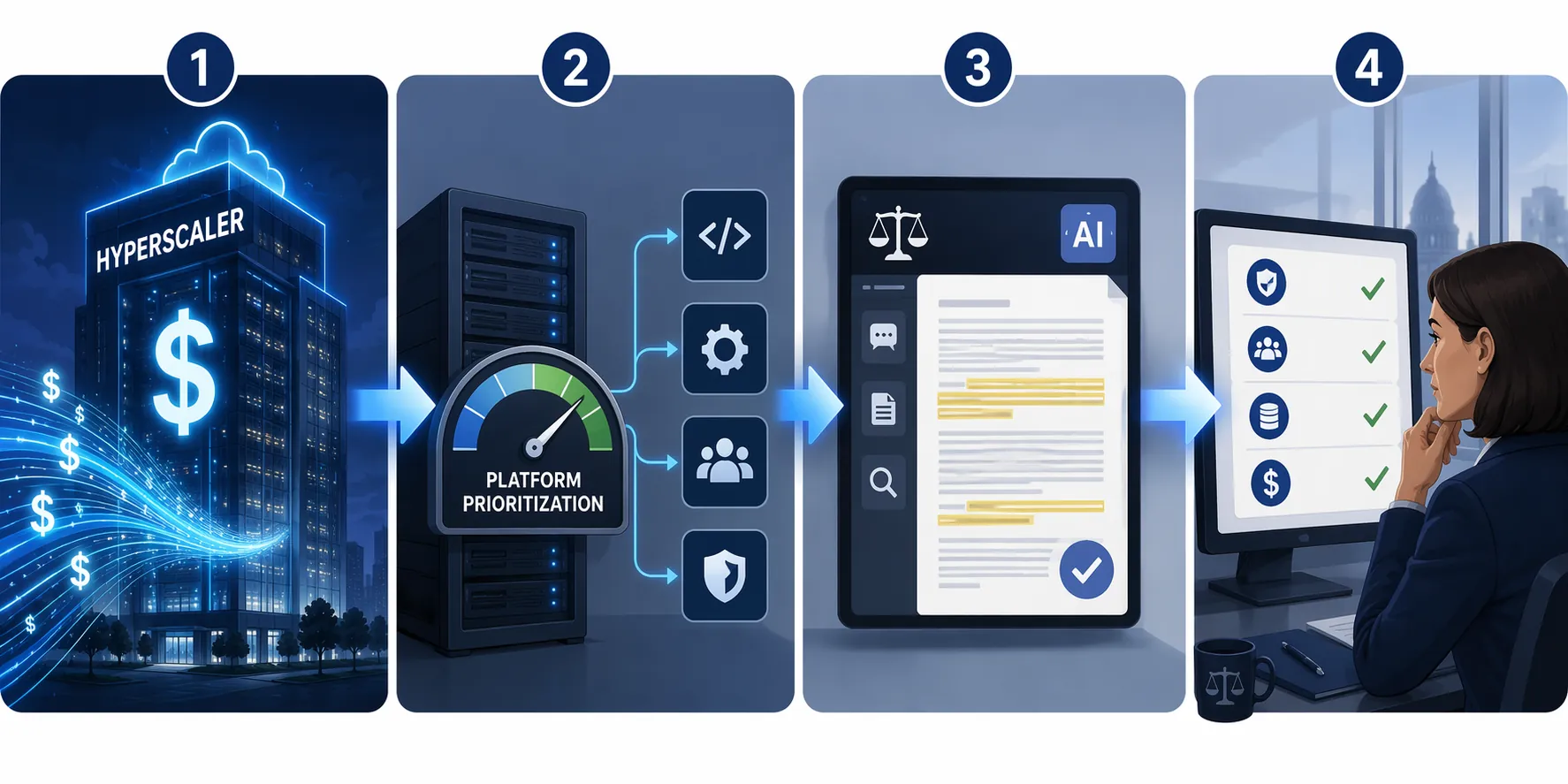
Where financial pressure could reach a legal workflow
The practical chain is not complicated, but it is easy to miss in ordinary procurement reviews. Hyperscaler spending affects capital allocation. Capital allocation affects which platform teams get resources and how quickly non-revenue engineering work moves. Platform changes affect downstream vendors. Downstream vendors turn those changes into response times, feature delays, pricing changes, or new limitations in legal workflows.
A legal team might experience that chain in modest ways before seeing anything dramatic. A vendor takes longer to ship a fix for faulty citation handling. A support escalation moves from a named enterprise channel into a general queue. A promised audit-log enhancement slips into the next renewal cycle. A vendor limits use of a more expensive model for long-document review unless the customer moves to a higher tier. None of those outcomes is established by Alphabet’s Q2 numbers. All are the kind of consequences that become more plausible when infrastructure costs rise and every nonessential engineering commitment has to justify itself.
The difference between direct and indirect dependency matters. A legal department using Gemini Enterprise or Vertex AI directly can press Google for platform commitments, service levels, data controls, and support terms. A law firm using a third-party brief-analysis tool built on Google Cloud has to ask what the vendor can actually control. The vendor may have excellent legal-domain safeguards and still be exposed to upstream changes in model pricing, rate limits, regional capacity, or support priority.
Why legal AI reliability is not ordinary software quality
Every software buyer cares about uptime and support. Legal AI adds a different failure mode: a fluent answer can be wrong in a way that looks usable until a lawyer, court, regulator, client, or opposing counsel catches it. Documented AI hallucination cases in litigation have continued to accumulate globally, with third-party summaries of the Damien Charlotin database reporting more than 1,200 cases by mid-2026 and more than $145,000 in U.S. sanctions in Q1 2026 alone; those figures should be treated as directional unless verified against primary sanctions updates before citation in client-facing materials.[6]
Those figures should not become the center of the procurement analysis. They do not measure how often legal AI tools fail in ordinary use, and they do not isolate Google-powered tools. Their value is narrower: they explain why reliability work in legal AI is not cosmetic. A hallucination patch, a citation-verification workflow, or an escalation path for a defective answer can be the difference between a correctable tool error and a professional-responsibility problem.
That is why “enterprise-grade” deserves unpacking. In legal AI, it should not mean only encryption, SSO, SOC reports, and a polished admin console. It should include an answer to who maintains the accuracy layer, who tests regressions after model changes, who reviews legal-domain failures, who owns the support queue, and who pays for work that protects the customer without immediately expanding revenue.
What to add to a legal AI evaluation
Alphabet’s Q2 2026 cash-flow result should not replace accuracy testing, contract diligence, human verification, or incident-history review. It belongs beside them. The procurement file should show that the team asked not only whether the tool works in a benchmark setting, but whether the vendor can keep it working when upstream infrastructure economics change.
Start with dependency mapping. Ask the vendor which parts of the product materially depend on Gemini, Vertex AI, Google Cloud regions, Google-managed retrieval or embedding services, or other Google infrastructure. A vague answer that the product is “cloud agnostic” is not enough if the current production environment is not actually portable. Portability matters only if the vendor has tested migration, priced it, and knows which features would degrade during a move.
Then press on support insulation. If Google changes pricing, rate limits, model availability, region capacity, or support tiers, what obligations does the legal AI vendor still owe the customer? The answer should appear in the contract or support documentation, not just in a sales call. For high-risk uses such as filing support, privilege review, regulatory response, or board materials, the buyer should know whether escalation depends on the vendor’s own staff or on an upstream ticket the customer cannot see.
Hallucination mitigation needs the same treatment as security patching. Ask how the vendor identifies defective legal outputs, how frequently it ships retrieval or model-behavior updates, whether regression tests include legal citations and jurisdiction-sensitive tasks, and how customers are notified when an accuracy-related fix changes prior behavior. If the vendor relies on Google model updates, ask what additional legal-domain testing occurs before those updates reach production.
Cost pass-through belongs in the discussion as well. A vendor built on expensive frontier models may respond to upstream cost increases by raising prices, throttling usage, changing default models, limiting context windows, or reserving stronger verification features for premium plans. None of those responses is automatically unreasonable. The risk is discovering the change after lawyers have embedded the tool into a review or drafting workflow.
A short renewal checklist
- Identify material Google dependencies: models, regions, storage, embeddings, retrieval, monitoring, and support channels.
- Require a written explanation of how support obligations survive upstream pricing, capacity, or model changes.
- Ask how hallucination reports become product fixes, who reviews them, and how quickly legal-domain regressions are tested.
- Review whether compliance features such as audit logs, data-residency controls, retention settings, and admin reporting are funded roadmap items or custom promises.
- Track vendor-financial-health indicators at renewal, including upstream cloud concentration, infrastructure-cost exposure, support staffing, and material changes in model usage terms.
The procurement implication
Alphabet’s negative free cash flow does not justify abandoning Google-powered legal AI tools. The available data supports a more measured conclusion: Google Cloud demand is strong, the AI buildout is enormous, and the resulting cash pressure is significant enough that legal buyers should treat upstream financial health as a reliability factor.
That factor should be handled like other procurement risks. It should be documented, assigned to an owner, monitored at renewal, and tied to concrete vendor commitments. The useful question is not whether Alphabet’s spending is sustainable as a market thesis. It is whether the legal AI vendor can keep funding the quiet work that legal users depend on: citation safeguards, regression testing, compliance controls, escalation paths, and timely fixes when the model produces an answer a lawyer cannot defend.
References
- Alphabet's AI spending pushes free cash flow into the red for first time, Seeking Alpha, July 22, 2026.
- Google increases capex forecast again after cloud-driven quarterly beat, Reuters, July 22, 2026.
- Alphabet resets the bar for AI infrastructure spending, CNBC, February 4, 2026.
- Alphabet raises funds after AI spending pushes free cash flow negative, Firstpost, July 23, 2026.
- Big Tech approaches 'red flag' moment, Fortune, February 17, 2026.
- AI Hallucination Cases Database, Damien Charlotin.
Related records
Tool profile
How Meta's AI Spending Reshapes Law Firm ProfitabilityGoverning regulation
Browse the obligations tracker →Preventive workflow
Browse verification workflows →
Report a correction or tip
Spotted an outdated figure, a misstated fact, or a ruling this case record should reflect? Public comments are disabled for this content given the professional cost of a misreported case outcome, penalty amount, or rule text — use the structured correction channel instead.
Report a correction or tip for this record →