
Amazon Prime Settlement Deadline Creates a New Compliance Baseline
The $2.5 billion Amazon Prime settlement establishes a de facto compliance standard for subscription enrollment and cancellation design—here are the specific conduct requirements every subscription business should audit against before the July 27 claim deadline.
- Jurisdiction
- US Federal
- Court
- US District Court
- AI tool named
- No AI tool implicated
- Ruling date
- Sep 1, 2025
- Source document
- View primary court order ↗
- Last verified
- Jul 25, 2026
Lex Machina Review is an independent risk-tracking and reference resource. Nothing on this site is legal advice, and using it does not create an attorney-client relationship. Every record is reviewed against primary sources but may not reflect the most current status of a matter — always verify directly against the cited court order, rule text, or a licensed attorney before relying on it.
Companion explanation — secondary to the source document above
The consumer-facing clock is the reason the Amazon Prime settlement is back in circulation: the FTC refund page now lists July 27, 2026, as the Amazon Prime settlement claim deadline and caps claims at $51 per claimant.[1] That deadline matters for consumers. For subscription businesses, it is mostly the reminder that a court order now sits behind the refund process.
The business-risk answer is more direct than the payout discussion. Yes, the settlement meaningfully changes enforcement risk for subscription enrollment and cancellation design. Not because every company is now bound by Amazon’s order, but because the order gives regulators, plaintiffs, board committees, and internal audit teams a concrete set of inspection criteria while the FTC’s broader Click-to-Cancel Rule remains unsettled.
Readers looking for the consumer filing mechanics can use the companion guide on Amazon Prime settlement eligibility and how to file. This piece treats the settlement as a compliance-risk record: what an enrollment screen must show, what must happen before billing information is collected, how cancellation must work, and what happens when design governance fails.

The Order Is the Operative Document
The settlement’s size gets attention for the right reason. The FTC described the $2.5 billion judgment as $1.4 billion in consumer restitution plus a $1.1 billion civil penalty, with the civil penalty identified as the largest ever obtained under ROSCA and only the third ROSCA civil penalty in agency history.[2] That is the kind of number that reaches executives who do not read negative-option billing guidance for recreation.
But the more durable compliance value is in the stipulated order. It converts subscription-design criticism into enforceable requirements: a visible way to decline before billing, material-term disclosure before billing information is collected, cancellation through the same method used to enroll, and a ten-year independent compliance monitor.[3]
That distinction matters. The order binds Amazon and the individual defendants subject to it; it is not a statute and it is not a replacement rule of general applicability. Still, sophisticated subscription businesses are unlikely to treat it as a one-company curiosity. Once the FTC has put these conditions into a filed court order, the next review of a negative-option flow has a ready-made comparison set.
Four Inspection Points for Negative-Option Billing
The useful audit is not a general debate over whether a product team used “dark patterns.” It is a screen-by-screen review against the conduct terms in the order. The first three requirements belong in product-flow testing. The monitor requirement belongs in governance review, because it shows how intrusive the remedy can become when the company cannot prove that compliance controlled the design.
| Order requirement | Audit question |
|---|---|
| Clear and conspicuous decline button before billing | Can an ordinary user decline the subscription before being charged, without hunting for a secondary path or reading around a visually dominant enrollment prompt?[3] |
| Disclosure of all material terms before collecting billing information | Are price, renewal, billing frequency, cancellation terms, and other material conditions shown before the company collects payment details?[3] |
| Cancellation through the same method used for enrollment | If the user enrolled online, can the user cancel online without being pushed into a different channel or materially heavier process?[3] |
| Independent third-party compliance monitor for ten years | Has the company created evidence that enrollment and cancellation design were reviewed, tested, escalated, and corrected before an outside monitor or regulator has to do it?[3] |
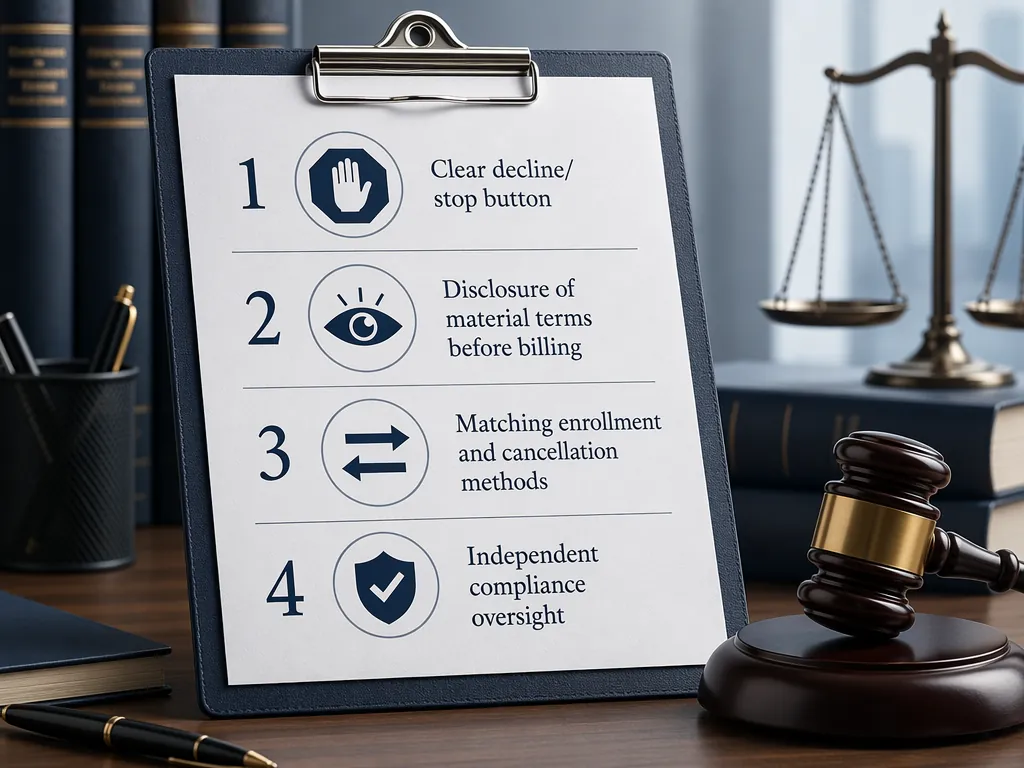
The Decline Button Is a Billing Control, Not Decorative Text
A pre-billing decline path is where many subscription funnels become fragile. The order does not merely say that a company should avoid deception in the abstract. It requires a clear and conspicuous decline mechanism before the consumer is billed.[3] That moves the review from brand tone to layout, sequencing, contrast, placement, button hierarchy, and whether the negative choice appears at the moment it still matters.
A compliance team reviewing a checkout flow should not ask only whether the words “no thanks” exist somewhere. It should ask what the user sees before the charge is authorized. If enrollment is presented as the primary path and refusal is buried under a fold, disguised as a low-contrast link, delayed until after billing information is entered, or separated from the decision screen, the company has a design fact that a regulator can describe without needing to infer much.
Material Terms Must Appear Before Payment Collection
The second requirement is a sequencing rule. The order requires disclosure of all material terms before collecting billing information.[3] A company that waits to show renewal terms, post-trial pricing, billing cadence, cancellation conditions, or automatic-renewal language until after payment details are captured has created a recordable event: it collected before it disclosed.
That is a cleaner compliance question than many teams expect. The audit can be run with a timestamped screen capture: first screen containing material terms, first field where billing information is requested, first affirmative consent action, and first charge authorization. If the order of those events is wrong, legal review after launch will not fix the user experience that already occurred.
Same-Method Cancellation Is About Friction Parity
The order also requires cancellation through the same method used for enrollment.[3] That language is narrower than a general wish for “easy cancellation” and more useful in an audit. If the user can subscribe on the website, the user should not have to call, chat, mail, wait for a retention agent, or navigate a materially different channel to stop the recurring charge.
Method matching does not eliminate every permissible confirmation screen. It does make asymmetry expensive. The question is not whether the cancellation path contains any retention content. The question is whether the company made cancellation depend on a different route, different burden, or different level of persistence than enrollment required.
The Monitor Requirement Is a Severity Signal
The ten-year independent third-party compliance monitor is not a universal checklist item for every subscription business. It is a remedy imposed in this settlement.[3] Its broader significance is what it says about lost trust. When a regulator concludes that internal controls did not prevent unlawful subscription practices, the remedy can move from “change the screens” to “pay for someone outside the company to watch the screens, documents, and controls for years.”
That is why documentation matters. A company should be able to show who reviewed the enrollment path, who reviewed cancellation, what objections were raised, what A/B tests were considered, whether legal advice changed the design, and who approved the final version. Those records can be inconvenient. The absence of them can be worse.
The Iliad Flow Shows Why Asymmetry Became Liability
The Amazon record has become shorthand because the contrast is easy to understand: one-click enrollment on one side, and a cancellation process described as four pages, six clicks, and fifteen options on the other.[4][5] The “Iliad Flow” label was memorable, but the legal risk did not come from the nickname. It came from the mismatch between the ease of entering the paid relationship and the work required to leave it.
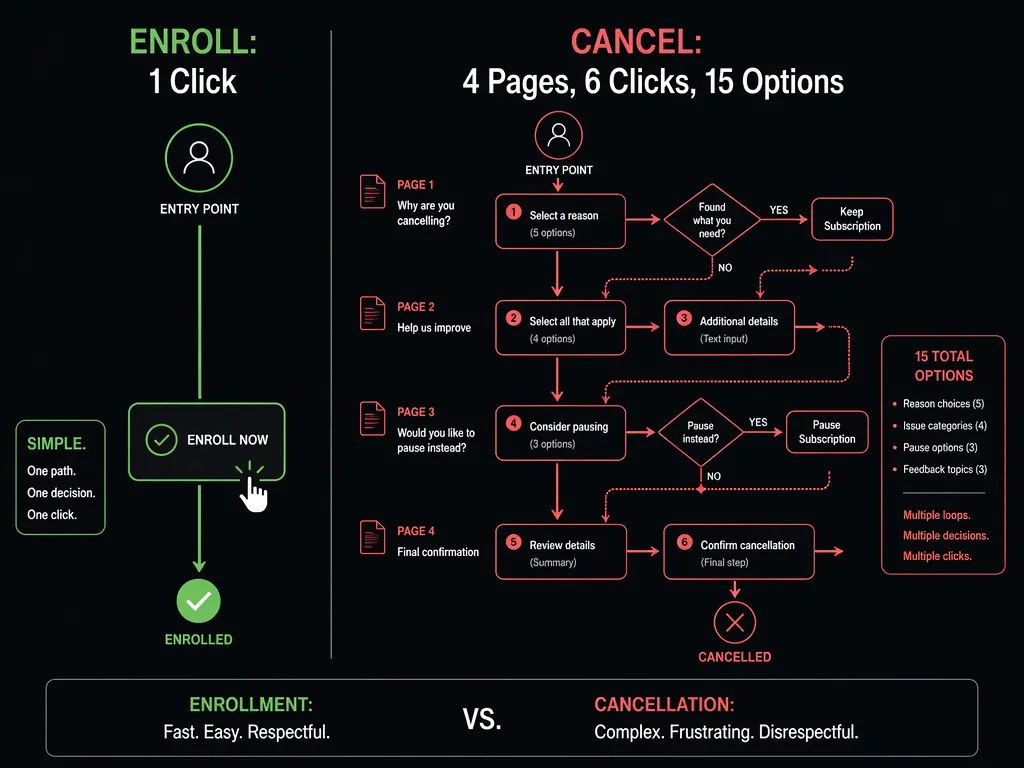
That mismatch is precisely what makes the settlement useful as an audit model. A reviewer can walk the live product flow and count the same things: pages, clicks, prompts, confirmations, offers, detours, required scrolls, default selections, and channel changes. None of those facts alone proves a violation in every context. Together, they show whether the business engineered enrollment as a low-friction event and cancellation as a persistence test.
The most revealing comparison is usually not cancellation against an idealized standard. It is cancellation against the company’s own enrollment path. Product teams already know how to remove friction when the metric is conversion. The Amazon settlement makes the reverse side of that design competence discoverable: if the company can make joining simple, why did it make leaving so much harder?
Knowing Conduct Can Be Written in Ordinary Email
The settlement also carries a governance warning. Law-firm advisories discussing the case point to internal Amazon language such as “subscription driving is a bit of a shady world” and unwanted subscriptions as “an unspoken cancer.”[6][7] The importance of that language is not that it sounds bad in hindsight. It is that routine internal communications can help establish that people inside the company understood the problem while the design remained in place.
This is where subscription-risk review leaves the UX team’s ticket queue and becomes an executive-governance issue. If internal reviewers identify a confusing decline path, a late disclosure, or a cancellation maze, the company has to decide whether that concern is a blocker, a launch risk, or a note buried in a thread. The enforcement consequence can turn on that difference.
The naming of senior subscription executives sharpened that point. Neil Lindsay, an Amazon senior vice president, and Jamil Ghani, a vice president, were named as individual defendants; advisories report that motions to dismiss were denied and that the final resolution included three-year personal injunctive orders.[5][7] Individual naming will not follow every subscription case. It does, however, change the conversation for leaders who own growth, Prime-like membership economics, or recurring-revenue funnels.
The Click-to-Cancel Vacatur Did Not Remove the Risk
The timing matters because the FTC’s Negative Option Rule, often described as the Click-to-Cancel Rule, was vacated by the Eighth Circuit in July 2025, days before the compliance deadline.[8] That vacatur left many companies asking what standard would actually govern subscription cancellation design.
The Amazon settlement does not resurrect the vacated rule. It also does not impose its terms on companies that were not parties to the case. But the stipulated order now functions as the practical benchmark unless and until the FTC successfully issues a new rule or a different court-enforceable standard becomes more relevant. The order itself anticipates that an amended FTC rule could supersede certain settlement conduct terms if re-promulgated.[3]
That leaves subscription businesses in a familiar posture: the formal rule landscape is in flux, but the enforcement record is not empty. A company waiting for perfect regulatory finality before fixing an obvious cancellation imbalance is choosing to preserve evidence of the imbalance.
What to Audit Before the Next Enforcement Letter
The immediate audit should use the order’s four requirements as the template. Start with the live user flow, not the policy deck. Capture the enrollment path from first offer through billing authorization. Capture the cancellation path from account entry through final confirmation. Preserve the screens the way a consumer, regulator, or plaintiff would see them.
- Confirm that the user sees a clear and conspicuous decline option before billing.
- Confirm that all material subscription terms appear before billing information is collected.
- Compare enrollment and cancellation by method, channel, clicks, pages, prompts, and required waiting.
- Review internal communications for known concerns that were acknowledged but not resolved.
- Document who approved the final flow and what changes were made in response to legal or compliance review.
The July 27 claim deadline will pass. The conduct standard will not. Subscription businesses should treat the Amazon order as the current audit template for negative-option billing, verify their own flows against the four requirements, and document who reviewed the design before the next regulator, plaintiff, or board committee asks the same question.
References
- Amazon refunds, Federal Trade Commission, July 2026.
- FTC Secures Historic $2.5 Billion Settlement Against Amazon, Federal Trade Commission, September 2025.
- Amazon ROSCA Order Filed, Federal Trade Commission, September 2025.
- Amazon’s $2.5B Dark Patterns Settlement: What All E-Retailers Must Change Now, Fair Patterns, October 2025.
- FTC’s Landmark $2.5 Billion Amazon Settlement Highlights Ongoing Focus on Dark Patterns, Katten, October 2025.
- FTC Settlement Prime Subscription Practices, Alston & Bird, October 2025.
- An Amazonian-Sized Settlement: FTC Secures $2.5 Billion Against Amazon for Use of Dark Patterns in Prime Enrollment Scheme, Davis+Gilbert, October 2025.
- Eighth Circuit Vacates FTC Click-to-Cancel Rule Days Before Compliance Deadline, Latham & Watkins, July 2025.
Related records
Tool profile
How Meta's AI Spending Reshapes Law Firm ProfitabilityGoverning regulation
Browse the obligations tracker →Preventive workflow
Browse verification workflows →
Report a correction or tip
Spotted an outdated figure, a misstated fact, or a ruling this case record should reflect? Public comments are disabled for this content given the professional cost of a misreported case outcome, penalty amount, or rule text — use the structured correction channel instead.
Report a correction or tip for this record →