
The Amazon Trump tariff refund lawsuit, explained
Verified case record showing that the "Amazon Trump tariff refund lawsuit" is two linked proceedings: the consolidated consumer class actions against Amazon and the Supreme Court/CIT machinery controlling who may claim IEEPA duties. It includes docket numbers, a dated timeline, Amazon's stated defenses, and the current status of each proceeding as of Q3 2026.
- Jurisdiction
- US-Federal
- Court
- U.S. District Court for the Western District of Washington; U.S. Supreme Court; U.S. Court of International Trade
- Judge
- Tana Lin
- AI tool named
- No AI tool named
- Ruling date
- Feb 20, 2026
- Source document
- View primary court order ↗
- Last verified
- Aug 1, 2026
Lex Machina Review is an independent risk-tracking and reference resource. Nothing on this site is legal advice, and using it does not create an attorney-client relationship. Every record is reviewed against primary sources but may not reflect the most current status of a matter — always verify directly against the cited court order, rule text, or a licensed attorney before relying on it.
Companion explanation — secondary to the source document above
Last verified: August 1, 2026, UTC. This is a case-record explainer, not legal advice. Legal review: pending named publication reviewer. The phrase “Amazon Trump tariff refund lawsuit” refers to two linked proceedings, not one case, and the record reviewed here does not show any Q3 2026 court order requiring Amazon to pass tariff refunds through to consumers. Primary materials checked for this record include the Amazon consumer-action materials, the Supreme Court tariff decision materials, and the Court of International Trade refund-order materials. [1][2][3][4][5][6]
| Track | Proceeding | Where it sits as of Q3 2026 | Why it matters |
|---|---|---|---|
| Consumer actions against Amazon | Markland v. Amazon.com, Inc., No. 2:26-cv-01670, filed May 15, 2026, and Rosen v. Amazon.com, Inc., No. 2:26-cv-01823, filed May 28, 2026, in the Western District of Washington; consolidated before Judge Tana Lin; consolidated amended complaint filed July 30, 2026. [1][2] | Plaintiffs plead consumer claims, including unjust enrichment and Washington Consumer Protection Act theories, over goods allegedly sold by Amazon during the tariff period. [1][2] | This is the track that could, if plaintiffs succeed, create consumer recovery from Amazon. It is not the CBP refund process. |
| Government tariff-refund machinery | Learning Resources, Inc. v. Trump, U.S. No. 24-1287, and V.O.S. Selections, No. 25-250; plus Atmus Filtration Technologies Inc. v. United States, Ct. No. 26-1259, in the Court of International Trade. [3][4][5][6] | The Supreme Court held 6-3 on February 20, 2026, that IEEPA did not authorize the presidential tariffs at issue; the Court vacated and remanded Learning Resources for dismissal for lack of jurisdiction and affirmed V.O.S. Selections. [3][4] | This is the track that controls importer refund claims against CBP. It does not, by itself, decide whether Amazon customers receive money. |
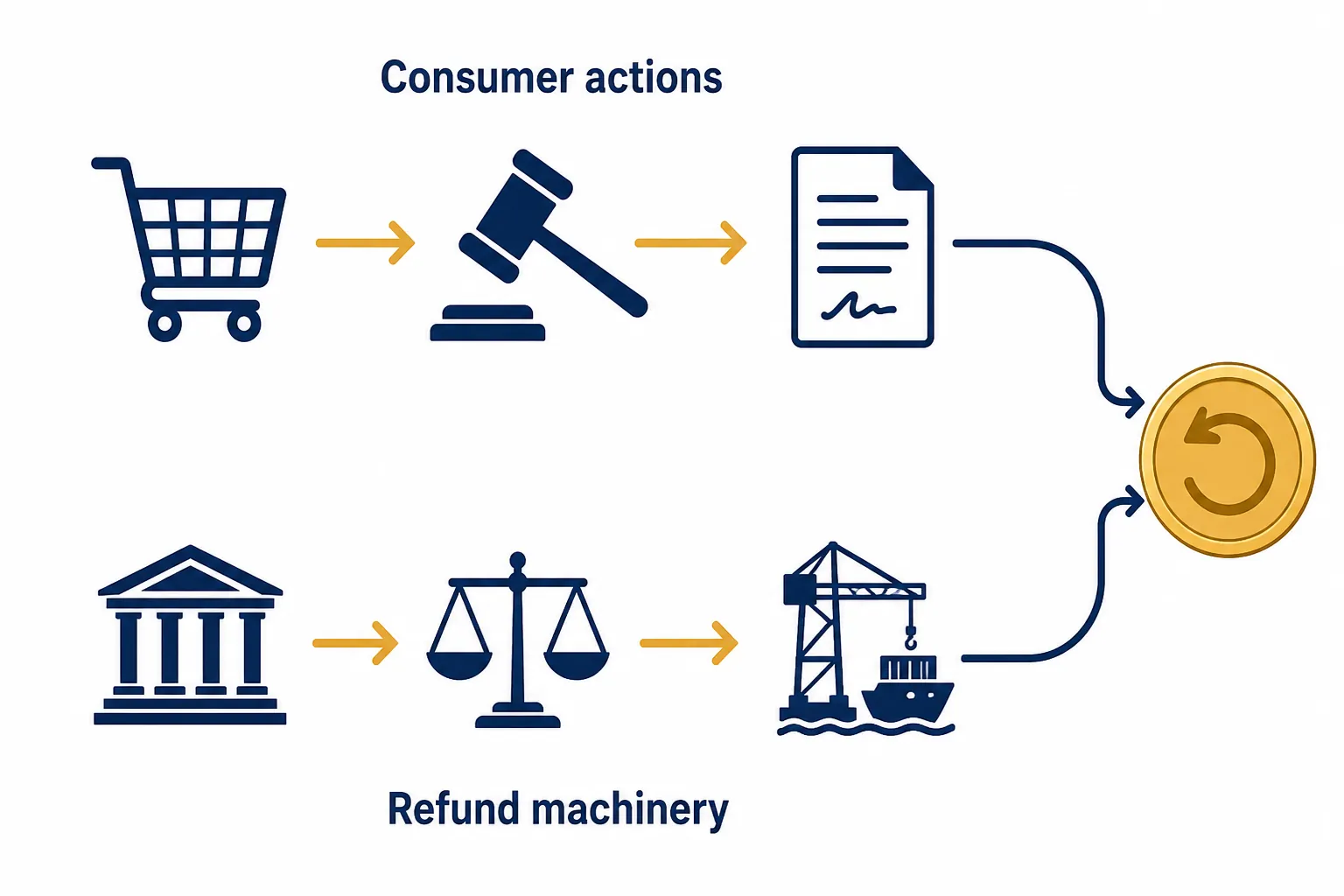
That separation is the whole case record. A shopper can plausibly say, as a matter of economics, that a tariff was built into the price paid at checkout. CBP, however, does not refund money to “the person who ultimately felt the price increase” as a general consumer category. The refund process turns first on importer-of-record status. The Amazon cases ask whether a consumer-law theory can bridge the gap between those two positions.
What the Amazon consumer complaint actually says
The consumer side began with Markland on May 15, 2026, and Rosen on May 28, 2026, both in the Western District of Washington. The cases were consolidated before Judge Tana Lin, and the consolidated amended complaint was filed July 30, 2026. [1][2] Those details matter because “the Amazon lawsuit” is already too loose a label: the pleading posture is not a final ruling, not a certified class judgment, and not a refund order.
The proposed class period identified in the consumer materials runs from February 4, 2025, through February 20, 2026. The product scope is limited to goods listed as “Sold by: Amazon.com” or “Ships from and sold by Amazon.com,” not every item appearing on Amazon’s marketplace. [1][2] That limitation is easy to lose in public shorthand, but it is central to the pleaded theory because third-party marketplace sales raise a different importer and seller problem.
The consolidated theory is straightforward at the allegation level: Amazon allegedly increased prices to account for tariffs, later became positioned to receive tariff refunds after the Supreme Court ruling, and retained money that plaintiffs say should have flowed back to consumers. The pleaded claims include unjust enrichment and Washington Consumer Protection Act theories. [1][2] None of that is a finding. It is the plaintiffs’ courthouse theory.
The complaint also relies on a pricing-study allegation drawn from The Wall Street Journal. As pleaded, the study looked at 2,500 products in July 2025 and alleged that Amazon raised prices on 1,200 low-cost goods by 5.2% while Walmart cut prices by about 2%. [2] That should be read exactly as a complaint-cited allegation. The materials reviewed do not independently establish the study’s methodology, product selection, or causal attribution.
There is also a more colorful allegation: that Amazon did not pursue or pass along refunds in order to curry favor with the Trump administration. ClassAction.org reported that theory as an allegation in the case. [7] It is not the organizing fact in the record. The harder legal question is not motive; it is entitlement.
Amazon’s stated position is about traceability and importer status
Amazon’s public response, as reported from its July 30, 2026, earnings call, is not that no tariff refunds existed. CFO Brian Olsavsky said Amazon received about $600 million in tariff refunds in the second quarter of 2026. [8][9] That figure is the reason the consumer claim has force as a practical grievance: money came back into Amazon’s world after customers allegedly paid tariff-inflated prices.
Amazon’s defense, however, is that the money cannot simply be mapped from a CBP refund to a retail customer receipt. Olsavsky said Amazon would proactively refund customers only in a “limited set of circumstances” where import charges were traceable, and he stated that Amazon “is not the importer of record for the large majority of items sold in our store.” [8][9]
That is not a throwaway defense. In the refund machinery, importer-of-record status is the entry point. If the importer of record was a supplier, third-party seller, logistics intermediary, or another entity, the CBP refund claim is not automatically Amazon’s claim. If Amazon was the importer of record for a given entry, that still does not automatically answer whether a retail customer has a state-law or restitution claim to any portion of the refund. Those are different steps.
The Supreme Court ruling created the refund problem, not the consumer remedy
The refund machinery starts with Learning Resources and V.O.S. Selections, not with Amazon. On February 20, 2026, the Supreme Court held 6-3 that IEEPA did not authorize the presidential tariffs at issue. The Court’s disposition was procedural as well as substantive: it vacated and remanded Learning Resources, No. 24-1287, with instructions tied to dismissal for lack of jurisdiction, while affirming V.O.S. Selections, No. 25-250. [3][4]
For a broader walk-through of that Supreme Court and refund pathway, see the site’s procedural roadmap. The short version for the Amazon matter is enough: once the tariffs were held unauthorized, importers began pressing for refunds of IEEPA duties. That did not make retail customers claimants before CBP.
The Court of International Trade then became the operational forum for refund implementation in Atmus Filtration Technologies Inc. v. United States, Ct. No. 26-1259. Judge Eaton entered an order on March 4, 2026, later amended March 27, 2026, addressing refund treatment for IEEPA duties. [5][6] Trade-practice updates described those orders as forcing the government to build a broader refund process rather than handling the issue one protest at a time. [5][10]
Where the refund money moves
The scale is large enough to make loose language dangerous. The refund program involved roughly $166 billion in duties paid by about 330,000 importers across more than 53 million entries. [11] CBP’s CAPE process launched in phases: Phase 1 began April 20, 2026; CBP reported 56,497 importers enrolled as of April 9, 2026, covering about 82% of entries; Phase 2 began June 29, 2026; and Phase 3 for finally liquidated entries was ordered in July 2026. [11][10] A June 9, 2026, CBP status filing was reported to show about $90 billion processed or approved. [12]
CAPE is the customs refund lane. It is not a consumer class settlement. Under the importer-refund framework described in trade-law updates, the party positioned to claim IEEPA duty refunds from CBP is the importer of record. [5][10] That distinction explains why the consumer complaint and the customs orders can concern the same tariff dollars without being the same legal proceeding.
A simple hypothetical shows the bridge plaintiffs still need. If Retailer A imports a product, pays an unlawful duty, raises the shelf price, and later receives a CBP refund, consumers may argue that retaining the refund is unjust. But CBP’s payment to Retailer A does not itself certify a consumer class, prove how much of the tariff was embedded in each price, or decide whether state law requires pass-through. The customs process answers who may claim from the government. The consumer case asks whether that claimant, or a related seller, must account to shoppers.
What consumers would still have to prove
The consumer plaintiffs do not get from “Amazon received about $600 million” to “each customer is owed a refund” in one step. They would need to establish the relevant Amazon-controlled transactions, the class boundaries, the price effect, the refund connection, and the legal reason Amazon’s retention of money is unlawful. The proposed class period and “Sold by Amazon” language narrow the field, but they do not resolve those questions. [1][2]
| Question | Why the record does not yet answer it |
|---|---|
| Was Amazon the importer of record for the item? | Amazon says it was not the importer of record for the large majority of items sold in its store. [8][9] |
| Was the tariff actually passed through in that item’s price? | The complaint pleads price-increase allegations, including a complaint-cited pricing study, but those allegations have not been converted into findings. [2] |
| Did Amazon receive a refund tied to the same transaction set? | Amazon acknowledged about $600 million in Q2 tariff refunds, while also saying proactive customer refunds are limited to traceable circumstances. [8][9] |
| Does consumer law require pass-through? | That is the unresolved merits issue in the consolidated consumer action, not something decided by Learning Resources or CAPE. |
The class-certification problem is equally practical. A court would have to decide whether common proof can handle millions of retail transactions involving different products, suppliers, import entries, prices, and refund pathways. The record reviewed here does not show a certified class as of Q3 2026.
What should not be mixed into this case
The FTC Amazon Prime refund program is unrelated to these tariff-refund cases. It may appear in social posts using the same words — Amazon, refund, consumers — but it is not the IEEPA tariff refund machinery, not the Markland/Rosen consolidated complaint, and not a CBP importer-refund process.
Market reaction is also background, not the case record. Amazon, Etsy, and retail-stock movement after the tariff ruling belongs in a market-impact account, not in the answer to whether shoppers have a legal entitlement to Amazon’s tariff refunds. For that context, see the market-impact timeline.
Other tariff-policy developments should be treated as freshness-sensitive. The available materials flagged Cato figures, Section 122 replacement-tariff status, Oregon v. Trump, and possible Atmus appeal references as items requiring live verification. They are not needed to explain the present Amazon consumer record and should not be folded into this article without a new docket and source check.
Status as of Q3 2026
| Item | Verified status |
|---|---|
| Consumer case | Markland and Rosen are consolidated in W.D. Wash. before Judge Tana Lin; consolidated amended complaint filed July 30, 2026. [1][2] |
| Consumer recovery | No record reviewed here shows a class certification order, merits ruling, settlement, or order requiring Amazon to pass tariff refunds through to consumers. |
| Amazon position | Amazon acknowledged about $600 million in Q2 tariff refunds and said customer refunds would be proactive only in limited, traceable circumstances; it also said it is not importer of record for the large majority of items sold in its store. [8][9] |
| Supreme Court tariff ruling | Learning Resources and V.O.S. Selections established the invalidity and disposition framework for the IEEPA tariff issue on February 20, 2026. [3][4] |
| CBP/CAPE process | Importer refunds are being processed through the CAPE machinery described in the CIT/CBP refund materials. [10][11][12] |
| Items requiring re-verification before publication | Class certification, rulings on the consolidated amended complaint, Atmus appeal status, and any post-July 30, 2026, docket developments. |
The consumer theory is not frivolous merely because CBP pays importers; a price increase can be economically borne by someone other than the party that wrote the check at the border. But the courthouse record still needs the bridge. As of Q3 2026, plaintiffs have alleged that consumers bore tariff-driven price increases, and Amazon has acknowledged substantial tariff refunds in some circumstances. No court in the record reviewed here has decided that those refunds belong to Amazon customers.
References
- Amazon Import Tariff Consumer Class Action, Hagens Berman.
- Rosen v. Amazon.com, Inc. complaint, Hagens Berman, May 28, 2026.
- Learning Resources Inc. v. Trump, SCOTUSblog.
- Learning Resources, Inc. v. Trump, Supreme Court of the United States, February 20, 2026.
- Trade Court Orders Refunds of IEEPA Duties, Davis Wright Tremaine, March 2026.
- Atmus Filtration Technologies Inc. v. United States, Order, U.S. Court of International Trade via CourtListener, March 4, 2026.
- Amazon not seeking tariff refunds to ‘curry favor’ with Trump, class action lawsuit alleges, ClassAction.org.
- Amazon Trump tariff refunds, CNBC, July 30, 2026.
- Amazon receives Trump tariff refunds, The Hill.
- Court of International Trade Clarifies Broad IEEPA Tariff Refund Eligibility, Kelley Drye.
- CBP Provides CIT Latest Updates on IEEPA Tariff Refunds, Thompson Hine, April 2026.
- Lawsuits seek Amazon to pass tariff refunds back to customers after IEEPA duties, Spectrum News, June 22, 2026.
Related records
Tool profile
How Meta's AI Spending Reshapes Law Firm ProfitabilityGoverning regulation
Browse the obligations tracker →Preventive workflow
Browse verification workflows →
Report a correction or tip
Spotted an outdated figure, a misstated fact, or a ruling this case record should reflect? Public comments are disabled for this content given the professional cost of a misreported case outcome, penalty amount, or rule text — use the structured correction channel instead.
Report a correction or tip for this record →