
Amy's Kitchen Recall Shows Why Food Lawyers Must Verify AI Output
The Amy's Kitchen recall of 184,200 cans across 28 states illustrates how time-pressured regulatory responses increase the temptation to skip AI verification steps. Recent sanction cases and ABA Formal Opinion 512 confirm that the verification duty applies to AI-generated food safety regulatory work, creating enforcement exposure for food companies that have not adopted structured AI verification workflows.
- Jurisdiction
- US-Federal
- Court
- U.S. Court of Appeals for the Sixth Circuit
- AI tool named
- Generative AI
- Ruling date
- Mar 15, 2026
- Source document
- View primary court order ↗
- Last verified
- Jul 24, 2026
Lex Machina Review is an independent risk-tracking and reference resource. Nothing on this site is legal advice, and using it does not create an attorney-client relationship. Every record is reviewed against primary sources but may not reflect the most current status of a matter — always verify directly against the cited court order, rule text, or a licensed attorney before relying on it.
Companion explanation — secondary to the source document above
The Amy's Kitchen lentil soup recall is not an AI story. That boundary has to stay clean. The public recall involved 184,200 cans of Amy's Kitchen Organic Lentil Light in Sodium Soup distributed across 28 states after a can defect created a potential for spoilage; FDA classified the recall as Class II on July 14, 2026.[1] There is no public record tying this recall to an AI-generated memo, hallucinated citation, or automated regulatory analysis.
It is still the right place to start, because a recall response is exactly where weak AI controls become attractive. Someone has to summarize the product issue. Someone has to draft or review consumer-facing language. Someone has to answer internal questions about classification, reportability, distribution scope, supplier responsibility, and whether any adjacent product or process documents need to be checked. The work is compressed, the audience is mixed, and the document that sounds merely preliminary at noon may be forwarded, quoted, or relied on by late afternoon.
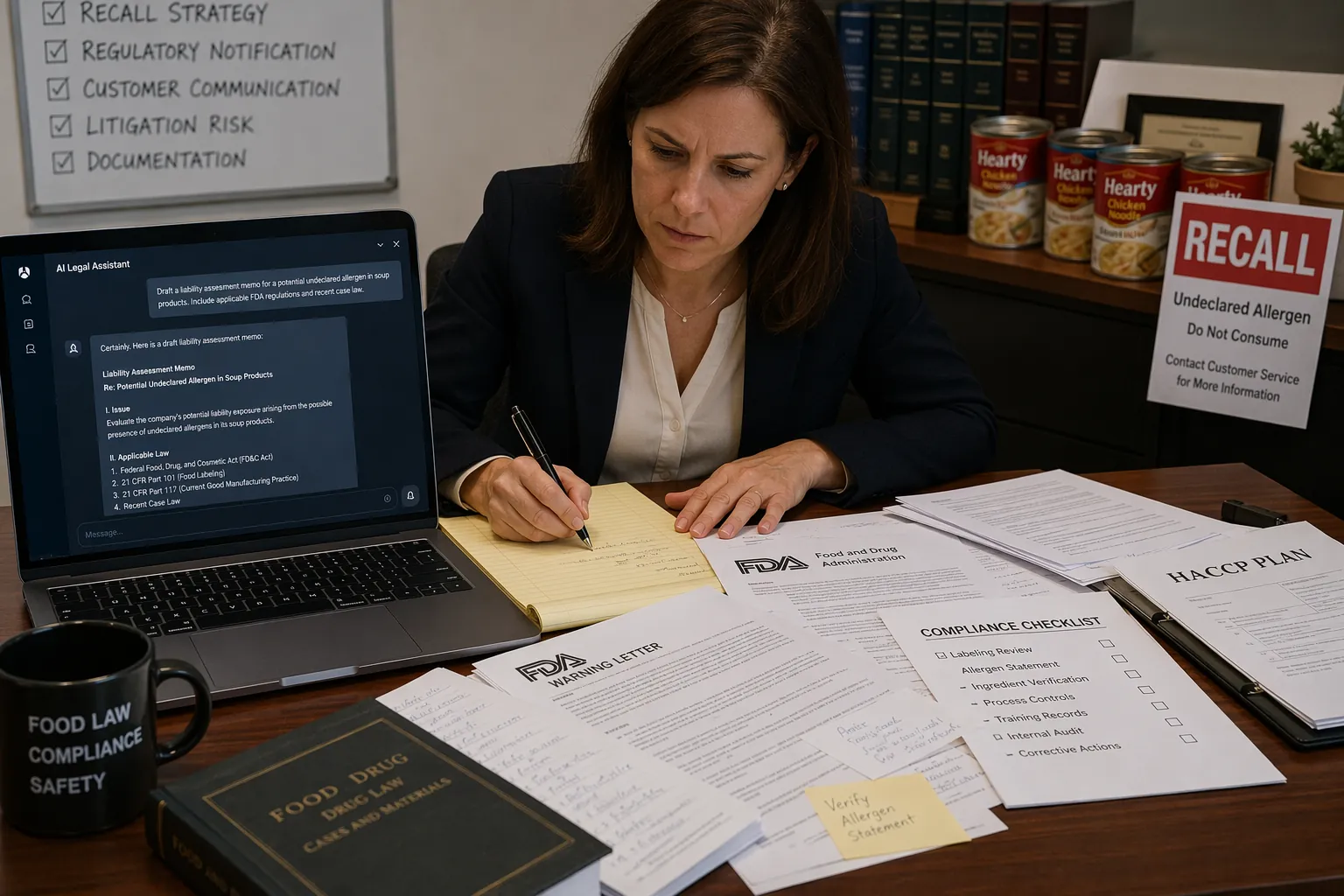
That is where the legal risk now sits. The question is no longer whether food lawyers may use generative AI to speed up recall work, HACCP-related drafting, supplier questionnaires, regulatory research, or internal compliance memos. The question is what the lawyer personally verifies before any AI-assisted work product leaves counsel's control.
A Recall File Is Not the Place to Discover a Citation Was Never Real
Recall teams do not need a philosophical debate about AI. They need reliable text under pressure. A model can produce a clean first pass on a recall chronology, a draft customer notice, a list of likely regulatory issues, or a summary of FDA recall classes. It can also produce a CFR section that looks familiar but does not say what the draft claims, a guidance document that never existed, or a scientific citation that cannot survive a basic search.
Plausibility is the trap. In food regulatory work, an error often wears the same clothes as a useful answer: agency vocabulary, confident cross-references, familiar phrases about preventive controls, hazard analysis, sanitation, traceability, or adulteration. A tired reviewer may catch an obviously strange sentence. The harder failure is the one that sounds normal enough to pass into the next draft.
The Amy's Kitchen recall shows the pressure chamber without proving an AI failure. A Class II recall over a can defect and potential spoilage is not an abstract compliance exercise; it is a live food safety event with public messaging, inventory questions, regulatory classification, and legal review moving together.[1] In that setting, an AI tool may be useful only if the verification process is already built. If the process starts with “this looks right,” it starts too late.
ABA Formal Opinion 512 Makes the Verification Duty Tool-Agnostic
ABA Formal Opinion 512 did not ban lawyers from using generative AI. It did something more operationally important: it placed AI use inside existing professional duties. The opinion treats generative AI tools as nonlawyer assistance for purposes of Model Rule 5.3, which means the lawyer must supervise the tool's work and remains professionally responsible for the result.[2]
That framing matters for food counsel because it avoids the false comfort of vendor labels. A tool marketed for legal research, compliance drafting, document automation, or enterprise knowledge management may reduce some risks and create others. None of those labels moves the professional duty from the lawyer to the software. If the output asserts that a regulation requires a specific corrective action, that a guidance document supports a position, or that a prior enforcement pattern makes a response defensible, the lawyer cannot treat the assertion as verified because the interface sounded authoritative.
Opinion 512 also changes how “draft” should be understood. Lawyers have always used drafts from juniors, specialists, templates, and clients. But when AI generates legal or regulatory authority, the draft is not merely rough prose. It may contain fabricated law or distorted authority inside polished language. A food regulatory lawyer reviewing AI output is not just editing style; the lawyer is deciding whether a legal assertion may safely be used by the business.
For related ethics coverage on AI use under time pressure, see our discussion of ABA Formal Opinion 512 and compound verification risk.
The Sanction Cases Are Litigation Cases, but the Rule Travels
The strongest recent warning comes from court filings, not FDA submissions. That distinction should not be blurred. Judges sanction lawyers in litigation because filings are submitted to courts under procedural and ethical rules. Food regulatory documents are reviewed in different settings, often by agencies, customers, auditors, insurers, or opposing counsel after something has already gone wrong.
Still, the verification principle is not confined to briefs. In Whiting v. City of Athens, reported in the Q1 2026 AI sanctions tracking, the Sixth Circuit imposed a $15,000-per-attorney sanction and stated a tool-agnostic rule: a filing should not contain citations the lawyer has not personally read and verified.[3] The important part for regulatory lawyers is not the courtroom posture. It is the professional act the court required: personal verification before reliance.
A food safety memo sent to a business team is not a court filing. A HACCP-related document is not an appellate brief. But when those documents cite legal authority, agency guidance, scientific support, or regulatory requirements, the same professional failure can occur: the lawyer allowed an authority to carry weight without confirming that it exists, says what the draft claims, and applies to the facts at hand.
Buchanan v. Vuori shows how quickly that failure can become more than an embarrassing footnote. In that Northern District of California case, AI-hallucinated citations in a class action settlement motion led the court to strike the motion and find plaintiff's counsel inadequate to represent the class.[4] The lesson is not that every AI error destroys representation. The narrower and more useful lesson is that hallucinated authority can infect a lawyer's credibility and the procedural life of a matter when it appears in a document the lawyer asks others to trust.
Wadsworth v. Walmart adds the supervision problem. In that product liability matter, eight of nine citations in a motion were AI-hallucinated, and the court sanctioned the drafting attorney, supervising partner, and local counsel while revoking pro hac vice admission.[5] Food companies and their outside counsel should read that as a chain-of-review case, not just a hallucination case. The person who pasted the text is not the only person exposed when the review structure fails.
The scale signals are now hard to dismiss. EDRM and ComplexDiscovery reported more than $145,000 in U.S. AI sanctions in Q1 2026 alone, tripling prior quarterly totals, and noted Oregon's fee schedule of $500 per fabricated citation and $1,000 per fabricated quotation.[3] Damien Charlotin's database, as reported by gc.ai, counted more than 1,490 documented AI hallucination decisions as of May 2026, including more than 1,000 in the United States and a pace approaching one new ruling per day.[6] Those numbers measure litigation decisions, not food regulatory enforcement. They still show that professional tolerance for unverified AI authority is falling fast.
Food Regulatory Work Has Its Own Failure Modes
The food-specific danger is not only a fake case citation. It is a fabricated FDA or USDA guidance document, a misstated CFR section, an invented scientific study, or a real study used for a claim it does not support. Meatingplace warned in 2026 that AI tools can confidently fabricate nonexistent USDA and FDA regulations and that an unverified hallucinated regulation embedded in a HACCP plan, processing standard, or regulatory submission could create enforcement exposure or recall risk.[7]
That warning should be kept in proportion. The available material does not identify a confirmed enforcement action caused by an AI-hallucinated food safety regulation. The risk is structural: food companies increasingly use AI-shaped text in documents that may later be read as evidence of what the company knew, believed, represented, or failed to verify.
Consider a hypothetical internal memo prepared during a recall review. If it says FDA guidance requires a particular consumer notice phrase, the reviewing lawyer needs to locate that guidance and confirm the language. If it says a can-defect spoilage issue fits a particular recall classification pattern, the lawyer needs to check the classification source and the factual fit. If it says a preventive control is “industry standard,” someone needs to identify whether that standard comes from regulation, guidance, customer specification, third-party audit practice, scientific literature, or merely the model's phrasing.
The same issue appears in supplier compliance questionnaires. An AI-assisted response may say the company follows a listed FDA requirement, maintains a required record, or validates a control under a named standard. If the citation is wrong, the problem is not only legal accuracy. The business may have represented a control it does not actually maintain, or may have missed the control the customer was really asking about.
HACCP-related documents are even less forgiving. A hallucinated authority can become part of the rationale for a hazard decision, monitoring step, corrective action, or verification record. Later, when an auditor, agency reviewer, customer, insurer, or plaintiff's lawyer asks why the company treated a hazard a certain way, “the AI summary looked consistent with other materials” is not a defensible verification trail.
What the Lawyer Must Personally Verify
A workable food regulatory AI protocol does not have to turn every lawyer into a software auditor. It has to identify the claims that cannot leave the legal function without source-level review. The following items deserve personal verification by the responsible lawyer, or by a supervised professional whose work the lawyer actually reviews, before the document is sent, filed, uploaded, or adopted by the business.
- Regulations: confirm the cited CFR section exists, is current, applies to the product and facility type, and supports the sentence being written.
- Agency guidance: confirm the document exists, comes from the named agency, has not been withdrawn or superseded, and is not being treated as binding law unless that characterization is supportable.
- Recall facts: confirm product name, lot or date information, distribution scope, recall classification, initiating date, and public notice language against primary sources or company records.
- Scientific support: confirm the study exists, review the relevant portion, and distinguish between a narrow finding and a broader claim the model may have supplied.
- Customer or supplier obligations: confirm whether the requirement comes from contract language, customer policy, certification scheme, regulation, or internal practice.
- Legal conclusions: confirm that the document separates required action, recommended action, risk-based judgment, and open factual assumptions.
This is not a request for ceremonial footnotes. It is a request for a file that shows who checked the source that mattered. If a recall communication says a product presents a potential spoilage issue, the file should show where that language came from. If a memo says a Class II classification reflects a particular level of health risk, the lawyer should have read the FDA source rather than relying on an AI paraphrase. If a HACCP-related document cites a regulation, the source should be saved or linked in a way that a later reviewer can reconstruct.
Tool choice still matters, but it does not end the duty. A specialized legal AI product may provide retrieval, citations, source links, or guardrails that a general-purpose chatbot lacks. Those features can make verification faster. They do not replace the lawyer's obligation to read and verify the authority being used. For a deeper treatment of tool selection and verification responsibilities, see Should Lawyers Use ChatGPT or Specialized Legal AI?.
The Missing Workflow Is Usually the Record
Many food companies already have document control habits for quality systems. They know how to preserve versions, approvals, corrective actions, supplier certifications, and training records. The AI verification gap often exists because legal and regulatory drafting happens in a less formal lane: emails, shared documents, chat exports, copied summaries, and hurried comments from multiple reviewers.
The fix is not to preserve every prompt forever. The more useful record answers four questions: which AI-assisted document was reviewed, which source-dependent claims were checked, who checked them, and what source confirmed or corrected the claim. For sensitive matters, the record also needs privilege and confidentiality handling, because a verification trail should not create a new uncontrolled distribution of legal advice.
| Document | Verification record that should exist |
|---|---|
| Recall communication | Source for product facts, classification, dates, distribution scope, and consumer-facing safety language |
| HACCP-related memo | Verified regulation, guidance, scientific support, and factual assumptions behind the hazard or control analysis |
| Supplier questionnaire | Confirmed source of each represented obligation, certification, control, or facility practice |
| Regulatory submission | Primary authority for legal requirements, checked factual attachments, and named reviewer approval |
| Internal compliance summary | Marked distinction between binding law, guidance, business judgment, and unresolved factual questions |
The reviewer also has to decide what cannot be AI-generated at all without heightened controls. Drafting a neutral summary of publicly available recall facts is one thing. Generating a legal conclusion about reportability, adequacy of corrective action, or whether a particular processing change satisfies a regulatory duty is another. The second category may still benefit from AI-assisted organization or issue-spotting, but the legal conclusion should be built from verified sources and company facts, not reverse-engineered from a model's confident answer.
Where Amy's Kitchen Fits, and Where It Does Not
The Amy's Kitchen recall should not be used as evidence that AI is already causing food safety failures. The known facts support no such claim. It should be used for the narrower point it actually illustrates: food safety events move through legal, quality, regulatory, communications, and commercial channels at a speed that rewards shortcuts unless verification has already been assigned.
:max_bytes(150000):strip_icc():focal(742x440:744x442)/Amys-ORGANIC-SOUPS-LENTIL-LIGHT-IN-SODIUM-072326-dd8f5b0b9ad04f94970eb642e21a92dc.jpg)
That assignment needs to be explicit. A junior lawyer may use AI to organize a timeline. A compliance manager may use it to compare draft wording. Outside counsel may use it to spot issues for a client call. But when the work product relies on a regulation, case, guidance document, scientific study, agency classification, or company obligation, someone with legal responsibility needs to verify the source and leave a record that the verification occurred.
After ABA Formal Opinion 512 and the 2025-2026 sanction cases, food regulatory lawyers cannot treat AI-generated regulatory analysis as a draft that becomes safe through plausibility review. If an AI-assisted memo, HACCP-related document, recall communication, supplier response, or regulatory submission depends on authority, the lawyer needs a structured verification trail before it leaves the building.
References
- FDA Enforcement Report: Amy's Kitchen Organic Lentil Light in Sodium Soup, U.S. Food and Drug Administration, July 14, 2026.
- Formal Opinion 512: Generative Artificial Intelligence Tools, American Bar Association, July 2024.
- Q1 2026 AI Hallucination Sanctions Update, EDRM/ComplexDiscovery, April 2026.
- AI Hallucinations And Class Action Settlements: Buchanan v. Vuori, Duane Morris Class Action Defense Blog, February 2026.
- Wadsworth v. Walmart Inc., U.S. District Court for the District of Wyoming, February 2025.
- AI Hallucination Cases Database, gc.ai, May 2026.
- AI hallucinations raise food safety compliance risks, Meatingplace.com, 2026.
Related records
Tool profile
How Meta's AI Spending Reshapes Law Firm ProfitabilityGoverning regulation
Browse the obligations tracker →Preventive workflow
Browse verification workflows →
Report a correction or tip
Spotted an outdated figure, a misstated fact, or a ruling this case record should reflect? Public comments are disabled for this content given the professional cost of a misreported case outcome, penalty amount, or rule text — use the structured correction channel instead.
Report a correction or tip for this record →