
Can lawyers safely use Apple Intelligence Siri AI?
Apple Intelligence Siri AI's on-device privacy architecture meets ABA confidentiality standards, but the tool remains a general-purpose generator with no legal-specific retrieval-augmented generation, meaning the hallucination rates that produced the 2026 sanctions apply. This assessment evaluates the specific confidentiality, accuracy, and professional responsibility risks for lawyers.
- Jurisdiction
- United States
- Court
- Mississippi state court
- AI tool named
- Apple Intelligence Siri AI
- Ruling date
- Jun 8, 2026
- Source document
- View primary court order ↗
- Last verified
- Jul 30, 2026
Lex Machina Review is an independent risk-tracking and reference resource. Nothing on this site is legal advice, and using it does not create an attorney-client relationship. Every record is reviewed against primary sources but may not reflect the most current status of a matter — always verify directly against the cited court order, rule text, or a licensed attorney before relying on it.
Companion explanation — secondary to the source document above
For lawyers evaluating Apple Intelligence Siri AI in 2026, the practical answer is narrower than the product excitement suggests: it is materially stronger than ordinary consumer AI on confidentiality, but it should not be approved for unsupervised legal research, citation generation, case-law statements, or filing-ready drafting. This assessment is not legal advice, is current as of July 30, 2026, and must be read with the beta caveat in mind: Apple announced the new Siri AI experience in June 2026, but final release behavior, benchmarks, and guardrails may differ from the announced design.[1]
That distinction matters because lawyers tend to collapse two different questions into one. The first is whether client information is exposed to a consumer AI vendor in a way that violates confidentiality duties. The second is whether the generated answer is reliable enough to place in a research memo, a partner draft, or a court filing. Apple has done unusually serious work on the first question. It has not, as of July 2026, published legal-query accuracy benchmarks that answer the second.
The confidentiality case is stronger than usual
Apple’s privacy architecture deserves more credit than the generic “consumer AI” label gives it. Private Cloud Compute is designed so that complex requests can be processed on Apple-controlled servers without Apple storing the user’s data or making it accessible to Apple personnel; Apple also emphasizes verifiable transparency and third-party security review as part of the model.[2] Apple’s legal privacy page for its intelligence engine likewise says that requests are handled on device when possible, routed to Private Cloud Compute when more capacity is needed, and that Apple does not store the data made available to PCC.[3]
For a law firm, the routing logic is the important part. A request that can be handled on the device presents a different confidentiality profile from a request transmitted to a general cloud chatbot. A request sent to PCC still leaves the device, but under Apple’s announced design it is not supposed to become a vendor training asset, a retained prompt log, or a support record visible to staff. If Siri AI needs to use Google Gemini, Apple describes that as requiring user consent rather than occurring silently in the background.[3]
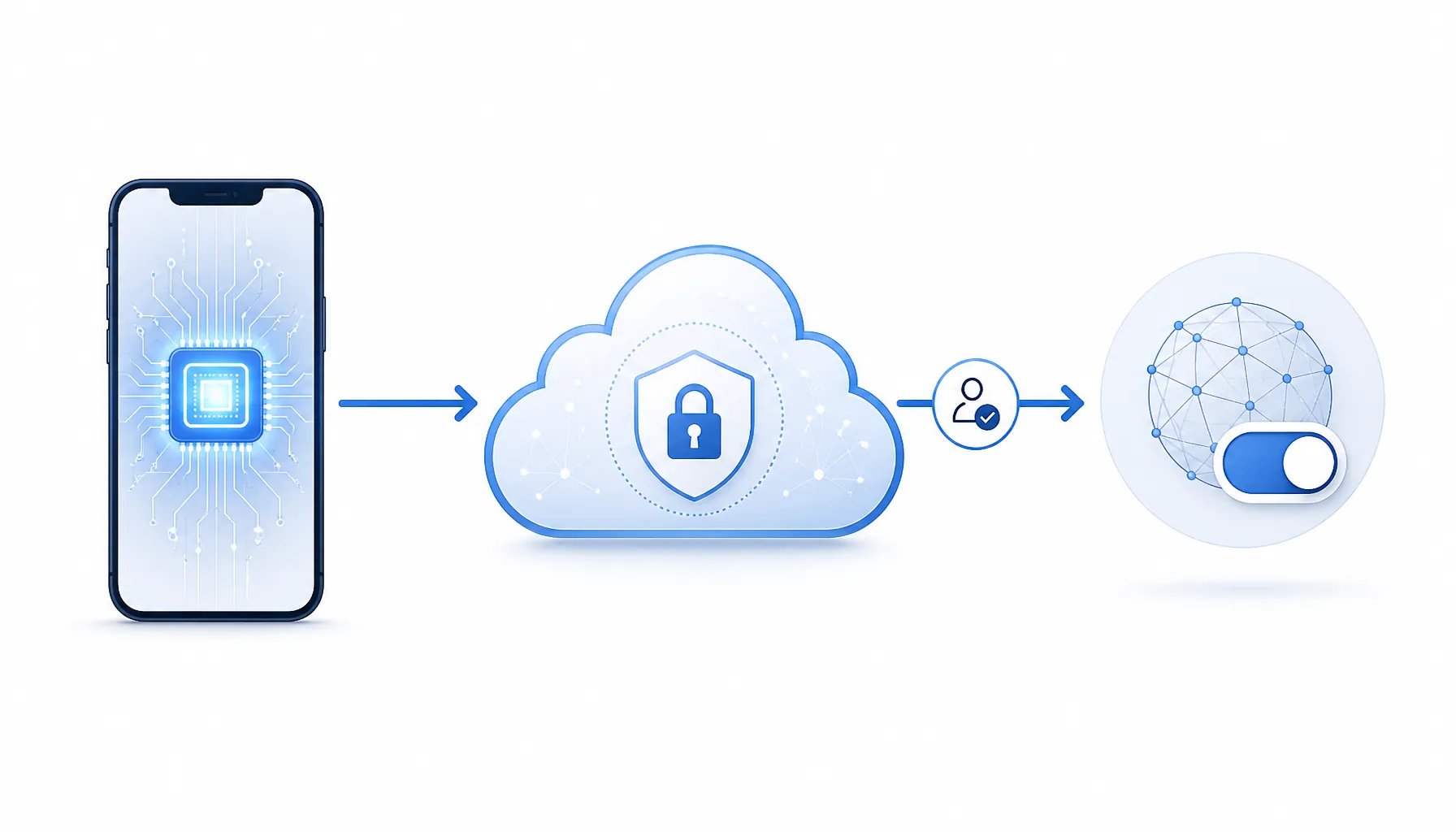
That is not a small improvement over the casual practice of pasting a client’s facts into whatever chatbot happens to be open in a browser tab. It directly addresses the vendor-visibility problem that many legal AI policies were written to prevent: prompt logging, cloud access, model training use, and uncertainty about who can see the input. If Apple’s final implementation matches the announced architecture, a firm could reasonably treat Siri AI as a different confidentiality risk category from a public chatbot account with broad data retention and training terms.
The ethics fit is still not automatic. ABA Formal Opinion 512, issued in July 2024, identifies duties involving competence, confidentiality, communication, supervision, and candor when lawyers use generative AI tools.[4] Formal Opinion 512 is advisory rather than binding state law, but it gives risk committees a useful frame: confidentiality is only one duty, and a vendor’s privacy architecture does not discharge the lawyer’s obligations to supervise the tool, understand its limits, communicate where required, and avoid misleading a court.
The procurement consequence is straightforward. Apple’s architecture may support a favorable confidentiality review for bounded use, but it should still go through vendor due diligence. A keynote slide is not a data-processing agreement. A privacy page is not a jurisdiction-specific ethics opinion. A beta feature is not a production control.
Privacy does not verify a citation
The harder problem is accuracy, and this is where Apple’s strongest privacy claims do the least work. A system can keep a prompt confidential and still invent a case. It can avoid storing client data and still summarize a holding that does not exist. It can route a request through a technically impressive private cloud and still produce a sentence that no associate should put in a brief.
The available legal-AI research gives no basis to treat Siri AI as a legal research authority. Stanford HAI reported in 2024 that general-purpose chatbots hallucinated between 58% and 82% of the time on legal queries in its benchmark.[5] A separate Stanford RegLab and HAI study found that even legal-specific retrieval-augmented generation tools, including Lexis+ AI and Westlaw AI-Assisted Research, hallucinated between 17% and 34% of the time.[6] Those findings should not be misread as a benchmark of Siri AI itself; they do show that legal questions are unforgiving even for systems closer to legal databases than a general-purpose assistant.
As of July 2026, Apple has not published a comparable benchmark evaluating Siri AI on legal queries. That absence is not proof that Siri AI performs badly. It is proof that a law firm lacks the evidence it would need to approve it as a research tool. Apple’s documentation for broad world knowledge from the web describes a general assistant pattern, not a controlled search of primary law, citators, docket materials, or jurisdiction-filtered legal databases.[1][3]
| Question | What Apple’s architecture helps with | What remains unresolved |
|---|---|---|
| Can client facts be exposed to the AI provider? | On-device processing and PCC reduce ordinary consumer-tool exposure if implemented as announced. | Firm review still has to confirm terms, settings, consent flows, and final-release behavior. |
| Can Siri AI find and state the law accurately? | No published legal-query benchmark establishes that it can. | Legal research still requires primary-source verification and citator review. |
| Can a lawyer rely on a generated citation? | Privacy controls do not address citation existence, quotation accuracy, or negative treatment. | Every citation and proposition must be independently checked before use. |
This is the central policy split. Confidentiality controls decide whether a lawyer may put information into a system. Accuracy controls decide whether a lawyer may take information out of it and use it. Apple has a serious answer to the first question. It has not supplied the materials a legal risk reviewer would need for the second.
The 2026 sanction cases punish the output failure
The 2026 sanctions record is not about Apple. None of the cited sanctions should be treated as a Siri AI case. The relevance is more practical: courts sanctioned lawyers for the exact failure mode that Apple’s privacy architecture does not solve.
Norton Rose Fulbright’s 2026 sanctions update discussed six representative matters from February through April 2026: Fletcher, with a $2,500 sanction; Whiting, with $15,000 imposed on each lawyer; Farris, involving removal and Criminal Justice Act appointment denial; Fivehouse, involving an Assistant U.S. Attorney’s resignation; Mississippi, involving removal of lawyers from a case; and Oregon, later reported as a record U.S. penalty.[7] The common thread was not a data breach. It was hallucinated citations, fabricated authority, or unsupported statements placed into litigation workflows.
The language from Fivehouse is the kind risk managers should keep in the policy file. The court said courts “should begin meeting this challenge with an eye towards deterring similar conduct” and move “beyond admonitions and reprimands into more punitive sanctions.”[7] That is not a technology procurement note. It is a judicial patience note.
The Mississippi order made the consequences even more concrete. Reporting on the June 8, 2026 order described a judge removing all four lawyers from a case after AI hallucinations and blind reliance on technology infected the litigation.[8] Oregon supplied the monetary warning: reporting in May 2026 described a $110,000 sanction tied to AI hallucinations in the courtroom, described in the research record as a record U.S. penalty.[9]
The Fifth Circuit posture summarized in the sanctions materials is just as important for internal training: ignorance is no excuse.[7] That principle is familiar outside AI. Lawyers do not get to blame a junior associate, a contract attorney, a database, or a form file when a false proposition reaches the court under their signature. Generative AI changes the speed and confidence with which bad authority can be manufactured; it does not move responsibility away from the lawyer.
Gamez v. County of Fresno is useful because it avoids the easy lesson that every AI mistake leads to sanctions. In that matter, Norton Rose Fulbright reported zero sanctions where the lawyer demonstrated candor and a credible verification effort.[7] That outcome does not make hallucination safe. It shows what courts are looking for after an error surfaces: honest disclosure, evidence of checking, and a record that the lawyer did not simply outsource professional judgment to a machine.
What a firm can approve without pretending Siri is a research tool
A defensible policy does not need to ban every use of Siri AI. It does need to stop treating all “legal work” as one category. A lawyer asking for a meeting agenda, a reminder, or a neutral rewrite of non-sensitive internal prose raises a different issue from asking for controlling authority on a dispositive motion. The former can be evaluated through confidentiality, supervision, and records controls. The latter requires legal-source verification that Siri AI has not been shown to provide.
- Lower-risk uses to evaluate: administrative summarization, calendar and task organization, non-filing brainstorming, plain-language rewrites, and personal productivity tasks where no legal proposition is relied on without review.
- Uses requiring heightened controls: summaries of client materials, draft communications that include legal analysis, intake notes, deposition or hearing preparation outlines, and internal research planning.
- Uses that should not be approved without independent legal-source verification: legal research, citation support, quotation generation, case-law statements, jurisdictional rule explanations, and court-facing drafting.
- Uses to prohibit in ordinary consumer-assistant workflows: filing-ready briefs, declarations, expert materials, pleadings, or any output submitted to a tribunal before a lawyer checks every cited source and proposition against primary authority.
The National Center for State Courts’ March 2026 guide gives the operating rule in simple terms: legal practitioners should “never trust, always verify” AI outputs and should treat hallucinations as a professional-risk problem rather than a novelty.[10] For Siri AI, that means the verification step cannot be satisfied by asking the assistant whether it is sure. Verification means opening the cited case, statute, rule, docket entry, or regulation in an authoritative source and checking that it exists, says what the draft claims, remains good law, and applies in the relevant jurisdiction.
The supervision piece also has to be explicit. If associates or staff use Siri AI to prepare a first pass, the responsible lawyer needs to know that AI was used and what was checked. If the tool generates citations, quotations, or legal standards, the reviewer should assume those elements are unverified until the file contains source confirmation. If a hallucination reaches opposing counsel or the court, the response plan should prioritize candor and correction rather than trying to explain the model.
The policy answer
Apple may have built the safest consumer-AI privacy architecture available to lawyers, especially if the final Siri AI implementation tracks the announced on-device and Private Cloud Compute design. That is a meaningful confidentiality development. It reduces unnecessary exposure of client information in a way ordinary consumer chatbot workflows often do not.
It does not make Siri AI a legal authority. Legal safety also requires accuracy, source verification, supervision, candor, and jurisdiction-specific ethics compliance. Approve only bounded and verified use. Do not approve Apple Intelligence Siri AI as a stand-alone legal research tool, citation source, or filing-draft authority.
References
- Apple introduces Siri AI, a profoundly more capable and personal assistant — Apple Newsroom, June 2026.
- Private Cloud Compute: A new frontier for AI privacy in the cloud — Apple Security Research.
- Intelligence Engine — Apple Legal Privacy.
- ABA issues first ethics guidance on a lawyer’s use of AI tools — American Bar Association, July 2024.
- AI on trial: Legal models hallucinate in 1 out of 6 or more benchmarking queries — Stanford HAI.
- Legal RAG Hallucinations — Stanford RegLab/HAI.
- AI in litigation: Update on Gen AI sanctions in 2026 — Norton Rose Fulbright.
- AI hallucinations prompt Mississippi judge to boot all lawyers from case for blindly relying on technology — Mississippi Free Press, June 8, 2026.
- AI hallucinations legal sanctions courtroom LexisNexis — Fortune, May 16, 2026.
- Legal Practitioner’s Guide to AI and Hallucinations — National Center for State Courts, March 2026.
Related records
Tool profile
How Meta's AI Spending Reshapes Law Firm ProfitabilityGoverning regulation
Browse the obligations tracker →Preventive workflow
Browse verification workflows →
Report a correction or tip
Spotted an outdated figure, a misstated fact, or a ruling this case record should reflect? Public comments are disabled for this content given the professional cost of a misreported case outcome, penalty amount, or rule text — use the structured correction channel instead.
Report a correction or tip for this record →