
Average Law Firm Data Breach Cost Reaches $5.08M in 2025
Law firm data breaches cost an average of $5.08 million in 2025—14.41% above the cross-industry average. This article decomposes the four compounding cost layers that make the legal sector's figure a floor rather than a ceiling when client defection and privilege-waiver exposure are factored in.
- Jurisdiction
- United States
- Court
- United States district courts
- AI tool named
- No AI tool implicated
- Ruling date
- Jan 1, 2025
- Source document
- View primary court order ↗
- Last verified
- Jul 30, 2026
Lex Machina Review is an independent risk-tracking and reference resource. Nothing on this site is legal advice, and using it does not create an attorney-client relationship. Every record is reviewed against primary sources but may not reflect the most current status of a matter — always verify directly against the cited court order, rule text, or a licensed attorney before relying on it.
Companion explanation — secondary to the source document above
The usable starting number for law-firm breach planning in 2025 is $5.08 million. That is the reported average cost of a law firm data breach in 2025, 10% higher year over year and 14.41% above IBM's $4.44 million cross-industry average for the same reporting period.[1][2]
It should not be treated as an invoice template. IBM's Cost of a Data Breach Report 2025 supplies the broad breach-cost framework and global benchmark; the law-firm-specific $5.08 million figure is carried in legal-industry summaries, including Programs.com and Clio, rather than in a fully transparent primary legal-sector sample.[1][2] For a managing partner's memo, that makes the number useful but not actuarial. It is the best available legal-sector benchmark, not a promise that the next incident will land neatly on the mean.

The more important point is that the average is probably a floor for planning purposes. Generic breach models capture much of the ordinary work after an incident: containment, investigation, legal coordination, notification, call centers, credit monitoring, regulatory response, and business disruption. Law firms carry those costs too. They then add professional duties, client-confidentiality exposure, privilege fights over the incident record, and a commercial consequence that may arrive quietly after the breach file is closed.
The U.S. context makes that distinction sharper. IBM's 2025 report put the average U.S. breach cost at $10.22 million, the highest regional figure for the 15th consecutive year, with rising regulatory fines and detection costs identified as important contributors.[3] A U.S. law firm, especially one holding regulated client data, merger files, litigation strategy, employment records, health information, or trade secrets, is not merely another breached company with a different logo on the letterhead.
What the $5.08 Million Usually Captures
A breach-cost model is strongest where the work is visible and billable. Outside incident counsel is retained. Forensics begins. Systems are isolated. E-discovery and document-management access may be restricted. Notifications are drafted. Regulators may ask questions. Clients ask whether their data was touched. Partners ask when the document-management system will be usable again.
Those costs are real, but they are also the cleanest part of the file. The invoice from the forensic firm can be reviewed. The ransom payment, if made, has a number. The notification vendor has a contract. The more legally specific cost layers are harder to price because they are tied to duties and relationships rather than a single payable.
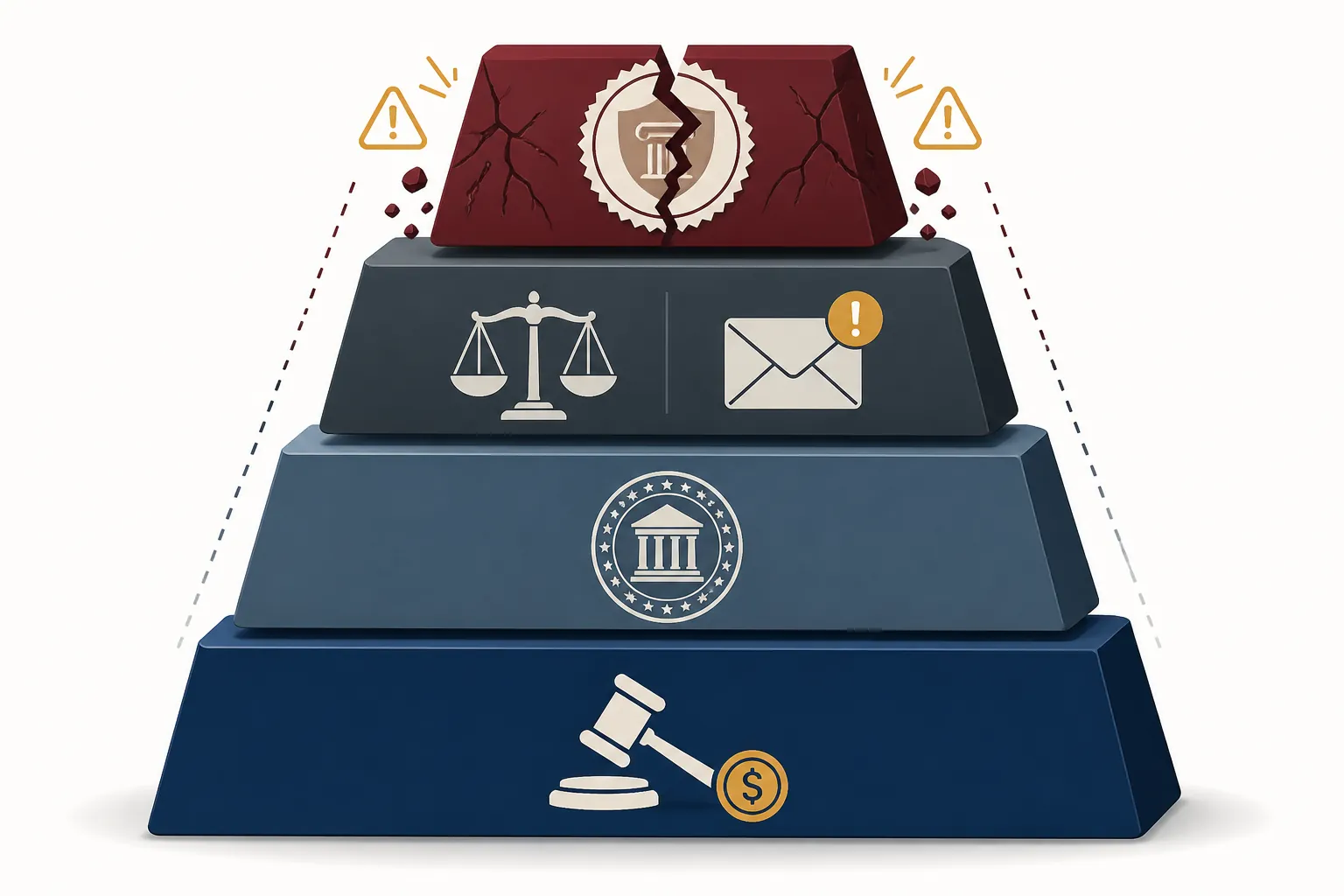
Layer One: Response Costs and Ransom Are Expensive, but Legible
Direct response is the first layer. It includes forensic investigation, restoration, outside breach counsel, crisis communications, replacement infrastructure, temporary workarounds, and the lost time of lawyers and staff who cannot safely use ordinary systems. For a law firm, the interruption has an immediate revenue shape: lawyers bill through access to documents, email, time-entry systems, research tools, and client portals. If those systems are unavailable, the firm is not only recovering technology. It is slowing the production line of legal work.
Ransomware adds a visible line item, but it should not dominate the analysis. Programs.com reports that BakerHostetler's Data Security Incident Response work found an average ransom payment of $501,388 for legal-sector targets in 2024, while Arctic Wolf data put the average legal-sector demand at $1.0 million in 2023.[2] A demand is not a payment, and a payment is not the full loss. The firm still has to investigate what happened, determine what data was accessed or exfiltrated, preserve privilege where possible, notify where required, and explain itself to clients whose files were part of the incident.
There is also concentration risk. Professional services, a category that includes law firms but is not limited to them, accounted for 18.9% of ransomware incidents in Q4 2025 in Coveware data reported by Deepstrike.[4] That figure should not be read as a law-firm-only ransomware share, but it does show why firms cannot dismiss ransomware as a hospital, school, or municipality problem.
Layer Two: Regulatory Fines Make the Average Less Predictable
The second layer is enforcement. IBM's 2025 data, as summarized by Baker Donelson, found that 32% of breached organizations paid regulatory fines, and 48% of those fines exceeded $100,000.[5] That is not a law-firm-specific fine rate, but it matters for firms because client files often contain data governed by someone else's regulatory environment.
A law firm may hold employee medical information in an employment matter, consumer data in litigation, financial records in deal diligence, or personal identifiers in a mass arbitration. The firm is not necessarily the regulated entity in the way its client is, but the exposure does not wait politely for that distinction. Regulators, clients, insurers, and plaintiffs' counsel will all want to know what categories of information were involved, when the firm knew, what it did before the breach, and what it did after.
This is where averages can become misleading. A firm with modest headcount but unusually sensitive matters may face a worse notification and regulatory burden than a larger firm whose incident touched less sensitive data. Cost does not follow attorney count in a straight line. It follows the data map.
Layer Three: Professional Duties Turn Client Data Exposure Into a Separate Cost Center
The third layer is the one generic breach summaries tend to flatten. A law firm does not only ask whether personal information was accessed under a state breach-notification statute. It must also ask what its professional obligations require when confidential client information may have been compromised.
ABA Model Rule 1.6(c) requires lawyers to make reasonable efforts to prevent unauthorized access to, or disclosure of, information relating to the representation of a client. ABA Formal Opinion 483 states that, after a data breach involving or having a substantial likelihood of involving material client confidential information, lawyers have a duty to notify current clients.[6] That duty is not the same thing as statutory notice to affected individuals. It is a professional obligation rooted in the lawyer-client relationship.
The factual trigger is not rare. Arctic Wolf survey data cited in the research record found that 56% of breached law firms lost sensitive client data.[4] That figure should be read as survey evidence, not as a universal rate for every firm or practice area. Still, it explains why the law-firm average carries a different risk profile: the breached asset is often not merely business data. It may be privileged communications, litigation strategy, settlement posture, deal timing, witness material, investigative records, or sensitive personal information entrusted to the firm precisely because the client needed legal protection.
Once that data is implicated, the firm's response becomes slower and more expensive. Someone has to determine which clients are affected, which matters are involved, whether notice is ethically required even if statutory notice is not, what can be said without worsening privilege or confidentiality problems, and whether the firm must advise clients to take protective steps. Knowledge-management teams suddenly become central witnesses to the firm's risk posture because they know where the documents actually sit, which repositories are shared across matters, and which legacy systems still contain client material no one has opened in years.
This work does not price cleanly. It is partner time, conflicts review, client-by-client communication, ethics analysis, and often uncomfortable calls with in-house counsel who must now decide whether their outside firm has become a risk to their own organization. The firm may be the victim of the intrusion, but the client is the party whose secrets may now be circulating outside the legal relationship.
Layer Four: The Forensic Report Can Become Its Own Litigation Risk
The fourth layer is privilege and work-product exposure. In many breach responses, the forensic report is commissioned through counsel with the hope that it will remain protected. Courts have become more skeptical when the same report serves both legal and business purposes, or when the record does not show that the investigation was meaningfully different from ordinary incident response.
Greenberg Traurig's 2025 analysis of the data-breach investigation landscape discusses decisions including Capital One in 2020, Rutter's in 2021, and McMenamins in 2023, where courts narrowed or rejected work-product protection for forensic materials in breach-related disputes.[7] These cases do not mean every forensic report is discoverable. They do mean that privilege depends on structure, documentation, purpose, and discipline before the report is written, not only on labeling afterward.
For a law firm, that risk is especially awkward. The firm is trained to protect privilege for clients, yet its own breach response may produce documents plaintiffs, regulators, adversaries, or clients later seek. A report created to understand containment can become evidence in later disputes about whether the firm used reasonable safeguards, when it knew client data was exposed, and whether its public or client-facing statements were complete.
The cost is not limited to producing or withholding the report. It includes motion practice, privilege logs, declarations about the investigation's purpose, possible waiver disputes, and the strategic problem of litigating over the document that may contain the clearest account of the firm's security failures. That is a professional embarrassment cost as much as a legal cost, and it rarely fits comfortably inside an average breach figure.
Client Loss Is Directional, but It Belongs in the Budget Conversation
Client attrition is the hardest layer to quantify and one of the easiest to understate. Integris surveyed 750 U.S. law firm clients for its 2025 Law Firm Cybersecurity Report and found that 40% would fire or consider firing a firm after a breach, while 37% would warn others.[8] Those are stated preferences, not observed churn rates. Clients often say they will switch providers more readily than they actually do, especially when matters are complex, counsel is embedded, or replacement costs are high.
Even with that caveat, the signal is commercially important. A client does not have to terminate every matter to punish the firm. It can stop sending new work. It can require more security questionnaires. It can move the next sensitive investigation to another firm. It can exclude the firm from a panel refresh. None of those decisions necessarily appears in the immediate breach ledger, but each can make the true cost exceed the reported average months later.
The Orrick breach illustrates the scale problem without needing to stand in for every law firm incident. Recorded Future reported that the 2023 Orrick breach exposed information related to more than 637,000 individuals.[9] A single incident at a firm with concentrated client data can therefore create consequences far beyond internal downtime or a ransom decision. The breached firm may have to manage not only affected individuals, but also institutional clients whose own employees, customers, or counterparties are now part of the event.
How to Use the $5.08 Million Benchmark Without Misusing It
The $5.08 million figure is most useful as a planning anchor. It gives a managing partner, executive committee, insurer, or client a defensible starting point for the cost of a serious law firm breach in 2025. It is also more relevant than a cross-industry average because it reflects the legal sector's heavier exposure to confidential client data, professional duties, and relationship damage.
It should be adjusted upward when the firm holds large volumes of sensitive client data, depends on shared repositories across practice groups, lacks a reliable matter-level data inventory, represents regulated clients, has weak forensic-retainer structure, or cannot quickly separate business-continuity investigation from legal-advice work. It should also be adjusted upward when a major client would have to explain the firm's breach to its own board, regulator, customers, or employees.
For in-house counsel evaluating outside firms, the question is not whether a firm can recite a security policy. It is whether the firm can show where the client's sensitive files sit, who can access them, how incident response is structured, how client notice would be handled, and how the firm protects privilege over forensic work. Those answers matter because the client inherits part of the consequence when its outside counsel becomes the breach site.
IBM has since published a 2026 breach-cost report with a new global average, but the research record for this article does not include a comparable 2026 law-firm-specific breakout. For law-firm planning in Q3 2026, the 2025 legal-sector figure remains the most useful sector benchmark, provided it is treated as a minimum planning number rather than the outer boundary of loss.
References
- Cost of a Data Breach Report 2025 — IBM
- The Latest Law Firm Cyberattack Statistics (2026) — Programs.com
- Study Finds Average Cost of Data Breaches Decreased Globally in 2025 — Morgan Lewis, April 2026
- Law Firm Data Breach Statistics 2026: Legal Data Risk — Deepstrike
- Ten Key Insights from IBM's Cost of a Data Breach Report 2025 — Baker Donelson
- ABA Formal Opinion 483 — Lawyers' Obligations After a Data Breach — ABA/Constangy
- Privilege Under Pressure: The Shifting Data Breach Investigation Landscape — Greenberg Traurig, February 2025
- 2025 Law Firm Cybersecurity Report — Integris
- The Hidden Cascade: Why Law Firm Breaches Destroy More than Data — Recorded Future
Related records
Tool profile
How Meta's AI Spending Reshapes Law Firm ProfitabilityGoverning regulation
Browse the obligations tracker →Preventive workflow
Browse verification workflows →
Report a correction or tip
Spotted an outdated figure, a misstated fact, or a ruling this case record should reflect? Public comments are disabled for this content given the professional cost of a misreported case outcome, penalty amount, or rule text — use the structured correction channel instead.
Report a correction or tip for this record →