
Legal Consequences of the BA919 Stall-Warning Investigation
With no injuries or BA919 lawsuits yet reported, the stall-warning investigation still raises legal-risk questions that aviation, insurance, and product-liability counsel need to track. This verified record maps each consequence channel — AAIB report admissibility under Rogers v Hoyle, Montreal Convention claims, crew and regulatory exposure, and the AF447 criminal precedent — and separates confirmed findings from reported-only allegations.
- Jurisdiction
- United Kingdom
- Court
- English Court of Appeal
- AI tool named
- None
- Ruling date
- Jul 6, 2026
- Source document
- View primary court order ↗
- Last verified
- Aug 3, 2026
Lex Machina Review is an independent risk-tracking and reference resource. Nothing on this site is legal advice, and using it does not create an attorney-client relationship. Every record is reviewed against primary sources but may not reflect the most current status of a matter — always verify directly against the cited court order, rule text, or a licensed attorney before relying on it.
Companion explanation — secondary to the source document above
Verified record before liability theories
The legal consequences of the BA flight stall warning investigation are, as of August 3, 2026, mostly investigatory and regulatory. The record supports a serious-incident investigation, no reported injuries, no identified BA919 passenger lawsuit, and no public charge posture. It does not yet support a defect conclusion, a crew-misconduct finding, or an assumption that Airbus, British Airways, or the crew will face civil or criminal proceedings.
| Record point | Status as of August 3, 2026 |
|---|---|
| Incident | British Airways flight BA919, an Airbus A320, was the subject of a BEA-notified serious incident at London Heathrow on July 6, 2026. The BEA notification, based on information from UK authorities, describes an ADR failure on approach, a stall warning, degraded flight law, a PAN upgraded to MAYDAY after a second stall warning at 3,000 ft, a potentially abrupt recovery maneuver, and no injuries.[1] |
| Investigation | The investigation remains the controlling legal fact. No final cause, product defect, crew breach, enforcement action, prosecution, or civil judgment has been established in the reviewed materials. |
| Confirmed vs. reported | Confirmed official material is treated separately from media-only allegations. Reported claims about cockpit conduct, “hull loss” language, or crew leave do not become established facts merely because they could matter later. |
| Last verified | August 3, 2026 (UTC). |
| Legal-background review | This is a legal-risk record for aviation, insurance, and product-liability readers. It is not legal advice. |
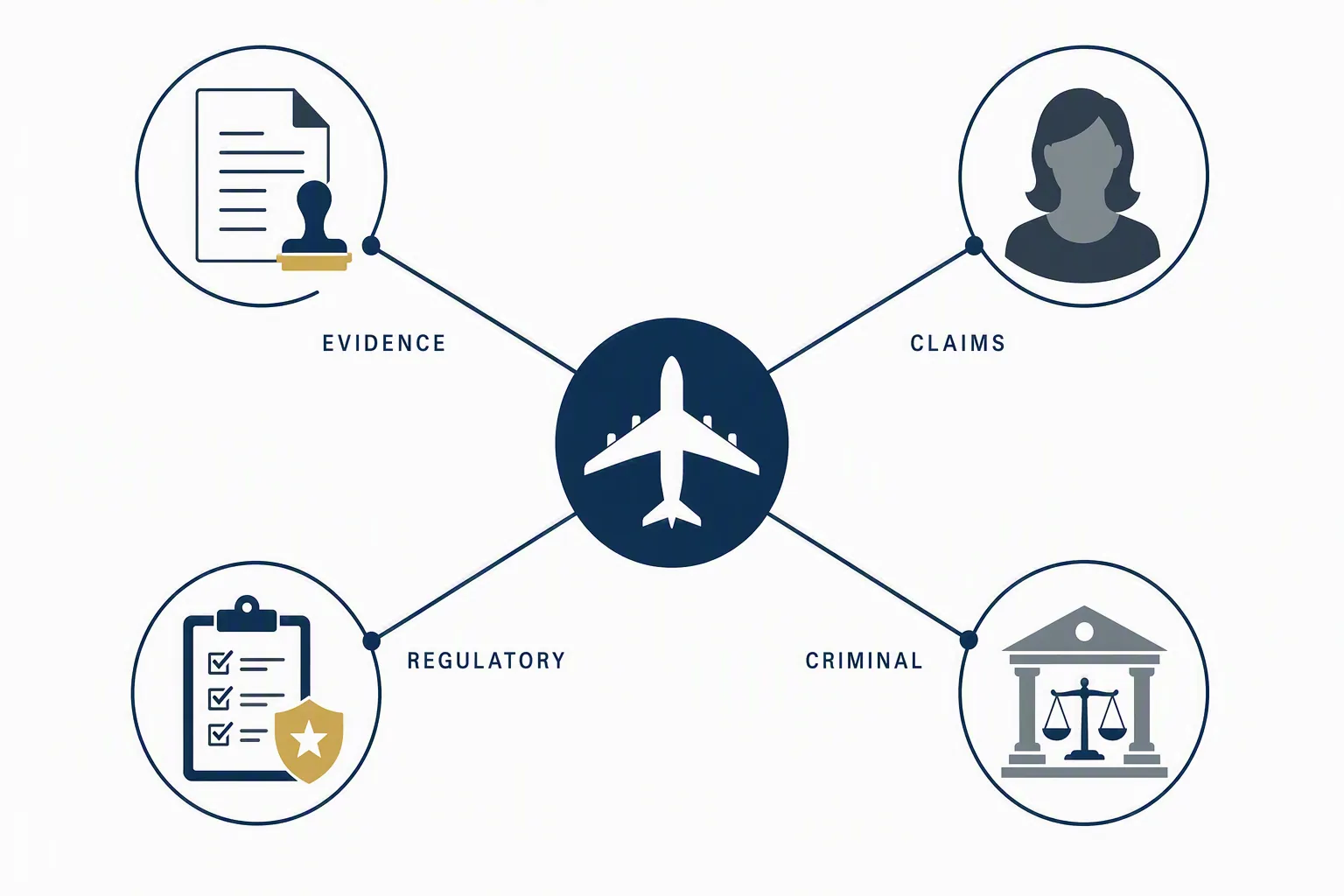
This article also sits beside, rather than repeats, the site’s existing British Airways near-crash liability analysis. That piece uses the incident to examine AI evidence and Rogers v Hoyle. This record maps BA919’s own aviation-liability channels: the AAIB report, Montreal Convention claims, regulatory and crew exposure, and the AF447 criminal-law backdrop.
The investigation file is already a legal consequence
A serious-incident file can change legal posture before anyone files a complaint. It creates preservation issues, coverage questions, internal-reporting work, and a record that may later be used in pleadings or expert evidence. The question is not whether the incident felt alarming. The question is which parts of the record can later do legal work.
The AAIB’s general investigation materials matter because they describe the machinery that may produce the next important document. The AAIB says it receives about 500 to 700 notifications a year, conducts around 30 to 40 field investigations, carries out more than 200 correspondence investigations, and that correspondence reports usually take around three months to complete.[2]
For BA919, the reported correspondence-investigation route is not a minor procedural footnote. TechTimes reported that the investigation is being handled as a correspondence investigation and that there may be no physical examination of the failed ADR unit.[3] If that remains the path, the eventual report may still identify a sequence, assess crew response, and record safety lessons. It may be less able, however, to make a hardware root-cause finding if the component itself is not examined.
That limitation is not exculpatory, and it is not accusatory. It is a weight issue. A lawyer briefing an insurer or board should separate “the report may be admissible” from “the report will prove a defect.” Those are different propositions, and conflating them is how a preliminary safety file becomes a bad liability memo.
Rogers v Hoyle: admissible does not mean decisive
The evidentiary channel is the most immediate civil-litigation consequence. In Rogers v Hoyle, the English Court of Appeal held that an AAIB accident report could be admitted in civil proceedings not only as factual evidence but also as expert opinion evidence.[4] For BA919, that means the eventual AAIB report should be assumed to be litigation-relevant even before any claimant appears.
The rule should not be overstated. Rogers v Hoyle concerns admissibility. It does not convert every AAIB conclusion into a binding finding against an airline, an OEM, a component supplier, or a pilot. The civil court still controls weight, relevance, and the treatment of any competing expert evidence.
That distinction matters especially here. A report based on correspondence can still be powerful on chronology: ADR failure, flight-law degradation, warnings, declarations, altitude, recovery, and post-incident handling. It may be less powerful on metallurgical, electronic, software, maintenance, or sensor-causation questions if the investigation does not include physical examination of the relevant unit. Counsel should preserve both points at once: the report may enter the case, and the court may still be asked to discount or contextualize parts of it.
That is also where this incident can become commercially significant without becoming a lawsuit. Reservation-of-rights letters, broker notices, board updates, and OEM litigation holds often move on the existence of an admissible investigation record, not on a filed complaint. The legal consequence is the record’s future usability.
Passenger claims remain conditional, not current
If an injured BA919 passenger later sued, the ADR-failure and stall-warning sequence would likely raise a serious Montreal Convention “accident” argument. That sentence has two important limits: it assumes an injured passenger, and it addresses only the accident element. The BEA notification reports no injuries, and no BA919 passenger lawsuit has been identified in the reviewed materials.[1]
Under Air France v Saks, an accident is generally an unexpected or unusual event external to the passenger. Moore v British Airways PLC, decided by the First Circuit in 2022, is also relevant because it assessed unexpectedness from the standpoint of a reasonable passenger rather than from the airline’s operational perspective.[5][6] A sudden air-data failure, degraded flight law, stall warnings, and a MAYDAY declaration on approach would be difficult to characterize as an ordinary passenger experience if bodily injury were alleged.
The Montreal Convention still requires more than a frightening flight. The materials reviewed for this record identify the bodily-injury requirement, a two-year limitations period, and a strict-liability tier of 128,821 Special Drawing Rights, reported as approximately US$170,000, subject to exchange-rate movement.[5] Fear, stress, or inconvenience without the required injury showing would not become a Montreal claim merely because the flight generated a serious-incident investigation.
Moore also needs a current-law caution. The reviewed research could not verify the U.S. Supreme Court’s final disposition of the later Moore certiorari materials. Before filing, advising, or publishing a U.S.-law position that depends on Moore, that status should be rechecked. For this record, the safe statement is narrower: Saks remains the baseline, Moore supplies a First Circuit passenger-perspective analysis, and BA919 has no identified injured-passenger claim at this stage.
Regulatory and crew channels: open questions, not findings
The regulatory channel should be kept separate from the passenger-claim channel. A serious incident can require reporting, cooperation with investigators, internal safety review, training review, and preservation of operational records even where no passenger is injured and no claimant appears. Those obligations are procedural consequences of the event and the investigation, not proof that anyone acted unlawfully.
British Airways has been reported as saying it was “legally unable to comment further.”[7] That is a posture fact. It is not an admission of liability, and it is not evidence that BA accepts any version of media-reported cockpit events. Airlines often limit comment while an official investigation, employment process, insurer notification, or legal review is live.
The same restraint applies to reported allegations attributed to The Sun: a physical intervention by the captain, “hull loss” language, and stress leave. Those claims may matter if later corroborated by AAIB materials, BA documents, employment records, or witness evidence. In the reviewed record, they are not corroborated by AAIB or BA materials and should not be written as established facts.
The Loss of Control In-Flight label deserves the same treatment. TechTimes reported the classification using ICAO terminology, but that is not the same thing as a directly reviewed AAIB classification for BA919.[3] It may be a useful reported frame for why regulators and insurers care. It should not be inflated into an official finding unless an AAIB source confirms it.
Reckless-endangerment or similar concepts belong only at the edge of the current map. They would require a developed evidentiary theory about conduct, knowledge, risk, and causation. At present, the stronger legal work is more ordinary: preserve flight data and maintenance records, track the AAIB route, avoid prejudging crew conduct, and keep privilege around internal legal assessments.
Product-liability exposure depends on what the ADR evidence can actually show
The Airbus and component-supplier channel is real but contingent. An ADR failure followed by alternate law and stall warnings naturally raises product, maintenance, software, sensor, and warning-design questions. It does not answer them. A hardware theory needs hardware evidence, maintenance history, data analysis, prior-event comparison, and expert work. The present record supports the question, not the conclusion.
That is why the correspondence-investigation point matters twice. It affects not only the future AAIB report’s evidentiary weight but also the practical shape of any product-liability case. If the failed unit is not physically examined in the investigation, later parties may have to rely more heavily on recorded flight data, fault messages, maintenance documentation, manufacturer submissions, and expert reconstruction.
None of that makes an OEM claim inevitable. It does mean that insurers, airline counsel, and manufacturer counsel should treat preservation and wording carefully now. The most damaging sentence in an early risk memo is often not a legal conclusion; it is an unnecessary factual certainty written before the technical record exists.
AF447 is the criminal-law comparator, with strict limits
AF447 belongs at the end of this analysis because it calibrates risk without deciding BA919. On May 21, 2026, the Paris Court of Appeal found Air France and Airbus guilty of involuntary manslaughter over the 2009 AF447 crash and imposed fines of €225,000 each; Airbus announced that it would lodge an appeal with the Court of Cassation.[8][9]
The comparison is legally relevant because AF447 involved an air-data failure cascade, degraded flight protections, stall warnings, and questions about manufacturer and airline responsibility. It shows that this class of technical sequence can sit inside an active criminal-law environment, not merely a civil or regulatory one.
The limits are just as important. BA919 did not crash. The BEA notification reports no injuries. No BA919 charge has been reported. No public finding establishes a defect, training breach, or criminally culpable act. AF447 therefore does not make BA919 “the next” criminal case. It marks the seriousness of the legal environment in which an ADR-to-alternate-law-to-stall-warning event will now be read.
The present legal consequences stop at that threshold: an admissible future investigation record, a potentially limited correspondence-investigation file, conditional Montreal Convention analysis if injury is later alleged, regulatory and internal review, careful treatment of reported-only crew claims, and a criminal-law comparator that warns against complacency without justifying prediction.
References
- Serious incident to an Airbus A320 operated by British Airways on 06/07/26 at London Heathrow, BEA
- How we investigate, GOV.UK
- Stall Warnings That Sparked British Airways Mayday May Have Been Sensor Ghosts, TechTimes, July 31, 2026
- Landmark English Court of Appeal Decision Accident Investigation Reports March 2014, HFW, March 2014
- British Airways Position on Montreal Convention Accident Determination Rejected, Kreindler & Kreindler
- Expecting the Unexpected: Moore v. British Airways and Defining “Accident” Under the Montreal Convention, University of Chicago Law Review
- British Airways flight BA919: What happened to plane that issued mayday at Heathrow?, BBC
- French court finds Air France, Airbus guilty of involuntary manslaughter over 2009 crash, France 24, May 21, 2026
- AF447 Flight: Airbus to lodge appeal with the Court of Cassation following Paris Court of Appeal decision, Airbus, May 2026
Related records
Tool profile
Browse tool evaluations →Governing regulation
Browse the obligations tracker →Preventive workflow
Browse verification workflows →
Report a correction or tip
Spotted an outdated figure, a misstated fact, or a ruling this case record should reflect? Public comments are disabled for this content given the professional cost of a misreported case outcome, penalty amount, or rule text — use the structured correction channel instead.
Report a correction or tip for this record →