
How British Airways near crash case affects AI liability
Analysis of how the British Airways near crash investigation, through the Hoyle v. Rogers framework, may influence the admissibility of AI hallucination benchmark evidence in U.S. attorney sanction and malpractice proceedings, increasing vendor and law-firm exposure.
- Jurisdiction
- eu
- Court
- English Court of Appeal
- AI tool named
- legal AI tools
- Ruling date
- Jan 1, 2014
- Source document
- View primary court order ↗
- Last verified
- Jul 31, 2026
Lex Machina Review is an independent risk-tracking and reference resource. Nothing on this site is legal advice, and using it does not create an attorney-client relationship. Every record is reviewed against primary sources but may not reflect the most current status of a matter — always verify directly against the cited court order, rule text, or a licensed attorney before relying on it.
Companion explanation — secondary to the source document above
The legal question raised by the British Airways near-crash investigation is not, at this stage, a question about who was at fault. The serious-incident notification for BA919 says only that an Airbus A320 operated by British Airways was involved in a serious incident at London Heathrow on July 6, 2026, with the UK Air Accidents Investigation Branch handling the investigation under the BEA-notified event record.[1] Aviation Herald has reported additional context about the flight, but those details remain reported context, not official probable cause.[2]
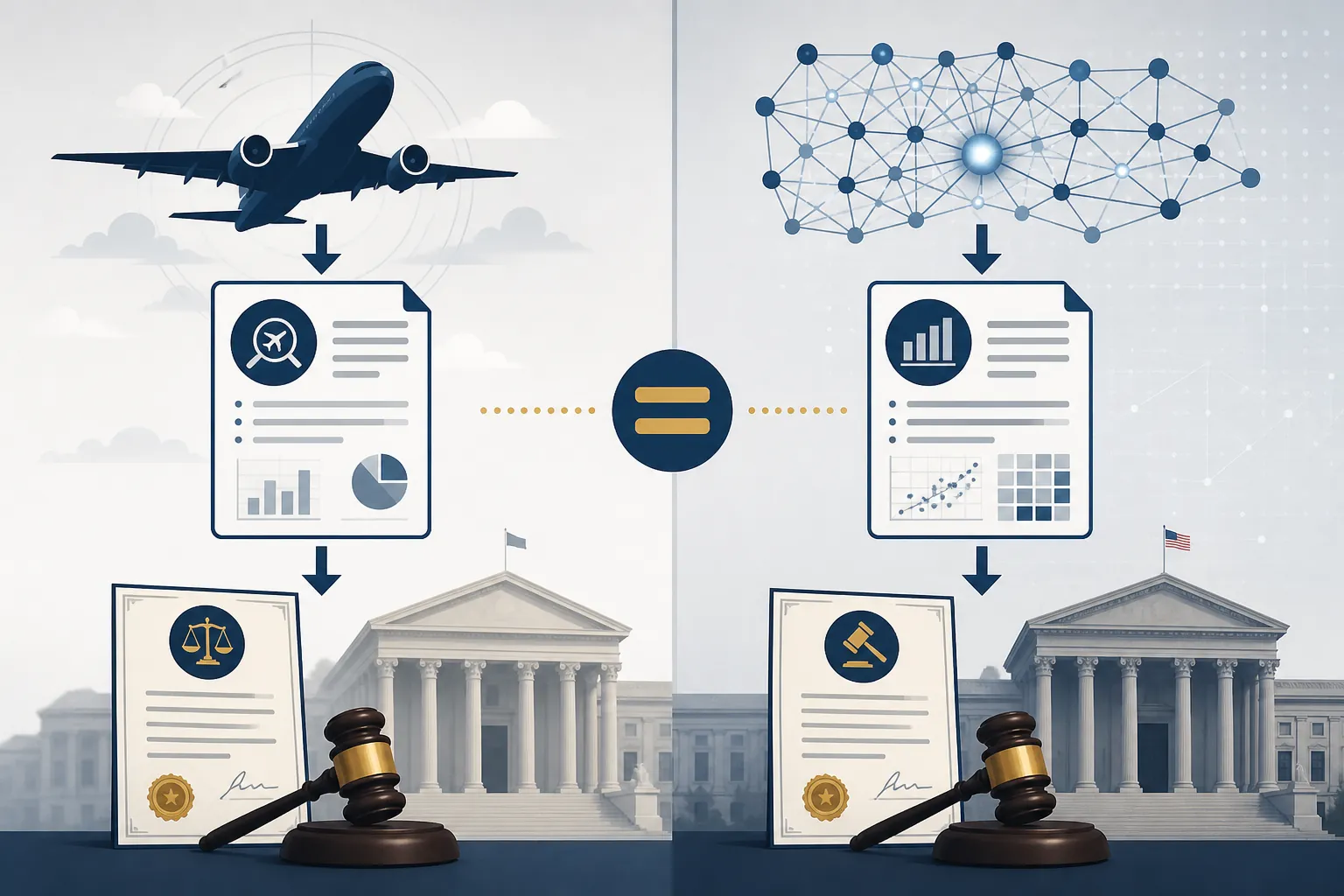
That distinction matters because the legal lesson worth taking from aviation is not a premature story about cockpit heroics or operational blame. It is narrower: a safety-investigation system designed to prevent future accidents can still produce reports that courts later allow into evidence. Once that happens, the same evidentiary logic becomes relevant outside aviation, including in disputes over whether AI hallucination benchmarks can be used in attorney sanctions, malpractice claims, vendor disputes, and disciplinary proceedings.

The court fight that does the real work here is not BA919. It is Hoyle v. Rogers, a 2014 English Court of Appeal decision about whether an AAIB accident report could be admitted in civil proceedings. The court allowed the report in for both factual findings and expert opinions, even though the report had been prepared for air-safety purposes rather than litigation.[3]
What Hoyle Actually Decided
Hoyle is easy to misuse if it is reduced to a slogan that accident reports are admissible. The more useful point is how the court got there. The defendant argued that the AAIB report should not be admitted because it contained findings and opinions produced outside the normal expert-witness process. The Court of Appeal disagreed. It did not treat the AAIB report as a judicial finding binding the court. It treated the report as admissible evidence that the trial court could evaluate.[3]
That distinction answered one of the most serious objections. The report was not being imported as a prior judgment. The court was not being asked to surrender its fact-finding role to investigators. The report entered the room as evidence, and the parties could argue about what weight it deserved.[3]
The expert-opinion point was more important. The Court of Appeal accepted that AAIB inspectors expressed technical opinions, but it did not apply the ordinary party-instructed expert framework as a bar. The inspectors were independent investigators, not experts retained by either litigant. On that basis, the court held that the civil-procedure rules governing party experts did not make the AAIB opinions inadmissible.[3][4]
This is the hinge for AI evidence. A benchmark report is often not written by a party expert. It may be produced by a university lab, a standards body, or an independent evaluation group before any lawsuit exists. That fact can be framed as a weakness: no cross-examination when the test was designed, no litigation-specific instructions, no case-specific duty to the court. Hoyle shows the opposite argument is available. Independence from the parties may strengthen the admissibility case, leaving methodology, scope, and fit for weight.
The chilling-effect objection also failed as an exclusionary rule. Aviation safety investigations depend on candor. Accident investigators work inside a legal culture that separates safety prevention from blame allocation. Yet in Hoyle, those concerns did not automatically keep the report out of a civil case. They informed the court’s assessment of weight and fairness, not a categorical rule of inadmissibility.[3][4]
The Safety Purpose Did Not Make the Evidence Untouchable
Aviation investigators are not claims adjusters. International accident-investigation norms emphasize independence and prevention, and Annex 13 has long been understood as part of that separation between safety investigation and liability adjudication.[5] The same pressure appears in just-culture discussions, where confidentiality is defended as a condition for learning from accidents rather than merely punishing participants.[6]
UK safety-data procedures also recognize that accident-investigation material sits inside a protected environment. SKYbrary’s UK procedure guide describes the legal handling of safety data disclosure and the tension between investigation confidentiality and later legal proceedings.[7] Hoyle did not pretend that tension was imaginary. It decided that the tension did not, by itself, defeat admissibility.
That is why the BA919 posture should be handled carefully. The current public record establishes an investigation, not a liability conclusion.[1] If a final AAIB report is later published, the legal question will not simply be whether the report was written for prevention. Hoyle suggests a court may ask a more practical question: is this independent technical material reliable enough to be considered, with objections reserved for weight?
AI hallucination litigation is moving toward the same kind of evidentiary fight. Benchmark studies are usually created for research, procurement, evaluation, or safety analysis. They are not malpractice reports. They do not decide whether a particular lawyer violated a duty in a particular filing. But if they measure a system’s tendency to generate unsupported legal assertions, they may become highly relevant once a lawyer, firm, or vendor argues that a hallucinated filing was unforeseeable.
Why AI Benchmark Evidence Looks Less Foreign After Hoyle
The Stanford RegLab and HAI legal-RAG study is the obvious example because its headline finding is courtroom-legible: tested legal AI tools hallucinated at reported rates between 17% and 33%.[8] That number should not be treated as a legal conclusion. Before it carries weight in any filing, counsel would need to examine the study date, tested tools, sample design, task selection, definition of hallucination, and whether the benchmark conditions resemble the use at issue.
Still, the evidence problem is not solved by saying the benchmark was not a real-world use case. That is an argument only if the difference matters. If the sanctioned lawyer used a tool for legal research, and the benchmark tested legal-research outputs, the vendor or firm opposing admission would need to explain why the benchmark’s design makes it unreliable or inapplicable. The objection should not get a free pass merely because the benchmark was produced outside the lawsuit.
| Aviation Evidence Question | AI Evidence Analogue |
|---|---|
| Was the AAIB report created for safety prevention rather than civil litigation? | Was the benchmark created for research, procurement, evaluation, or safety analysis rather than sanctions or malpractice litigation? |
| Were the inspectors independent and not instructed by a party? | Was the benchmark produced by an independent lab, standards body, or evaluator rather than the litigating vendor or firm? |
| Do confidentiality and candor concerns justify exclusion? | Do trade-secret, privilege, or audit-confidentiality concerns justify exclusion or merely limit use and weight? |
| Does the report contain technical opinions beyond raw facts? | Does the benchmark include expert judgments about model behavior, failure modes, and reliability under defined tasks? |
For U.S. courts, Hoyle is not binding authority. A federal judge would still work through the Federal Rules of Evidence, especially Rule 702 for expert testimony and, where the report is offered for the truth of its contents, a hearsay route such as Rule 803. The point is not that an English aviation case answers those questions. The point is that Hoyle gives litigants a disciplined structure for answering them.
Under that structure, the strongest benchmark evidence is independent, methodologically transparent, and close enough to the disputed use to help the fact-finder. A NIST-style evaluation, a university lab study, or a neutral system-incident record will generally be easier to defend than a vendor’s litigation-driven statement about its own product. The court still has to ask whether the test measures the right thing. But that is a reliability and fit inquiry, not an automatic exclusion because the benchmark was not commissioned for trial.
The closer case is the vendor-internal audit. Internal audits may be probative. They may show what the vendor knew, when it knew it, and how it described the risk before customers or lawyers relied on the system. But party control changes the admissibility posture. Privilege assertions, trade-secret protection, confidentiality promises, remedial-measure arguments, hearsay objections, and Rule 403 balancing can all become more serious. Hoyle helps most when the evaluator is meaningfully independent.
Foreseeability Is Where the Benchmark Starts to Bite
In an attorney-sanction case, the benchmark may not need to prove that a particular hallucination happened. The false citation, misquoted case, or nonexistent authority will usually be proved by the record itself. The benchmark matters because it helps establish what was foreseeable before the filing was made.
That makes the evidentiary use more modest and more dangerous. A disciplinary authority or opposing party does not have to argue that a 17% to 33% reported hallucination rate mechanically proves misconduct in every AI-assisted filing.[8] It can argue that a lawyer using a legal AI system had notice that unsupported outputs were a known failure mode, making independent verification part of reasonable practice.
A malpractice plaintiff can use the same evidence differently. The question may be whether competent counsel would have relied on AI-generated legal research without checking citations, quotations, and procedural authorities. A benchmark report can help show that the risk was not obscure. It can also help defeat the after-the-fact defense that the tool’s failure was surprising, idiosyncratic, or outside normal professional anticipation.
For vendors, the exposure is not limited to consumer-facing marketing claims. Benchmark evidence can shape disputes over procurement representations, contractual risk allocation, warnings, supervision, and product suitability for legal work. If an independent study documented a known class of errors before a law firm adopted the product, the fight may shift from whether the court can see the study to how closely the study maps onto the customer’s actual workflow.
The Objections Still Matter
A benchmark opponent has serious arguments. The tested tool version may differ from the version used by the lawyer. The benchmark may have used prompts unlike the firm’s workflow. It may measure hallucinations in retrieval-augmented legal research but not drafting assistance, summarization, contract review, or jurisdiction-specific litigation tasks. It may report aggregate failure rates that hide wide variation across task types.
Those objections are not cosmetic. A study can be independent and still poorly fitted to the issue in dispute. A headline rate can be memorable and still unhelpful if the benchmark tested a materially different use. Hoyle does not require courts to credit weak technical evidence. It suggests that many of these objections should be handled through cross-examination, competing experts, limiting instructions, and weight rather than a threshold exclusion.
That distinction is the practical risk. Once the report is admitted, the lawyer or vendor has to explain it. The defense becomes more expensive, more technical, and more fact-bound. The party resisting sanctions or liability must show why the benchmark does not prove notice, why the tool’s tested behavior did not resemble the actual use, or why the firm’s verification process was reasonable despite the known failure mode.
What This Means for Sanctions, Ethics, and Firm Audit Trails
This is where the argument connects to the sanction cases tracked in Lex Machina Review’s Risk Digest entry on AI Hallucinations and Attorney Ethics. The sanction table is not just a list of embarrassing filings. It is a map of recurring proof problems: what the lawyer knew, what the tool did, what review occurred, and whether the court views the failure as isolated error or unreasonable practice.
The ethics-enforcement context makes admissibility more consequential. Lex Machina Review’s discussion of ABA Formal Opinion 512 and state divergence in From Ethics Opinions to Enforcement shows why a single national compliance script is difficult. Some jurisdictions may move faster through discipline, others through judicial sanctions, and others through malpractice pleadings. In each setting, benchmark evidence can become a way to prove the professional baseline even when the governing rule text remains general.
The firm’s own verification workflow can then become evidence too. The Double-Compliance Burden frames verification as both a professional obligation and a recordkeeping problem. If a firm builds audit trails showing who reviewed AI output, which citations were checked, which errors were caught, and which warnings were ignored, those records may protect the firm. They may also be discoverable, depending on how they were created, stored, and used.
That creates an uncomfortable but manageable risk architecture. Independent benchmarks may show that hallucination risk was foreseeable. Ethics opinions and state enforcement patterns may show that verification was expected. Internal audit trails may show whether the firm actually did the work. None of those materials automatically proves liability. Together, they make it harder to defend an AI-assisted legal error as an unforeseeable accident.
Hoyle does not mean U.S. courts will adopt English aviation evidence doctrine. It means litigants now have a ready-made argument that independent technical reports created for prevention, evaluation, or safety can still be admitted when they help resolve foreseeability and reasonableness. In AI hallucination disputes, that may be enough to move benchmark reports from procurement files into the evidentiary record.
References
- Serious incident to an Airbus A320 operated by British Airways on 06/07/26 at London Heathrow, BEA
- Accident: British Airways A320 at London on Jul 6th 2026, The Aviation Herald
- Admissibility of AAIB reports in court proceedings, CMS Law
- Sarah Stewart discuss recent Court of Appeal decision Roger v Hoyle case, Stewarts Law
- Article on Annex 13 independence, Vanderbilt Journal of Transnational Law
- Aircraft Accident Investigation: The Concept of Just Culture in Prevention, Confidentiality and the Tension with Legal Liability, Aurelio Fernández Concheso, June 8, 2026
- Accident Investigation - Safety Data Disclosure Related to Legal Procedure - UK, SKYbrary
- Legal_RAG_Hallucinations.pdf, Stanford RegLab/HAI
Related records
Tool profile
How Meta's AI Spending Reshapes Law Firm ProfitabilityGoverning regulation
Browse the obligations tracker →Preventive workflow
Browse verification workflows →
Report a correction or tip
Spotted an outdated figure, a misstated fact, or a ruling this case record should reflect? Public comments are disabled for this content given the professional cost of a misreported case outcome, penalty amount, or rule text — use the structured correction channel instead.
Report a correction or tip for this record →