
AI audio authentication risks in Ben Crump Tyler Smith case
The July 2026 dispute over TMZ's AI-enhanced audio of the Nolan Wells distress call, now linked through Ben Crump's consolidated representation to the Tyler Smith wrongful death case, exposes how AI-processed evidence without chain-of-custody documentation and metadata preservation creates authentication risks under FRE 901 that litigators must anticipate.
- Jurisdiction
- United States
- Court
- Pre-litigation
- AI tool named
- General AI audio enhancement
- Ruling date
- Jul 30, 2026
- Source document
- View primary court order ↗
- Last verified
- Jul 31, 2026
Lex Machina Review is an independent risk-tracking and reference resource. Nothing on this site is legal advice, and using it does not create an attorney-client relationship. Every record is reviewed against primary sources but may not reflect the most current status of a matter — always verify directly against the cited court order, rule text, or a licensed attorney before relying on it.
Companion explanation — secondary to the source document above
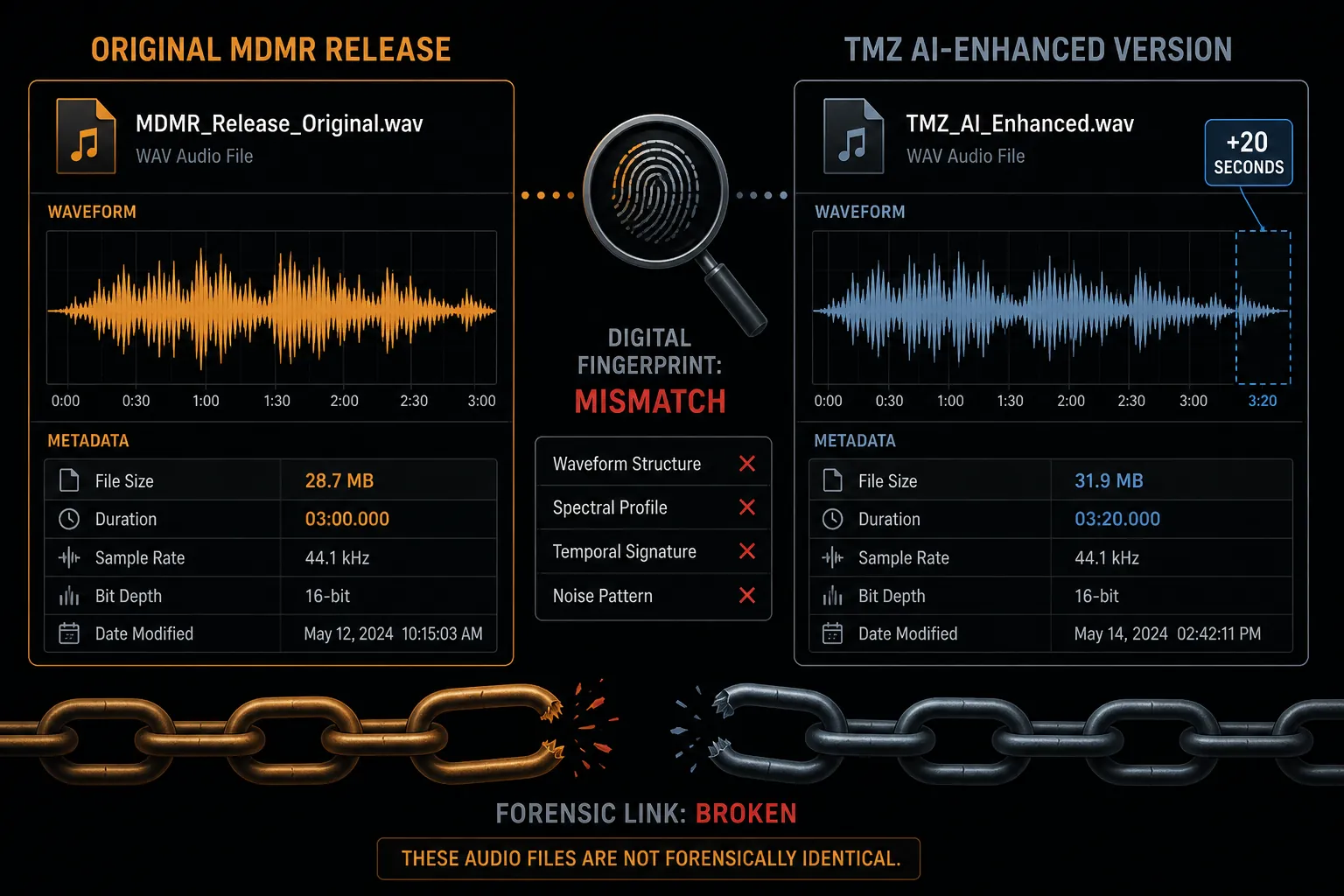
The first problem with the Nolan Wells recording is not that a media outlet said artificial intelligence made it clearer. The first problem is simpler and harder to talk around: the AI-enhanced file that TMZ aired was reportedly not the same length as the audio released by the Mississippi Department of Marine Resources. Digital forensics expert Robert Fried of Page One, Inc. told NewsNation that TMZ's version of the Sea Tow distress-call audio was 20 seconds longer than the MDMR release, had measurably different digital fingerprints, and did not allow his team to corroborate the claimed phrases TMZ said were audible, including "Is he dead?" and "Nolan."[1]
That is the line a litigator should underline. Once an enhanced recording differs in duration and fingerprint from the source file, the issue is no longer whether the sound feels more intelligible to a listener. The issue is whether the proponent can explain what the item is, where it came from, what changed, who changed it, and why those changes did not create a new persuasion object untethered from the original evidence.
This matters for readers searching for a Ben Crump Tyler Smith case update 2026 because the Wells audio dispute has now been pulled into a broader public case cluster. On July 30, 2026, Ben Crump stood with the families of Nolan Wells of Mississippi, Daniel Erving of Texas, and Tyler Smith of Kentucky at the National Urban League conference, saying, "No one has been held accountable in any way."[2] Mississippi Today likewise reported the three matters together as unresolved deaths in which post-event evidence questions have become central to the families' demands for answers.[3]
The distinction is important. The Tyler Smith case itself is not reported to involve AI evidence. The AI authentication issue enters through the Wells recording and through Crump's public grouping of the Wells, Smith, and Erving families. Treating Smith as an "AI evidence case" would be sloppy. Treating the cluster as a 2026 warning about post-event evidence handling is fairer, and more useful.
What Changed When the Audio Was Enhanced
AI audio enhancement is often described as a clarification step, as if the tool merely wipes dust off a window. That language is too comfortable for evidence work. In a courtroom, a recording is not just sound. It is a file with a source, a format, timestamps, metadata, hash values, custodians, and a history of handling. A cleaned version may be demonstrative, investigative, or potentially admissible, depending on the foundation. But it does not become reliable because the output sounds more decisive.
Fried's reported findings go directly to that foundation. A 20-second difference is not a cosmetic observation. Different digital fingerprints are not a preference dispute between listeners. They indicate that the file being evaluated is materially different from the file against which it is being compared. That does not prove bad faith, fabrication, or even error. It does mean the path between the original MDMR release and the TMZ version must be documented before anyone asks a judge, jury, investigator, or family to rely on the enhanced version as evidence of what was said.[1]
The metadata problem compounds the difficulty. NewsNation reported that the original MDMR audio release had metadata redacted, including account numbers and phone numbers.[1] There may be defensible privacy or operational reasons to remove sensitive fields before public release. But from an authentication standpoint, every redaction narrows what an outside examiner can verify. If the public file lacks metadata and the enhanced file differs in length and fingerprint, the examiner is left trying to reconstruct a chain of custody from partial materials.
That is where litigation risk starts. A party may have the unredacted original, a processing log, tool settings, export records, and custody documentation. Or it may not. The public reporting does not establish either. The point is that an AI-enhanced version cannot carry its own foundation. Someone still has to authenticate it.
The FRE 901 Problem Arrives Before the Bigger Evidentiary Fights
Federal Rule of Evidence 901 asks for evidence sufficient to support a finding that the item is what the proponent claims it is. That is a modest threshold, but it is not a mood. The proponent of an AI-enhanced recording needs more than a statement that the tool improved audibility. The proponent needs a witness, process, or forensic basis that connects the offered file to the source material and explains the transformations along the way.
| Authentication question | Why it matters for AI-enhanced audio |
|---|---|
| Was the original preserved? | Without the original or a verified source copy, the enhanced version cannot be meaningfully checked against the starting point. |
| Was metadata retained or was its removal explained? | Missing fields may be harmless, privileged, private, or material; the distinction depends on documentation. |
| Were processing steps logged? | Tool selection, settings, exports, and intermediate files may explain why the output differs from the source. |
| Can an independent examiner reproduce or validate the result? | A claimed phrase is weaker if another qualified examiner cannot corroborate it from the same materials. |
| Is the enhanced file being offered as evidence or only as an aid? | A demonstrative aid and a substantive recording invite different foundation and prejudice fights. |
Those questions come before the disputes lawyers usually enjoy arguing: hearsay, unfair prejudice, expert qualifications, reliability standards, and whether jurors will give too much weight to machine-polished sound. If the file cannot first be shown to be what the proponent says it is, the later arguments may never become the real battleground.
A careful enhancement workflow would preserve the original recording, calculate and store hashes for the original and each derivative, maintain metadata or document why fields were removed, record the software and settings used, keep intermediate exports, and separate human interpretation from machine processing. If someone hears a phrase after enhancement, the record should identify who heard it, from which file, under what conditions, and whether another examiner could validate the same phrase. That is not bureaucracy for its own sake. It is how an audio file remains evidence instead of becoming advocacy.
The Wells dispute is especially useful because it does not require a court to declare the TMZ audio false before the risk becomes visible. Fried's team reportedly could not corroborate TMZ's claimed audible phrases.[1] That is enough to change how counsel should evaluate the material. An uncorroborated enhanced phrase may still guide an investigation, but using it to anchor public certainty or courtroom proof is a different act with different consequences.
Why the Smith, Wells, and Erving Cases Now Travel Together
Crump's July 2026 presentation joined three families whose cases are not identical but rhyme in one painful respect: after the death, evidence handling became part of the fight over accountability. That does not mean the same defect appears in each matter. It means the families' public questions now sit in the same evidentiary weather system.
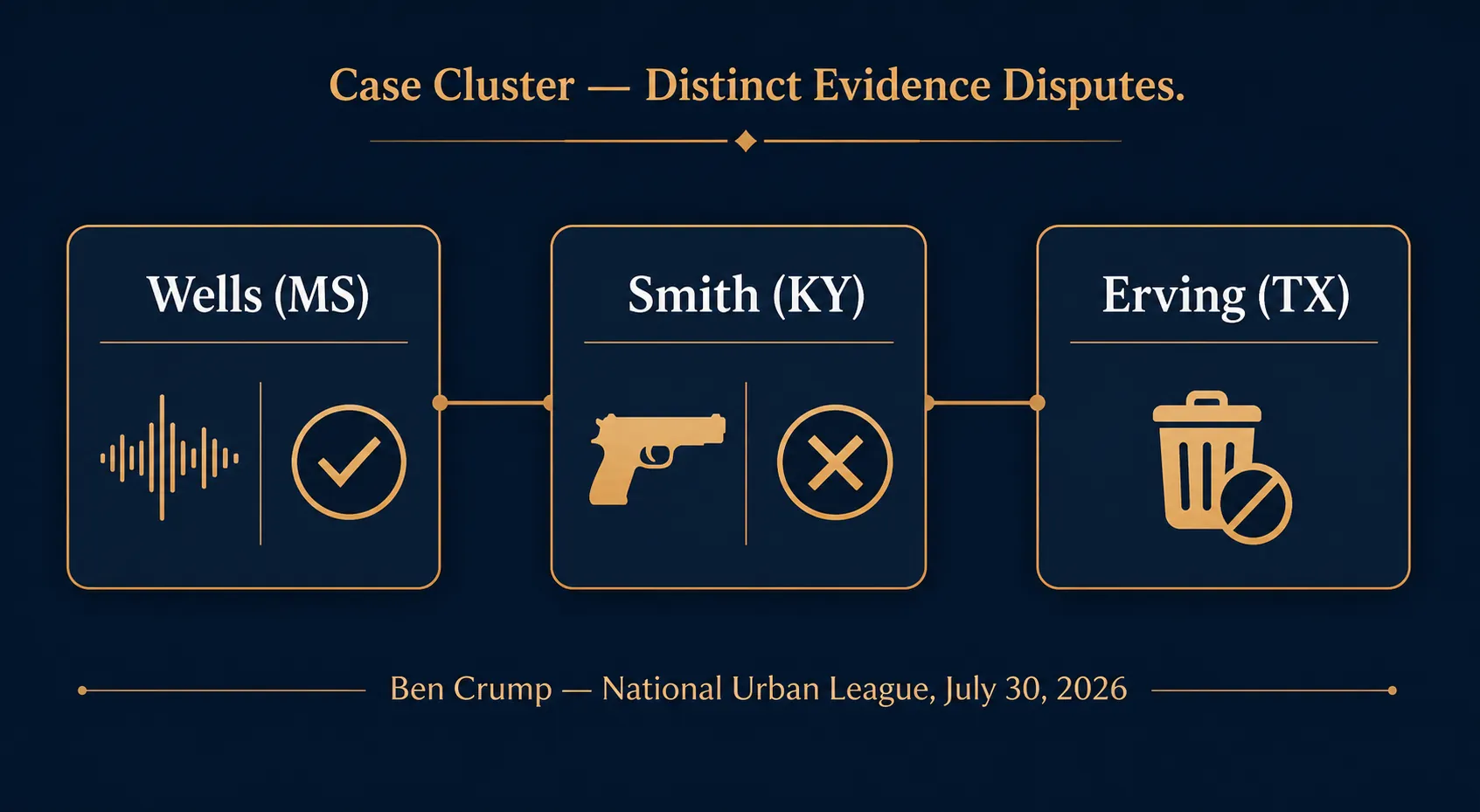
In the Wells matter, the public dispute centers on the distress-call audio and the difference between the MDMR release and TMZ's AI-enhanced version. The reported forensic critique is specific: longer duration, different digital fingerprints, redacted metadata in the original public release, and no corroboration of the phrases TMZ claimed the enhancement revealed.[1]
In the Tyler Smith matter, the reported dispute is different. Smith died in Lexington, Kentucky, on July 4, 2026. WKYT reported that police ruled the shooting self-inflicted, while the family disputes that conclusion. The same coverage reported that the firearm officers recovered did not match the shell casing found at the scene, that the family said gunshot-residue testing was not done on Smith's hands, and that Bryce Chestnut was charged with evidence tampering, not with Smith's death.[2]
The gunshot-residue point should be handled carefully. Based on the located materials, it is a family statement reported by media, not a quoted finding from a primary police record or court filing. That does not make it unimportant. It does mean counsel should not write it as an established forensic fact unless primary records later support it.
In the Daniel Erving matter, Mississippi Today reported allegations involving deleted texts and discarded clothing, with two teens charged with tampering. The same reporting framed the Wells, Smith, and Erving matters as cases in which no one had been charged in connection with the deaths themselves, while post-event tampering allegations or evidence disputes remained central.[3]
| Case | Reported evidence issue | What not to overclaim |
|---|---|---|
| Nolan Wells | Disputed AI-enhanced distress-call audio; reported duration and fingerprint differences; redacted metadata in the public MDMR release. | Fried's critique has been reported publicly, but the dispute has not been resolved by a court. |
| Tyler Smith | Firearm and shell-casing mismatch reported by WKYT; family statement that gunshot-residue testing was not done; evidence-tampering charge after the death. | No located source shows an AI evidence issue in Smith's case. |
| Daniel Erving | Reported deleted-texts and discarded-clothing allegations; two teens charged with tampering. | The tampering allegations do not establish who caused the death. |
For lawyers, the shared lesson is not that every unresolved death now has an AI problem. It is that post-event evidence handling can become the case. A removed firearm, deleted messages, discarded clothing, redacted metadata, or an enhanced audio file may each send counsel into a different doctrine and a different expert discipline. But each one forces the same practical question: can the evidence be traced, explained, and tested?
Public Claims Are Not Court Findings
There is a necessary caveat here, and it should not be treated as fine print. The located record for this article consists of news reporting and public-facing materials, not court orders, evidentiary rulings, police case files, or primary civil pleadings. The Wells audio controversy has not, on the available materials, been litigated to a judicial finding. Fried's analysis is reported and attributed to a credentialed digital forensics expert, but it has not been peer-reviewed or tested through courtroom examination in the sources reviewed.
That caveat protects more than the article. It protects the analysis. Families are entitled to ask why evidence was moved, deleted, redacted, enhanced, or left untested. Lawyers are entitled to demand that those questions be answered with records rather than vibes. But public outrage, however justified, cannot authenticate a file. Neither can a media segment. Neither can a lawyer's press conference.
Crump's broader civil-rights practice materials show that his firm is attentive to AI-related harms, including pages addressing AI deepfake harassment, facial-recognition wrongful arrest claims, and AI hiring discrimination.[4][5][6] Those pages are relevant context for the firm's litigation posture around technology. They do not prove anything about the Wells audio, the Smith shooting, or the Erving allegations.
The Litigation Risk in a Cleaner-Sounding File
The dangerous thing about AI-enhanced evidence is that it can feel more usable before it becomes more provable. A muffled distress call invites uncertainty. A cleaned recording with apparent words invites narrative. Once those words enter public circulation, every later examiner works in their shadow. Witnesses may hear what they have been told is there. Investigators may prioritize one theory over another. Families may believe a withheld truth has finally surfaced. Opposing counsel may argue that the enhancement manufactured certainty from noise.
None of those consequences depends on the tool being fraudulent. A well-documented enhancement can help a case. It can make a low-quality recording more intelligible, assist an expert's analysis, or support investigative decisions. The litigation failure occurs when the enhancement is treated as self-authenticating because it appears to clarify the disputed event.
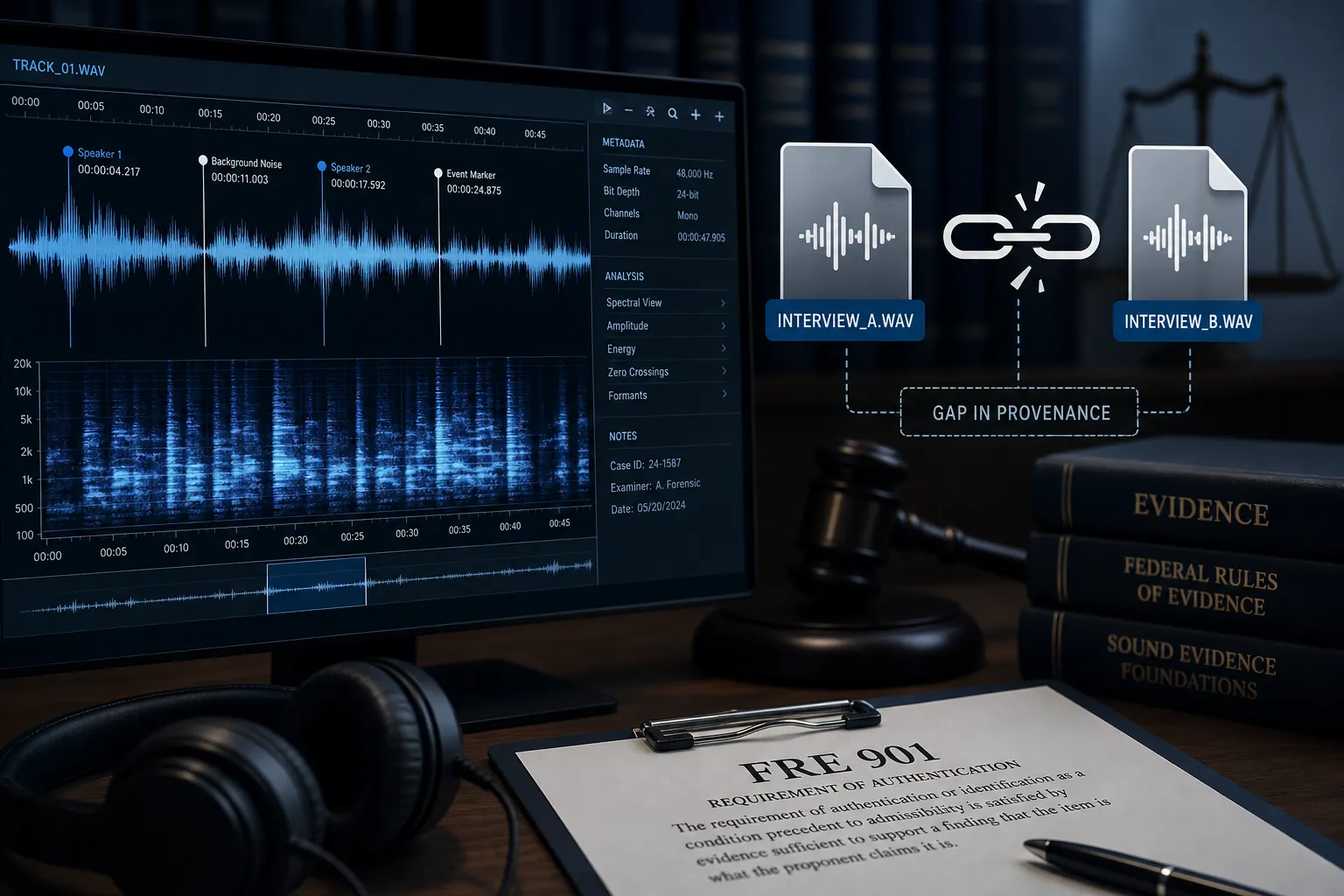
A supervising attorney reviewing AI-processed audio should ask for the original before listening to the enhancement. Then ask for the hash values. Then the metadata. Then the processing log. Then the tool information. Then the names of everyone who handled each file. Then an independent examiner's view of whether the claimed words or sounds can be reproduced from the same source material. If the answer at each stage is "we only have the enhanced version," the evidentiary value may be moving in the wrong direction.
The same discipline applies outside court. A company, agency, newsroom, or law firm that publishes an enhanced recording without explaining provenance invites the audience to trust the output while withholding the basis for trust. That may win attention. It may also create a record that is easier to attack than the imperfect original would have been.
Where the 2026 Case Update Actually Stands
As of July 31, 2026, the responsible update is narrow. Ben Crump publicly grouped the Nolan Wells, Tyler Smith, and Daniel Erving families at the National Urban League conference on July 30, 2026.[2] The Wells matter includes a reported forensic challenge to TMZ's AI-enhanced distress-call audio.[1] The Smith matter includes a reported dispute over the self-inflicted-shooting determination, the firearm and shell-casing evidence, and the family's statement about gunshot-residue testing.[2] The Erving matter includes reported tampering allegations involving deleted texts and discarded clothing.[3]
The Wells audio controversy does not prove what happened to Nolan Wells. It does not prove what happened to Tyler Smith or Daniel Erving. It has not been resolved in court on the materials located. But it gives litigators a live 2026 warning: AI-processed evidence without preserved originals, metadata, documented chain of custody, and independent forensic validation can weaken the very evidentiary claim it is meant to strengthen.
References
- Nolan Wells case: forensic expert disputes TMZ enhanced audio claims, NewsNation
- Attorney Ben Crump stands with families of 3 deceased Black teens at National Urban League conference in Nashville, WKYT
- Nolan Xavier Wells deaths unclear, Mississippi Today
- AI Deepfake Harassment Settlement, Ben Crump Law
- Facial Recognition Wrongful Arrest Settlement, Ben Crump Law
- AI Hiring Discrimination, Ben Crump Law
Related records
Tool profile
How Meta's AI Spending Reshapes Law Firm ProfitabilityGoverning regulation
Browse the obligations tracker →Preventive workflow
Browse verification workflows →
Report a correction or tip
Spotted an outdated figure, a misstated fact, or a ruling this case record should reflect? Public comments are disabled for this content given the professional cost of a misreported case outcome, penalty amount, or rule text — use the structured correction channel instead.
Report a correction or tip for this record →