
Berlin Pride Manhunt: Legal Implications for AI Surveillance
Assesses the legal exposure of Berlin police and AI vendors after the July 2026 manhunt deployed newly authorized AI surveillance tools, analyzing compliance with the EU AI Act's prohibition on real-time biometric identification and the unresolved quorum controversy threatening the underlying German police law.
- Jurisdiction
- Germany (EU)
- Court
- Landgericht Berlin
- AI tool named
- AI-assisted video monitoring system
- Ruling date
- Jul 27, 2026
- Source document
- View primary court order ↗
- Last verified
- Jul 27, 2026
Lex Machina Review is an independent risk-tracking and reference resource. Nothing on this site is legal advice, and using it does not create an attorney-client relationship. Every record is reviewed against primary sources but may not reflect the most current status of a matter — always verify directly against the cited court order, rule text, or a licensed attorney before relying on it.
Companion explanation — secondary to the source document above
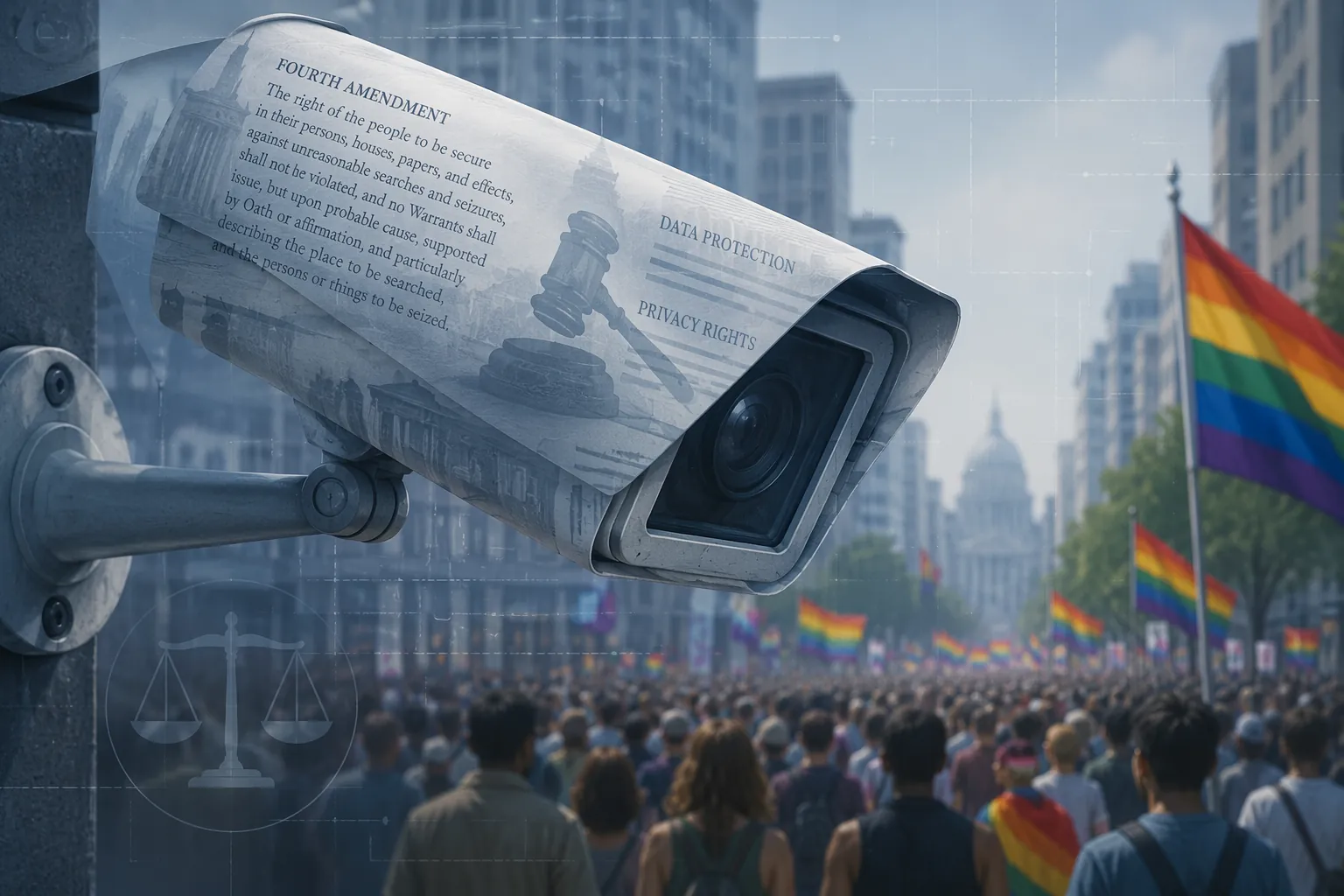
As of July 27, 2026, the Berlin Pride manhunt is less a settled surveillance case than a legal file with missing exhibits. The public record supports a cautious assessment: Berlin police conducted an urgent manhunt after the Pride attack; Germany had recently expanded police access to AI-assisted monitoring and live facial recognition powers; EU law prohibits real-time remote biometric identification in publicly accessible spaces except within narrow law-enforcement exceptions; and no publicly confirmed independent authorization or fundamental-rights impact assessment has yet been identified for any real-time biometric use in this operation.
That distinction matters for anyone assessing the legal implications of the Berlin Pride manhunt. The legal exposure does not turn on whether AI surveillance sounds novel or intrusive in the abstract. It turns on classification, authority, records, and proof: what tool was actually used, which public body authorized it, whether the statutory basis was valid, whether the EU AI Act exception was documented, and whether any AI-generated lead later influenced detention, search, arrest, charging, or evidentiary decisions.
| What can be assessed now | What remains unconfirmed | Why counsel should care |
|---|---|---|
| Berlin entered 2026 with an ASOG reform allowing AI-assisted video monitoring in designated crime-prone areas, alongside broader police powers including predictive analytics, state trojans, and body cameras in private homes. [1] | Whether those Berlin ASOG tools were actually used during the Pride manhunt, and if so in which locations, time windows, and configurations. | AI-assisted video monitoring creates GDPR, proportionality, retention, and evidentiary questions even when it is not live facial recognition. |
| The Federal Police Act was reported as approving live facial recognition use by federal police in terrorism-related emergencies shortly before the incident. [2] | Whether live facial recognition was deployed in the Berlin operation, and whether the unresolved quorum challenge to the Bundestag vote affects the law’s validity. | If the authority underneath the tool is unstable, every downstream AI-derived lead becomes harder to defend. |
| EU AI Act Article 5(1)(h) prohibits real-time remote biometric identification in publicly accessible spaces for law enforcement, subject to narrow exceptions including a genuine and present or foreseeable terrorist threat. [3] | Whether any prior independent authorization and fundamental-rights impact assessment were completed and recorded for the operation. | The terrorist-threat exception is not a verbal formula. It is a documented legal gate. |
Start with the tool, not the label
The phrase “AI surveillance” is too blunt for this file. Three different things are being compressed into one public-safety narrative: AI-assisted video monitoring, behavioral pattern detection, and live facial recognition. They may all sit inside the same operational command room. They do not create the same legal problem.
The Berlin ASOG reform, reported in January 2026, concerns police powers at the state level. The Berliner described a package of more than 700 pages that permits AI-assisted video monitoring in designated crime-prone areas such as Alexanderplatz, Kottbusser Tor, and Görlitzer Park, and also expands police tools through predictive analytics, state trojans for phone hacking, and body cameras in private homes. The measure was reported as passing with CDU, SPD, and AfD support. [1]
That is not the same legal object as live facial recognition. A system that flags unusual movement patterns, crowd behavior, abandoned objects, or suspected preparatory conduct may involve automated analysis of video data. It may still process personal data. It may still chill movement in public space. It may still generate an investigative lead that a defendant later challenges. But it is not automatically “real-time remote biometric identification” under Article 5(1)(h) of the EU AI Act.
Live facial recognition is narrower and legally more explosive. It attempts to identify a person by comparing biometric characteristics captured in public space against a reference database while events are unfolding. The Federal Police Act reported on July 17, 2026 is the relevant newly available federal power for that category, described as permitting live facial recognition use by federal police in urgent danger situations, including terrorism emergencies. [2]
Those distinctions decide the first round of litigation. If Berlin police used only ASOG-style AI-assisted monitoring, the core dispute is likely to concern state police authority, proportionality, data minimization, retention, human review, and whether an AI-generated lead tainted later investigative steps. If live facial recognition was used, the case immediately enters the EU AI Act’s prohibited-practices architecture and the much narrower exception in Article 5(1)(h).
The Article 5 gate is narrow, and the missing records are the problem
Article 5(1)(h) of the EU AI Act prohibits the use of real-time remote biometric identification systems in publicly accessible spaces for law-enforcement purposes, subject to specific exceptions. The terrorist-threat exception matters here because the manhunt followed a Pride attack and was treated as an urgent public-safety operation. The text permits use only where the conditions fit the listed grounds, including a genuine and present or genuine and foreseeable threat of a terrorist attack. [3]
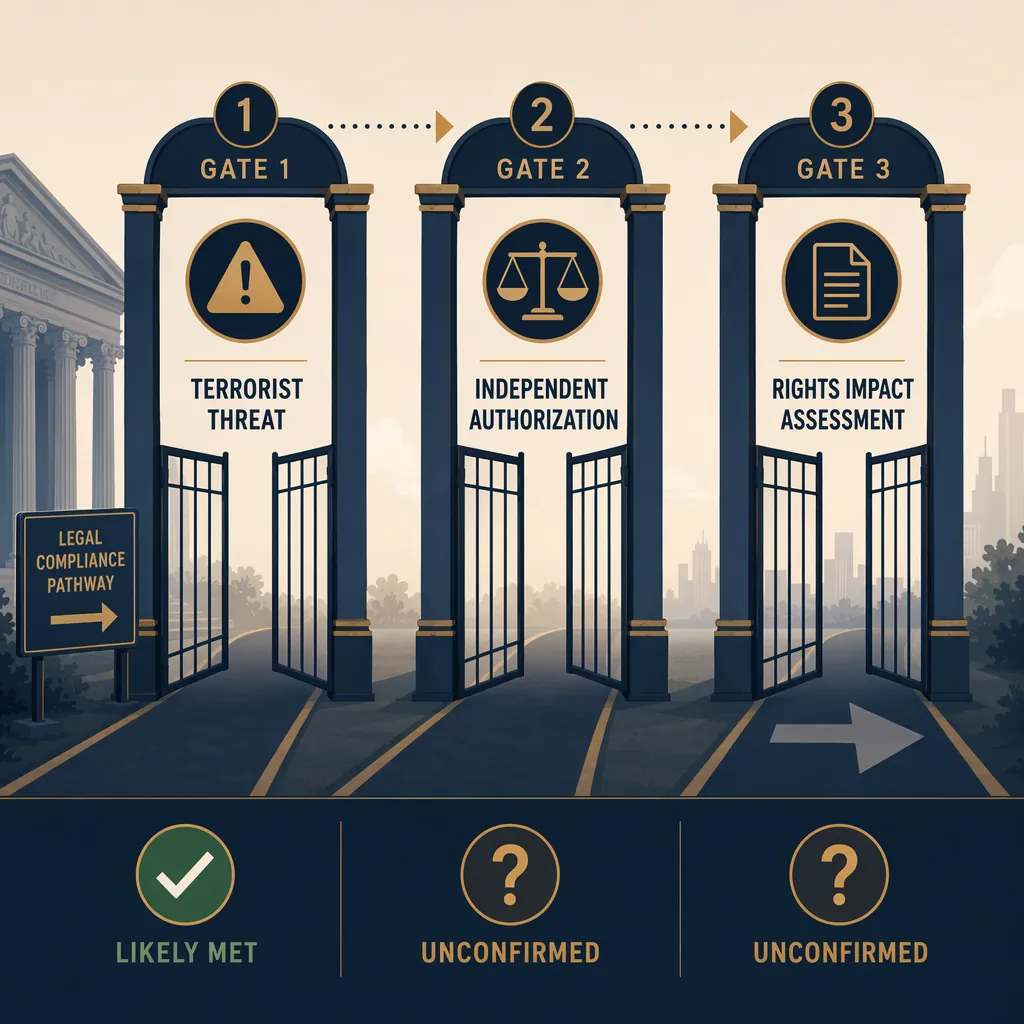
A serious Pride attack and possible terrorism concern could satisfy the first gate, at least on the facts as they were likely perceived in real time. This is exactly the kind of scenario in which emergency powers are expected to be tested. The harder issue is not whether the police had a public-safety reason to move quickly. The harder issue is whether the real-time biometric exception, if invoked, was reduced to the records that make it lawful.
For a real-time biometric identification deployment, Article 5 requires more than a threat assessment. The research record for this assessment identifies two safeguards as central: prior authorization by an independent administrative authority and a fundamental-rights impact assessment. As of July 27, 2026, no publicly confirmed record of either safeguard has been identified for the Berlin manhunt. That is not proof of illegality. It is proof of legal exposure.
The distinction is not semantic. An authorization may exist without being public. An impact assessment may have been completed internally. Emergency procedures may later be explained by the competent authority. But until those exhibits are available, the legal analysis cannot jump from “terrorism concern” to “lawful live facial recognition.” Article 5 creates an exception with conditions, not a general emergency override.
For prosecutors, the paperwork gap becomes a chain problem. If an AI match or AI-prioritized camera feed led officers to a location, vehicle, phone, associate, or eventual detention, the defense will ask whether the initial processing was lawful. If the initial processing was unlawful, counsel will then ask whether later evidence was independently obtained or tainted by the AI-derived lead. German criminal courts do not need to treat every unlawful investigative act as automatic exclusion for the problem to matter. The prosecution still has to explain the path from signal to suspicion to evidence.
A terrorism exception still needs a file
A defensible file would identify the statutory basis, the competent deploying authority, the precise operational objective, the suspect or threat category, the geographic perimeter, the time window, the databases queried, the human-review protocol, the retention rules, and the reasons less intrusive measures were inadequate. It would also distinguish between AI systems used to prioritize video review and systems used to identify people biometrically in real time.
Those details are not bureaucratic decoration. They decide whether the use was necessary and proportionate, whether bystanders were swept into biometric processing, whether false positives were caught before coercive action, and whether later disclosure can be made without compromising unrelated police methods. In a high-speed manhunt, the temptation is to document after the fact. In a prohibited-practices framework, late reconstruction is weaker than prior authorization.
The German-law foundation may be unstable
The federal live facial recognition authority arrived at an awkward moment. The Bundestag vote was reported on July 17, 2026, only shortly before the Berlin attack and manhunt. Biometric Update reported that German lawmakers approved live facial recognition use by federal police, while also noting the controversy over whether the vote had the required quorum after Correctiv journalists claimed that fewer than the necessary 316 representatives were present. [2]
If that quorum challenge remains unresolved, it is not a side story. It is a validity risk around the very statutory basis that may be invoked to justify live facial recognition. A later court would not be assessing only whether the police response to the Pride attack was operationally reasonable. It could also be asked whether the legal authority relied upon had validly entered into force.
That matters differently for the two tool categories. Berlin ASOG-style AI-assisted monitoring depends on state-law authority and its own constitutional limits. Live facial recognition by federal police depends on the federal authority and then still has to pass through Article 5. If the federal statute is vulnerable, the EU AI Act exception cannot repair the missing domestic legal basis. EU law may allow a narrow category of real-time biometric use, but a police authority still needs a valid national power to act.
The broader German context makes the timing less surprising. Reuters reported in February 2026 that Germany was seeking to enlist AI and modernize security bodies in the fight against organized crime. [4] The Berlin episode therefore sits inside a larger modernization push rather than a single improvised technology decision. That wider policy context, however, does not answer the narrower legality question. Modernization explains why the tools were politically available. It does not show that a particular deployment was authorized.
Who carries the exposure
The first exposed actor is the police authority that deployed or requested the system. Its file will have to show lawful basis, necessity, proportionality, data-protection controls, retention limits, access logs, and human oversight. If the operation used live facial recognition, the authority also needs to account for the Article 5 exception and the missing public record of independent authorization and impact assessment.
The second exposed actor is the prosecution service, even if prosecutors did not choose the tool. Once a criminal case depends on evidence reached through an AI-assisted lead, the prosecution inherits the disclosure problem. A defense lawyer does not need to prove that the algorithm was biased or defective on day one. The first demand will be more basic: identify the system, the legal basis, the query or trigger, the officer who reviewed it, and the investigative step that followed.
The third exposed actor is the vendor. Vendors often prefer to describe themselves as technology suppliers, not public-law decision makers. That boundary may hold for some purposes, but it will not end the inquiry. If a vendor supplied a system capable of real-time biometric identification, configured watchlists, retained logs, supported deployment, or marketed the product for emergency police use, counsel will need to assess whether the vendor is only a provider, whether it has any deployer-like role, and whether its documentation anticipated prohibited-use scenarios under the EU AI Act.
The fourth exposed group is less visible: people scanned, flagged, or indirectly affected who may never receive notice. Their route is likely to run through data-protection complaints, access requests, constitutional litigation, or criminal proceedings in which an affected defendant can force disclosure. The hardest cases may involve people who were not arrested at all. A person wrongly flagged and quietly cleared still has a privacy claim to understand, but may lack the factual foothold needed to bring it.
This is where the upcoming EU AI Act compliance calendar becomes relevant without deciding the Berlin case. The next high-risk obligations date falls on Aug. 2, 2026, creating adjacent pressure on documentation, governance, and role classification for organizations already handling AI systems in regulated settings. For the broader timing issue, see our analysis of the EU AI Act high-risk obligations taking effect on Aug. 2, 2026.
The evidentiary fight will be about deference to the machine
The most important factual question in later proceedings may be mundane: what did officers do after the AI system produced a signal? A system that merely placed a camera feed higher in a review queue creates one kind of record. A system that generated a biometric match and caused officers to stop or detain a person creates another. A system that produced a false signal that officers hesitated to override creates the most difficult human-rights and evidentiary problem.
The reported UK case of Alvi Choudhury is useful only as a cautionary comparator. As summarized in The Berliner, an AI monitoring system wrongly flagged an innocent man due to racial bias; police detained him for 10 hours despite a CCTV alibi because officers hesitated to override the AI signal. [1] That case does not prove that Berlin’s systems failed, that Berlin officers deferred to an algorithm, or that any Pride manhunt detention was wrongful. It shows why the human-review step cannot be treated as a box ticked by the mere presence of an officer.
For defense counsel, the practical discovery sequence is predictable. Ask for the watchlist or target criteria, the confidence threshold, the timestamp of the AI alert, the identity and training of the reviewing officer, the contemporaneous notes, the audit logs, any contrary information available before detention, and the non-AI evidence used to corroborate the lead. If the authority refuses disclosure on security grounds, the court still has to decide whether the defendant can fairly test the legality of the investigative path.
For public authority lawyers, the defensive file should not overclaim. If only behavioral analytics were used, say so and prove it. If live biometric matching was technically available but not activated, preserve configuration logs showing that. If a federal system assisted a Berlin operation, identify which authority was the deployer for which processing step. If emergency authorization was obtained, produce the authorization trail and the rights assessment rather than relying on generalized threat language.
Vendor risk is no longer remote procurement risk
Surveillance vendors face a different problem from police authorities. They may not control the public-safety decision, but they do control product design, documentation, configuration options, auditability, and sales claims. A vendor that markets real-time identification capability for emergency deployment should expect counsel to compare that marketing language with EU AI Act prohibited-use boundaries.
The immediate vendor questions are practical: could the system perform real-time biometric identification in publicly accessible spaces; could that function be disabled or segregated from ordinary video analytics; what logs prove whether it was enabled; who controlled watchlist ingestion; and did the contract require the police customer to obtain independent authorization before activation? A vendor that cannot answer those questions may have a documentation problem even before an enforcement authority reaches the merits.
The provider-versus-deployer boundary will be contested. A police authority that chooses to use a tool in a manhunt is the obvious public actor. But a vendor that configures the system during the operation, hosts the matching environment, supplies reference databases, or provides real-time analytic support may be harder to keep outside the operational frame. The EU AI Act’s role classifications will matter, but the facts of control will matter more.
There is also a litigation-export risk. European surveillance vendors and public authorities should not assume that disclosure fights stay local. AI surveillance litigation in the United States, including disputes over automated camera networks, has shown how quickly procurement documents, product claims, and system architecture become central to privacy litigation. The European legal structure is different, but the evidentiary instinct is the same: plaintiffs and defendants both look for the system records that explain how a person became a target.
What the current record can and cannot support
The current record supports a narrow judgment. It does not establish that Berlin police unlawfully deployed live facial recognition during the Pride manhunt. It does not establish that a false AI match caused an arrest. It does not establish that the suspect was identified through biometric processing. It does not establish which specific vendor systems, if any, were active during the relevant hours.
It does establish legal exposure. Berlin had newly expanded AI-assisted policing powers. Federal police had just received a reported live facial recognition authority whose validity is clouded by a quorum controversy. EU law treats real-time biometric identification in public as prohibited unless a narrow exception and safeguards are satisfied. The public record, as of this assessment, does not show the independent authorization or fundamental-rights impact assessment that would make a live biometric manhunt easier to defend.
That is enough to shape the next legal phase. Defense lawyers will seek the AI trail behind any coercive step. Data-protection complainants will ask whether they were scanned and on what basis. Prosecutors will try to separate admissible evidence from any contested algorithmic lead. Vendors will review whether their documentation, contracts, and logs can withstand an EU AI Act inquiry. Public authorities will need to show that emergency language did not replace the legal gates that make emergency powers lawful.
The Berlin Pride manhunt is therefore not yet a proven illegal deployment. It is already a legally exposed one.
References
- Berlin's Big Brother: New Police Surveillance Powers and What They Mean For You, The Berliner
- German lawmakers approve live facial recognition use by federal police, Biometric Update
- Article 5: Prohibited AI Practices, EU Artificial Intelligence Act
- Germany seeks to enlist AI, modernise security bodies in fight against organised crime, Reuters, February 25, 2026
Related records
Tool profile
How Meta's AI Spending Reshapes Law Firm ProfitabilityGoverning regulation
Browse the obligations tracker →Preventive workflow
Browse verification workflows →
Report a correction or tip
Spotted an outdated figure, a misstated fact, or a ruling this case record should reflect? Public comments are disabled for this content given the professional cost of a misreported case outcome, penalty amount, or rule text — use the structured correction channel instead.
Report a correction or tip for this record →