
Bite of Seattle shooting suspect faces a decline hearing
A judge, not the charge alone, will decide whether the 15-year-old Bite of Seattle shooting suspect is tried as an adult. This breakdown explains how RCW 13.40.110's discretionary decline-hearing standard works, what factors the court must weigh, how long comparable King County proceedings have run, and the sentencing exposure if he is convicted in adult court.
- Jurisdiction
- Washington
- Court
- King County Juvenile Court
- Judge
- Tanya Thorp
- AI tool named
- No AI tool involved
- Ruling date
- Jul 29, 2026
- Source document
- View primary court order ↗
- Last verified
- Jul 31, 2026
Lex Machina Review is an independent risk-tracking and reference resource. Nothing on this site is legal advice, and using it does not create an attorney-client relationship. Every record is reviewed against primary sources but may not reflect the most current status of a matter — always verify directly against the cited court order, rule text, or a licensed attorney before relying on it.
Companion explanation — secondary to the source document above
For readers tracking the Seattle food festival shooting suspect legal case, the immediate procedural answer is narrower than many headlines suggest: prosecutors have asked for adult court, but the charge itself has not moved the 15-year-old out of juvenile court. Washington’s decline-hearing statute makes the adult-court question available when a respondent is age 15 or older and charged with a serious violent offense, then requires a judge to decide whether declination serves “the best interest of the juvenile or the public” and to enter written findings. [1]
KUOW reported on July 29, 2026, that King County prosecutors had moved to try the teen, charged with first-degree assault, as an adult. KUOW also reported that the judge must conduct a decline hearing before that can happen. [2] That is the point to hold onto: eligibility, motion, hearing, and actual transfer are separate procedural steps.
This is a procedural explainer, not legal advice, and the posture should be rechecked against the King County juvenile docket before anyone relies on a hearing date. The respondent is a minor and is not named here. The Spokesman-Review/Seattle Times report did not publish his name because he was being handled as a juvenile suspect at that point. [3]
This site usually spends its closest docket attention on AI-related litigation risk and sanctions records. This article sits slightly outside that lane for the same reason those records matter: a public narrative can move faster than the controlling document. Here, the controlling document is not a charging headline. It is RCW 13.40.110 and, eventually, the judge’s written findings.
What is actually verified before the transfer question
The juvenile-court posture is not blank. Judge Tanya Thorp found probable cause and ordered the 15-year-old held in secure juvenile detention after the Seattle Center shooting, according to the Spokesman-Review’s republication of Seattle Times reporting. [3] Prosecutors then asked for adult-court handling. [2]
The alleged facts are serious enough to explain why prosecutors would make that request. KOMO reported that investigators described 13 fired casings, evidence of four handguns, and a Polymer80 ghost gun recovered from the suspect with a 33-round magazine and the phrase “1 SHOT 1 KILL” engraved on it. KOMO also reported that autopsies excluded that Polymer80 as the weapon that killed either bystander. [4]
The casualty reporting should not be silently harmonized. KOMO reported four injured people; KUOW reported five. [4][2] That discrepancy matters less to the legal mechanics than the first-degree assault charge and firearm allegation, but it matters to competent coverage. Where public reports do not match, the safer procedural statement is that multiple people were reported injured and that the precise count should be checked against filings or later official statements.
A claimed Sept. 11 adult-court decision date has circulated outside the cited materials, but it was not confirmed in the sources reviewed for this article. Treat it as unverified unless it appears in the court record or in a later report tied to the docket.
The charge opens the decline-hearing question; it does not answer it
RCW 13.40.110 is the statute doing the work. Subsection (1)(a) requires the juvenile court to hold a decline hearing when the respondent is 15, 16, or 17 and the information alleges a serious violent offense. [1] That gets the case to the threshold. It does not supply the ruling.
The ruling comes later, under subsection (3). The court may decline juvenile jurisdiction only if it finds that doing so would be in the best interest of the juvenile or the public. Subsection (4) then requires written findings. [1] Those written findings are not paperwork after the fact; they are the place where the judge must show the reasoning that connects the record to the transfer decision.
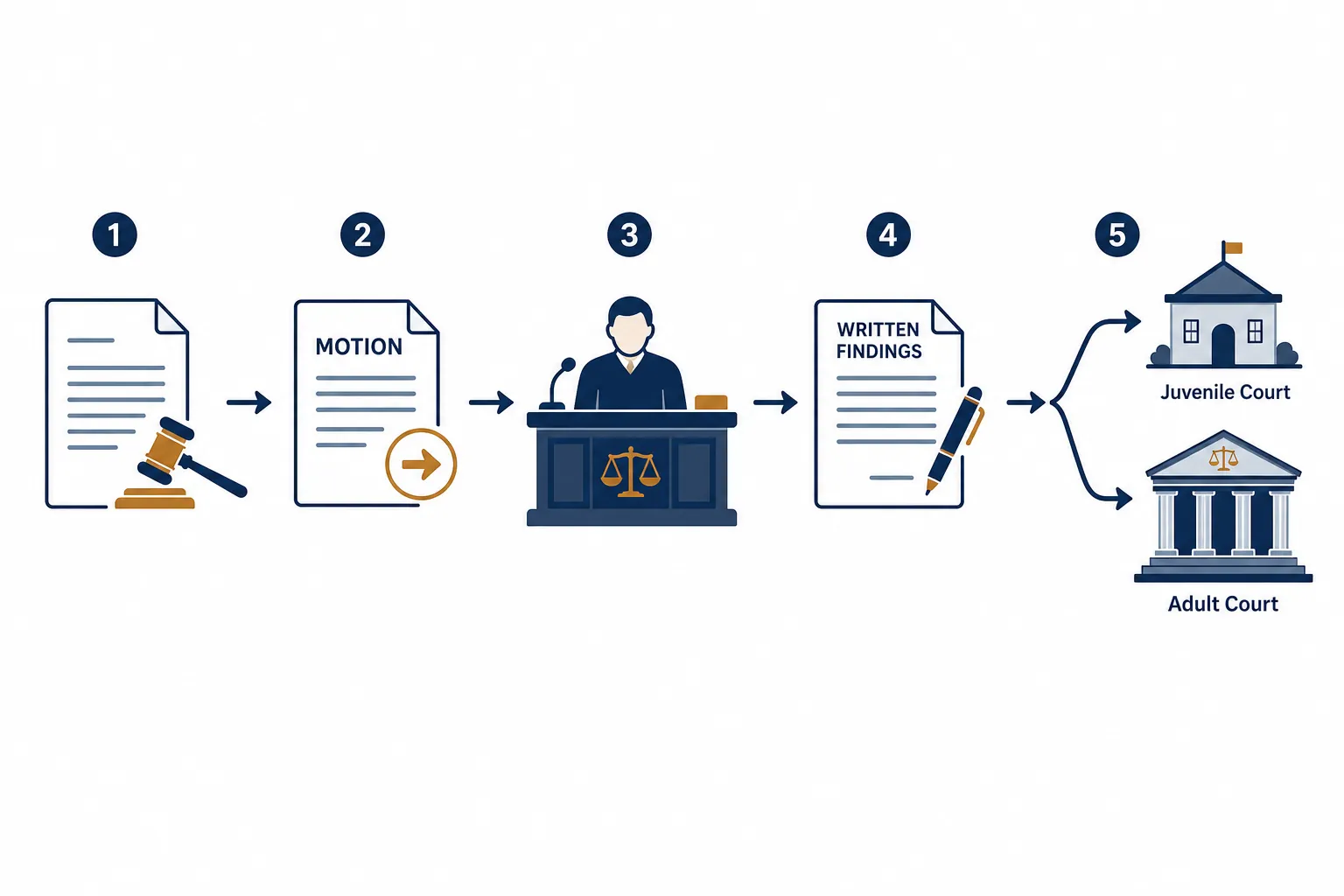
| Procedural point | What it means in this case |
|---|---|
| Eligibility | Because the respondent is 15 and charged with a serious violent offense, RCW 13.40.110(1)(a) makes a decline hearing available. [1] |
| Prosecutor motion | King County prosecutors have asked for adult-court handling, according to KUOW. [2] |
| Decline hearing | The court hears and considers the statutory transfer question; the motion itself is not the transfer. |
| Written findings | The judge must put the reasons for declining or retaining juvenile jurisdiction in writing. [1] |
| Result | Only if juvenile jurisdiction is declined does the case proceed in adult criminal court. |
The Office of Juvenile Justice and Delinquency Prevention’s Washington transfer-law summary places this kind of adult-court movement within a state-law framework of specified transfer mechanisms, not a free-floating media label. [5] For this case, the mechanism that matters is discretionary decline under RCW 13.40.110.
What the judge must examine
The statute directs the court to consider the relevant reports, facts, opinions, and arguments presented by the parties, then decide whether juvenile jurisdiction should be declined. It identifies considerations including the seriousness of the alleged offense, whether the protection of the community requires waiver, the respondent’s sophistication and maturity, the respondent’s criminal history, and related best-interest questions. [1]
In this record, the prosecution’s public-protection argument is not hard to anticipate. The allegation is not merely possession of a firearm by a child. The reported theory is that shots were fired in a crowded public festival setting, with multiple people injured, and that the suspect had a ghost gun with an extended magazine. [4] Those facts do not transfer the case by themselves, but they are the kind of facts prosecutors can be expected to press under offense seriousness and community protection.
The defense side of the hearing will not be limited to disputing the facts of the shooting. In a decline hearing, the respondent’s age, development, maturity, sophistication, prior record if established, amenability to juvenile-court programming, and the consequences of adult prosecution can all become part of the transfer fight. The judge is not asked to decide guilt at this hearing. The judge is asked which court system should keep jurisdiction while the charge is litigated.
That distinction matters because some of the evidence that makes the case sound grave to the public may carry different weight depending on the statutory question being asked. A large-capacity magazine can bear on public protection. An engraving can bear on sophistication or intent arguments, depending on how the parties use it. Autopsy exclusions may explain why the teen was not charged with murder on the reported ballistics record, but they do not erase the first-degree assault transfer issue if prosecutors can prove the charged assault theory. [4]
The written findings are the pressure point
Subsection (4) is easy to underrate because it is procedural. It should not be. Written findings force the court to tie the ruling to the statutory considerations rather than to the atmosphere around the case. [1] In a high-profile juvenile shooting, that is the guardrail against treating public anger, charging severity, or a prosecutor’s motion as if they were substitutes for adjudication.
A proper transfer ruling therefore should not look like a one-line conclusion that the case is serious. Seriousness is one consideration. The judge still has to address why juvenile court is or is not adequate in light of the respondent, the alleged conduct, the record presented by both sides, and the public-interest standard. [1]
The next court date may not decide the transfer
The public rhythm of a case like this invites a false expectation: arrest, charge, adult-court decision. Washington decline practice is slower than that. KUOW reported that a decline hearing typically takes several months. [2] The Spokesman-Review/Seattle Times report noted that comparable King County decline proceedings have stretched for months and even two years while both sides investigated. [3]
That delay is not necessarily drift. The parties may need time to examine police reports, video, ballistics evidence, social-media evidence, school or treatment records, prior contacts with the court system, expert assessments, and proposed juvenile-system alternatives. Some of that material goes to guilt. Some of it goes to the separate decline question. The same filing can become relevant to both, but the judge must keep the questions distinct.
It also means that a short scheduling entry should not be read as the transfer ruling unless the court actually holds the required hearing or enters the required findings. For legal teams briefing this matter, the useful docket questions are concrete: Has the state filed the decline motion? Has the court set the decline hearing? Have the parties requested evaluations or continuances? Has the judge entered written findings under RCW 13.40.110?
Adult sentencing exposure comes only after transfer and conviction
The adult-court consequences are real, but they are conditional. KUOW reported that if the teen is tried as an adult and convicted, the first-degree assault charge carries roughly eight to ten years, plus a mandatory five-year firearm enhancement. [2] That is not the sentence he faces today in the sense of an outcome already attached to him. It is the exposure if the juvenile court declines jurisdiction, the adult criminal case proceeds, and the prosecution proves the charge.
That conditional framing is not softening the allegation. It is keeping the legal sequence in order. Transfer determines forum. Conviction determines criminal liability. Sentencing follows only after those steps. Collapsing them into one headline makes the case easier to describe and easier to misunderstand.
What this case turns on procedurally
The Bite of Seattle allegations give prosecutors obvious material for a decline request: a 15-year-old respondent, a first-degree assault charge, reported gunfire into a crowd, multiple reported injuries, and a firearm record that includes a ghost gun and extended magazine. [2][4] Those facts explain why adult court is on the table.
They do not eliminate the hearing. The judge still has to decide, under RCW 13.40.110, whether declining juvenile jurisdiction is in the best interest of the juvenile or the public and then say why in written findings. [1] Until that happens, the decisive legal document in the Seattle food festival shooting suspect legal case is not the public assumption that a serious violent charge automatically produces adult prosecution. It is the decline-hearing record the judge is required to make.
References
- RCW 13.40.110: Decline hearing — Notice — Transfer of case — Jurisdiction, Washington State Legislature.
- 15-year-old Seattle Center shooting suspect charged with first-degree assault, prosecutors seek adult trial, KUOW, July 29, 2026.
- Seattle Center suspect, 15, held; 1 alleged shooter dead, The Spokesman-Review / The Seattle Times, July 27, 2026.
- Bite of Seattle mass shooting: 15-year-old charged with unlawful possession of a firearm, first-degree assault, KOMO News, July 29, 2026.
- Washington Transfer Laws, Office of Juvenile Justice and Delinquency Prevention.
Related records
Tool profile
How Meta's AI Spending Reshapes Law Firm ProfitabilityGoverning regulation
Browse the obligations tracker →Preventive workflow
Browse verification workflows →
Report a correction or tip
Spotted an outdated figure, a misstated fact, or a ruling this case record should reflect? Public comments are disabled for this content given the professional cost of a misreported case outcome, penalty amount, or rule text — use the structured correction channel instead.
Report a correction or tip for this record →