
How the Bondi Rescission Enabled DOJ Subpoenas of Journalists
This regulatory-risk record documents how Attorney General Bondi's April 2025 rescission of key § 50.10 protections, combined with the Senate's failure to pass the PRESS Act, eliminated the two main structural barriers to DOJ subpoenas targeting journalists and their newsgathering records.
- Jurisdiction
- US Federal
- Court
- Federal
- AI tool named
- None
- Ruling date
- Apr 1, 2025
- Source document
- View primary court order ↗
- Last verified
- Jul 24, 2026
Lex Machina Review is an independent risk-tracking and reference resource. Nothing on this site is legal advice, and using it does not create an attorney-client relationship. Every record is reviewed against primary sources but may not reflect the most current status of a matter — always verify directly against the cited court order, rule text, or a licensed attorney before relying on it.
Companion explanation — secondary to the source document above
Last checked July 24, 2026. This record is a regulatory-risk analysis, not legal advice. It addresses the Department of Justice news-media guidelines in 28 C.F.R. § 50.10, Attorney General Pam Bondi’s April 2025 rescission of the Garland-era protections, and the December 2024 failure of the federal PRESS Act.
The current First Amendment fight over Trump-era subpoenas to journalists and families is easier to misread than it should be. The withdrawn or challenged subpoenas are downstream events. The operative infrastructure is the DOJ guideline change. The missing backstop is the federal shield statute Congress did not enact.
That distinction matters because a subpoena dispute can end with withdrawal, narrowing, or a judicial rebuke without restoring the rule that would have made the subpoena harder to authorize in the first place. Lex Machina Review’s Risk Digest entry on the NYT subpoena withdrawal and its separate analysis of the material-witness label show why the machinery now matters. This article is about that machinery.
The Rule That Disappeared Was a Bright Line, Not a Mood
The April 2025 Bondi rescission did not create a new statute authorizing journalist subpoenas. It did something narrower and, for risk purposes, more important: it removed the Garland-era categorical language that had made certain uses of compulsory process against members of the news media presumptively unavailable under DOJ policy. The Reporters Committee for Freedom of the Press identifies the deleted protections as including the bar on compulsory process for “receipt, possession, or publication” of government information, the deletion of the “sole purpose” safeguard, and the removal of a Director of National Intelligence certification requirement in specified national-security matters.[1]
Those are not cosmetic edits. They change the internal path an investigator, prosecutor, section chief, and approving official can take before a subpoena, court order, or warrant request reaches a journalist or a platform holding a journalist’s records.
| Garland-era protection | Bondi-era change | Operational effect |
|---|---|---|
| Protection for receipt, possession, or publication of government information | Deleted | Leak investigations no longer encounter the same categorical policy barrier when the journalist’s conduct is framed around obtaining or publishing protected information. |
| “Sole purpose” safeguard | Deleted | DOJ has more room to characterize a journalist as part of a criminal inquiry without the same policy language aimed at preventing the Rosen loophole. |
| Protection for newsgathering activity | Retained only with a “lawful newsgathering” qualifier | The dispute can shift to whether the conduct counts as lawful, a question DOJ may itself press in the investigation. |
| DNI certification requirement | Removed | A specific national-security gatekeeping step no longer has to be documented in the same way. |
| AG approval, exhaustion, and notice rules | Retained in revised form | They remain internal DOJ safeguards, not a private cause of action or a judicially enforceable privilege. |
Why “Receipt, Possession, or Publication” Did Work
In leak investigations, the protected verbs mattered because they described the ordinary end of confidential-source reporting. A journalist receives information. A journalist may possess notes, drafts, messages, or documents. A journalist may publish. The Garland-era policy treated those acts as protected newsgathering activity for purposes of DOJ’s own compulsory-process rules, even when the information involved government records or classified information, subject to the policy’s own terms and exceptions.[1]
That language gave a media lawyer something concrete to invoke before the subpoena was served and gave a DOJ lawyer something concrete to account for before seeking approval. It did not guarantee that a journalist would never face process. It did force categorization: is the government really targeting criminal conduct, or is it targeting the journalistic act of receiving, holding, or publishing information?
After the rescission, the revised policy no longer contains that same bright-line formulation. Ballard Spahr’s practitioner alert reads the change as permitting DOJ to seek subpoenas, court orders, and warrants in leak investigations where the prior Garland policy would have barred compulsory process for covered newsgathering activity.[2]
The practical effect is not that every leak inquiry now produces a reporter subpoena. The practical effect is that an internal policy objection has lost its cleanest sentence.
The “Sole Purpose” Clause and the Rosen Loophole
The deleted “sole purpose” safeguard did a different job. It responded to the concern that DOJ could label a journalist a suspect, co-conspirator, or criminal participant to get around protections that would otherwise apply to news-media work product, while having no actual intention of prosecuting the journalist. RCFP describes the rescission as deleting the clause that barred compulsory process where the sole purpose was to obtain news-media records and not to investigate or prosecute the journalist.[1]
This is the part of the policy that lawyers tend to understand faster than public commentary does. A label can do procedural work. If the government’s theory moves a reporter from observer to participant, different investigative tools become easier to argue for. The Garland-era language did not make that impossible, but it made the maneuver harder to treat as routine.
Once that clause is gone, the fight shifts from a categorical policy safeguard to a more discretionary assessment of purpose, evidence, and characterization. That is a worse posture for counsel trying to advise a newsroom, platform, firm committee, or in-house team before the government’s theory is fully visible.
“Lawful Newsgathering” Is Not a Neutral Adjective
The revised § 50.10 did not abandon the word “newsgathering.” It narrowed the protected concept by referring to “lawful newsgathering,” a qualifier RCFP flags as a material addition.[1]
In ordinary compliance writing, “lawful” can sound like housekeeping. In this setting, it is a contested gateway. Source solicitation, encrypted communications, document receipt, retention of sensitive material, and publication decisions can all be described at different levels of generality. If DOJ is investigating a disclosure and also deciding whether the journalist’s conduct was “lawful newsgathering,” the protection is no longer doing the same front-end filtering work.
That does not mean every aggressive reporting practice is immune, and it does not mean DOJ has no legitimate interest in non-journalistic criminal conduct. It means the revised policy makes legality part of the threshold dispute. For outside lawyers assessing confidential-source reporting, that is a material change because the same fact pattern may be treated as protected reporting by one lawyer and as suspect conduct by an investigator.
The Lost DNI Certification Gate
The removal of the DNI certification requirement is easier to overlook because it is less vivid than a subpoena to a reporter. It is also the kind of procedural deletion that matters inside government. Under the Garland-era framework, specified national-security matters required certification by the Director of National Intelligence before certain process could be pursued; RCFP identifies that requirement as removed by the Bondi revision.[1]
Certification requirements slow things down. They force an official outside the immediate prosecution team to make a record, take responsibility, and confirm that a national-security rationale satisfies the policy’s terms. Removing that gate does not decide the merits of any later subpoena fight. It changes who has to pause before the fight begins.

What Remains Is Real, but It Is Internal
The Bondi revision did not leave DOJ with no rules. The revised framework retains important process requirements, including Attorney General approval, an exhaustion requirement, and presumptive notice within a 90-day framework, as described in the RCFP and Ballard Spahr analyses.[1][2]
- Attorney General approval still requires elevation before covered compulsory process is used against news media.
- Exhaustion still directs prosecutors to pursue reasonable alternative sources before turning to journalists or their records.
- Notice remains presumptively required, with delayed notice tied to the policy’s timing rules.
- Negotiation and narrowing remain part of the policy architecture rather than disappearing entirely.
Those safeguards are worth tracking. They can affect timing, internal accountability, and the quality of the administrative record. They may give counsel a basis to ask who approved the process, what alternatives were considered, and why notice was delayed.
But they are not the same thing as an enforceable legal shield. The § 50.10 guidelines are internal DOJ policy. RCFP emphasizes that the guidelines do not create enforceable rights and do not supply a judicial remedy if DOJ violates them.[1]
That is the hinge. A retained approval requirement can discipline the Department internally. It does not necessarily give a journalist, platform, family member, law firm, or source a court-enforceable privilege. For risk managers, the question is not simply whether DOJ still has a checklist. The question is who can enforce the checklist when the government treats it as satisfied, inapplicable, or waivable.
The Statutory Backstop Never Arrived
The PRESS Act would have addressed a different layer of the problem. It was not another DOJ memo. It was proposed federal shield-law legislation, and its failure matters because the rescinded Garland-era policy was never a substitute for a statute.
The bill passed the House unanimously in 2024, but failed in the Senate in December 2024 after Senator Tom Cotton blocked it; VOA reported that Donald Trump publicly urged Republicans to “kill this bill.”[3]
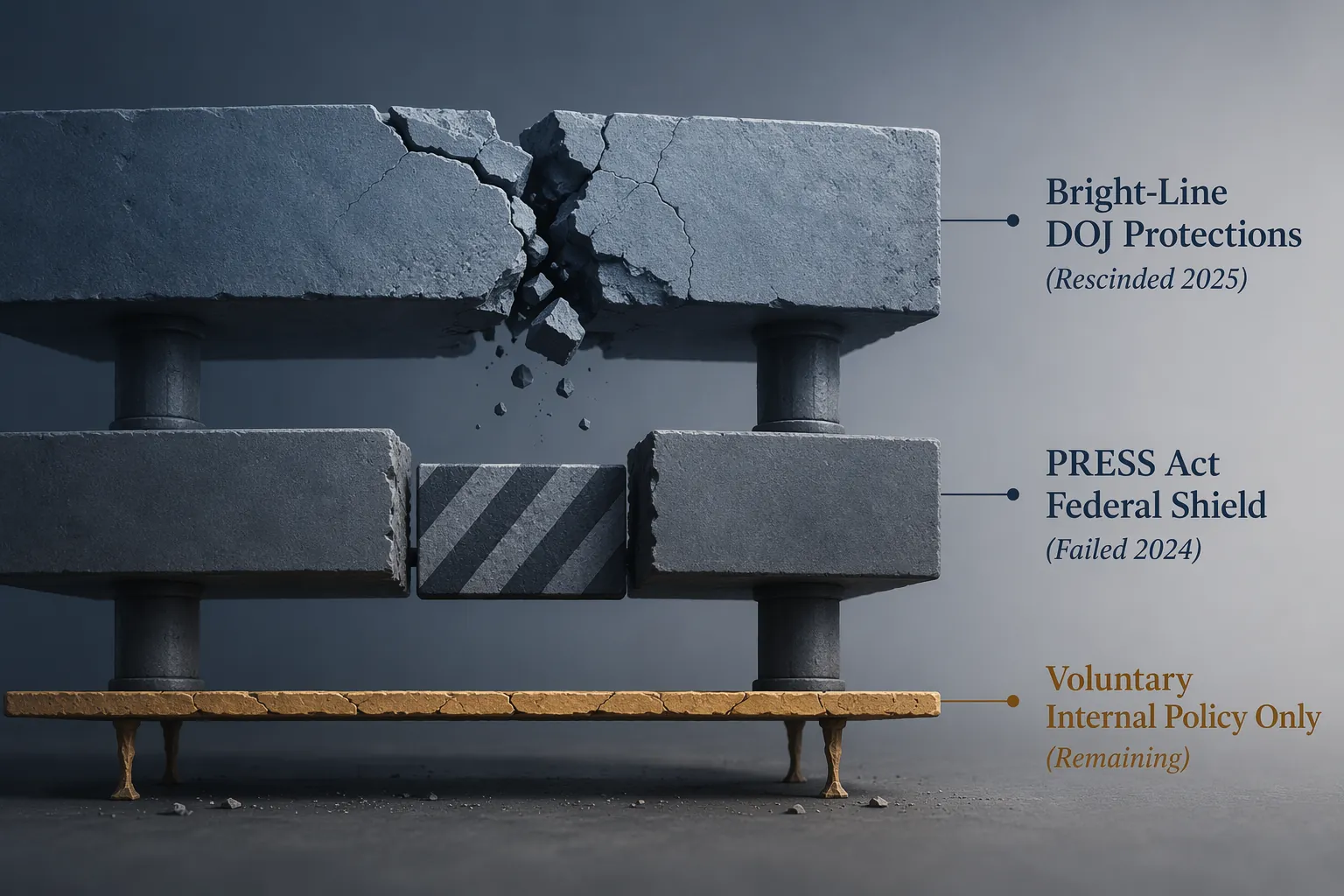
The result is a two-layer absence. The bright-line DOJ policy language was later rescinded. The federal statutory shield that might have supplied a more durable privilege was not enacted. Lawyers should not collapse those facts into one event, but they do have to read them together when assessing current exposure.
Federal reporter’s privilege remains fragmented rather than settled as a comprehensive federal shield. The Knight First Amendment Institute has described the law of reporter’s privilege as a “mess,” reflecting the uneven doctrine and forum-dependent treatment that make statutory protection consequential.[4]
Why This Changes the Risk File for Lawyers Who Use Source-Based Reporting
The immediate subpoena recipient may be a journalist, newsroom, phone provider, email host, platform, or family member. The downstream user of the reporting may be someone else entirely: litigation counsel building a theory from investigative coverage, an in-house lawyer evaluating a regulatory exposure, a legal ethics partner deciding whether to rely on a leaked-record account, or a firm risk committee assessing client conflicts from press reports.
Those professionals rarely know the source chain. They know the published article, perhaps the reporter’s track record, and the legal sensitivity of the underlying subject. When DOJ policy makes source-identifying process easier to pursue, the risk is not confined to newsroom autonomy. It affects whether confidential-source reporting remains a stable input for legal judgment.
The adjusted risk assessment is practical:
- Treat confidential-source reporting in leak-adjacent matters as more legally exposed than it was under the Garland-era § 50.10 bright-line language.
- Separate a DOJ internal-policy argument from a privilege argument that a court must recognize.
- Ask whether the government could characterize the reporting conduct as outside “lawful newsgathering,” rather than assuming the label is uncontested.
- Do not treat subpoena withdrawal in one dispute as restoration of the prior regulatory barrier.
- Track AG approval, exhaustion, notice, and negotiation because they still matter operationally, while recognizing that they are not a federal shield law.
This is also why personality-driven coverage of the Trump subpoena disputes can obscure the useful point. The relevant legal infrastructure does not depend on assuming that every subpoena will succeed, or that every judge will accept DOJ’s theory, or that the Bondi memo itself created new statutory power. The shift is narrower: a prior internal bar was removed, a proposed statutory shield failed, and the remaining safeguards largely depend on DOJ’s own compliance with DOJ’s own rules.
The Structural Position Now
Before the Bondi rescission, a lawyer resisting journalist-directed process could point to DOJ’s own bright-line protection for receipt, possession, or publication of government information, the “sole purpose” safeguard, and the DNI certification gate in specified national-security matters. None of that was a statute. All of it could still matter inside the Department.
After the rescission, the lawyer points to a thinner set of internal safeguards: approval, exhaustion, notice, and negotiation. Those may slow or shape compulsory process. They do not replace the deleted categorical language, and they do not supply the federal shield-law backstop the PRESS Act would have attempted to create.
For legal professionals who rely on investigative reporting built on confidential sources, the current environment is therefore not just louder. It is procedurally different. What remains is discretionary DOJ self-restraint, useful to monitor and unsafe to treat as an enforceable barrier.
References
- DOJ Rescinds News Media Guidelines Analysis, Reporters Committee for Freedom of the Press.
- AG Permits Journalist Subpoenas in Leak Investigations, Ballard Spahr, May 2025.
- Bill to protect journalists fails in US Senate, VOA News, December 2024.
- The Law of the Reporter’s Privilege is a Mess, Knight First Amendment Institute.
Related records
Tool profile
Browse tool evaluations →Governing regulation
Browse the obligations tracker →Preventive workflow
Browse verification workflows →
Report a correction or tip
Spotted an outdated figure, a misstated fact, or a ruling this case record should reflect? Public comments are disabled for this content given the professional cost of a misreported case outcome, penalty amount, or rule text — use the structured correction channel instead.
Report a correction or tip for this record →