
Bryan Kohberger's Guilty Plea Withdrawal Signals New IAC Risks
Bryan Kohberger's ineffective-assistance claim, though procedurally ordinary, arrives in a legal landscape transformed by AI sanction rulings and the United States v. Michel precedent. This analysis explains why his post-conviction posture is the template for coming AI-era IAC litigation and what risk signals appellate counsel should watch.
- Jurisdiction
- Idaho (state)
- Court
- Idaho state court
- AI tool named
- No specific AI tool
- Ruling date
- Jul 27, 2026
- Source document
- View primary court order ↗
- Last verified
- Jul 30, 2026
Lex Machina Review is an independent risk-tracking and reference resource. Nothing on this site is legal advice, and using it does not create an attorney-client relationship. Every record is reviewed against primary sources but may not reflect the most current status of a matter — always verify directly against the cited court order, rule text, or a licensed attorney before relying on it.
Companion explanation — secondary to the source document above
The first correction is the most important one: Bryan Kohberger’s July 27, 2026 petition to withdraw his guilty plea does not allege that artificial intelligence was used by his lawyers, by prosecutors, or by the court. The petition, as reported in the July 27–29 coverage, alleges an involuntary plea based on claimed unkept promises about prison conditions and alleged nondisclosure of exculpatory evidence, including a hair said to have been found in Ethan Chapin’s hand.[1] Anyone publishing on the Kohberger plea-withdrawal matter should also verify the current Idaho docket before treating the filing as anything more than a pending post-plea petition; the available reporting in this research window supports the filing and allegations, not a hearing outcome.[1]
That boundary matters because the useful question is not whether Kohberger’s defense was an AI case. It was not. The useful question is why this kind of filing—a defendant, after a guilty plea, attacking counsel performance and the reliability of the plea record—is the procedural place where future AI-assisted-lawyering failures will have to survive ordinary ineffective-assistance doctrine.

The plea record is the first obstacle, not a dramatic afterthought
Kohberger’s allegations deserve to be stated cleanly before the procedural bar does its work. The petition reportedly says his plea was not voluntary because counsel made promises about where and how he would be imprisoned that were not kept, and because counsel failed to disclose potentially exculpatory evidence before the plea.[1] Those are familiar ineffective-assistance themes: pressure, incomplete information, and a defendant’s later account that the decision to plead would have been different if counsel had acted differently.
But the timing matters. Idaho Rule of Criminal Procedure 33(c) permits withdrawal of a guilty plea after sentencing only to correct “manifest injustice.”[2] That is not the same litigation posture as a pre-sentencing request to withdraw a plea, and it is not an invitation to relitigate the case as though the plea never happened. A post-sentencing petition arrives after the defendant has already stood in court, answered questions under oath, and supplied the record that judges later use to test claims of coercion, misunderstanding, or hidden conditions.
That is why the plea colloquy cannot be treated as courtroom theater. It is evidence. In CNN’s analysis of the petition, University of Idaho College of Law professor Samuel Newton was quoted describing sworn plea-colloquy statements as carrying “a strong presumption of truthfulness.”[1] If the defendant said under oath that no one forced the plea, that he understood the consequences, and that no outside promises controlled the decision, a later petition has to do more than offer a better narrative. It has to explain why the sworn record should not control.
That does not make plea withdrawal impossible. It makes the route narrow. The petition must connect counsel’s alleged errors to the voluntariness of the plea in a way that can overcome both the “manifest injustice” standard and the ordinary judicial reliance on sworn admissions. The point is not that every defendant’s plea-colloquy answers are metaphysically true. The point is that post-conviction courts need administrable records, and the colloquy is built for exactly that purpose.
That is also where sloppy coverage tends to do the most damage. A petition alleging broken promises about prison conditions is not the same thing as proof that such promises were made. An allegation about undisclosed evidence is not the same thing as a ruling that the evidence was exculpatory, material, or improperly withheld. A pending plea-withdrawal request is not a reversal, and it is not a new trial. The procedural posture supplies the legal meaning.
Why this belongs in an AI-risk discussion anyway
The reason to read Kohberger beside AI-assisted-lawyering cases is structural. Ineffective-assistance claims do not become exotic because a lawyer used a new drafting tool, a research assistant, or a litigation platform. They still have to enter through the same doors: deficient performance and prejudice. After a plea, they also have to account for the plea record. After sentencing, they face the additional weight of the withdrawal standard.
The AI-era version will often sound different at the fact level. A defendant may allege that counsel relied on a generative tool that invented authority, summarized discovery incorrectly, missed a viable suppression issue, distorted forensic evidence, or produced a filing that damaged credibility. But the court still has to ask the old questions in a concrete way: what did counsel do, what should competent counsel have done, and did the difference matter to the outcome?
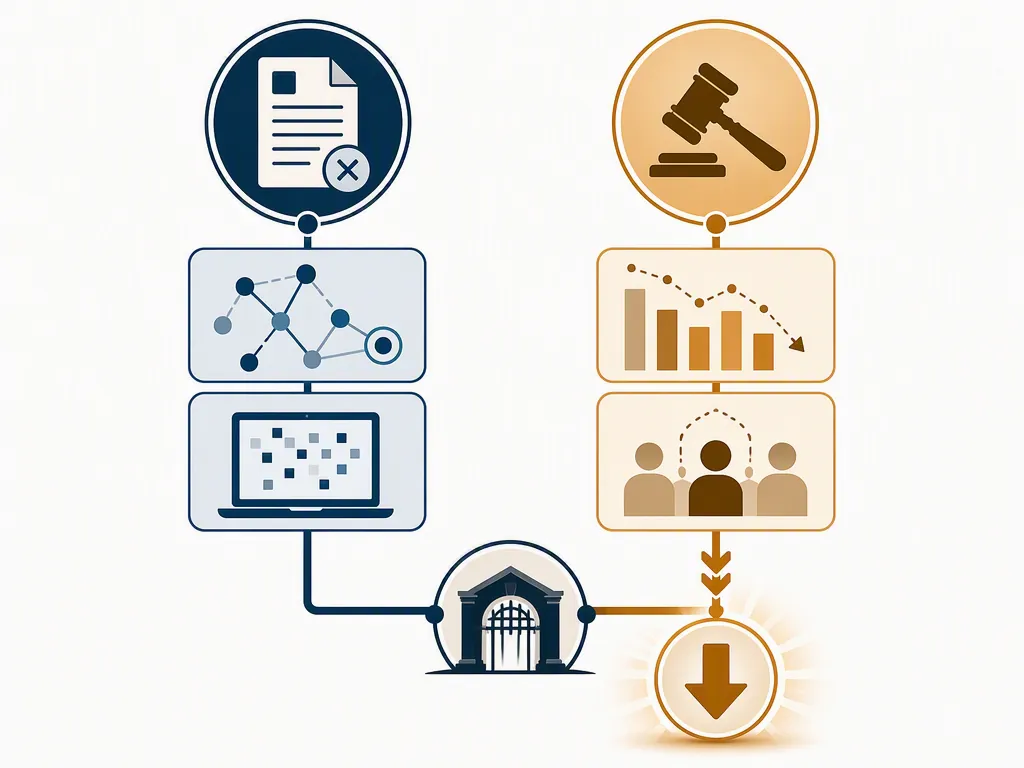
Michel stayed inside Strickland
United States v. Michel is useful precisely because it did not become a free-floating judicial essay about artificial intelligence. In the 2024–2025 D.C. federal litigation, the court analyzed a claim involving AI-drafted closing arguments under Strickland’s two-prong ineffective-assistance framework and resolved the issue on prejudice.[3] The court did not need to decide that AI drafting, by itself, was constitutionally deficient representation.[3]
That distinction is doing the real work. If a lawyer used an AI tool and the output was mediocre, embarrassing, or ill-advised, that still may not establish a constitutional violation. Strickland does not ask whether the tool choice makes a later reader uncomfortable. It asks whether counsel’s performance fell below the required standard and whether there is a reasonable probability that, but for the error, the result would have been different. Michel’s AI facts mattered only to the extent they could be tied to that prejudice inquiry.[3]
Michel is not a nationwide settlement of the question. It is a federal district-court framework from one case, not binding doctrine for Idaho post-conviction practice or for state courts generally. But it is the rare directly citable example of a court putting generative AI allegations into Strickland instead of pretending AI requires a separate constitutional vocabulary. That makes it more useful than a dozen broad predictions about the future of legal work.
The future claim will have to show the missing link
For appellate counsel inheriting a record, the question is not simply, “Was AI used?” The better question is, “Where did the alleged AI use enter the representation, and what did it change?” A hallucinated case in a brief may trigger sanctions, but an ineffective-assistance claim still needs to show how the hallucination affected the judgment, plea decision, sentence, preserved issue, or appellate posture. A flawed AI summary of discovery matters differently if it caused counsel to miss an exculpatory item than if it was caught before any strategic decision was made.
The same discipline applies after a plea. Suppose, hypothetically, that a lawyer used an AI tool to summarize a discovery set before advising a client to plead. If the tool omitted a fact that competent counsel would have found, the post-conviction question would not be satisfied by pointing to the omission alone. The petitioner would still have to connect that omission to the decision to plead and, depending on the jurisdiction and posture, to the standard governing withdrawal or collateral relief. The record would matter: counsel notes, tool logs if available, the plea colloquy, advisement forms, and any contemporaneous communications about the evidence.
That is why Kohberger’s petition is a useful template even without any AI allegation. It shows the terrain future AI claims will have to cross: a defendant’s after-the-fact account, counsel’s alleged failure, a plea record that may say the opposite, and a legal standard that is intentionally hard to satisfy after sentencing.
Sanctions and judicial AI use are pressure readings, not substitute doctrine
The risk environment does feel different in 2026, and not just because lawyers are talking about AI more often. Norton Rose Fulbright’s 2026 litigation update, citing a Northwestern Pritzker School of Law survey, reported that 61.6% of federal judges use AI tools and that 45.5% reported no AI training.[4] That is an awkward enforcement landscape: judges, lawyers, clerks, and vendors are all adjusting to the same technology, but lawyers remain the ones whose filings, citations, and record representations can immediately generate sanctions or professional consequences.
The sanctions numbers add to that pressure. EDRM and ComplexDiscovery, citing Damien Charlotin’s database, reported a $145,000 wave of GenAI-related sanctions in Q1 2026.[5] That figure should not be treated as proof that AI ineffective-assistance claims will succeed. Sanctions punish litigation misconduct, false citations, or related procedural failures; Strickland asks a different question about constitutional representation and prejudice. The overlap is practical, not doctrinal.
Still, sanctions orders create the factual raw material that later petitioners will quote. A court order finding that counsel submitted fabricated authority is easier to plead around than a vague allegation that counsel “used AI.” A documented failure to verify an AI-generated evidentiary summary is more useful than generalized anxiety about automation. The more courts write sanctions decisions describing what went wrong, the more future post-conviction lawyers will mine those descriptions for Strickland theories.
What appellate counsel should watch in AI-adjacent IAC files
The appellate lawyer who inherits the file is usually not handed a clean laboratory experiment. She gets a plea transcript, a client’s new account, scattered emails, perhaps a sanctions order, perhaps nothing more than suspicion about how trial counsel worked. The first task is separating tool use from outcome-relevant error.
| Risk signal | Why it matters under ordinary IAC analysis |
|---|---|
| Invented or misquoted authority appeared in a dispositive filing | The issue is not embarrassment; it is whether the false authority caused waiver, denial of a viable motion, loss of credibility on a material issue, or some other prejudicial consequence. |
| AI-assisted discovery review missed evidence counsel later claims not to have seen | The record must connect the missed item to a strategic decision, plea advice, trial theory, sentencing position, or preserved appellate issue. |
| A generated summary distorted forensic or witness evidence | The relevant question is whether competent review would have changed counsel’s advice or litigation choices. |
| Counsel cannot explain who reviewed AI output before filing or advising the client | Poor supervision may support a deficiency argument, but prejudice still has to be shown. |
| The plea colloquy contradicts the defendant’s later AI-related account | The petitioner must overcome the same sworn-record problem that makes ordinary post-plea claims difficult. |
This is also where internal law-firm risk work becomes relevant to later appellate review. Version history, tool-input logs where they exist, research memos, cite-check records, and human review notes may become the difference between a bad-looking tool process and a legally meaningful claim. The absence of those materials does not automatically prove deficient performance, but it can make reconstruction harder when a client later says the advice to plead or proceed to trial rested on a faulty understanding of the record.
For plea cases, the cleanest risk question is whether the alleged AI-related error affected the defendant’s decision-making before the sworn plea. Did counsel miss a defense that would have mattered? Did counsel misstate sentencing exposure? Did counsel fail to disclose evidence that would have changed the plea calculus? Did the defendant then swear to facts that make the later claim difficult to credit? Those are ordinary questions. AI changes the way the error may arise; it does not remove the need to prove the error mattered.
Kohberger is instructive because he is unlikely to be the test case people want
Kohberger’s petition is unlikely to become a successful AI-era ineffective-assistance landmark for two straightforward reasons. First, it is not an AI case. Second, it comes through a post-sentencing plea-withdrawal posture where Idaho’s “manifest injustice” standard and the sworn plea colloquy give the court a narrow frame for relief.[1][2]
That does not make the filing irrelevant to AI-risk analysis. It makes it a useful reminder of where the law will resist novelty. Future petitioners may bring more technologically interesting facts than Kohberger has alleged. They may point to AI-generated citations, defective summaries, automated issue-spotting failures, or vendor-assisted review mistakes. The court will still ask whether counsel’s conduct was constitutionally deficient and whether the defendant was prejudiced.
Michel supplies a working federal framework, not a universal rule. Kohberger supplies the harder post-plea posture, not an AI fact pattern. Read together, they point away from the easy question—whether AI was somewhere in the room—and toward the one that will decide most cases: whether the alleged use or misuse created a legally cognizable defect in the record, the advice, the advocacy, or the outcome.
References
- Kohberger petition coverage, CNN/AP/Courthouse News/USA Today, July 27–29, 2026, source link not provided in research brief
- Idaho Rule of Criminal Procedure 33(c), Idaho Rules of Criminal Procedure, source link not provided in research brief
- AI and Ineffective Assistance of Counsel, Substack, March 2025, source link not provided in research brief
- AI in litigation: Update on Gen AI sanctions in 2026, Norton Rose Fulbright, 2026, source link not provided in research brief
- Q1 2026 GenAI sanctions coverage citing Damien Charlotin’s database, EDRM/ComplexDiscovery, 2026, source link not provided in research brief
Related records
Tool profile
How Meta's AI Spending Reshapes Law Firm ProfitabilityGoverning regulation
Browse the obligations tracker →Preventive workflow
Browse verification workflows →
Report a correction or tip
Spotted an outdated figure, a misstated fact, or a ruling this case record should reflect? Public comments are disabled for this content given the professional cost of a misreported case outcome, penalty amount, or rule text — use the structured correction channel instead.
Report a correction or tip for this record →