
Kohberger Plea Withdrawal: The AI Hallucination Blind Spot
This article examines why post-conviction plea-withdrawal petitions like Bryan Kohberger's represent a high-risk zone for AI hallucination errors, extrapolating from benchmarking data and analogous sanction cases to identify liability exposure for practitioners.
- Jurisdiction
- US-Idaho
- Court
- Idaho state court
- AI tool named
- Lexis+ AI
- Ruling date
- Jul 28, 2026
- Source document
- View primary court order ↗
- Last verified
- Jul 31, 2026
Lex Machina Review is an independent risk-tracking and reference resource. Nothing on this site is legal advice, and using it does not create an attorney-client relationship. Every record is reviewed against primary sources but may not reflect the most current status of a matter — always verify directly against the cited court order, rule text, or a licensed attorney before relying on it.
Companion explanation — secondary to the source document above
This Risk Digest analysis is current as of July 31, 2026, and is not legal advice. It uses the reported Bryan Kohberger guilty plea withdrawal effort as an illustrative vulnerability profile for AI-assisted legal drafting, not as an AI-sanctions incident. No public material reviewed for this article shows that AI was used in the Kohberger petition, and the petition itself has not been directly reviewed from the court docket.
The useful question is not whether Bryan Kohberger can undo his plea. CNN and USA Today both framed the current posture through experts describing an uphill battle to reverse it, which is enough for the news trigger and not much more for a legal-risk analysis.[1][2] The better question for litigators and risk managers is why this kind of filing is exactly where a polished AI draft can become dangerous before anyone notices.
A post-sentence plea-withdrawal motion asks the court to disturb a record the system is designed to treat as settled. The filing has to classify the procedural standard correctly, align the argument with what the defendant said during the plea colloquy, and make any ineffective-assistance claim fit the Strickland and Hill framework. Those are not decorative citations. They are gates.
That is the blind spot in legal analysis of a Bryan Kohberger guilty plea withdrawal that leans on AI. Legal AI often looks most useful when the work is dense, deadline-driven, and procedurally obscure. But post-conviction plea withdrawal is not just another memorandum topic. It combines jurisdiction-specific law, fact-record discipline, and a prejudice inquiry that can collapse if the draft ignores what the plea hearing already locked in.
The Standard Is the First Risk Point
Idaho Criminal Rule 33(c) draws the line that matters here: after sentencing, plea withdrawal requires a showing of manifest injustice. That is not the same thing as the more forgiving pre-sentence “just cause” inquiry. A draft that blurs those standards has not made a small stylistic mistake. It has placed the filing in the wrong procedural room.
The problem is easy to miss because both standards live near the same subject matter. A model that has seen thousands of plea-withdrawal discussions can produce fluent paragraphs about voluntariness, ineffective assistance, and fairness while importing the wrong timing rule. The sentence may read like law. The filing may still be unusable.
The ineffective-assistance route adds another trap. Under Hill v. Lockhart, a defendant challenging a guilty plea through ineffective assistance must connect deficient performance to plea prejudice. In practical terms, the filing must address whether the defendant would have made a different plea decision, not merely whether counsel might have handled some part of the case differently. If the plea colloquy contains sworn answers that cut against that theory, the petition cannot pretend the transcript does not exist.
That makes the plea transcript a risk-control document, not just background. Before a lawyer relies on an AI-assisted draft, someone has to compare every factual premise against the colloquy: what the court asked, what the defendant acknowledged, what rights were waived, what factual basis was accepted, and what complaints were or were not preserved. A hallucinated case is obvious once found. A prejudice argument that quietly contradicts the record can be more expensive because it survives long enough to waste judicial time.
Why This Sits in the High-Hallucination Quadrant
The Stanford RegLab and Stanford HAI benchmark is not proof that any particular 2026 legal AI product would fail on an Idaho plea-withdrawal petition. It is a 2024 risk signal. But it is a relevant one: the study reported that Lexis+ AI and Ask Practical Law AI hallucinated on more than 17% of benchmark queries, while Westlaw AI-Assisted Research hallucinated on more than 34%, and it flagged jurisdiction-specific questions as a high-failure category.[3]
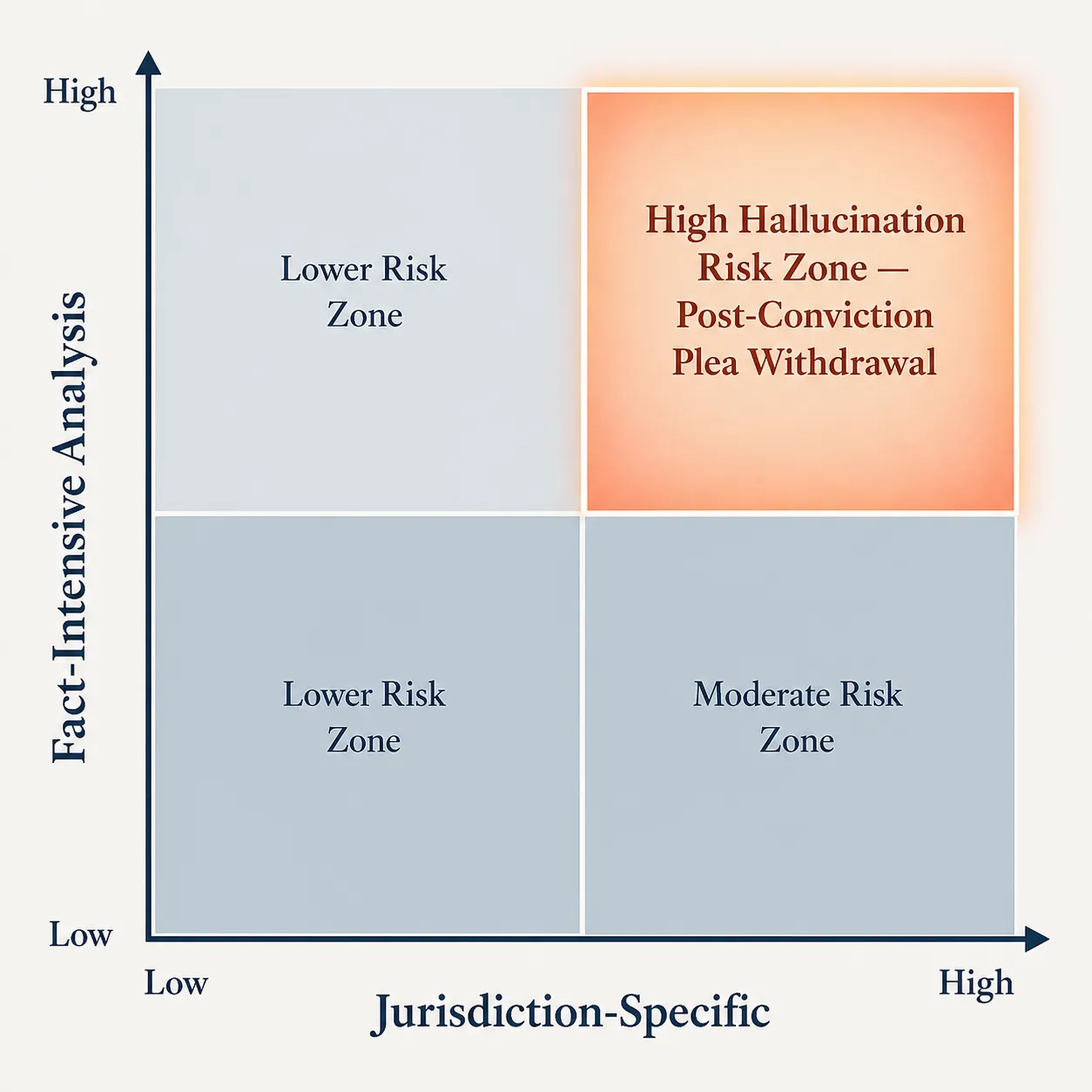
Post-sentence plea withdrawal sits in the difficult corner of that matrix. The law is jurisdiction-specific. The facts are transcript-bound. The relevant moment is temporally constrained: the question is not whether a defendant now regrets the plea, but whether the legal standard for undoing it is met against the record made when the plea was entered.
| Task in a plea-withdrawal workflow | What AI may appear to do well | What must be verified before filing |
|---|---|---|
| Identify the governing standard | Produce a fluent explanation of plea withdrawal | Whether the filing uses Idaho’s post-sentence manifest-injustice standard rather than a pre-sentence just-cause standard |
| Support the legal rule | Generate case names and quotations | Whether every authority exists, remains good law, and actually states the proposition used |
| Apply Hill prejudice | Draft a plausible ineffective-assistance narrative | Whether the argument addresses plea prejudice and accounts for the plea-colloquy record |
| Summarize the record | Condense facts into a coherent procedural history | Whether each factual assertion is tied to the docket, transcript, order, or exhibit being relied on |
Retrieval-augmented systems do not eliminate that risk by merely attaching sources. Retrieval can fetch a nearby rule, a related case, or a secondary explanation that is accurate in one posture and wrong in another. In a routine research memo, that may be caught during editing. In a post-conviction filing, the wrong standard can contaminate the prayer for relief, the prejudice theory, and the record citations all at once.
The dangerous output is not always a fake citation. It can be a real citation used for the wrong proposition. It can be a correct quote from a case outside the governing jurisdiction. It can be a true statement about pre-sentence plea withdrawal carried into a post-sentence motion. It can be a Hill paragraph that never confronts the defendant’s sworn plea answers.
That is why “human in the loop” is not a control unless the human knows what loop to run. A reviewer who reads only for coherence may approve the very feature that makes the draft risky: a smooth, confident procedural narrative with no visible seams.
The Kohberger Filing Is an Example of Posture, Not Proof of AI Use
The Kohberger petition matters here because of its procedural shape. News accounts describe an effort to reverse a guilty plea after conviction, with expert commentary emphasizing the difficulty of that path.[1][2] That is enough to place the matter in the category that should make a reviewing lawyer slow down: post-sentence relief, plea finality, ineffective assistance, and a record that likely matters more than rhetoric.
It would be irresponsible to go further than the public materials allow. This article does not treat the petition as a hallucination event, does not assert that any lawyer or party used AI, and does not evaluate the merits of claims that have not been checked against the docket. The point is narrower: if an AI tool were used to draft or review a filing in this posture, the predictable failure modes would be unusually consequential.
The notoriety of the case is mostly a distraction for risk purposes. The same workflow would be dangerous in an obscure county-court matter with no cameras outside the courthouse. A defendant seeks to reopen a plea. The rule changes after sentencing. The prejudice inquiry depends on what the defendant knew and said. The court will look for manifest injustice, not a generalized sense that the bargain now feels harsh.
Where Liability Starts to Accumulate
No reported AI-sanctions case in the materials reviewed involves a Kohberger-level post-conviction plea-withdrawal filing. The perimeter is built from analogous litigation: cases and sanction reports showing how courts and litigants respond when AI-generated legal work crosses from research aid into filed error.
Nippon Life v. OpenAI is useful for a different reason than a sanctions order. The Stanford CodeX analysis describes a March 2026 lawsuit alleging that a pro se litigant used ChatGPT to draft 44 post-settlement filings, with Nippon Life asserting claims including abuse of process, tortious interference, and unauthorized practice of law; the analysis frames the dispute as a product-liability warning about guardrails and “uncrossable threshold” design.[4]
That is not the same as a lawyer filing a defective Idaho post-conviction petition. But it matters to risk managers because it treats the drafting system itself as part of the litigation-harm story. Once AI output moves from private experimentation into repeated filings, the harm is no longer confined to the user’s embarrassment. Opposing parties, courts, clerks, and supervising lawyers inherit the cleanup.
Jordan v. Chicago Housing Authority supplies the professional-responsibility side. According to the Klemchuk analysis, the Illinois court imposed a $60,000 sanction in December 2025 and rejected the idea that “AI made me do it” excuses counsel, emphasizing that Rule 11 and Illinois Rule of Professional Conduct 3.3 duties are tool-agnostic and predate electronic research by centuries.[5]
That principle is the one a supervising lawyer should assume will apply. The court does not need to dislike AI to sanction a filing. It only needs a false citation, a false quotation, a misrepresented record, or a legal contention that reasonable verification would have caught.
The broader sanctions picture points in the same direction. ComplexDiscovery’s Q1 2026 aggregation reported $145,000 in AI-related filing penalties, while noting the tracking nature of the figure rather than presenting it as a complete census.[6] The useful lesson is not the exact aggregate. It is that courts are becoming less patient with the explanation that a tool produced the defect.
Per-infraction sanction schedules make that impatience calculable. Reported schedules such as $500 for a fabricated citation and $1,000 for a fabricated quotation turn hallucination risk into a budget line. A post-conviction petition with multiple unsupported authorities, record misstatements, or invented quotations can become expensive before the court ever reaches the substantive claim.
Damien Charlotin’s AI Hallucination Cases Database identified 1,811 cases globally, including 1,252 in the United States, as of July 29, 2026; criminal post-conviction and habeas matters were described in the available tracking materials as a small but growing subset.[7] That does not prove frequency in Idaho plea-withdrawal litigation. It does show that hallucinated legal authority is no longer a novelty risk.
A Review Workflow That Actually Controls the Risk
The safe use of AI in this setting starts by assigning it the right job. Retrieval tools can help locate docket materials, surface potentially relevant Idaho authority, compare rule language, or flag other cases involving the same procedural posture. They should not be trusted to decide, without primary-source review, which standard governs or whether the plea record supports prejudice.
- Open the governing rule first, and confirm whether the filing is pre-sentence or post-sentence before reviewing any AI-drafted standard.
- Verify every case citation against a primary source, including jurisdiction, procedural posture, quoted language, and current validity.
- Build the Hill prejudice section from the plea-colloquy transcript, not from a generalized ineffective-assistance template.
- Tie each factual assertion to the docket, transcript, order, exhibit, or news source being used, and label any uncertainty.
- Keep a verification log showing what was checked, where it was checked, and who approved it before filing.
That last item is not paperwork for its own sake. It is the difference between meaningful supervision and the ritual phrase “human reviewed.” If a filing later draws a show-cause order, the question will not be whether a person glanced at the draft. The question will be whether someone performed the checks that the posture demanded.
For an inherited pro se or potentially AI-assisted filing, the review should be even more mechanical. Strip the document down to authorities, standards, record facts, and requested relief. Do not start by improving the prose. Start by finding the load-bearing assertions. If the filing cites an Idaho case, open it. If it quotes the plea hearing, compare the transcript. If it says the defendant would have gone to trial, identify what record facts support that claim and what plea-colloquy answers complicate it.
A polished brief can create the wrong order of operations. It invites the reviewer to ask whether the argument is persuasive. In this category, the first question is more basic: can the filing survive source verification, procedural classification, and record alignment?
What Not to Infer
The Stanford benchmark should not be stretched into a claim that current legal AI tools hallucinate at the same rates in every 2026 workflow. The study was published in 2024, and product behavior may have changed.[3] The numbers remain useful because they identify the kind of task that deserves heightened control: jurisdiction-specific legal research, especially when the answer depends on procedural context.
The sanctions cases should not be stretched either. Nippon Life is not a plea-withdrawal case. Jordan is not an Idaho post-conviction case. The Q1 2026 sanction aggregation is a tracking estimate, not a comprehensive census.[4][5][6] Their combined value is perimeter-setting: they show that courts and litigants have moved past treating hallucinated filings as harmless experiments.
Nor should the Kohberger petition be treated as a referendum on AI. It is better understood as a clean example of the procedural posture that exposes AI weakness: high-stakes finality, a state-specific withdrawal rule, a plea record that narrows the available arguments, and an ineffective-assistance theory that must satisfy a precise prejudice inquiry.
The Risk Classification
Post-conviction plea-withdrawal work is not categorically off-limits for AI support. It is a disproportionate risk zone. The tool may help find materials faster, but it cannot be allowed to supply the governing standard, the case law, the record facts, or the prejudice theory without disciplined human verification against primary sources.
For the Kohberger posture and any analogous filing, the filing should not move forward until four things are checked: the jurisdictional standard, every cited authority, every quoted or paraphrased record fact, and the Hill prejudice argument against the plea-colloquy record. If those checks have not happened, the draft is not ready for persuasion. It is still in admissibility triage.
References
- Experts: Bryan Kohberger faces uphill battle to reverse plea deal, CNN, July 28, 2026
- Bryan Kohberger guilty plea withdrawal, USA Today, July 29, 2026
- AI on Trial: Legal Models Hallucinate in 1 out of 6 (or More) Benchmarking Queries, Stanford HAI, 2024
- Designed to Cross: Why Nippon Life v. OpenAI Is a Product Liability Case, Stanford Law School, March 7, 2026
- AI Court Filing Sanctions, Klemchuk
- The AI Sanction Wave: $145K in Q1 Penalties Signals Courts Have Lost Patience with GenAI Filing Failures, ComplexDiscovery
- AI Hallucination Cases Database, Damien Charlotin
Related records
Tool profile
Generation Beta Inherits a Legal AI Reliability RecordGoverning regulation
Browse the obligations tracker →Preventive workflow
Browse verification workflows →
Report a correction or tip
Spotted an outdated figure, a misstated fact, or a ruling this case record should reflect? Public comments are disabled for this content given the professional cost of a misreported case outcome, penalty amount, or rule text — use the structured correction channel instead.
Report a correction or tip for this record →