
Generation Beta Inherits a Legal AI Reliability Record
Generation Beta will inherit legal AI, but not a clean reliability record: leading research tools still hallucinate on a meaningful share of queries, with authoritativeness and multi-jurisdiction gaps that persist even where accuracy rivals the lawyer baseline. The benchmark record — from Stanford RegLab/HAI and Vals VLAIR — points to a single practical conclusion: verification discipline, not AI-native fluency, is the protection firms must build into procurement and training.
- Tool
- Lexis+ AI, Westlaw AI-Assisted Research, Ask Practical Law AI, Alexi, Counsel Stack, Midpage, ChatGPT
- Benchmark source
- Stanford RegLab/HAI; Vals VLAIR
- Hallucination rate
- 17-33% legal research tools; 58-88% general chatbots
- Test methodology
- Preregistered 200+ legal-query evaluation; VLAIR 210-question legal-research rubric vs. lawyer baseline
Generation Beta will not be the first lawyers to use legal AI. They will be the first cohort to inherit it as ordinary infrastructure after the profession already had a reliability record to read. McCrindle defines Generation Beta as people born from 2025 through 2039, projects the cohort at 16% of the global population by 2035, and describes it as the first generation that will not know a world without AI [1][2]. Other boundary lines are already in circulation, including a World Economic Forum range ending in 2038 and Jean Twenge’s Gen Alpha framing that implies a later start, so the cohort label should be treated as a useful shorthand rather than a settled demographic statute.
The legal question is narrower than the generational one. If the oldest McCrindle-defined Gen Beta members were born in 2025, then a rough arithmetic estimate places the first law-school entrants around 2047 and the first bar admissions around 2050, assuming a conventional college-to-law-school-to-bar timeline. That is not a demographic forecast. It is enough time for firms, law schools, courts, and vendors either to normalize weak verification habits or to make verification part of the operating system.
The record they inherit is not clean. Stanford RegLab’s preregistered evaluation of LexisNexis and Thomson Reuters legal research tools found hallucination rates in the 17% to 33% range, while Stanford HAI’s writeup framed the per-tool results as more than 17% for Lexis+ AI and Ask Practical Law AI, and more than 34% for Westlaw AI-Assisted Research [3][4]. Earlier studies of general-purpose chatbots on legal queries were worse, with reported hallucination ranges of 58% to 82% in one Stanford HAI study and 69% to 88% in Dahl et al.’s “Hallucinating Law,” including at least 75% on holdings questions [5]. Those studies should not be collapsed into one universal legal-AI failure rate. They test different systems under different conditions. But together they make one procurement point hard to avoid: fluent legal output is not evidence of legal reliability.
| Benchmark or source | What it tested | Headline result | Caveat buyers should keep attached |
|---|---|---|---|
| Stanford RegLab / Magesh et al. | Preregistered evaluation using a 200+ legal-query dataset against LexisNexis and Thomson Reuters legal research tools | Hallucination rates in the 17% to 33% range [3] | This is not the same dataset as earlier general-chatbot studies; it concerns named legal research products. |
| Stanford HAI “AI on Trial” writeup | Per-tool framing of the RegLab findings | More than 17% for Lexis+ AI and Ask Practical Law AI; more than 34% for Westlaw AI-Assisted Research [4] | The writeup makes the “1 out of 6 or more” framing legible, but buyers still need the underlying methodology. |
| Earlier general-chatbot legal studies | General-purpose chatbots answering legal questions | 58%–82% hallucination range in one HAI-reported study; 69%–88% in Dahl et al., with at least 75% on holdings questions [5] | Useful as a warning baseline, not as a substitute for product-specific legal-research benchmarking. |
| Vals VLAIR — Legal Research | 210-question legal-research rubric comparing AI systems with a lawyer baseline | Grouped AI scored 80% versus a 71% lawyer baseline [6][7] | The benchmark was limited to general legal research and did not include Thomson Reuters, LexisNexis, or vLex. |
The Stanford baseline: product-specific, not a generic chatbot panic
The Stanford RegLab evaluation matters because it moved the discussion from general chatbot behavior to leading legal research products. The study was preregistered and used a dataset of more than 200 legal queries to assess tools from LexisNexis and Thomson Reuters [3]. That makes it harder for a buyer to dismiss the results as a problem limited to consumer chatbots or to lawyers who entered careless questions into a public model.
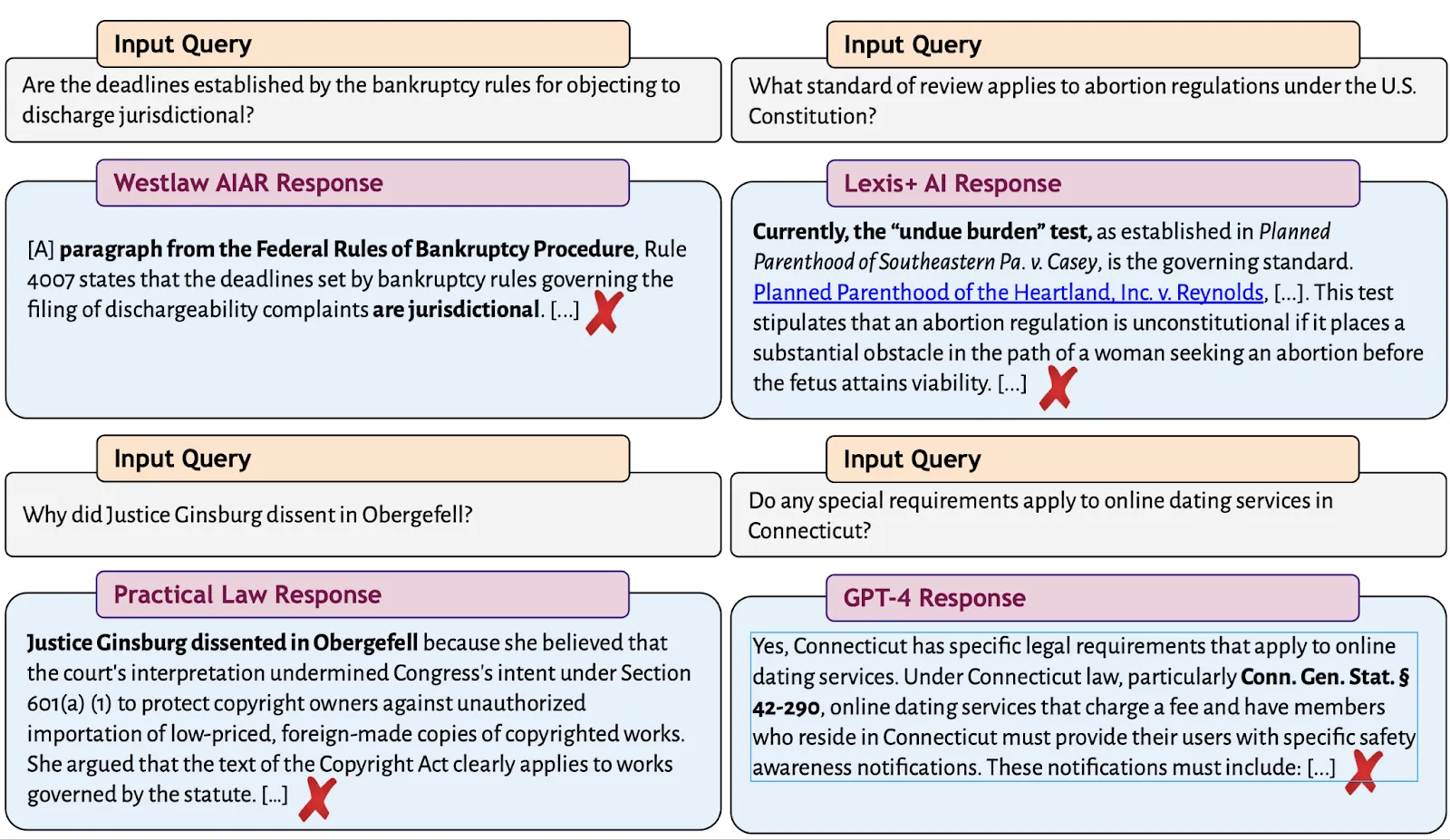
The distinction is important for anyone writing an intake checklist or vendor questionnaire. A 17% query-level hallucination rate is not a theoretical edge case. In a litigation setting, it is the difference between a research assistant who needs routine checking and a research assistant whose work can never be allowed to pass into a brief, memo, client alert, or filing without a second system of control. The higher end of the reported range makes the point more sharply, but the lower end is already material.
The earlier general-chatbot studies should be kept in the file, but in the right folder. Legal Dive’s coverage of the Stanford HAI and Dahl et al. findings reported hallucination rates from 58% to 82% for legal queries in one study and 69% to 88% in “Hallucinating Law,” with holdings questions at 75% or higher [5]. Those numbers are useful when a firm is deciding whether general-purpose AI belongs anywhere near legal research without a controlled workflow. They are not the same as the RegLab product evaluation. Mixing them together may produce a dramatic paragraph, but it produces a bad risk memo.
For readers comparing tool-risk categories, the same distinction appears in this site’s pro se legal-AI risk evaluation, where product-specific legal research findings sit beside court-required verification steps. The useful question is not whether a model is “legal AI” or “general AI.” The useful question is what task was tested, against what authority, on what date, and with what definition of failure.
VLAIR improves the accuracy picture, then exposes the next problem
Vals AI’s VLAIR — Legal Research benchmark is the strongest counterweight to a simple “legal AI is too unreliable” story. In its October 14, 2025 industry report, Vals used a 210-question legal-research rubric and found grouped AI systems scoring 80% against a 71% lawyer baseline [6]. LawNext’s coverage reported individual scores of Alexi at 80%, Counsel Stack at 81%, Midpage at 79%, and ChatGPT at 80% [7].
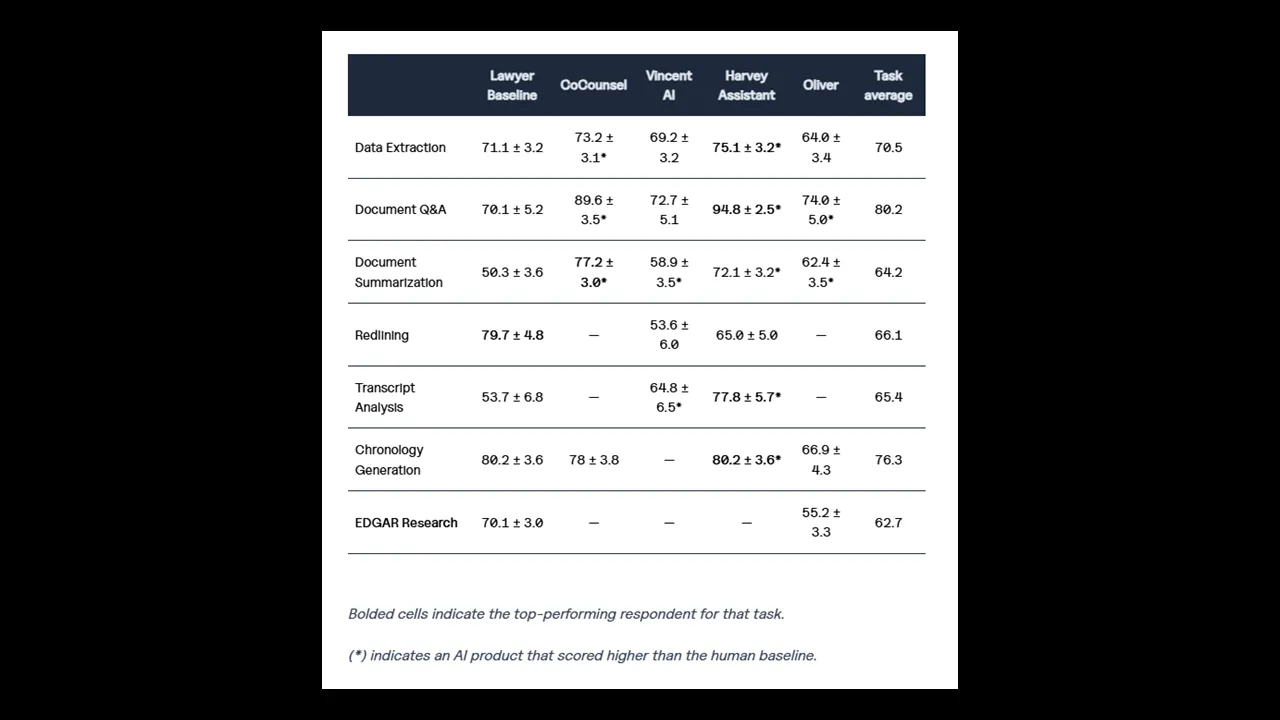
That result deserves attention. It does not support the broader claim that legal AI, as a category, is safer than lawyers or ready to be trusted without controls. VLAIR did not include Thomson Reuters, LexisNexis, or vLex; vLex withdrew after its Clio acquisition [6][7]. Vals also cautioned that the benchmark covers general legal research, not drafting, litigation strategy, privilege review, contract negotiation, or the many other tasks that procurement decks tend to place under the same AI heading [6].
The more useful lesson is in the gaps beneath the headline accuracy number. ChatGPT scored 70% on authoritativeness, below the 76% legal-AI average reported in the VLAIR materials, and all systems dropped by roughly 11 points on multi-jurisdictional questions [6][7]. Authoritativeness is not a decorative metric. A research answer can be directionally correct while relying on weak, secondary, outdated, or non-controlling support. Multi-jurisdiction work creates a different failure mode: the system may state a rule that exists somewhere, or existed at some time, while failing to keep the governing jurisdiction straight.
This is where the Generation Beta framing becomes dangerous if it is used loosely. An AI-native lawyer may be faster at prompting, quicker at spotting interface affordances, and less intimidated by iterative research. None of that proves the lawyer will ask whether the cited authority controls, whether a jurisdictional distinction has been flattened, or whether the system is agreeing with a false premise embedded in the question.
The legibility problem is bigger than any one benchmark
Stanford HAI’s July 2026 discussion of the PNAS special section gives the procurement problem its most useful name: legal AI “lacks legibility.” The analysis documents more than 1,700 legal cases involving hallucinated facts, cases, and laws, and argues that the absence of systematic public benchmarking makes procurement and ethics compliance nearly impossible [8].
Legibility is not the same as accuracy. A tool is legible when a buyer can understand what was tested, what was excluded, what failure means, how the system behaves on harder legal tasks, and whether performance has been measured by someone other than the vendor. A procurement team cannot manage what it cannot see. A knowledge-management team cannot write a useful standard operating procedure around a benchmark that hides the question set, date range, jurisdiction mix, or scoring rules.
The failure patterns identified across the Stanford materials explain why raw accuracy can coexist with serious legal risk: citations can be misgrounded, models can be sycophantic when the user’s question contains a false premise, performance can degrade when more than one jurisdiction is in play, and public benchmarking can be too sparse for buyers to compare systems on equal terms [8]. Each pattern is especially easy to miss when the output reads like a competent research note.
That is the procurement trap. A vendor can show a strong score on a general legal-research benchmark. A partner can report that the tool “worked” on a familiar question. An associate can produce a polished answer in half the usual time. None of those facts tells the risk committee whether the tool remains reliable when the question crosses jurisdictions, requires controlling authority, or begins with an assumption the model should reject.
What firms should require before AI-native lawyers arrive
By the time the oldest McCrindle-defined Gen Beta lawyers reach practice, legal AI will likely feel less like a tool category and more like a layer inside research, drafting, intake, and document systems. The profession should not wait until then to decide whether comfort counts as competence. It does not. Comfort may increase use, but it does not verify a case, select controlling law, or detect a hallucinated premise.
- Require independent benchmark evidence before procurement. A vendor record should disclose the benchmark date, task type, jurisdiction mix, question source, scoring rubric, and whether the test was conducted or audited independently.
- Separate accuracy from authoritativeness. A score that rewards the right bottom-line answer should not be treated as proof that the tool selects controlling, current, citable authority.
- Track jurisdictional performance as its own risk field. Multi-jurisdiction degradation is not a footnote for firms with national, cross-border, regulatory, or appellate practices.
- Preserve citation retrieval as a mandatory human step. The workflow should require source opening, citation validation, jurisdiction checking, and confirmation that quoted or summarized propositions actually appear in the cited material.
- Treat vendor exclusions as material. If a benchmark excludes major platforms, excludes drafting, or covers only general legal research, the score should stay inside that boundary.
The training implication is just as concrete. Law schools and firms should teach AI-assisted research as a verification workflow, not as a display of tool fluency. The valuable junior lawyer will not be the one who can coax the longest answer out of a model. It will be the one who can identify the authority path, test the jurisdictional premise, preserve the source trail, and explain what was checked. That skill set is already visible in verification-centered legal AI roles, where the work is less about being impressed by output and more about building a record that someone else can audit.
The procurement implication is equally plain. Buyers should ask for independent audits or explain why they are proceeding without them. They should require change logs when models, retrieval systems, or source databases change. They should insist that benchmark claims remain tied to the tested version and tested task. The same independent-audit problem appears outside legal research in this site’s review of Microsoft MAI model legal risk: without external testing, a buyer is left translating vendor confidence into institutional risk.
Generation Beta will not change the legal profession simply by using these systems naturally. Its impact will depend on whether the institutions around future lawyers make verification unavoidable. AI-native fluency may make legal work faster and less lonely. It is not a control. Verification discipline is the control.
References
- Welcome Gen Beta — McCrindle.
- Gen Beta characteristics — McCrindle.
- Hallucination-Free? Assessing the Reliability of Leading AI Legal Research Tools — Stanford RegLab.
- AI on Trial: Legal Models Hallucinate in 1 out of 6 (or More) Benchmarking Queries — Stanford HAI.
- Legal use of GenAI tools error-prone with hallucinations: Stanford researchers — Legal Dive.
- VLAIR - Legal Research — Vals AI, October 14, 2025.
- Vals AI’s Latest Benchmark Finds Legal And General AI Now Outperform Lawyers In Legal Research Accuracy — LawNext, October 2025.
- Legal AI's Legibility Problem — Stanford HAI, July 2026.
Chronological incident history
- Wisconsin absentee ballot replacement rules just changed
- What the '1933 double' Reveals About ChatGPT Benchmarks
- FBI agent Patrick Yaroch charged with stealing Bitcoin
- What charges does the FBI agent face for crypto theft?
- FBI agent cryptocurrency theft case, explained
Report a correction or tip
Spotted an outdated figure, a misstated fact, or a ruling this tool profile should reflect? Public comments are disabled for this content given the professional cost of a misreported case outcome, penalty amount, or rule text — use the structured correction channel instead.
Report a correction or tip for this record →