
The Capital One Trump Case Isn't a Money Laundering Lawsuit
Headlines describe a 'Capital One Trump Organization money laundering lawsuit,' but the docket runs the other way: Trump family entities are the plaintiffs, suing Capital One over account closures, and the bank's July 31, 2026 dismissal motion raises AML review as a defense, not a charge. The key question — who is suing whom and what the filing does and does not say — is answered directly from the record.
- Jurisdiction
- United States (S.D. Fla.)
- Court
- U.S. District Court for the Southern District of Florida
- Judge
- Roy K. Altman
- AI tool named
- No AI tool named
- Ruling date
- Jul 31, 2026
- Source document
- View primary court order ↗
- Last verified
- Aug 2, 2026
Lex Machina Review is an independent risk-tracking and reference resource. Nothing on this site is legal advice, and using it does not create an attorney-client relationship. Every record is reviewed against primary sources but may not reflect the most current status of a matter — always verify directly against the cited court order, rule text, or a licensed attorney before relying on it.
Companion explanation — secondary to the source document above
The phrase “capital one trump organization money laundering lawsuit” starts in the wrong place. The case is not a lawsuit accusing the Trump Organization of money laundering. The docket caption runs the other way: The Donald J. Trump Revocable Trust, DJT Holdings, LLC, DTTM Operations, LLC, and Eric Trump are plaintiffs; Capital One, N.A. is the defendant in a de-banking suit pending in the Southern District of Florida as The Donald J. Trump Revocable Trust v. Capital One, N.A., No. 1:25-cv-21596, before Judge Roy K. Altman.[1]
Money laundering enters the story through Capital One’s reported July 31, 2026 motion to dismiss. As reported by Reuters, CNBC, and Bloomberg/Yahoo, the bank says it closed the accounts after an anti-money-laundering review. That is a defense rationale in litigation brought by Trump-family entities and Eric Trump. It is not a money-laundering charge against them, and the press reports say the bank did not accuse the Trump Organization of illegal money laundering.
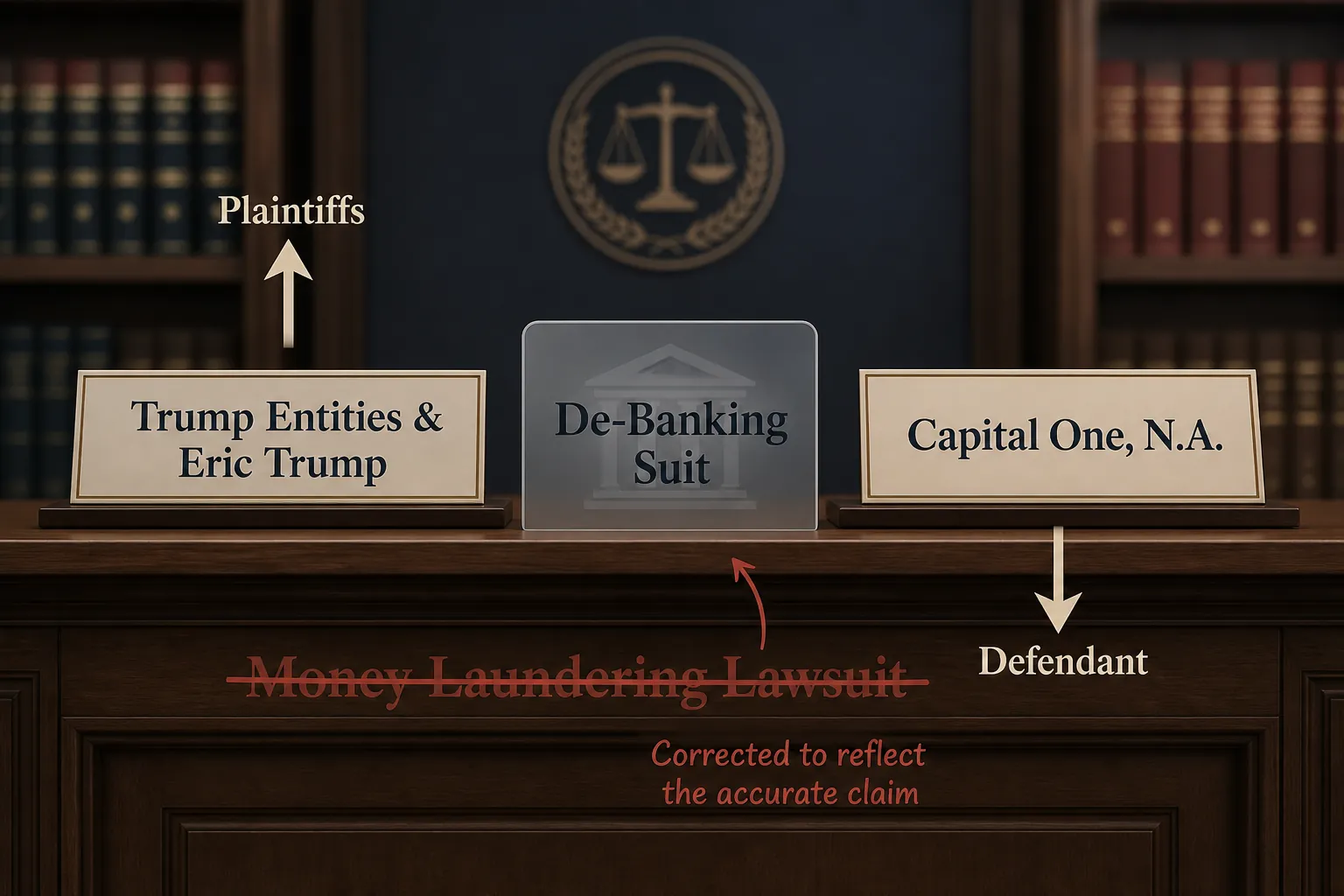
The lawsuit is a de-banking case brought by Trump entities
The complaint was filed on March 7, 2025, in Florida state court and later removed to federal court on April 7, 2025.[1][2] Its theory is political de-banking: the plaintiffs allege Capital One closed more than 300 accounts associated with Trump family entities without advance notice and did so because, after January 6, 2021, the bank “believed the political tide favored doing so.”[2][3]
That matters because the first job of any legal headline is to get the direction of the case right. A reader should not have to discover three paragraphs later that the supposed “money laundering lawsuit” is actually a customer-side complaint over account closures. The plaintiffs are pressing consumer-protection and consumer-fraud theories under North Carolina, Nebraska, New Jersey, and Minnesota law, as summarized by the ABA Banking Journal and reflected in the complaint materials.[2][3]
For the underlying claim map, the better place to go is the site’s prior case record, What the refiled Capital One Trump lawsuit claims. This article is narrower: it fixes the caption problem and separates the AML language from the claim actually filed.
Where the AML language appears
The July 31, 2026 motion to dismiss is the filing that generated the money-laundering headlines. One caveat belongs up front: the motion itself, identified in the docket as ECF 91, was not reviewed directly for this article. The quoted wording below is press-reported by Reuters, CNBC, and Bloomberg/Yahoo and should be checked against PACER before anyone treats it as the final text of the filing.[1][4][5][6]
Reuters reported that Capital One told the court that “documents and Plaintiffs’ own allegations make clear that Capital One closed Plaintiffs’ accounts for anti-money laundering (‘AML’) reasons,” and that the closures were “the result of months of analysis and a careful review by Capital One’s AML team in accordance with bank policies and regulatory guidance.”[4] CNBC’s account carried the same core point: Capital One says the closures followed an internal AML investigation, not a political decision to punish Trump-linked customers.[5]
Reuters also reported that the bank pointed to “transaction patterns” that “are among the types of activity flagged by federal banking guidance.”[4] That is the sharpest reported language. It ties the closure decision to AML review and federal banking guidance. It does not, on the public reporting available here, identify particular transactions, say that any transaction was unlawful, or allege that the Trump Organization committed money laundering.
Bloomberg’s report, carried by Yahoo Finance, adds the bank’s explanation for why the AML rationale was not public before the litigation: Capital One says it did not publicize the termination decision or its confidential internal process, and that it is making the AML review public only because the plaintiffs sued. The same report says the bank asserts it gave the plaintiffs months, including extensions, to find new banking services.[6]
A short procedural map, without re-litigating the whole docket
The timing is relevant because the AML filing did not arrive in a fresh complaint. It came after earlier pleading rounds. The docket shows prior dismissals with leave to amend, a Second Amended Complaint filed July 17, 2026, Capital One’s third motion to dismiss filed July 31, 2026, a plaintiffs’ response due August 14, 2026, and a continued trial setting.[1]
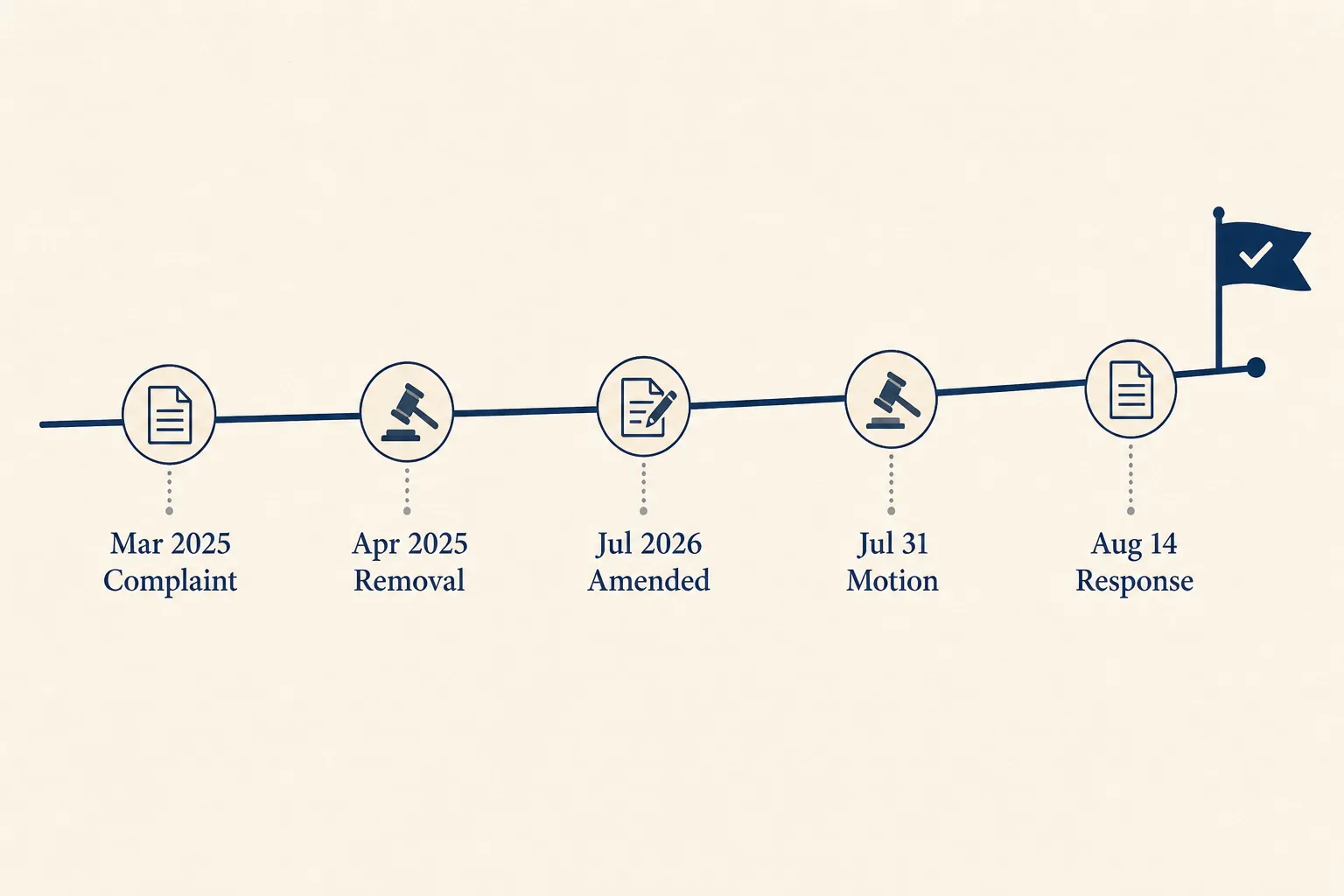
| Date | Record event | Why it matters here |
|---|---|---|
| March 7, 2025 | Original complaint filed | Trump-family entities and Eric Trump begin the de-banking suit against Capital One. |
| April 7, 2025 | Removal to the Southern District of Florida | The case moves into federal court as No. 1:25-cv-21596. |
| March 2026 | Prior complaints dismissed with leave to amend | The AML motion arrives after earlier pleading challenges, not at the start of the case. |
| July 17, 2026 | Second Amended Complaint filed | The live complaint includes redacted material, including a section titled “January 6, 2021: The Political Trigger.” |
| July 31, 2026 | Third motion to dismiss filed | Capital One’s reported AML rationale enters the current public coverage. |
| August 14, 2026 | Plaintiffs’ response due | The next scheduled pleading response, as reflected in the docket. |
The deeper docket chronology is already tracked in Trump family Capital One lawsuit refiled; bank cites AML. That record is the place for deadlines, sealed-filing status, and the moving docket. The point here is more basic: a motion to dismiss raising AML reasons is not the same thing as a plaintiff filing a money-laundering case.
What the reported AML wording does not say
The distinction is not cosmetic. “AML review” is a bank compliance category. “Money laundering” as a legal accusation carries a different weight. The reported Capital One language says the accounts were closed for AML reasons after months of internal analysis and review by the bank’s AML team.[4][5] It does not, in the reporting available as of August 2, 2026, plead a money-laundering count, identify charged conduct, name a criminal statute, or supply transaction-level facts for the public to test.
That does not make the AML reference irrelevant. If accurately quoted, it is a material explanation for the bank’s account-closure decision and a direct answer to the plaintiffs’ political de-banking theory. But it still remains the bank’s asserted rationale in a dismissal motion. A motion to dismiss can argue that the complaint’s own allegations and documents defeat the claim. It does not turn the defendant into a prosecutor.
The public record is also incomplete. The docket reflects that the Second Amended Complaint includes a 10-page section titled “January 6, 2021: The Political Trigger” that is entirely redacted, and that a pending motion seeks to keep employee names sealed.[1] Those redactions may matter to the parties’ competing narratives. They do not authorize a reader to fill in missing transaction facts or convert AML-review language into a laundering allegation.
For a separate discussion of how AML review, SAR confidentiality, and discovery pressure may interact, see Can Capital One’s AML review defeat Trump’s debanking claim?. For the evidence-preservation angle around AML systems and review trails, see What Capital One’s Trump-account AML review demands of AI. Neither point changes the caption.
The old Capital One subpoena fight is not this case
There is a separate historical reason readers may remember Capital One and Trump in the same sentence: the 2019 House subpoena litigation involving Deutsche Bank and Capital One, later addressed by the Supreme Court in 2020. That was a congressional-subpoena dispute. It is context for why the names sound familiar, not the same lawsuit and not the source of the 2026 AML-motion language.
The same caution applies to broader debates over banking access, political de-banking, and AML enforcement. Those debates may explain why the story travels quickly, but they do not answer the record question. The record question is who sued whom and what the filing actually says.
How far the headline can fairly go
A careful version of the headline claim would be limited: Capital One has, in litigation brought by Trump-family plaintiffs, reportedly asserted that it closed accounts after an AML review and after identifying transaction patterns of a kind flagged by federal banking guidance.[4][5] That may be the first time a bank has formally tied AML concerns to Trump-linked accounts in this litigation posture, as reported in the August 1–2, 2026 coverage. It is not the same as saying the Trump Organization has been sued for money laundering.
The clean reading rule is simple enough to survive a docket check: if someone calls this a “Capital One Trump Organization money laundering lawsuit,” ask what they mean. If they mean a lawsuit against the Trump Organization for money laundering, the materials here do not support it. If they mean Capital One’s reported AML defense in a Trump-family de-banking suit against the bank, that is the actual posture as last checked against available reporting on August 2, 2026.
References
- The Donald J. Trump Revocable Trust v. Capital One, N.A. — CourtListener
- Trump v. Capital One complaint — Fox News
- Trump organizations sue Capital One over debanking allegations — ABA Banking Journal
- Capital One says it closed Trump Organization’s accounts after anti-money laundering review — Reuters — August 1, 2026
- Capital One closed Trump Organization accounts after investigation — CNBC — August 1, 2026
- Capital One Cites Money Laundering Concerns in Trump Account Closures — Bloomberg via Yahoo Finance
Related records
Tool profile
How Meta's AI Spending Reshapes Law Firm ProfitabilityGoverning regulation
Browse the obligations tracker →Preventive workflow
Browse verification workflows →
Report a correction or tip
Spotted an outdated figure, a misstated fact, or a ruling this case record should reflect? Public comments are disabled for this content given the professional cost of a misreported case outcome, penalty amount, or rule text — use the structured correction channel instead.
Report a correction or tip for this record →