
Carlos Palazuelos and the Nancy Guthrie case, explained
Headline coverage of the Nancy Guthrie matter can read like an AI-sanction case, but no court order or ruling exists. This risk-graded record separates what is confirmed — the July 2026 notice of claim against Pima County — from the AI-authorship hypothesis and deepfake proof-of-life concerns that remain reported, not established.
- Jurisdiction
- US-Arizona
- Court
- No court action filed (pre-suit notice of claim)
- AI tool named
- Unspecified AI/deepfake tools
- Ruling date
- Jul 27, 2026
- Source document
- View primary court order ↗
- Last verified
- Aug 2, 2026
Lex Machina Review is an independent risk-tracking and reference resource. Nothing on this site is legal advice, and using it does not create an attorney-client relationship. Every record is reviewed against primary sources but may not reflect the most current status of a matter — always verify directly against the cited court order, rule text, or a licensed attorney before relying on it.
Companion explanation — secondary to the source document above
Record status as of August 2, 2026
For anyone searching “Carlos Palazuelos Nancy Guthrie case explained,” the short answer is procedural before it is technological: this is not an AI-hallucination sanctions case, not an AI-generated-court-filing case, and not a matter with a court order establishing misconduct. As of August 2, 2026, the concrete legal record involving Palazuelos is a pre-suit notice of claim against Pima County, not a filed complaint, not a judgment, and not a sanctions ruling.[1][2]
| Risk Digest field | Current status |
|---|---|
| Last verified | 2026-08-02 |
| Court order or sanctions ruling | None in the available record |
| AI-tool-implicated court filing | None in the available record |
| Concrete legal document involving Carlos Palazuelos | July 27, 2026 notice of claim against Pima County |
| Case posture | Pre-suit claim; response window still running |
| AI status | Risk vectors reported or hypothesized; no official finding that AI caused the detention |
That threshold point matters. A real AI sanctions record usually starts with a docket event: a motion, a court order, a filing certification problem, a show-cause order, or a finding that counsel used unverifiable AI-generated material. That is the lane covered in AI-hallucinated immigration brief sanctions. The Guthrie-Palazuelos record is different. It belongs in a risk digest because an investigation’s public environment appears to have been shaped by AI-era doubt, fake-note reporting, amateur image work, and online identification pressure. But those are not the same thing as a court-confirmed AI violation.
What is actually on record about Carlos Palazuelos
The reported facts relevant to legal risk are narrow and serious. Palazuelos was detained at gunpoint on February 10, 2026 in Rio Rico, Arizona, held for roughly seven to eight hours, and released without charges, according to ABC15, PEOPLE, and AZFamily coverage of the later claim.[1][2][3]
On July 27, 2026, Robbins Curtin Millea & Showalter filed a notice of claim against Pima County. The claim seeks a combined $3.25 million: $2.5 million for Palazuelos, $500,000 for Daniel Maddox, and $250,000 for Josefina Maddox. The theories reported in the claim coverage include wrongful arrest, defamation, and property damage.[1][2]
That breakdown is not a technicality. Some headlines understandably center the $2.5 million figure because that is Palazuelos’s individual demand. The combined settlement demand is $3.25 million. Keeping those figures separate avoids turning a claimant-specific amount into a case-wide number, or vice versa.[1][2]
Sheriff Chris Nanos’s publicly reported position should also be stated narrowly. AZFamily reported that the sheriff said a tip came in because Palazuelos resembled a person in suspect footage, that other factors existed which he could not discuss, and that investigators had not ruled anyone out.[3] That is a law-enforcement posture, not a public merits ruling on Palazuelos’s claim.
The notice of claim is the load-bearing legal document
The notice of claim is important because it is the first concrete legal record in the available materials that places Palazuelos’s detention into a compensation demand. It is also limited because it is a pre-suit document. It preserves and presents claims; it does not adjudicate them. No judge has accepted the factual allegations, rejected them, sanctioned anyone, or resolved the warrant basis on the record available here.
The claim coverage says the warrant application is under seal.[1][2] That sealing point is one of the hard stops in this file. Without the warrant materials, the public record cannot resolve what investigators presented, what the issuing authority relied on, what information was omitted, or whether the detention was legally justified. The absence of that document does not defeat the claim; it prevents a clean public answer.
Arizona notice-of-claim practice also creates a timing problem for anyone trying to write the ending too early. The reported claim has a 60-day response window, which, from a July 27, 2026 filing date, runs to roughly late September 2026.[1][2] Until that window closes, or until a complaint is filed, settled, denied, or otherwise converted into a court record, the safer label is pending pre-suit claim.
For a narrower document-level treatment of the claim itself, see Wrongful arrest lawsuit in Savannah Guthrie case? Not yet. This article is broader: it treats the claim as one legal-risk record inside a larger information-risk environment.
One small provenance note is worth preserving. ABC15’s notice-of-claim page includes a disclosure that an AI tool converted the television story into article format and that an editor reviewed it. That disclosure speaks to the news article’s production process; it is not evidence that AI was used by investigators, claimants, or courts in the Guthrie matter.[1]
Why AI belongs in the file anyway
The AI layer should come after the legal posture because it is easy to overstate. Nothing in the present record establishes that an AI system wrote a court document, caused the detention, or produced an official investigative finding. The reason AI still belongs in the analysis is that the Guthrie investigation sat inside several modern failure modes at once: proof-of-life skepticism, fake-message uncertainty, amateur image “enhancement,” viral identification, and possible technology use by law enforcement.
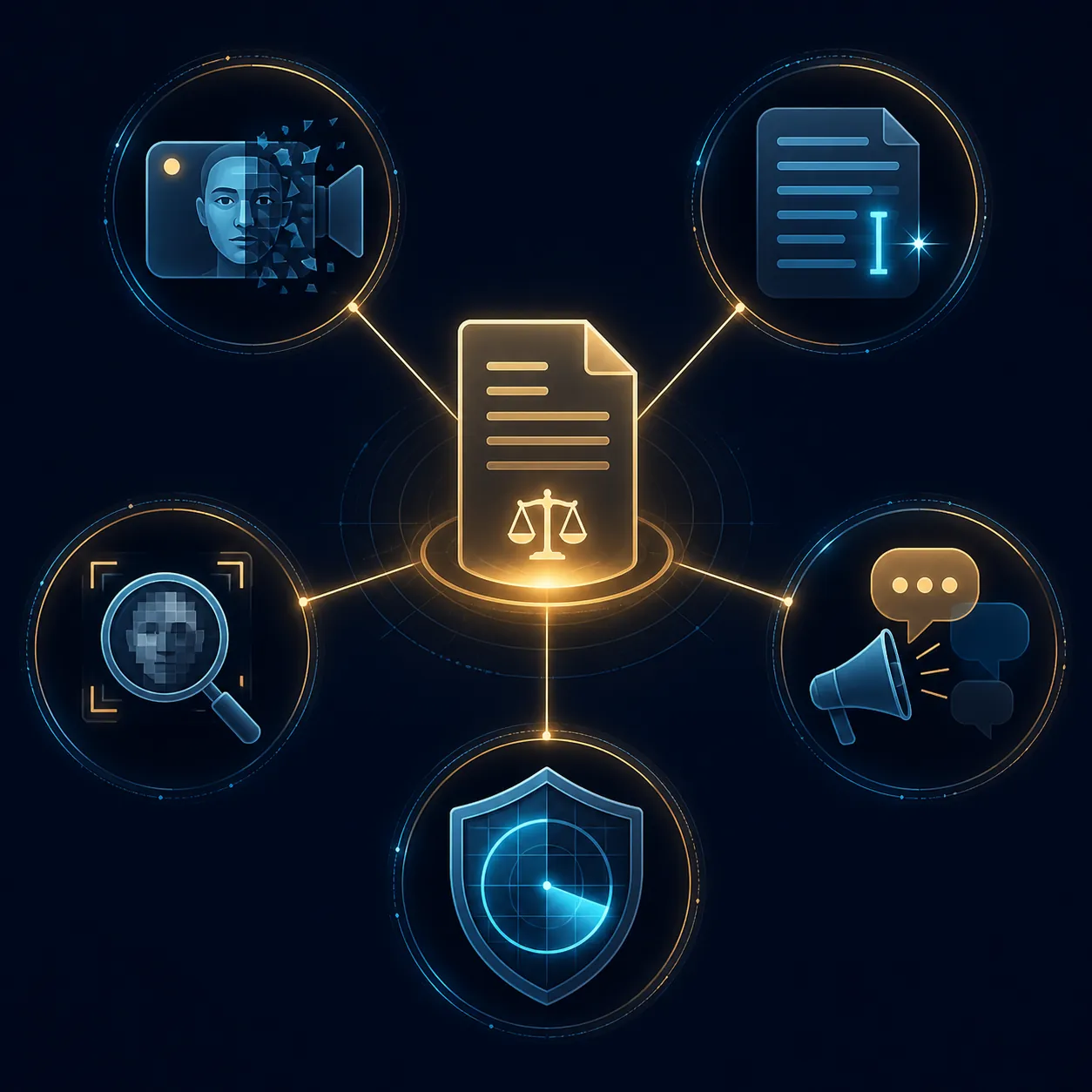
| AI-era risk vector | Current status in this record | Why it matters |
|---|---|---|
| Deepfake proof-of-life doubt | Confirmed as an investigative concern reported by officials and experts | A video or voice clip can no longer be treated as simple proof of life without authentication work. |
| “AI wrote it” ransom-note theory | Reported expert hypothesis, not an official finding | Fake does not automatically mean AI-generated. |
| Amateur AI unmasking | Reported public-information risk, not authoritative evidence | Online enhancement can make weak visual comparisons look more confident than they are. |
| AI-amplified misidentification | Plausible risk theory tied to the defamation and wrongful-detention allegations | Named people bear consequences long after the public moves on. |
| Law-enforcement AI tooling | Unresolved on this record | No public court record here establishes which tools, if any, were used in the detention decision. |
The proof-of-life problem is the cleanest AI point. NPR reported FBI Phoenix Chief Heith Janke’s warning that investigators “can’t just take a video and trust that that’s proof of life because of advancements in AI.” NPR also quoted UC Berkeley professor Hany Farid explaining that a single LinkedIn profile plus a voicemail can be enough material to clone aspects of identity.[4] AP placed that concern against a broader December 2025 FBI IC3 warning about AI-enabled kidnapping scams.[5]
That does not mean every fake communication in the Guthrie matter was AI-generated. It means the authentication burden has changed. A family, an investigator, or a journalist can be forced to ask whether a recording, image, note, or demand is genuine before there is time to reach a confident answer.
The ransom-note chronology should not be flattened
The ransom-note record is where imprecise narration does the most damage. Reuters reported on June 30, 2026, based on a source, that the FBI had determined three kidnapping-related messages were fake, including an unclaimed small FBI cryptocurrency deposit.[6] That is a source-based report about fake communications; it is not a public judicial finding and it is not, by itself, an AI-authorship finding.
On July 1, FBI Phoenix publicly distinguished between notes that were “extortion attempts without legitimacy” and other communications that remained under investigation, according to LA Times and CNN coverage.[7][8] That official distinction is narrower than “all notes solved” and broader than “all notes credible.” Both edges matter.
On July 2, Derrick Callella, 42, of Hawthorne, pleaded guilty to transmitting a ransom demand and harassment by telecommunication device, with sentencing set for September 10, according to LA Times and CNN.[7][8] A human guilty plea for a fake ransom demand undercuts any casual claim that fake-note status equals AI authorship.
There is also a reported AI-authorship hypothesis. NewsNation reported former FBI agent Jennifer Coffindaffer’s view that an AI study suggested the ransom or death-note language may have been AI-written.[9] That should remain exactly where the record puts it: an attributed hypothesis. It is not a court finding, not an FBI public conclusion in the available materials, and not a basis for rewriting the case as an established AI-generated ransom-note matter.
Public identification pressure is a separate risk from AI authorship
The risk most directly connected to Palazuelos is not that an AI system necessarily authored a note. It is that an investigation surrounded by unstable media, unclear visual material, and online speculation can harden around a person’s name before the legal record catches up. That is where the notice of claim’s defamation theory matters: the alleged injury is not abstract reputational discomfort, but a real-world detention, property-damage claim, and public association with a high-profile unresolved case.[1][2]
AZPM’s coverage, including comments from former investigator Joseph Lestrange, captured the pressure investigators face when deepfakes and AI-generated materials may be in the mix: examiners have to move quickly while still deciding what is authentic and what is noise.[10] That pressure can explain why caution is difficult. It does not prove that any particular detention was justified.
ABC15’s separate technology-role coverage belongs in the same limited category. It is useful for understanding why image analysis, public tips, and authentication questions became part of the search environment. It should not be treated as proof that a specific AI tool selected Palazuelos or that law enforcement relied on an undisclosed AI system to detain him.[11]
For counsel, the practical distinction is familiar from AI filing ethics: a risk signal is not a proved fact. The obligations mapped in defense attorney AI court filing ethics are triggered by duties of competence, supervision, confidentiality, and verification. Here, the comparable discipline is status labeling: confirmed detention, filed notice of claim, sealed warrant, reported hypotheses, unresolved investigation.
What this record does not establish
- It does not establish that Palazuelos has filed a lawsuit. The current legal document is a notice of claim, as reported on July 27, 2026.[1][2]
- It does not establish that a court found the detention unlawful. No ruling is available in the current record.
- It does not establish that AI authored the ransom or death-related communications. The AI-writing point is a reported hypothesis, while other fake-note developments include source-based FBI reporting and a human guilty plea.[6][7][8][9]
- It does not establish that law enforcement used a particular AI tool to identify or detain Palazuelos. The warrant application remains sealed, and the public record is not enough to reconstruct the investigative basis.[1][2]
- It does not resolve the underlying Nancy Guthrie investigation. The available materials continue to treat the matter as unresolved.
The temptation in a file like this is to pick the most dramatic label and let the rest of the record follow it. That is how an AI-risk story becomes an AI-proof story, or a pre-suit demand becomes a court-confirmed wrongful arrest. The materials do not support either move.
Update triggers
This record should change if any of four things appears: a filed complaint, a court order, disclosure of the warrant materials, or an official finding about AI use in a relevant communication or investigative step. The notice-of-claim response window runs to roughly late September 2026, so the current posture is still live.[1][2]
Until then, the operative lesson is not that AI caused the Palazuelos detention, or that Palazuelos’s claim will succeed. It is that AI-era legal-risk tracking has to preserve status flags. Confirmed, reported, disputed, sealed, hypothesized, and unresolved are not decorative labels; they are the line between a useful case record and another public misidentification.
References
- Man detained in Nancy Guthrie case files notice of claim against Pima County Sheriff's Department, ABC15
- Nancy Guthrie Case Sparks $3.25M Claim from Men Who Say They Were Wrongfully Detained, PEOPLE
- Another dead end in Nancy Guthrie case as man who was detained plans to sue, AZFamily, July 30, 2026
- AI complicates proof of life in the search for Savannah Guthrie's mother, NPR, February 9, 2026
- Savannah Guthrie wants proof that her mom is alive. That's complicated in this era of AI, AP News
- FBI determines Nancy Guthrie kidnapping notes to be fakes, source says, Reuters, June 30, 2026
- L.A. County man admits he sent Nancy Guthrie's family fake ransom note, LA Times, July 2, 2026
- CNN timeline, CNN
- Nancy Guthrie new AI study, NewsNation
- How the use of AI and "deepfakes" play a role in the search for Nancy Guthrie, AZPM, February 10, 2026
- WATCH: Looking at tech's role in the search for Nancy Guthrie, ABC15
Related records
Tool profile
How Meta's AI Spending Reshapes Law Firm ProfitabilityGoverning regulation
Browse the obligations tracker →Preventive workflow
Browse verification workflows →
Report a correction or tip
Spotted an outdated figure, a misstated fact, or a ruling this case record should reflect? Public comments are disabled for this content given the professional cost of a misreported case outcome, penalty amount, or rule text — use the structured correction channel instead.
Report a correction or tip for this record →