
Carr's ABC License Review Now Hinges on Procedure
Maps the FCC's early renewal of ABC's eight owned stations under 47 CFR § 73.3539(c) — the DA-26-416 and DA-26-541 docket trail, the petitions to deny, and the procedural fights that will decide where the proceeding goes next.
- Jurisdiction
- US federal
- Court
- FCC
- AI tool named
- None
- Ruling date
- Apr 28, 2026
- Source document
- View primary court order ↗
- Last verified
- Aug 2, 2026
Lex Machina Review is an independent risk-tracking and reference resource. Nothing on this site is legal advice, and using it does not create an attorney-client relationship. Every record is reviewed against primary sources but may not reflect the most current status of a matter — always verify directly against the cited court order, rule text, or a licensed attorney before relying on it.
Companion explanation — secondary to the source document above
Risk Digest verification frame
Last verified: August 2, 2026. Classification: Risk Digest legal analysis, not legal advice. Primary record checked: DA-26-416 [1], DA-26-541 and MB Docket 26-131 [2], 47 CFR § 73.3539(c) [3], and 47 U.S.C. § 309 [4].
In the Brendan Carr FCC-ABC license review, the first legally operative move was not a televised threat, a settlement, or a network programming decision. It was an early-renewal order: the FCC told eight ABC owned-and-operated stations to file renewal applications within 30 days, even though their ordinary renewal windows were not otherwise due until 2028–2031 [1][5].
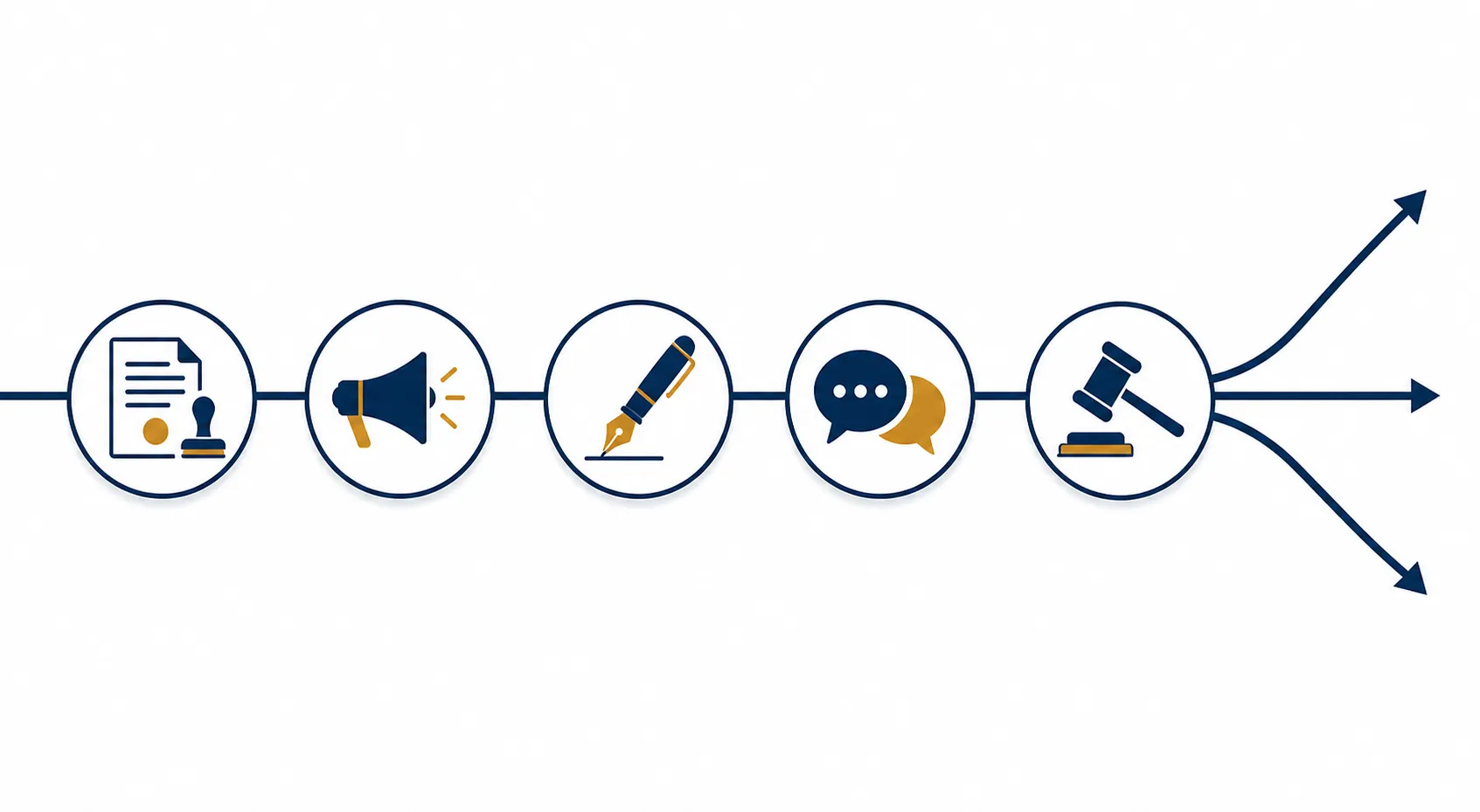
That order has now become a pleading fight. DA-26-541 placed the Disney/ABC applications on public notice, opened MB Docket 26-131, set ex parte procedures, and created the petition-and-reply track now controlling the next step [2]. The question is therefore narrower than most commentary suggests: what procedural doorway, if any, remains open after the early-renewal order, the public notice, the petitions to deny, and ABC’s replies?
What paper changed ABC’s legal position?
DA-26-416 changed the posture of eight licenses at once. The order covered WABC-TV, KABC-TV, WLS-TV, WPVI-TV, KTRK-TV, KGO-TV, WTVD-TV, and KFSN-TV, and required renewal applications by May 28, 2026 [1]. Before that order, those licenses sat in future renewal cycles. After it, ABC had to choose between refusing to file and risking a separate compliance fight, or filing under protest and forcing the dispute into the renewal machinery.
ABC chose the second route. Its May 28 filings were made under protest, and the company argued that the early-renewal demand was “untimely and unwarranted” and left its stations under a regulatory “sword of Damocles” [6]. That phrase matters because it identifies the operational harm of an unresolved agency cloud: the stations continue to broadcast, sell advertising, hire, negotiate distribution, and plan programming while their licenses are no longer merely future-renewal assets.
| Date | Paper or event | Procedural effect |
|---|---|---|
| April 28, 2026 | DA-26-416 | FCC orders early renewal applications for eight ABC O&O stations within 30 days [1]. |
| May 28, 2026 | ABC renewal filings under protest | The dispute moves from an order-to-file fight into the license-renewal application process [6]. |
| May 29, 2026 | DA-26-541 / MB Docket 26-131 | FCC issues public notice, identifies the applications, and sets pleading and ex parte procedures [2]. |
| After public notice | Petitions to deny by Media Research Center and Center for American Rights | The matter becomes a § 309(d)/(e) contest over whether petitioners have raised legally sufficient grounds for denial or hearing designation [2][4]. |
| July 28, 2026 | Former FCC chairs’ filing | A group of former chairs urges the FCC to reject the early-license-review approach; the filing adds institutional resistance but does not itself decide the statutory question [7]. |
| July 29–30, 2026 | ABC reply reported publicly | ABC asks the FCC to reject the petitions and points to more than 153,000 comments, with reported support above 95% [8]. |
| August 5, 2026 | Reply deadline | As of August 2, replies remain due; the FCC has not ruled on the petitions and has not designated a hearing [2]. |
The early-filing hook is small, and that is why it matters
The FCC did not simply announce that it was displeased with ABC. It invoked the early-filing mechanism in 47 CFR § 73.3539(c), a rule that allows the Commission to require a broadcast renewal application before the ordinary filing date when early filing is “essential to the proper conduct of a hearing or investigation” [3].
That word “essential” carries more weight than it first appears to. It does not say “useful,” “convenient,” “newsworthy,” or “politically salient.” It asks why pulling a license into renewal years early is necessary to conduct a hearing or investigation properly. The harder the agency presses this mechanism beyond a narrow investigatory need, the more the proceeding depends on a record explaining why ordinary enforcement tools or ordinary renewal timing would not do.
Commissioner Anna Gomez’s dissent called the move “unprecedented, unlawful, and going nowhere” [9]. That sentence has been useful shorthand, but it is not the governing test. The governing test is whether DA-26-416 can be tied to § 73.3539(c)’s early-filing condition and then carried through § 309 without skipping the statutory findings required at the renewal stage.
The scale problem is not merely rhetorical. Senate Democrats asked the FCC to identify every prior invocation of § 73.3539(c), and their letter also flagged a Bridge News LLC early-renewal order issued one day before the Disney/ABC order [10]. The Bridge reference matters because it weakens any claim that ABC is literally the only recent target of the mechanism. It does not answer the harder question: whether eight network O&O stations can be called in years early on this record and then held in a contested renewal posture.
Once the applications exist, § 309 controls the exits
Section 309(b) is the first timing gate. For covered applications, the FCC may not grant the application earlier than 30 days after public notice [4]. In an ordinary renewal, that delay is unremarkable. In this proceeding, it becomes part of ABC’s injury theory: the agency compelled early applications, then placed them into a public-notice and petition cycle that necessarily prevents immediate grant and keeps the licenses under review.
Section 309(k) is the renewal standard. It directs the FCC to grant a broadcast renewal if it finds that the station served the public interest, convenience, and necessity; that there were no serious violations of the Communications Act or FCC rules; and that there was no pattern of abuse that would constitute a serious violation [4]. If those findings cannot be made, the statute gives the Commission options, including denial after notice and opportunity for hearing, or renewal on appropriate terms and conditions, including a short-term renewal [4].
Section 309(d) and § 309(e) govern the petition-to-deny path. A petitioner must present specific allegations of fact, supported as required by the statute, sufficient to show that grant would be prima facie inconsistent with the public interest. If the FCC finds a substantial and material question of fact, or cannot make the required public-interest finding, § 309(e) points toward hearing designation [4].
That structure is why the proceeding is procedurally awkward for both sides. If the FCC grants the renewals, it must explain why the early-renewal order was necessary enough to compel the filings but not substantial enough to prevent grant. If it denies or designates a hearing, it must connect the record to the station-specific renewal standard rather than to generalized displeasure with network speech. If it dismisses the petitions and ends the matter, ABC’s argument that it was forced through an unnecessary process does not simply vanish.
The petitions to deny are not the same thing as a hearing
DA-26-541 identifies the renewal applications and establishes the pleading cycle; it does not itself deny, condition, or designate the licenses for hearing [2]. The Media Research Center and Center for American Rights petitions therefore occupy an intermediate position. They can force the agency to confront § 309(d)’s sufficiency requirements, but the filing of a petition is not proof that § 309(e)’s hearing threshold has been met.
ABC’s reported July 29–30 reply presses that distinction. The company asked the FCC to reject the petitions and cited more than 153,000 comments in the docket, with reported support above 95% [8]. Those figures are relevant to the public record, but they should not be mistaken for a plebiscite on license renewal. The statutory question remains whether the petitions allege facts that matter under § 309(k), and whether any disputed facts are substantial and material under § 309(e).
The former FCC chairs’ July 28 filing is important for a different reason. It signals resistance from people who understand the institutional costs of using broadcast-license renewal as a pressure point against network editorial activity [7]. Still, the filing does not replace the agency’s required findings. It is strongest as a warning about what the FCC must not let the proceeding become.
The larger First Amendment and coercion questions remain real, but they are not the work this docket has to do first. For the coercion standard after NRA v. Vullo, see the companion analysis of Carr’s “Speech Police” denial. For Section 326 and broadcast editorial discretion, see the record on CBS and Trump speech under broadcast law. This ABC proceeding may eventually make those issues unavoidable, but the current procedural record still runs through § 73.3539(c) and § 309.
Why the review can be vulnerable and still last
The easiest mistake is to treat legal vulnerability as procedural finality. A weak early-filing theory does not automatically grant the licenses. A controversial petition does not automatically send the matter to hearing. A public backlash does not automatically terminate the docket. The proceeding now contains actual applications, a public notice, petitions to deny, replies, and an approaching reply deadline.
That is the practical consequence of forcing renewal years early. ABC can argue that the agency had no lawful reason to pull the licenses forward, but ABC also has to defend the applications because they are now pending. The FCC can argue that it has only opened a renewal review, but it must now choose a legally reviewable path: grant, deny, designate for hearing, condition, short-term renew, dismiss the petitions, or otherwise dispose of the applications under the statute.
The political context explains why the proceeding drew immediate attention, but it does not supply the missing statutory findings. The site’s separate comparison of ABC, NBC, and CNN exposure addresses why broadcast licensees sit differently from cable networks, and the record on FCC license-threat mechanisms addresses the adjacent Section 310 merger-review channel. Here, the point is narrower: the ABC docket is already inside the renewal statute, and that makes procedure the leverage.
Decision points to watch after August 2
- August 5 reply deadline: as of August 2, 2026, replies to the petitions to deny are still due, and the FCC has not ruled on the petitions or designated a hearing [2].
- The § 73.3539(c) justification: the FCC still has to defend why early filing was “essential” to a hearing or investigation, not merely useful to a policy or political review [3].
- The § 309(d) sufficiency screen: the agency must decide whether the petitions allege facts that, if true, would make renewal contrary to the public interest [4].
- The § 309(e) hearing threshold: if the record raises a substantial and material question of fact, the next step is not a press statement but a hearing-designation decision [4].
- The § 309(k) renewal findings: any final renewal grant, denial, condition, or short-term renewal has to be tied to the statutory renewal standard for the stations, not just to ABC’s network-level controversy [4].
As of this verification date, the proceeding is unprecedented in scale, legally vulnerable in several procedural respects, and capable of lasting for years because neither side has a clean, consequence-free exit on the present record. The next useful filing is not a prediction. It is the post-August 5 docket entry that shows whether the FCC treats this as a petition dispute it can dispose of on paper, or as the beginning of a hearing track.
References
- FCC Order DA-26-416, Federal Communications Commission, April 28, 2026.
- Applications of Disney’s ABC; Pleading Cycle; Ex Parte Procedures, Federal Communications Commission, May 29, 2026.
- 47 CFR § 73.3539, Legal Information Institute.
- 47 U.S.C. § 309, Legal Information Institute.
- FCC chair Brendan Carr says broadcast licenses are "not a property right", CBS News.
- ABC Pushes Back On FCC Demand For Early License Renewals Amid Trump Attacks, Deadline, May 28, 2026.
- FCC former officials urge agency to reject ABC license challenge, The Guardian, July 28, 2026.
- Disney’s ABC Rejects Trump-Ally Challenges to FCC License Renewals, Variety, July 30, 2026.
- FCC begins review of Disney broadcast licenses years ahead of schedule, CNBC, April 28, 2026.
- Cantwell and Colleagues Demand FCC Rescind Order for Early License Renewals to Disney Following Trump’s Latest Attacks on Broadcasters, Office of Senator Maria Cantwell, May 8, 2026.
Related records
Tool profile
Browse tool evaluations →Governing regulation
Browse the obligations tracker →Preventive workflow
Browse verification workflows →
Report a correction or tip
Spotted an outdated figure, a misstated fact, or a ruling this case record should reflect? Public comments are disabled for this content given the professional cost of a misreported case outcome, penalty amount, or rule text — use the structured correction channel instead.
Report a correction or tip for this record →