
Ceuta migrant crisis meets the EU AI Act's border deadline
Days after the July 30-31 Ceuta surge, the EU AI Act's high-risk border obligations became enforceable on August 2, 2026 — a date still subject to a pending EU delay. This record maps the provider and deployer duties that now attach to any AI system used at the Spanish-Moroccan border for risk scoring, credibility assessment, or person detection, and why, with no verified AI deployment in the Ceuta response, the exposure is a forward-looking compliance risk rather than a confirmed incident.
- Jurisdiction
- EU
- Court
- No court (regulatory record)
- AI tool named
- Annex III point 7 border AI system
- Ruling date
- Aug 2, 2026
- Source document
- View primary court order ↗
- Last verified
- Aug 3, 2026
Lex Machina Review is an independent risk-tracking and reference resource. Nothing on this site is legal advice, and using it does not create an attorney-client relationship. Every record is reviewed against primary sources but may not reflect the most current status of a matter — always verify directly against the cited court order, rule text, or a licensed attorney before relying on it.
Companion explanation — secondary to the source document above
Record posture: last verified August 3, 2026
Last verified: August 3, 2026, UTC. This is a risk-digest record, not legal advice. The jurisdictional frame is the EU AI Act as it applies to Spain, Ceuta, and EU-facing providers or deployers of AI systems used in migration, asylum, or border-control management. As of this verification, no reliable reporting reviewed for this record confirms that Spain deployed an AI system during the July 30–31 Ceuta border response.
The reason the Ceuta migrant crisis belongs in an AI immigration law record is the calendar. The surge peaked on July 30–31, 2026. Compliance trackers treated the EU AI Act’s high-risk obligations for Annex III systems as becoming applicable on August 2, 2026, while the European Parliament’s voted delay and the Digital Omnibus proposal remained pending and not yet enacted through the Council process. That makes August 2 the operative date to verify, not a settled background assumption. [1][2]

The practical question is therefore narrow: if an AI system is used at or around the Spanish-Moroccan border for person-level risk assessment, credibility or evidence assessment, or detection, recognition, or identification of people in a migration or border-control context, has it been classified and documented under the high-risk regime before the next deployment? The Ceuta death toll and return figures provide operational pressure and context. They do not supply proof of AI use.
The Annex III point 7 trigger
Annex III point 7 is the part of the EU AI Act that turns ordinary border-technology procurement into a high-risk classification exercise. The European Commission’s AI Act Service Desk and the Annex III text identify four migration, asylum, and border-control use cases that matter here. None of the following is a finding that the use case occurred in Ceuta during the July 30–31 response. [3][4]
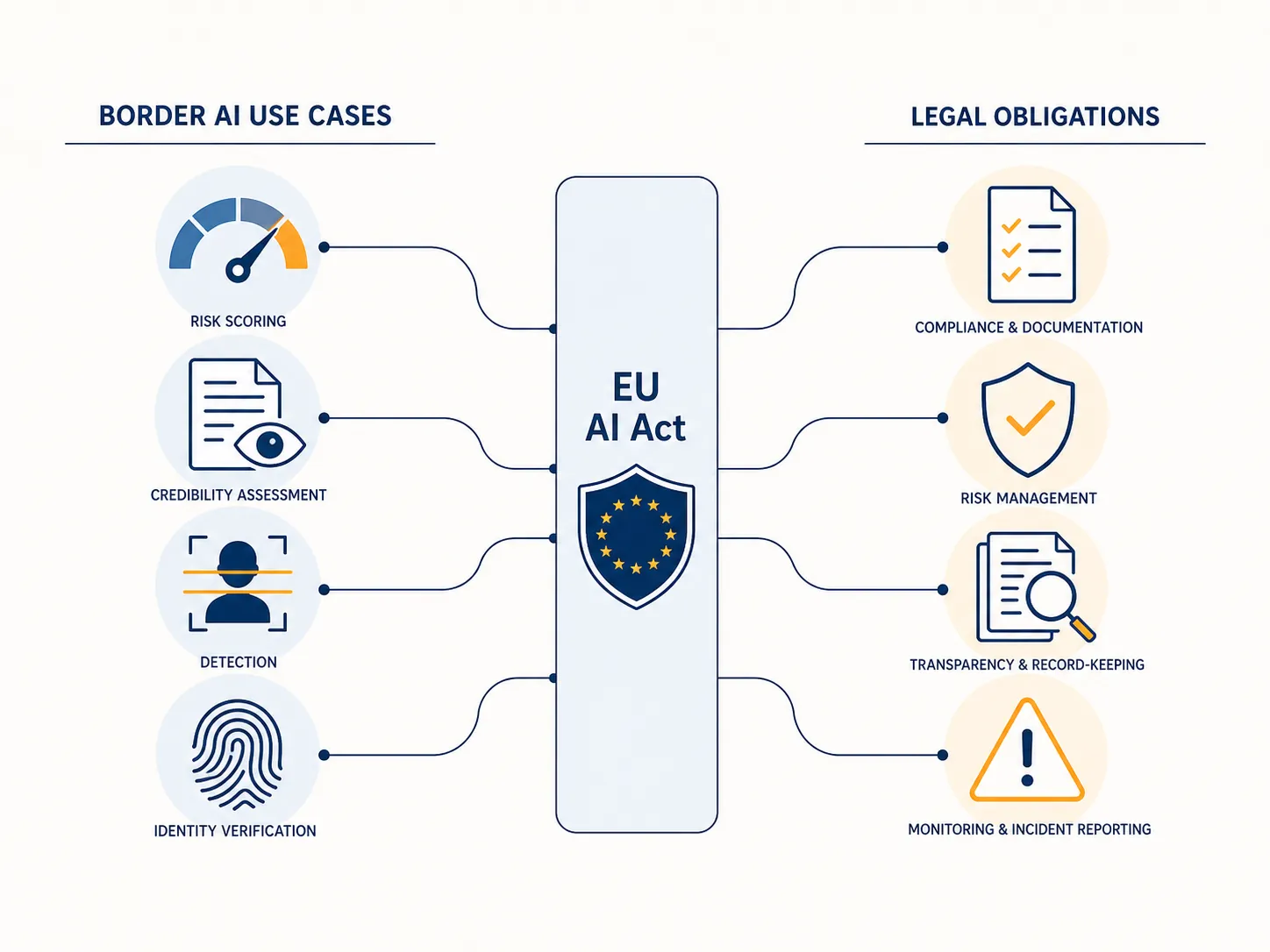
| Annex III point 7 category | Border-function translation | Why classification cannot wait |
|---|---|---|
| Polygraph-type tools or similar tools | A system that claims to infer deception, stress, credibility, or truthfulness in interviews or screening. | The risk is not just whether the tool is accurate. It is whether officials are using an AI output to influence a person’s access to territory, procedure, or protection. |
| Risk assessment of persons intending to enter or having entered a Member State | A system that scores or ranks people for security, irregular-migration, absconding, vulnerability, or other person-level risk. | Once the output is person-level and migration or entry-related, the classification question is triggered even if the interface looks like ordinary case-management software. |
| AI assistance in examining asylum, visa, or residence applications, including reliability-of-evidence assessment | A system that helps assess documents, statements, claimed origin, route, identity, or other evidence in an application or screening file. | The legally relevant point is the role of the AI in the examination process, not whether a human officer remains formally responsible for the decision. |
| Detection, recognition, or identification of persons in migration, asylum, or border-control contexts, excluding travel-document verification | A system that detects, recognizes, tracks, identifies, or matches people at the perimeter, in reception areas, or in operational footage. | The Annex III carve-out for travel-document verification should not be stretched into a general exemption for person detection or identification. |
That table is deliberately functional. A procurement label such as “situational awareness,” “screening support,” “case triage,” or “smart surveillance” does not decide the matter. The relevant inquiry is what the system processes, whose status it affects, what output it produces, and whether that output is used in migration, asylum, or border-control management.
What changes once a border system is high-risk
If a system falls into Annex III point 7 and the August 2 date remains operative, the work does not sit with a public-affairs office. It moves to provider product owners, compliance teams, contracting authorities, deployer governance staff, and whoever is expected to sign off on operational use. Compliance summaries tracking the August 2026 deadline identify Articles 9–17 for providers, Article 26 for deployers, Article 27 for fundamental-rights impact assessment, and Article 99 penalties as the core exposure points. [1][2]
- Provider-side work under Articles 9–17: risk-management documentation, data-governance controls, technical documentation, logging, transparency instructions for deployers, human-oversight design, accuracy and cybersecurity controls, quality-management processes, and conformity-assessment work where required.
- Deployer-side work under Article 26: using the system according to instructions, assigning human oversight that is more than nominal, monitoring operation, keeping or preserving logs where required, and ensuring that the input and use context do not quietly turn the system into something the provider never documented.
- FRIA work under Article 27: where the obligation applies, the deployer has to assess the reasonably foreseeable impact on fundamental rights before use, not after the first complaint or access-to-file dispute.
- Registration work: the public EU database is only part of the picture. Commentary on the border provisions has flagged Article 49(4) non-public registration issues for certain law-enforcement, migration, asylum, and border-control systems, which means absence from a public database should not be treated as proof that no qualifying system exists. [5]
- Penalty exposure: Article 99 fine levels cited in compliance materials include exposure up to EUR 15 million or 3% of total worldwide annual turnover for certain infringements. [2]
Emergency conditions do not remove these questions. They make them harder to answer cleanly. A surge compresses vendor support, public-authority sign-off, operator training, log preservation, human-oversight design, and later disclosure. That is exactly why the classification decision has to exist before the system is fielded in the next operation, not reconstructed from email fragments after litigation begins.
What the Ceuta reporting supports
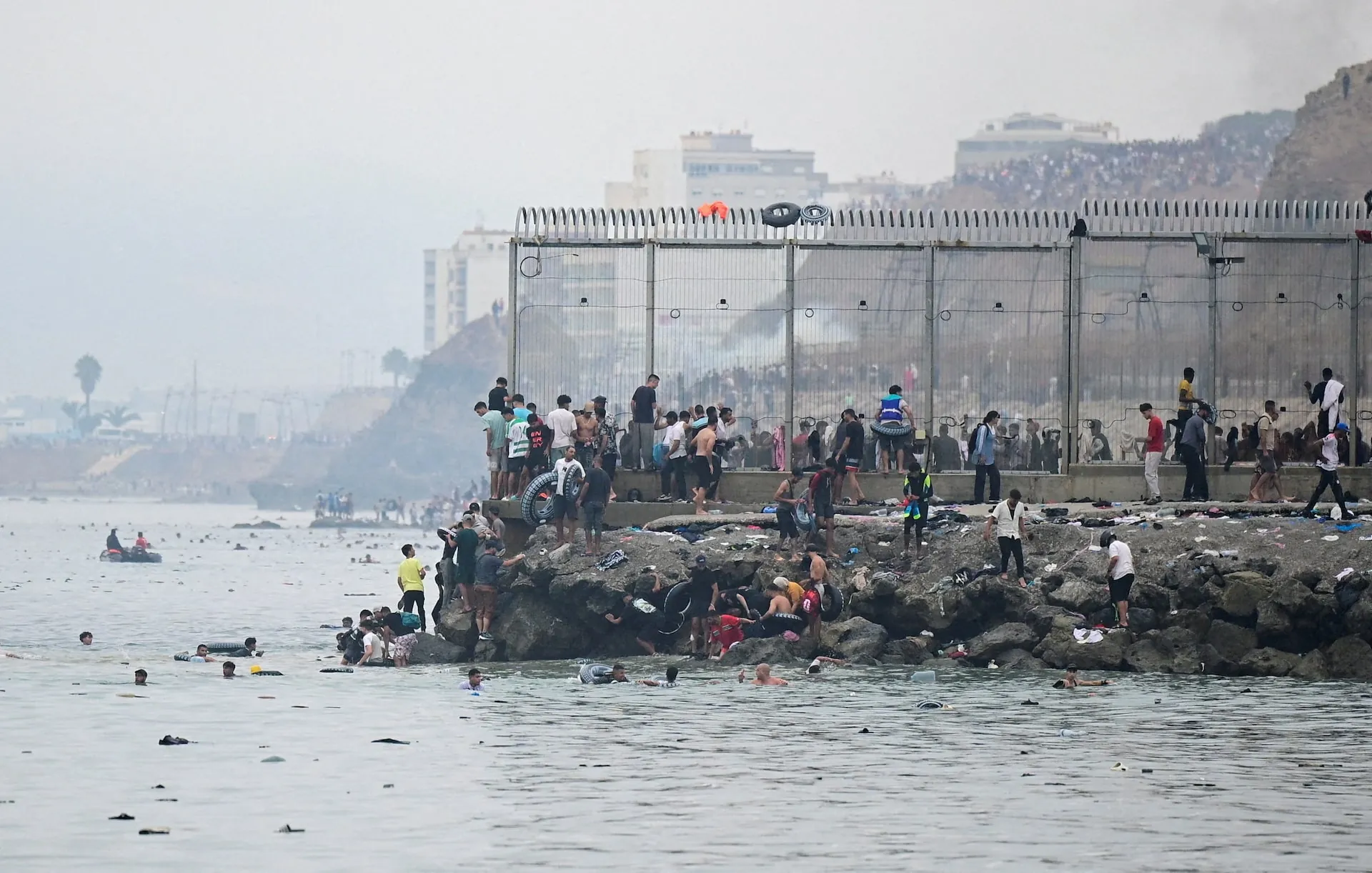
The Ceuta record is severe without needing technological embroidery. The New York Times live file for July 31 reported approximately 49,000 entries within roughly 24 hours, at least 48,300 returns by 6 p.m. on July 31, Spanish armed-forces mobilization, and rejection of Ceuta’s request for a national-emergency declaration on the ground that migration flows were not a qualifying risk under the emergency statute. [6]
Fatality figures were still unstable as of this August 3 record. NPR reported at least 18 deaths. [7] Reuters carried a headline figure of 57 dead and reported around 49,000 crossings in a day. [8] The BBC reported that at least 72 bodies had been pulled from the sea and described the political storm that followed. [9] Wikipedia’s incident page listed 41, a figure that should be treated as a fast-moving secondary entry rather than a settled count. [10]
Those numbers matter for the legal record because they describe the operational stress under which border systems may be used. They do not establish that an AI system was used. The reviewed Ceuta reporting supports a crisis timeline, a disputed casualty picture, rapid returns, and a political-legal fight over emergency status. It does not support claims that Spain deployed AI-powered surveillance towers, AI risk scoring, AI credibility assessment, or AI identification systems in the July 30–31 response.
Why the AI issue is still a real compliance contingency
The absence of a verified Ceuta AI deployment does not make the border-technology question artificial. A 2024 EuroMed Rights report on digital technologies for migration control at the Spanish-Moroccan border found that AI was not yet explicitly evident at Ceuta and Melilla, while describing older fixed surveillance infrastructure in the area. [11] That is a baseline, not an immunity certificate.
Earlier reporting had already documented upgrades at the Spanish-Moroccan borders. Statewatch reported in 2019 that a Ceuta CCTV upgrade would replace 52 cameras with facial-recognition-capable systems. [12] Facial-recognition-capable infrastructure is not the same thing as verified facial-recognition deployment in the July 2026 response, but it is precisely the kind of procurement trail counsel should not ignore when a later system is described in vague operational language.
The broader European context also points toward automation pressure. Euronews Next reported in March 2025 that 12 EU member states were testing automated border-control or AI border systems, and that Germany’s BAMF had used dialect-recognition technology in 43,593 cases in 2023. [13] Those figures do not say anything about Spain’s July 2026 Ceuta operation. They do show why a forward-looking risk record is more useful than pretending the next border deployment will necessarily be manual.
Two legal frictions make the next disclosure especially important. First, the AI Act’s self-classification structure can leave initial high-risk categorization in the hands of the provider or deployer most invested in a smooth rollout. Second, border and security contexts can involve carve-outs, non-public registration, or fragmented disclosure, which makes public visibility a poor proxy for legal relevance. EuroMed Rights and legal commentary have both warned that the AI Act’s border architecture leaves migrants and people on the move exposed to gaps in transparency and accountability. [5][14]
The watch items after August 2
The Ceuta file should be updated on evidence, not suspicion. The first item to recheck is the Digital Omnibus delay status: if the delay is enacted and changes the operative date, the compliance clock changes with it. If it is not enacted, August 2, 2026 remains the date against which Annex III point 7 deployments have to be tested.
- Spanish, Frontex, or vendor disclosures describing AI-assisted screening, triage, identification, risk scoring, or surveillance at Ceuta, Melilla, or adjacent Spanish-Moroccan border operations.
- Procurement notices, contract amendments, technical appendices, pilot descriptions, or emergency-support agreements that convert generic border technology into one of the Annex III point 7 use cases.
- Any public registration, non-public registration signal, FRIA reference, data-protection assessment, parliamentary answer, or litigation filing that ties a specific system to migration or border-control decisions.
- Any verified report later linking an AI system to the July 30–31 Ceuta response itself, which would move this record from forward-looking compliance risk toward incident analysis.
On the present evidence, Ceuta is not an AI incident record. It is a compliance-clock event. The next disclosed Spanish, Frontex, or vendor deployment at the Spanish-Moroccan border will be legally consequential if it performs person-level risk scoring, credibility or evidence assessment, or person detection, recognition, or identification in a migration or border-control context.
References
- EU AI Act High-Risk Deadline: Enterprise Readiness Gap — Cloud Security Alliance, March 13, 2026
- U.S. Companies Face EU AI Act's Possible August 2026 Compliance Deadline — Holland & Knight, April 28, 2026
- Migration, asylum and border control management — EC AI Act Service Desk
- Annex III — Artificial Intelligence Act
- Regulating AI at Europe’s Borders — Verfassungsblog
- Spain-Ceuta-Migrants-Morocco live updates — The New York Times, July 31, 2026
- Morocco-Spain migration — NPR, July 31, 2026
- Spain, Morocco halt deadly rush to Spanish enclave after 49,000 cross in a day — Reuters, July 31, 2026
- Ceuta migrant crisis: at least 72 bodies pulled from the sea — BBC
- 2026 Morocco–Spain border incident — Wikipedia
- DIGITAL TECHNOLOGIES FOR MIGRATION CONTROL AT THE SPANISH-MOROCCAN BORDER — EuroMed Rights, 2024
- Spanish-Moroccan borders upgraded with new cameras, facial recognition and a barbed wire swap — Statewatch, September 2019
- From surveillance to automation: How AI tech is being used at European borders — Euronews Next, March 21, 2025
- A dangerous precedent: how the EU AI Act fails migrants and people on the move — EuroMed Rights
Related records
Tool profile
How Meta's AI Spending Reshapes Law Firm ProfitabilityGoverning regulation
Browse the obligations tracker →Preventive workflow
Browse verification workflows →
Report a correction or tip
Spotted an outdated figure, a misstated fact, or a ruling this case record should reflect? Public comments are disabled for this content given the professional cost of a misreported case outcome, penalty amount, or rule text — use the structured correction channel instead.
Report a correction or tip for this record →