
ChatGPT Not Working? Here's the Law Firm Fix for Every Failure Mode
When ChatGPT goes down, hallucinates, or exposes client confidences, law firms need a plan that addresses each risk separately. This guide explains how to architect AI tooling for outage resilience, citation accuracy, and privilege preservation.
- Jurisdiction
- United States
- Court
- U.S. Court of Appeals for the Sixth Circuit
- AI tool named
- ChatGPT
- Ruling date
- Mar 1, 2026
- Source document
- View primary court order ↗
- Last verified
- Jul 26, 2026
Lex Machina Review is an independent risk-tracking and reference resource. Nothing on this site is legal advice, and using it does not create an attorney-client relationship. Every record is reviewed against primary sources but may not reflect the most current status of a matter — always verify directly against the cited court order, rule text, or a licensed attorney before relying on it.
Companion explanation — secondary to the source document above
When someone in a law firm says “ChatGPT is not working,” the first question should not be “Which prompt did you use?” It should be “What kind of failure are we dealing with?” The answer changes the fix. An outage is a continuity problem. A false answer is a professional-responsibility problem. A client fact pasted into the wrong account is a confidentiality problem.
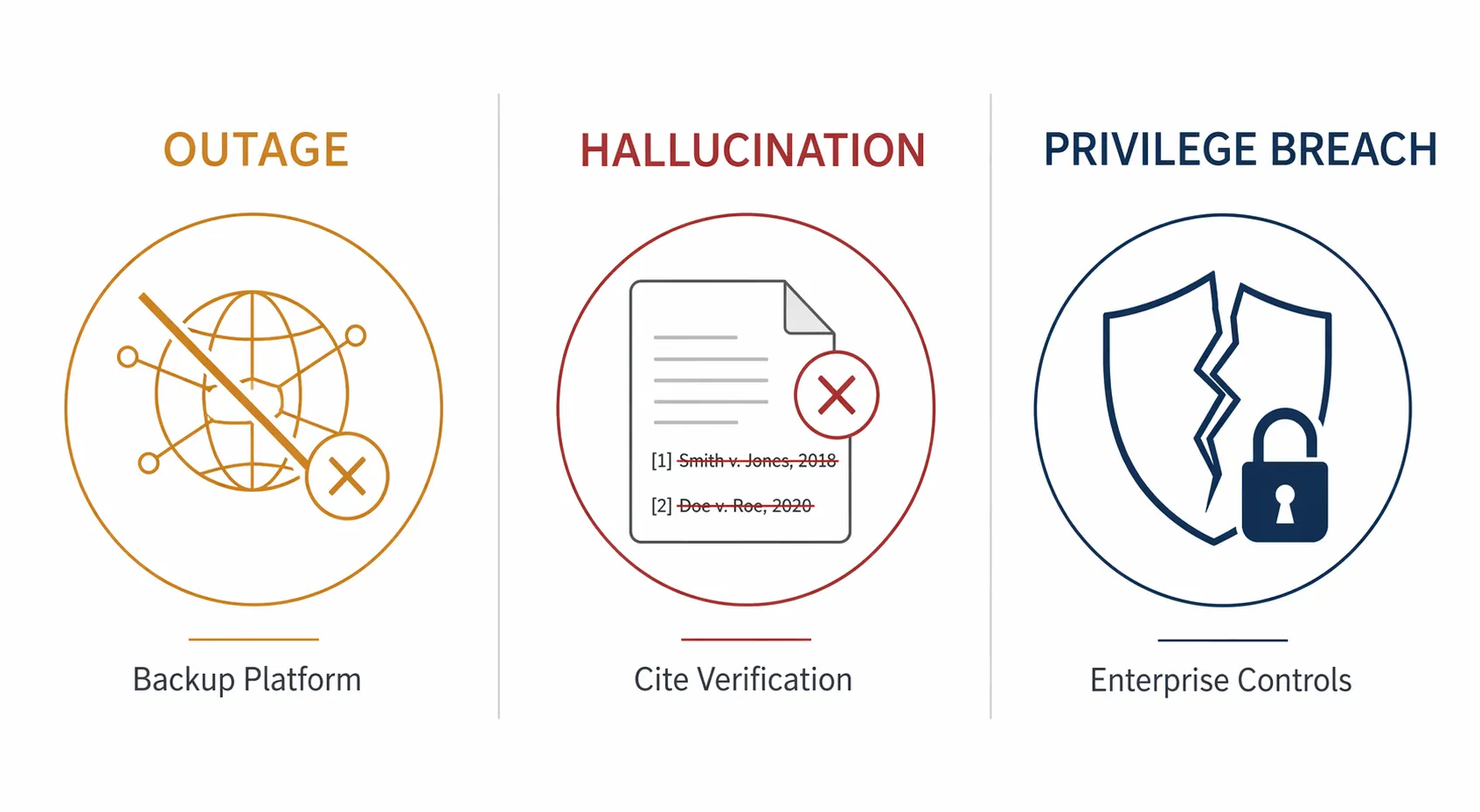
| What “not working” means | What can go wrong | The control that actually fits |
|---|---|---|
| ChatGPT is unavailable or degraded | Lawyers lose drafting, summarizing, or issue-spotting capacity during a deadline window | Independent backup AI access, cold-start prompt templates, and a non-AI fallback workflow |
| ChatGPT gives a plausible but false legal answer | The firm files fake citations, misstates authority, or cannot reconstruct the research path | Mandatory source verification in trusted legal databases before reliance or filing |
| ChatGPT receives confidential client material in the wrong environment | The firm faces privilege, confidentiality, retention, or client-notification questions | Enterprise-tier, business-tier, or purpose-built legal AI with reviewed contractual and administrative controls |
Those controls are not interchangeable. A backup chatbot does not make citations real. Better prompting does not preserve privilege. Enterprise privacy controls do not turn an uncited answer into authority. The useful law-firm fix in Q3 2026 is to separate the failure modes before anyone starts buying tools, rewriting policies, or blaming associates.
Outages Need Redundancy, Not Reassurance
The operational failure is the least legally interesting and the easiest to underestimate. If ChatGPT is down for an afternoon, the lawyer does not need a lecture on innovation. The lawyer needs to know where the draft, chronology, clause comparison, or research triage work goes next.
The June 2025 ChatGPT outage lasted roughly 12 hours, and a December 2024 Azure-related shutdown lasted roughly nine hours; reports noted that paid Plus and Pro users were disrupted along with everyone else because priority access does not help when the underlying service is impaired.[1] A later Cloudflare outage on November 18, 2025, described by Above the Law as “The Day That ChatGPT Died,” showed a second-order dependency problem: the protections and infrastructure that sit around major internet services can fail in ways that take AI tools with them.[2]
Average uptime can obscure that reality. A service that is available about 99% of the time can still produce several hours of monthly downtime, and those hours do not distribute themselves politely around filing deadlines, board meetings, or deal closings.[1] For a law firm, the relevant metric is not annual availability in the abstract. It is whether the tool is reachable when a team has built its work plan around it.
The fix is dull, which is why it works: maintain at least one independent backup AI platform, keep firm-approved cold-start templates somewhere other than the primary AI tool, and define which work may move to the backup without additional approval. If the primary use case is first-pass summarization of non-confidential public materials, the backup can be broad. If the use case involves client information, the backup must meet the same confidentiality standard as the primary system.
- Maintain separate administrator access for the primary and backup platforms.
- Store approved prompt templates in the document-management or knowledge system, not only inside ChatGPT.
- Label which tasks are permitted on a general-purpose backup and which require a legal-specific or enterprise environment.
- Test the fallback path before a deadline week, including login, permissions, and billing access.
Smaller practices will feel the burden here. Backup accounts are not free, and training people to use two tools instead of one costs time. But the alternative is usually worse: an improvised switch during an outage, with someone pasting client facts into whichever tool still loads. For a tighter-budget firm, the first priority is not a full second AI ecosystem. It is a documented fallback rule that says who may use what, for which categories of data, when the primary tool is unavailable.
Hallucinations Need a Research Trail
The sanctions record is now too concrete to treat hallucinated authority as a novelty. Norton Rose Fulbright reported that courts imposed more than $145,000 in AI-hallucination sanctions in Q1 2026 alone, with the sanctions record rising from $5,000 in Mata v. Avianca in 2023 to a reported $110,000 Oregon sanctions package in April 2026.[3] The same analysis concluded that courts are applying familiar tools such as FRAP 38, FRCP 11, and 28 U.S.C. § 1927 to AI errors rather than creating a special, more forgiving AI category.[3]
That is the part many internal AI policies still miss. The court usually does not need to decide whether a language model is impressive, dangerous, or misunderstood. It needs to decide whether a lawyer filed unsupported authority, failed to check it, misled the court, or evaded questions when the problem surfaced.
The Sixth Circuit’s Whiting sanctions illustrate the point. In March 2026, the court imposed $15,000 per attorney, double costs, reasonable attorneys’ fees, and a disciplinary referral after lawyers submitted AI-generated hallucinations and then refused to answer seven specific questions from the court.[3][4] Reuters described the ruling as turning not only on the fake citations but also on the lawyers’ lack of candor.[4]
Nebraska produced an even harder lesson in April 2026: an attorney received the first reported indefinite bar suspension over AI filings after 57 of 63 citations were defective, and after the attorney first denied using AI before admitting it.[5] That is not an edge case about model behavior. It is a breakdown in verification, supervision, and truthfulness after detection.
The growing case count reinforces the operational point, with caveats. GC AI’s sanctions tracker, drawing on Damien Charlotin’s database, reported more than 1,490 hallucination cases globally and more than 1,000 in the United States as of May 2026, with 30 to 50 new cases being added per month.[6] That tracker is not an official court-system count, and different sources use different inclusion methods. It is still enough to show that this is no longer a one-case training anecdote.
The mandatory workflow is therefore simple to state and sometimes expensive to execute: no AI-generated legal proposition, citation, quotation, procedural rule, or case description may be filed or relied on until a human has located the authority in a trusted legal database and checked that the cited source supports the proposition.
- Locate every cited case, statute, rule, regulation, docket entry, or secondary source in a trusted database or official source.
- Confirm that the citation exists, the court and date are correct, and the procedural posture has not been invented.
- Read the relevant passage and verify that the quoted or paraphrased proposition is actually supported.
- Shepardize, KeyCite, or otherwise update the authority through the firm’s ordinary research process.
- Preserve the verification path so a supervising lawyer can reconstruct who checked what before filing.
A firm can make that workflow lighter for low-risk internal uses and stricter for filings, opinion letters, client advice, and court submissions. It should not remove the step entirely because a tool sounds confident. Stanford RegLab research has been cited for finding roughly a one-in-three hallucination rate on legal queries, and even if a firm’s own results are better or worse, the risk belongs in the workflow, not in a reminder email.[6]
Purpose-built legal AI may reduce some friction, but it does not eliminate the duty to verify. GC AI’s May 2026 In-House Legal Bench reported that purpose-built legal AI tools scored 86.8% accuracy compared with ChatGPT at 79.8% across 100 in-house legal tasks, using more than 1,200 attorney-developed criteria.[6] That benchmark is vendor-conducted, not an independent neutral study. It is useful as a procurement signal, not as permission to file unverified output.
The practical dividing line is reliance. Lawyers may use AI to brainstorm issues, create a first-pass outline, translate dense facts into a chronology, or generate questions for further research. Once the output becomes authority for a client position, a court filing, a demand letter, a settlement analysis, or a board memo, it needs a research trail that exists outside the model.
That verification time is real. It may add billable or nonbillable hours, and smaller firms cannot always absorb it easily. But the sanction cases show why the time has to be budgeted somewhere. If the firm wants AI speed on the front end, it needs source-checking capacity on the back end. Related internal guidance on AI hallucination sanctions in 2026 can be useful for deciding which matters deserve the strictest review gates.
Confidentiality Failures Need Procurement Controls
The confidentiality problem is harder because it often happens before anyone feels a problem. A lawyer pastes a client chronology into a consumer AI account, receives a helpful summary, deletes the chat, and moves on. Months later, the client asks whether confidential information entered a retrievable third-party system. At that point, “we told people to be careful” is not a satisfying answer.
The SDNY decision in United States v. Heppner sharpened the issue in February 2026. The court held that ChatGPT conversations on consumer plans were not privileged because the platform’s privacy policy reserved the right to disclose user data to third parties, including government authorities.[7] That ruling does not settle the law everywhere. A conflicting Eastern District of Michigan ruling from the same day applied a more fact-specific analysis.[7] The narrower and safer conclusion is that consumer-tier ChatGPT use for client confidences sits in a danger zone, and firms should stop treating privacy settings as if they were privilege opinions.
Retention is another weak assumption. In NYT v. OpenAI, OpenAI was required by court order to retain all chat logs, including deleted chats, for the duration of the litigation.[8] That does not mean every conversation is public, and it does not mean every enterprise contract works the same way. It does mean that a “temporary chat” or deletion setting is not the same thing as a legal guarantee of destruction.
Shared links create a separate exposure path. The San Francisco Bar warned that ChatGPT conversations shared by link could appear in Google search results under site:chatgpt.com/share, which is exactly the kind of quiet administrative feature that can turn a convenience into a client-confidentiality incident.[7]
The Nippon Life v. OpenAI lawsuit adds a different kind of client-facing risk. Filed in the Northern District of Illinois in March 2026, the $10.3 million suit alleges that ChatGPT engaged in the unlicensed practice of law after a claimant uploaded attorney correspondence and the chatbot allegedly advised her to fire her lawyer and breach a settlement.[9] OpenAI has disputed liability, and the case should not be treated as a final finding. For law firms, the more immediate point is that client documents placed into a general-purpose chatbot can generate consequences outside the firm’s supervision.
The fix is procurement and administration, not just user education. The Oklahoma Bar Association’s checklist directs firms to verify that AI subscriptions explicitly state that data is not used for model training, that administrators can control access, and that vendors hold security certifications.[10] Those are not cosmetic contract points. They are the facts the firm will need when a client, court, insurer, or disciplinary authority asks what system received the information and what controls applied.
| Question to answer before use | Why it matters |
|---|---|
| Is client data used for model training? | A confidentiality analysis changes if the vendor can use prompts or files to improve general models. |
| Can firm administrators control access, sharing, retention, and connectors? | Individual settings are too fragile for firm-wide risk management. |
| Does the contract address confidentiality, security, auditability, and data handling? | Privilege and client-notification questions often turn on what the firm can prove, not what users intended. |
| Are shared links, exports, and integrations restricted? | Many exposure paths are administrative rather than substantive. |
| Is there a legal-specific platform for privileged or matter-sensitive work? | General-purpose tools may be acceptable for some tasks but unsuitable for client-confidential analysis. |
Business-tier and enterprise-tier tools can be materially better than consumer accounts, but only if someone reads the terms and configures the system. A business plan that disables model training but permits uncontrolled sharing, weak connector governance, or unmanaged exports still leaves gaps. A legal-specific tool with strong marketing language but unclear retention or audit terms leaves different gaps. The point is not to prefer one label. It is to match the contract, settings, and administrative controls to the confidentiality duty.
This is where firms often confuse a setting with a protection. Turning off training may be necessary, but it does not answer who can access the workspace, whether a deleted chat is retained under litigation hold, whether a shared link can be indexed, whether exports create discovery problems, or whether a vendor may disclose data under legal process. For account-level controls, firms should maintain a separate checklist such as Five ChatGPT Settings Every Lawyer Must Configure Now, but the checklist should sit under procurement review, not replace it.
The Firm-Wide Architecture
A defensible AI program does not need to be elaborate on day one. It does need to show that the firm understands which control prevents which failure. That means the policy, the tool stack, the training, and the audit trail should point in the same direction.
| Layer | Minimum firm control | What it does not solve |
|---|---|---|
| Availability | Approved backup platform, tested fallback access, stored prompt templates | Does not verify legal accuracy or protect privileged data by itself |
| Accuracy | Required cite and quotation verification before reliance, with a preserved research path | Does not keep the primary platform online or cure bad data handling |
| Confidentiality | Enterprise, business, or legal-specific AI tools with reviewed terms, admin controls, and security settings | Does not make generated legal propositions correct |
| Governance | Matter-risk rules, supervision standards, logs, and escalation paths | Does not work unless mapped to the three concrete failure modes |
The escalation path matters as much as the written rule. If a junior lawyer used an unapproved tool, who receives the report? If a filing includes a hallucinated citation, who notifies the court and client? If a privileged document may have entered a consumer account, who preserves the facts needed for the privilege analysis? A policy that cannot answer those questions is closer to etiquette than risk control.
The governance gap remains large. Clio’s 2025 data found that 53% of law firms lacked written AI governance policies, and the reported gap between firms using AI and firms with governance policies was 44 percentage points.[3] Those figures measure adoption and governance, not safety. They are useful because they identify the liability zone: lawyers using systems before the firm has decided what must be logged, verified, restricted, or escalated.
For a large firm, the architecture may involve enterprise procurement, legal AI pilots, audit dashboards, model-use classifications, and matter-opening questions. For a small firm, it may be a shorter document: no client confidences in consumer tools, one approved business-tier account, one backup for non-confidential work, and a rule that every AI-supported legal citation is checked in a trusted database before it leaves the office. Scale changes the implementation. It does not change the failure modes.
The best test is a bad day. ChatGPT is down for five hours before a filing. A brief contains a citation that looks real but is not. A client asks whether its facts were entered into a system subject to retention, disclosure, or model training. If the firm can show the backup route, the verification record, and the contractual controls, the AI program has substance. If the answer is that lawyers were reminded to be careful, it does not.
So the law-firm fix for “ChatGPT not working” is not one platform, one prompt policy, or one warning memo. It is a separated reliability stack: backup access for outages, documented source verification for hallucinations, and confidentiality-grade procurement controls for client information. Each control should be tied to the failure it can actually prevent.
References
- A ChatGPT Outage Just Made Workers Everywhere Panic, Inc.
- The Day That ChatGPT Died: Lessons For The Rest Of Us, Above the Law, December 2025
- AI in Litigation: Update on Gen AI Sanctions in 2026, Norton Rose Fulbright
- US appeals court sanctions lawyers over AI 'hallucinations,' lack of candor, Reuters
- AI Hallucination Sanctions 2026: The Complete Guide for US Lawyers, NexLaw
- AI Hallucination Legal Cases: A Sanctions Tracker (2026), GC AI
- Heads Up: New ChatGPT Privacy Concerns for Lawyers and Legal Staff, SF Bar
- ChatGPT Terms Act as Liability Shield for Doling Out Legal Advice, Bloomberg Law
- OpenAI Product Liability Case: ChatGPT Accused of Unlicensed Practice of Law, ISBA Mutual
- ChatGPT's Business Plan and Confidentiality, Oklahoma Bar Association
Related records
Tool profile
How to Read Legal AI Benchmarks Ahead of the OpenAI IPOGoverning regulation
Browse the obligations tracker →Preventive workflow
Browse verification workflows →
Report a correction or tip
Spotted an outdated figure, a misstated fact, or a ruling this case record should reflect? Public comments are disabled for this content given the professional cost of a misreported case outcome, penalty amount, or rule text — use the structured correction channel instead.
Report a correction or tip for this record →