
No court order revoked the Cheluget 5,800-acre Narok title
No court revoked Isaiah Cheluget's title to the 5,800-acre Narok parcel: in Environment & Land Case 53 of 2018 the court dismissed the 583-plaintiff cancellation suit as res judicata and never reached the merits, and the dispute ended in August 2026 through a voluntary government buyout. This record reconstructs the judgment's reasoning, the 2003–2024 procedural chain, and where news reports diverge from the primary order.
- Jurisdiction
- Kenya
- Court
- Environment and Land Court at Narok
- Judge
- CG Mbogo
- AI tool named
- No AI tool named
- Ruling date
- Jun 11, 2024
- Source document
- View primary court order ↗
- Last verified
- Aug 28, 2026
Lex Machina Review is an independent risk-tracking and reference resource. Nothing on this site is legal advice, and using it does not create an attorney-client relationship. Every record is reviewed against primary sources but may not reflect the most current status of a matter — always verify directly against the cited court order, rule text, or a licensed attorney before relying on it.
Companion explanation — secondary to the source document above

| Record field | Details |
|---|---|
| Case | Kones & 582 others v Johnstone Kipkoech Langat, Julius Kipkurui Langat & Laurence Kimutai Langat (as personal representatives of Isaiah Kiplangat Arap Cheluget) & 3 others, Environment & Land Case 53 of 2018 [2024] KEELC 4577 (KLR) [1] |
| Court | Environment and Land Court at Narok |
| Judge | Justice CG Mbogo |
| Judgment date | June 11, 2024 [1] |
| Primary source | https://new.kenyalaw.org/akn/ke/judgment/keelc/2024/4577/eng@2024-06-11 |
| Last verified | August 28, 2026 |
| Legal-background review | Miriam Wekesa |
| Notice | This case record is general information, not legal advice. |
The operative result in the Isaiah Cheluget Narok 5,800-acre land title deeds case was a dismissal. The 583 plaintiffs asked the Environment and Land Court to cancel the registered title, but the court held that their suit was barred by res judicata under section 7 of the Civil Procedure Act. It did not issue an order revoking, nullifying or canceling the title.[1]
| Proposition | What the record establishes |
|---|---|
| The cancellation claim | It failed procedurally because the court treated the dispute as already litigated.[1] |
| The fraud and illegality allegations | They were not decided on their merits. After finding res judicata, the court said it was unnecessary to address the remaining issues.[1] |
| The eventual transfer of the land | The original deed was surrendered through an August 2026 government buyout, not canceled by a judicial order.[2] |
Those propositions must remain separate. A procedural dismissal does not prove that the challenged adjudication was lawful, but neither does it establish the plaintiffs’ allegations of fraud. The later settlement changed possession and control of the land through an agreement with the Cheluget family; it did not rewrite the 2024 judgment.
What the court actually decided in 2024
The suit was brought by Samwel Kipkirui Kones and 582 other plaintiffs. They sought cancellation of the title held through the estate of Isaiah Kiplangat Arap Cheluget, advancing allegations concerning fraud, illegality and the land-adjudication process conducted between 1974 and 1980. The estate disputed that account and asserted its own history of how the land had been granted, including a claimed grant by the Purko clan through Senior Chief Ole Sandale. That was the estate’s litigation position, not a factual finding ultimately made by the court.[1]
The decisive question was whether the plaintiffs could litigate the ownership dispute again after earlier proceedings brought on behalf of the Sagamian Community. Section 7 of the Civil Procedure Act bars a court from trying a suit or issue that was directly and substantially in issue in an earlier case between the same parties, or parties claiming under them, where a competent court has already heard and finally decided it. The rule also reaches matters that ought to have been raised in the earlier proceeding; changing the requested remedy or legal formulation does not necessarily create a new dispute.[1]
In paragraphs 129–137, the court connected the 2018 action to the earlier adverse-possession litigation. The prior claim had been advanced by representatives of the Sagamian Community against the Cheluget interest over the same land. The 2018 plaintiffs were again asserting community-based rights against the estate, this time through a request to invalidate the registered title. The court concluded that the relevant parties and subject matter were sufficiently connected and that the issues raised in the new action either had been litigated or should have been raised in the earlier case.[1]
That is the context for the court’s description of the litigation as a “gross abuse of the court process.” The phrase addressed the attempt to reopen a dispute after the earlier suit and appeal had failed. It was not a finding that the historical adjudication was free from fraud, that every transaction affecting the land complied with the law, or that the estate’s account of acquisition had been proved.[1]
The boundary of the decision appears most clearly in paragraph 137. Having upheld the res judicata objection, the court said it was “not necessary to delve into the other issues.”[1] The allegations about the 1974–1980 adjudication therefore remained allegations the plaintiffs had asked the court to determine, not allegations the court accepted or rejected after a merits hearing.
Arguments involving objection procedures under the Land Adjudication Act, the legal treatment of first registration and section 6 of the Land Control Act appear in the record as part of the parties’ competing cases. Once res judicata disposed of the plaintiffs’ suit, the court did not need to resolve those arguments. They cannot be extracted from the pleadings and presented as additional holdings.
The counterclaim did not produce an eviction order
The treatment of the estate’s counterclaim requires the same attention to the order. The court found the counterclaim merited in terms of prayer (c), the eviction prayer. It nevertheless declined to grant that relief because an eviction application was already pending.[1]
It is therefore inaccurate to report that the 2024 judgment itself evicted the occupants. The court recognized the basis of the prayer but did not issue the requested eviction order in that judgment. That distinction later mattered when the family withdrew eviction cases as part of the government settlement.
How the earlier cases created the procedural bar
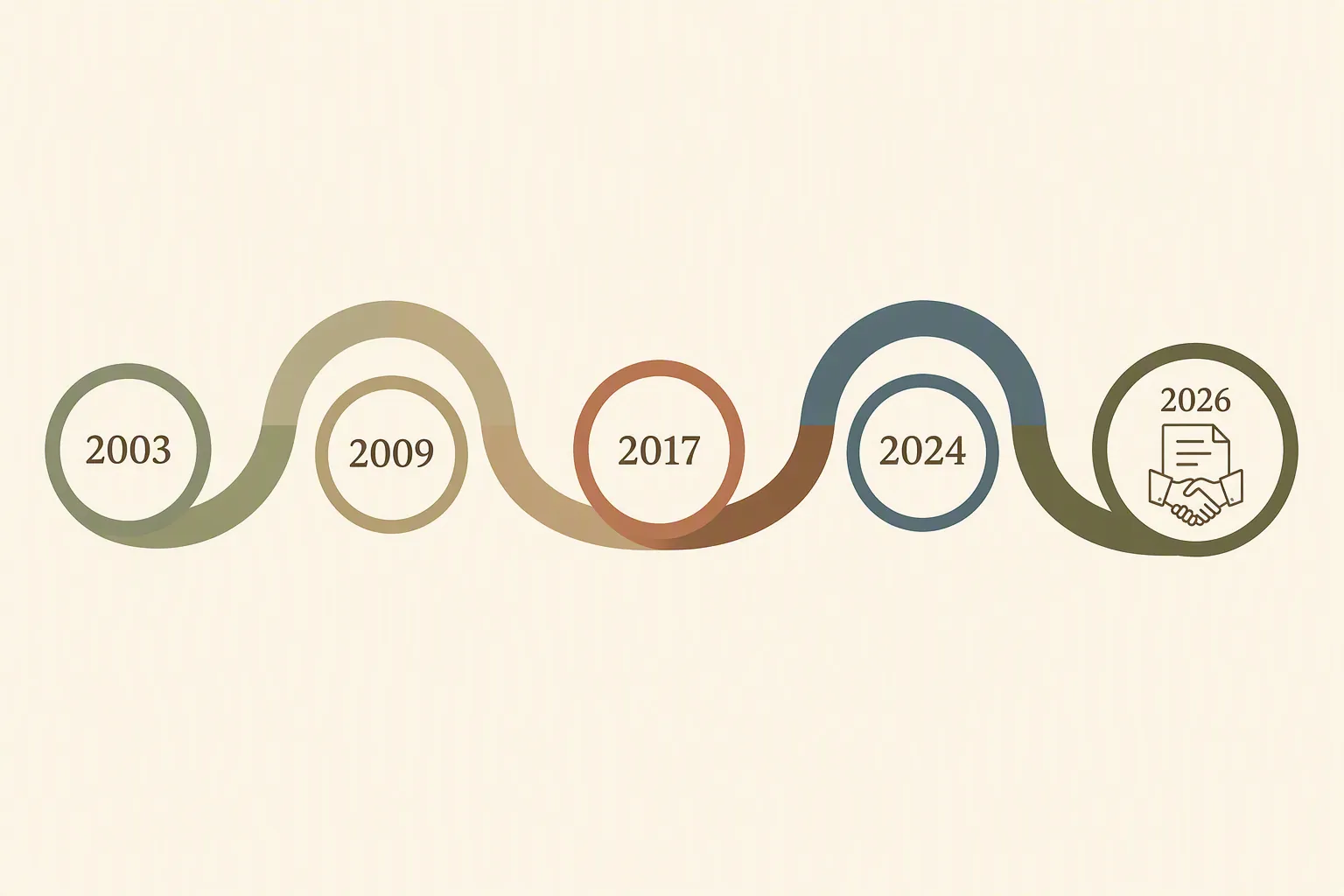
| Date | Proceeding or event | Result relevant to the record |
|---|---|---|
| 2003 | Nairobi High Court Miscellaneous Civil Application No. 400 of 2003 (Originating Summons) | Representatives of the Sagamian Community claimed the land by adverse possession.[1] |
| August 19, 2009 | High Court judgment by Justice JB Ojwang | The adverse-possession claim was dismissed.[1] |
| December 29, 2017 | Civil Appeal No. 289 of 2009 | The Court of Appeal dismissed the appeal and described the plaintiffs’ presence on the land as that of trespassers.[1] |
| 2018–2024 | Environment & Land Case 53 of 2018 | The 583 plaintiffs sought cancellation of the title; the court dismissed the action as res judicata on June 11, 2024.[1] |
| August 19, 2026 | Government buyout and handover | Government possession was announced after the original title deed was surrendered and eviction cases were withdrawn.[2] |
The procedural chain began with an originating summons filed in 2003. Representatives of the Sagamian Community claimed approximately 2,329 hectares by adverse possession. Adverse possession asked whether occupation over the legally required period had displaced the registered owner’s rights; it was not a direct action to cancel the title because of defects in the earlier adjudication process.[1]
Justice JB Ojwang dismissed that claim on August 19, 2009. The claimants appealed, but the Court of Appeal dismissed Civil Appeal No. 289 of 2009 on December 29, 2017. In doing so, the appellate court described their presence as trespass rather than possession capable of supporting the relief they sought.[1]
The next action was filed in 2018. Its legal route was different: instead of asking to acquire rights through adverse possession, the 583 plaintiffs attacked the registered title and sought its cancellation. The change mattered to the form of the pleadings, but it did not persuade the Environment and Land Court that this was an independently triable controversy. The court treated the claimants as returning to the same land dispute against the same opposing interest after the represented community’s earlier case had reached a final appellate result.[1]
That reasoning explains both the dismissal and its limits. The cancellation action could not proceed because of the earlier litigation. It does not follow that the 2009 or 2017 courts conducted and resolved the separate historical inquiry into every allegation made about the 1974–1980 adjudication. In 2024, the court’s conclusion was that those matters could not now be opened through this suit.
The August 2026 buyout ended the title dispute outside court

On August 19, 2026, at Kwalela Primary School in Narok South, Lands Principal Secretary Nixon Korir announced that the government had taken possession of the land following a buyout agreement. Julius Cheluget, a son of Isaiah Cheluget, confirmed that the family had handed over the original title deed and withdrawn eviction cases. Officials said the government would proceed with processing individual title deeds for families occupying the land.[2]
The handover resolved a problem the judgment had not. The 2024 court decision had left the registered title in place and had not granted an eviction order. The 2026 agreement then moved the land out of the estate through a government purchase, accompanied by surrender of the deed and withdrawal of the remaining eviction litigation. Contemporary reporting likewise presented the development as a government buyout accepted by the family.[3]
The promised processing of individual deeds should not be confused with completed registration for every occupant. The official announcement described the administrative work that would follow the handover. It supports the conclusion that the government intended to regularize the occupying families’ interests, but it does not by itself establish that every beneficiary had already been identified or issued a registered title.[2]
Why names, acreage and family counts differ
The description “5,800-acre Cheluget land” is the figure used in the government announcement and current news coverage. The litigation record contains different measurements: the plaint referred to approximately 4,900 acres, a witness spoke of approximately 5,000 acres, and the 2003 originating summons described approximately 2,329 hectares.[1][2] The 5,800-acre figure is appropriate for identifying the publicly reported dispute, but it should not be presented as the only measurement found in the court file.
| Point of divergence | Primary or official record | Other reporting |
|---|---|---|
| Lead plaintiff | The judgment names Samwel Kipkirui Kones.[1] | Daily Nation identifies Charles Kones.[3] |
| August 2026 venue | The Ministry of Lands identifies Kwalela Primary School.[2] | Daily Nation reports Kaplelach Primary School, while Citizen Digital also reports Kwalela.[3][4] |
| People affected | The court case had 583 named plaintiffs.[1] | Daily Nation reports more than 600 families; the Ministry and Citizen Digital use the broader description of thousands of families.[2][3][4] |
| Acreage | The court record uses several measurements, including approximately 4,900 acres, approximately 5,000 acres and approximately 2,329 hectares.[1] | The official announcement and news coverage use 5,800 acres.[2][3][4] |
These figures do not necessarily count the same thing. Named plaintiffs are individuals joined to a suit; “families” may refer to households considered for settlement; and a reference to thousands of families may describe a wider occupying population. None should be silently substituted for another. For the parties’ names and the judicial outcome, the signed judgment is controlling. For the government handover, the Ministry’s account carries the stronger official attribution.
The final position is deliberately narrow. No court order revoked Isaiah Cheluget’s title to the Narok land, and the 2024 dismissal did not judicially validate the merits of the title’s historical acquisition. The cancellation suit was barred as res judicata before the fraud and illegality allegations were decided. The deed left the estate only through its surrender under the August 2026 government buyout.
References
- Kones & 582 others v Johnstone Kipkoech Langat, Julius Kipkurui Langat & Laurence Kimutai Langat (As Personal Representatives of Isaiah Kiplangat Arap Cheluget) & 3 others (Environment & Land Case 53 of 2018) [2024] KEELC 4577 (KLR) (11 June 2024) — Kenya Law, June 11, 2024
- Government resolves Cheluget land tussle, to issue title deeds to individual family beneficiaries — State Department for Lands
- 30-year ex-PC Cheluget land dispute ends as government buys 5,800 acres for settlers — Daily Nation
- Gov't resolves Cheluget land tussle, to issue title deeds to individual family beneficiaries — Citizen Digital
Related records
Tool profile
How Meta's AI Spending Reshapes Law Firm ProfitabilityGoverning regulation
Browse the obligations tracker →Preventive workflow
Browse verification workflows →
Report a correction or tip
Spotted an outdated figure, a misstated fact, or a ruling this case record should reflect? Public comments are disabled for this content given the professional cost of a misreported case outcome, penalty amount, or rule text — use the structured correction channel instead.
Report a correction or tip for this record →