
China's Memory Chip Surge Raises Legal AI Supply Chain Risks
CXMT's Shanghai IPO and narrowing HBM gap with SK Hynix create real but forward-looking risks for legal AI tools dependent on memory-supplied GPUs. This analysis identifies the sanctions and supply constraints that law firms should evaluate in their AI vendor due diligence.
- Jurisdiction
- US Federal
- Court
- U.S. District Court for the Northern District of California
- AI tool named
- Legal AI platforms
- Ruling date
- Jul 27, 2026
- Source document
- View primary court order ↗
- Last verified
- Jul 29, 2026
Lex Machina Review is an independent risk-tracking and reference resource. Nothing on this site is legal advice, and using it does not create an attorney-client relationship. Every record is reviewed against primary sources but may not reflect the most current status of a matter — always verify directly against the cited court order, rule text, or a licensed attorney before relying on it.
Companion explanation — secondary to the source document above
CXMT’s first day on Shanghai’s market looked, at first glance, like a chip-stock story: shares surged roughly 466% to 500%, Korean memory names sold off, and reports put the Chinese memory maker’s implied valuation near $515 billion after its July 27, 2026 debut.[1][2] For a law firm choosing or renewing an AI platform, the more important point is not whether that valuation survives. It is that investors are suddenly repricing Chinese memory capability, and legal AI systems do not run on “AI” in the abstract. They run on GPU capacity, and the most advanced GPUs depend on high-bandwidth memory.
That is where fears about SK Hynix, Chinese chip competition, and AI supply become less like market noise and more like a procurement question. If a legal AI vendor depends on scarce HBM-equipped GPUs, then a shift in memory supply can become a cost issue, an availability issue, or, under export-control rules, a compliance issue. The point is not that CXMT has already created a sanctions problem for law firms. There is no known court sanctions decision or privilege ruling turning on semiconductor provenance. The point is that by Q3 2026, the hardware chain behind legal AI is specific enough, and regulated enough, that it belongs in vendor diligence rather than in the footnotes of semiconductor coverage.
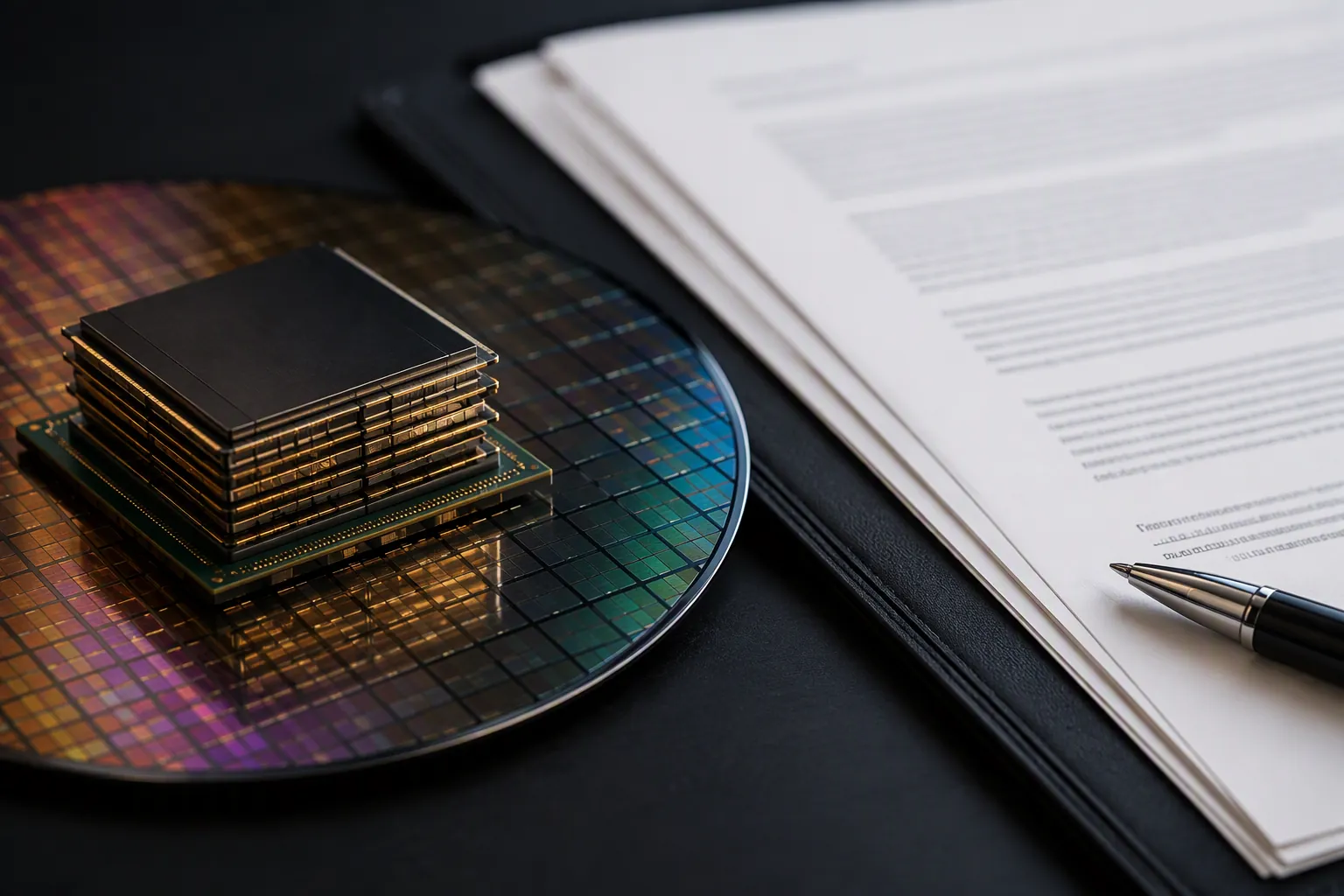
The market shock matters because it points to capacity
Speculative debut trading is not the same thing as durable manufacturing power. A first-day surge can overstate what a company can actually ship, and it can say more about retail momentum than about usable supply. But the CXMT reaction was not built only on a stock chart. SemiAnalysis reported that CXMT raised about $4.4 billion, had roughly 257,000 wafers per month of DRAM capacity, equal to about 15% of global capacity, and was targeting 300,000 wafers per month by the end of 2026.[3]
Those figures matter to legal AI buyers because DRAM scale is the base from which more specialized memory ambitions become credible. HBM is not just another component sitting somewhere inside the data center. It is the memory format that lets advanced AI accelerators feed data fast enough to make large model training and high-throughput inference commercially useful. When that input is scarce, the scarcity travels downstream: hardware procurement gets tighter, cloud capacity becomes more expensive or less predictable, and vendors begin making allocation decisions that customers may not see until service levels change.
CXMT is still behind Korean leaders. AI Frontiers described the company as manufacturing HBM2-equivalent products, technology associated with Korea’s 2016 generation, while attempting to skip forward toward HBM3; the same analysis said the gap with SK Hynix and Samsung had narrowed from more than five years to roughly three years.[4] That is not parity. It is enough, however, to change the diligence posture from “remote industrial policy story” to “ask the vendor how the hardware stack is sourced.”
HBM turns memory competition into AI infrastructure risk
The dependency chain is short. Memory production becomes HBM supply. HBM supply becomes GPU availability. GPU availability becomes the price, latency, and reliability of the AI services a law firm uses for document review, drafting, research, contract analysis, or internal knowledge search. If that chain is interrupted, the lawyer does not receive a memo saying “HBM allocation changed.” The lawyer sees slower queues, narrower model access, higher usage pricing, or a vendor explaining that a promised deployment window has moved.
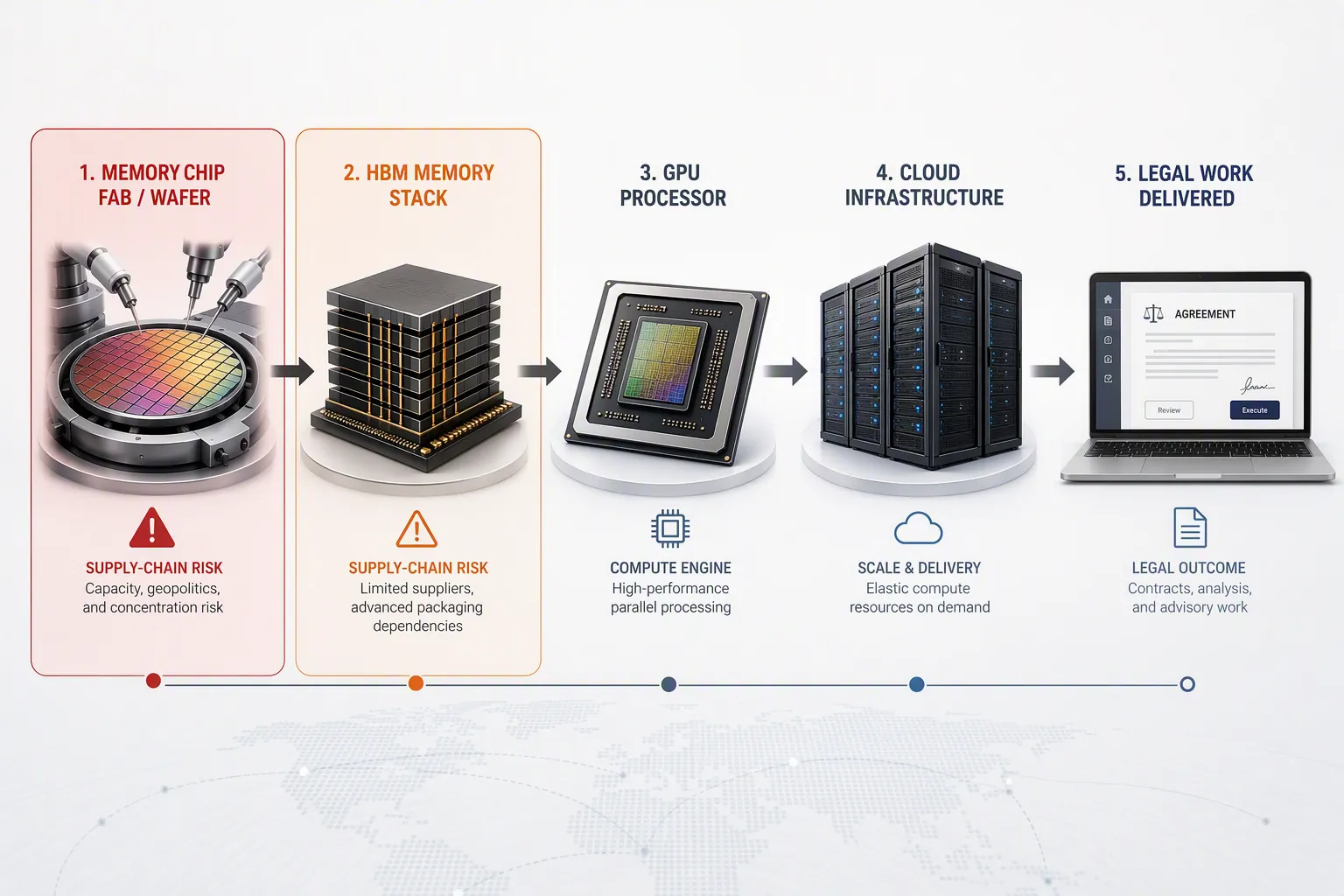
This is the same class of infrastructure exposure that legal AI buyers have already seen in other forms. The site’s prior analysis of CoreWeave’s stock drop and legal AI infrastructure risk and IREN’s stock decline and AI data center investment treated market volatility as a warning signal, not because stock moves decide professional responsibility, but because data-center financing and hardware availability now sit inside the legal AI service promise. Memory supply belongs in that same map.
The reason HBM deserves special attention is that advanced AI accelerators consume it in stacks, not in an abstract commodity bucket. The available record supports a practical, not dramatic, conclusion: Blackwell- and Hopper-class GPUs depend on multiple HBM3E stacks, with the estimate at six to eight stacks per GPU. When controls, shortages, or allocation choices affect those stacks, they affect the accelerators that legal AI vendors rent, reserve, or resell.
Controls have already changed behavior around HBM
Export controls do not need to produce a courtroom scandal before they become relevant to procurement. They can change who can ship, who can receive, which intermediary matters, and what documentation a vendor should be able to produce. SemiAnalysis reported that 13 million HBM stacks reached China, including 7 million during the one-month gap between the announcement and enforcement of December 2024 controls; the same reporting attributed 11.4 million stacks to Samsung shipments.[3] Those figures come from a paid-subscriber analysis whose methodology is not fully visible in the public record, so they should be treated with care. Even with that caveat, they show the kind of timing and routing behavior that appears when a critical AI input is about to become more restricted.
The June 1, 2026 BIS guidance sharpened the issue. Al Jazeera reported that U.S. licensing requirements for AI chip shipments apply to PRC-headquartered companies even when shipments go to facilities outside China.[5] That matters for legal AI because the risk question is no longer confined to whether a data center sits physically inside China. A vendor’s cloud provider, hardware lessor, manufacturing affiliate, or overseas facility can become relevant if PRC-headquartered entities sit in the transaction chain.
That does not make every tool with an Asian hardware supplier suspect. It does mean a law firm cannot stop at “our vendor uses a major cloud provider” and call the infrastructure question answered. The relevant inquiry is more exact: whose accelerators, which memory, which facility, which contracting entity, which license position, and which contingency if the route changes.
CXMT is not SK Hynix, but it is no longer dismissible
SK Hynix and Samsung remain the incumbents to beat in advanced HBM. The legal buyer’s question, though, is not whether China overtakes Korea on a neat timeline. It is whether Chinese-origin memory is becoming plausible enough to enter AI hardware supply chains, reroute demand, trigger export-control analysis, or intensify shortages elsewhere.
On that narrower question, the facts have moved. CXMT’s reported DRAM scale, its 300,000 wafer-per-month target, its HBM2-equivalent manufacturing, and its attempt to move toward HBM3 all point in the same direction: a competitor once easy to place outside the immediate AI infrastructure conversation is now close enough to affect the conversation.[3][4] SemiAnalysis has also estimated that CXMT can produce about 2 million HBM stacks in 2026, enough for roughly 250,000 to 300,000 Ascend 910C AI accelerators.[3]
There are other stress signals around memory, but they should stay in proportion. Blocks & Files reported a U.S. class-action lawsuit in the Northern District of California alleging that Korean memory makers colluded to limit output and raise prices, with DRAM prices up about 700% since 2022.[6] That lawsuit is not proof of liability, and it is not an AI procurement rule. It does show that memory markets are already economically and legally strained before a law firm even gets to the newer question of Chinese HBM capacity.
A separate Reuters report in late June 2026 said Apple had lobbied the Trump administration to allow Chinese memory in some products.[7] For legal AI buyers, the prudent reading is modest: Chinese memory may be approaching forms of Western hardware qualification in some contexts. That is not evidence that a legal AI platform is already running on CXMT-supplied HBM.
The diligence questions should be specific enough to answer
A useful AI vendor questionnaire should not ask a vendor to predict the future of Chinese semiconductor policy. It should ask for facts the vendor either knows or should be able to obtain from its cloud, data-center, or hardware providers. This is where a semiconductor issue becomes a professional-duty issue: not because the Rules of Professional Conduct mention HBM, but because a firm that depends on an AI workflow needs a supervised, documented basis for believing the workflow is reliable, compliant, and resilient.
The existing ABA Model Rules-mapped AI vendor due diligence checklist for law firms should now include hardware-provenance questions for vendors whose products rely on model training, hosted inference, private deployments, or reserved GPU capacity.
| Diligence area | Question to ask the AI vendor | Why it matters |
|---|---|---|
| Training and inference hardware | Identify the GPU classes used for training, fine-tuning, retrieval, and customer inference, and state whether any capacity uses Chinese-origin HBM or DRAM. | The risk may differ between model training, hosted inference, and private customer deployments. |
| Cloud and hardware chain | Name the cloud, data-center, hardware leasing, and accelerator providers involved in production service delivery. | A firm cannot assess export-control or continuity exposure if the vendor treats infrastructure as an unnamed black box. |
| PRC-headquartered entities | Disclose whether any PRC-headquartered company, including an overseas facility or affiliate, participates in the shipment, hosting, leasing, or operation of AI accelerators. | The June 2026 BIS guidance makes entity location and headquarters status relevant beyond mainland China. |
| Provenance documentation | Provide available documentation for GPU and memory provenance, including supplier attestations, cloud-provider statements, or contractual commitments. | A signed renewal should not rest on an oral assurance that the vendor is “not exposed.” |
| Licensing position | State whether the vendor or its providers rely on export licenses, license exceptions, geofencing, contractual restrictions, or customer-use restrictions for AI hardware access. | Licensing assumptions can affect where workloads may run and whether capacity can be reassigned. |
| Capacity contingency | Explain what happens to latency, model availability, pricing, and customer priority if HBM-equipped GPU supply is constrained. | A compliance-safe vendor can still create operational risk if it has no credible capacity fallback. |
The answers do not need to be perfect on the first pass. Many legal AI vendors buy capacity through layers of providers. That is precisely why the question should be asked before renewal, deployment, or a major matter depends on the tool. If the vendor cannot answer, the next step is not necessarily rejection; it is contractual follow-up, service-level protection, and an escalation path for changes in hardware sourcing or export-control status.
What a satisfactory answer looks like
A mature vendor should be able to distinguish between customer data location, model hosting location, accelerator ownership, and component provenance. “We host in the United States” answers only one part of the problem. A better answer identifies the production cloud region, the accelerator family, whether capacity is reserved or spot-based, whether subcontractors can substitute equivalent hardware, and how the vendor monitors changes in export-control obligations.
For private deployments or sensitive litigation workflows, the firm may also need a notice obligation. If the vendor changes cloud providers, moves workloads to a different accelerator pool, relies on a new hardware lessor, or becomes unable to document memory provenance for a dedicated environment, the firm should not learn that only after a performance incident or a client audit.
Where the risk stops, for now
There is an important limiting point. The current record does not support telling law firms that using a mainstream legal AI tool creates an ethics violation merely because Chinese memory capacity is rising. The available materials do not identify a court sanction, privilege waiver, bar opinion, or client-confidentiality finding based on semiconductor provenance. Any claim stronger than forward-looking supply-chain and sanctions-risk assessment would outrun the evidence.
Nor does CXMT’s IPO prove that Chinese HBM is about to displace SK Hynix or Samsung in the most advanced AI accelerators. The first-day valuation may be frothy. CXMT’s HBM capability remains behind the leaders. SK Hynix’s Q3 2026 earnings, expected on July 29, 2026, could also affect the market’s near-term reading of memory supply and demand. Those caveats matter because procurement diligence works best when it separates what is known, what is likely, and what is merely dramatic.
Still, the practical threshold has been crossed. CXMT’s scale, the reported narrowing of the HBM gap, the dependence of advanced GPUs on multiple HBM3E stacks, the history of HBM timing behavior around controls, and the June 2026 BIS position on PRC-headquartered firms make semiconductor provenance a material AI vendor diligence topic. The instruction to the procurement team is not “avoid China” or “panic about SK Hynix.” It is simpler and more defensible: ask the provenance, licensing, capacity, and contingency questions before the firm’s AI workflow depends on an answer it never obtained.
References
- Asian chip stocks slide as China competition fears rattle AI trade, Reuters, July 28, 2026
- AI Memory Stocks on Rocky Ground: 3 Reasons SK Hynix Fell 13%, Yahoo Finance, July 28, 2026
- Huawei Ascend Production Ramp: Die Banks, TSMC Continued Production, HBM is The Bottleneck, SemiAnalysis
- High-Bandwidth Memory: The Critical Gaps in US Export Controls, AI Frontiers, February 2026
- US says ban on AI chip shipments applies to Chinese firms outside China, Al Jazeera, June 1, 2026
- Samsung and SK Hynix spending big on chip fabs, Blocks & Files, July 6, 2026
- Apple lobbying coverage, Reuters, June 27, 2026
Related records
Tool profile
How Meta's AI Spending Reshapes Law Firm ProfitabilityGoverning regulation
Browse the obligations tracker →Preventive workflow
Browse verification workflows →
Report a correction or tip
Spotted an outdated figure, a misstated fact, or a ruling this case record should reflect? Public comments are disabled for this content given the professional cost of a misreported case outcome, penalty amount, or rule text — use the structured correction channel instead.
Report a correction or tip for this record →