
How Circle K v. Gawlitza Redefines Lottery Ticket Ownership Risk
The ongoing $12.8 million dispute in Circle K v. Gawlitza tests whether an employee commits conversion by purchasing an unsold winning lottery ticket after a customer refused it, with the Arizona Administrative Code and persuasive Pennsylvania precedent supporting the retailer's ownership claim.
- Jurisdiction
- Arizona
- Court
- Maricopa County Superior Court
- Judge
- Joseph Kreamer
- AI tool named
- No AI tool
- Ruling date
- Jul 27, 2026
- Source document
- View primary court order ↗
- Last verified
- Jul 27, 2026
Lex Machina Review is an independent risk-tracking and reference resource. Nothing on this site is legal advice, and using it does not create an attorney-client relationship. Every record is reviewed against primary sources but may not reflect the most current status of a matter — always verify directly against the cited court order, rule text, or a licensed attorney before relying on it.
Companion explanation — secondary to the source document above
This Risk Digest case profile addresses an ongoing lottery-ticket ownership dispute, not legal advice. Circle K v. Gawlitza is pending in Maricopa County Superior Court as CV2026-007273 before Judge Joseph Kreamer; the current account is based on media reports and filings summarized in those reports, not on a primary court order reviewed directly. The available materials do not present an AI-tool, AI-evidence, or AI-hallucination issue. The operational risk is narrower and more ordinary: if Arizona treats an unpaid, refused, terminal-printed lottery ticket as retailer property, an employee who buys it after discovering it is a winner may face a conversion claim, not just an internal discipline problem. [1]
The ownership problem starts before the jackpot
The useful question is not who eventually stood closest to the winning ticket. It is when title or the right to possession moved, if it moved at all. A lottery terminal printed tickets. A customer paid for only part of what had been ordered. The remaining printed tickets stayed in the store. One of those tickets later appeared to be worth $12.8 million. Those facts make the dispute look unusual, but the risk category is familiar: inventory in a retail location, employee access to that inventory, and a later transaction that may or may not have been authorized.
The jackpot amount adds pressure but does not change the legal hinge. The prize has been reported as $12.8 million, the fourth-largest prize in The Pick history and the largest Arizona lottery jackpot since 2019. Circle K also had an independent financial stake because Arizona lottery retailers reportedly receive a 6.5% commission on jackpot-winning tickets sold at their locations. [1]

The Nov. 24–25 sequence matters more than the prize figure
The reported timeline is doing most of the work in Circle K’s theory. On Nov. 24, 2025, a customer identified in reports as Kim ordered $85 in lottery tickets at a Circle K store, paid $60, and left the remaining $25 in tickets unpaid. The account matters because the unpaid tickets were not inventory that had never come into existence. They had been printed by the lottery terminal and were physically present in the store after the customer left. [1]
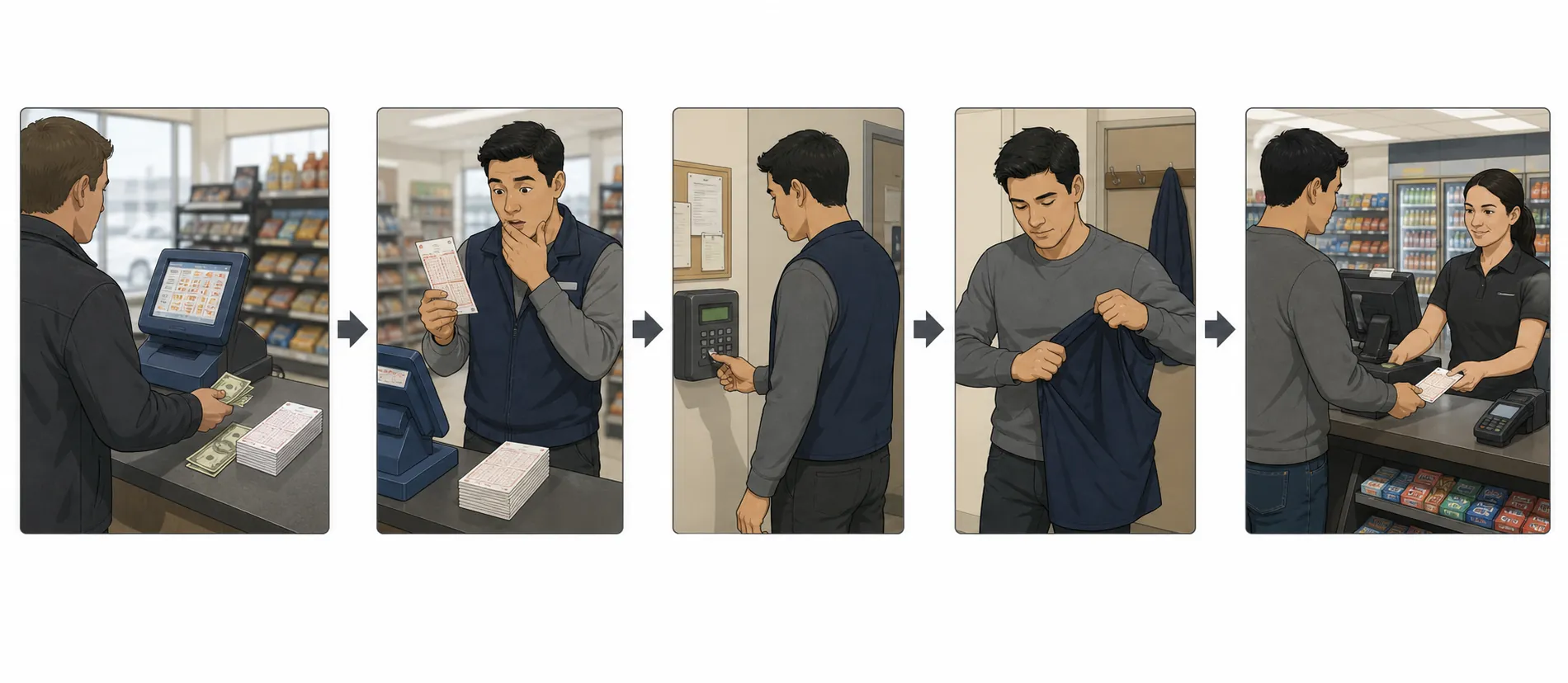
The next day, Nov. 25, 2025, store manager Robert Gawlitza allegedly identified one of the remaining tickets as a winner. He then clocked out, removed his uniform, and bought the ticket for $10 from cashier Ybarra. Those steps are not decorative details. Clocking out and removing the uniform may show an attempt to separate the purchase from his managerial role; they also make the knowledge sequence sharper. By the time the purchase occurred, the employee allegedly knew what the ordinary buyer would not have known at the moment of sale. [1]
| Moment | Reported act | Why it matters legally |
|---|---|---|
| Nov. 24, 2025 | Customer Kim orders $85 in lottery tickets, pays $60, and leaves the remaining $25 in tickets unpaid. | The ticket was printed but not paid for by the ordering customer. |
| After Kim leaves | The remaining printed tickets stay at the Circle K store. | Possession remains with the retailer, and the tickets do not simply vanish from the property chain. |
| Nov. 25, 2025 | Gawlitza identifies one of the remaining tickets as a winner. | Knowledge of value allegedly precedes the employee purchase. |
| After identifying the ticket | Gawlitza clocks out and removes his uniform. | The role change may become relevant to authority, employee duty, and whether the transaction was a genuine retail purchase. |
| After clocking out | Gawlitza buys the ticket for $10 from cashier Ybarra. | The transaction is the act Circle K can characterize as unauthorized dominion over retailer property. |
For a retailer, the uncomfortable lesson is that the critical control point arrives before any prize claim is made. Once the terminal prints a ticket and a customer refuses or fails to pay, the store needs a rule for who may hold it, where it is stored, how it is logged, whether employees may buy it, and whether anyone must check its status before disposition. Without those steps, the later dispute becomes a reconstruction exercise built from register activity, employee conduct, and witness accounts.
Arizona’s regulatory frame gives Circle K its cleanest ownership argument
Circle K’s strongest current position comes from the treatment of unsold or refused draw-game tickets under the Arizona Administrative Code. As summarized in the available materials, that regulatory framework treats unsold or refused draw-game tickets as retailer property. If that rule controls the disputed ticket, the customer’s partial payment does not transfer ownership of the unpaid ticket, and the employee’s later purchase has to be tested against Circle K’s property right rather than treated as a normal consumer transaction. [2]
That is why the exact status of the ticket after Kim left matters. If the ticket was part of the unpaid $25, and if Arizona’s rule treats refused or unsold draw-game tickets as retailer property, the store did not merely have custody of a stray item. It had an ownership claim to a printed lottery instrument that could not be appropriated by an employee simply because the original customer declined to pay for it.
The harder question is whether “unsold” fits cleanly when a customer ordered a batch, paid for part, and left the rest behind. The materials support a strong retailer argument, but they do not support pretending Arizona appellate law has already answered every version of this fact pattern. The point for counsel is to keep the regulatory category visible: refused or unpaid terminal-printed tickets should not be handled as casual waste, employee perks, or ownerless paper.
Acme Markets is persuasive, not binding, but it is the closest legal lens
The useful comparison is Acme Markets v. Seltzer, a Pennsylvania Superior Court decision discussed in a Marshall Dennehey analysis. It is not Arizona precedent and does not bind Judge Kreamer. Its value is analogical: it addressed terminal-printed lottery tickets, retailer ownership, mistake or unsold tickets, and an employee purchase after the relevant ticket was already in the retailer’s possession. [3]
In Acme Markets, the court reasoned that the retailer owned terminal-printed tickets “as soon as it is printed, unless and until it is resold to a customer.” The analysis also emphasized that the ticket was not abandoned where mistake tickets were kept in a known location, and that the employee’s later purchase could constitute conversion. [3]
That reasoning maps onto Circle K’s case in a limited but important way. It does not prove Arizona will adopt Pennsylvania’s approach. It does, however, offer a structured answer to the inventory question: a printed ticket can belong to the retailer before resale, and an employee cannot cure an unauthorized taking merely by ringing up a purchase after learning the ticket is valuable.
The analogy is strongest if Arizona’s regulatory language is materially similar in practical effect to the rule applied in Acme Markets. It is weaker if the court treats Kim’s order as creating a different relationship to the unpaid tickets or finds that Circle K’s own workplace practices altered the ordinary ownership analysis. That is the right use of Acme: not as a prediction machine, but as a way to ask which fact controls the transfer of ownership.
What would make the purchase conversion rather than a permitted sale
Circle K’s conversion theory depends on a property chain that never left the retailer. The chain would look like this: the lottery terminal printed the ticket; the customer did not pay for that ticket; Arizona’s rules left unsold or refused tickets as retailer property; Gawlitza learned the ticket was a winner; and only then did he clock out, remove his uniform, and buy it for $10 through another cashier. If those facts are accepted in that order, the sale form does not necessarily defeat the conversion theory.
The cashier’s participation also does not end the inquiry. Ybarra’s act of selling the ticket may show that a register transaction occurred, but the legal question is whether the store had authorized that disposition of its own property under those conditions. Retailers sell lottery tickets every day; that does not mean every employee-directed sale of unsold inventory after discovery of a winning status is authorized.
The timing makes the alleged conduct especially exposed. Buying an unsold ticket before anyone knows its outcome presents one kind of policy issue. Buying it after identifying it as a winner presents another. The second scenario gives the retailer a much cleaner argument that the employee used access and information obtained through the job to exercise dominion over property the store still owned.
The procedural pressure is already visible
Circle K filed for declaratory judgment rather than waiting for the Arizona Lottery claim process to resolve every competing story. That choice fits the practical problem: if several people assert ownership over a single ticket, someone must preserve the claim window and identify who has the superior right before the prize is paid. Reports describe a temporary restraining order extending the 180-day claim deadline. [4]
The deadline issue is not housekeeping. Lottery prizes are built around claim windows, and ownership litigation can easily consume the time needed to present the ticket. Extending the deadline keeps the disputed asset from expiring while the court sorts out who, if anyone, may claim it. That is an immediate procedural consequence of the ownership question.
Reports also identify three competing ownership claims and an order requiring Bank of America to produce customer identifying information. Those developments show why the case cannot be reduced to Circle K versus one employee. The original customer’s identity and conduct matter because the unpaid-ticket sequence began with Kim’s order, partial payment, and departure. [5]
Gawlitza’s reported whereabouts add another procedural complication. Phoenix New Times reported that Circle K did not know his current whereabouts as of May 2026. That does not answer the property question, but it affects service, participation, leverage, and the court’s ability to manage a live dispute over a time-sensitive prize. [5]
The facts that keep this from being an automatic retailer win
Circle K has the cleaner regulatory theory, but the record described in current reporting is not one-sided. Gawlitza has reportedly produced six employee affidavits alleging an unofficial policy that required employees to buy unsold tickets over $20. If credited, that evidence could support an implied-contract or workplace-practice defense: the employee may argue that buying unsold tickets was not a rogue taking but a store-sanctioned way to handle inventory the retailer did not want to carry. [1]
That defense has limits. A general practice of making employees buy unsold tickets would not automatically authorize a manager to inspect a ticket, learn it was a jackpot winner, clock out, remove a uniform, and buy it for a fraction of its known value. But the affidavits matter because they contest the premise that employee purchase of unsold tickets was inherently unauthorized. They turn a simple theft-like narrative into a dispute about actual store practice.
The customer abandonment issue is also unresolved. Kim ordered tickets, paid for only part of them, and left the rest unpaid. Circle K can argue that nonpayment left those tickets as retailer property. Another claimant may argue that the customer’s conduct, or the store’s handling of the tickets after the customer left, complicates the chain. The available materials do not identify a clear Arizona precedent deciding that precise fact pattern.
Acme Markets helps Circle K here because it rejected abandonment where the disputed tickets were kept in a known location rather than discarded. But that was a Pennsylvania case, under Pennsylvania law, on its own facts. An Arizona court may still ask whether Kim’s nonpayment, the store’s procedures, and any employee-purchase practice changed what “unsold” or “refused” means in this setting. [3]
The retail-control lesson
For retailers that sell state lottery tickets, the compliance issue is not limited to jackpot tickets. The same weak point exists whenever a terminal prints tickets that a customer refuses, cannot pay for, or leaves behind. If the store does not define who owns those tickets, who may buy them, when they may be voided or retained, and whether employees may check them, the policy will be written later by litigators from security footage, register records, and affidavits.
A sound policy would treat refused or unpaid terminal-printed tickets as controlled inventory unless state rules say otherwise. It would require a log, manager review by someone without a personal claim to the ticket, segregation from saleable customer inventory, and a clear bar on employee purchase after the ticket’s status is known. Those controls do not decide Circle K v. Gawlitza, but they address the operational hinge that made the dispute possible.
On the current record, the stronger argument is that the unpaid ticket remained Circle K’s property under the Arizona regulatory framework and that Gawlitza’s after-hours purchase after allegedly identifying the win creates serious conversion exposure. The six employee affidavits and the unsettled abandonment question keep the case from being a guaranteed retailer win. They do not make the risk smaller for retail counsel; they show why the risk has to be controlled before a winning number is known.
References
- El País English edition coverage of Circle K v. Gawlitza, El País English, July 23, 2026
- Arizona Administrative Code provisions governing unsold or refused draw-game tickets
- Marshall Dennehey analysis of Acme Markets v. Seltzer, Marshall Dennehey
- New York Post coverage of Circle K v. Gawlitza, New York Post, June 26, 2026
- Phoenix New Times coverage of Circle K v. Gawlitza, Phoenix New Times
Related records
Tool profile
How Meta's AI Spending Reshapes Law Firm ProfitabilityGoverning regulation
Browse the obligations tracker →Preventive workflow
Browse verification workflows →
Report a correction or tip
Spotted an outdated figure, a misstated fact, or a ruling this case record should reflect? Public comments are disabled for this content given the professional cost of a misreported case outcome, penalty amount, or rule text — use the structured correction channel instead.
Report a correction or tip for this record →