
Boasberg: Trump visa policy likely violates free speech
A primary-source-documented record of CITR v. Rubio (1:26-cv-00815-JEB), detailing the challenged visa policy, Judge Boasberg's viewpoint-discrimination analysis, chilling-effect findings, and the July 14, 2026 stay—so practitioners can assess exposure for noncitizen researchers.
- Jurisdiction
- US Federal
- Court
- U.S. District Court for the District of Columbia
- Judge
- James E. Boasberg
- AI tool named
- None
- Ruling date
- Jul 14, 2026
- Source document
- View primary court order ↗
- Last verified
- Jul 25, 2026
Lex Machina Review is an independent risk-tracking and reference resource. Nothing on this site is legal advice, and using it does not create an attorney-client relationship. Every record is reviewed against primary sources but may not reflect the most current status of a matter — always verify directly against the cited court order, rule text, or a licensed attorney before relying on it.
Companion explanation — secondary to the source document above
The current status is narrower than the political shorthand around the James Boasberg Trump visa ruling on free speech. In Coalition for Independent Technology Research v. Rubio, No. 1:26-cv-00815-JEB, the U.S. District Court for the District of Columbia entered an interim stay under APA § 705 on July 14, 2026, freezing a State Department visa policy directed at certain noncitizen technology researchers and related advocates.[1] The order found that the plaintiffs were likely to succeed on a First Amendment viewpoint-discrimination theory, but it did not finally invalidate the policy.[1]
That distinction matters operationally. The challenged policy is presently stayed; the court’s analysis is strong enough to create an immediate risk signal for agencies, universities, research coalitions, and counsel advising noncitizen researchers; and the posture remains provisional because later proceedings or an appeal could change the result. The Knight First Amendment Institute’s case page remains the practical docket checkpoint for filings after the July 14 order.[2]

Status Card
| Item | Current Record |
|---|---|
| Case | Coalition for Independent Technology Research v. Rubio, No. 1:26-cv-00815-JEB |
| Court | U.S. District Court for the District of Columbia |
| Judge | Chief Judge James E. Boasberg |
| Filed | March 9, 2026 |
| Order | July 14, 2026 stay under APA § 705 |
| Immediate effect | The challenged State Department visa policy is frozen while the case proceeds |
| Merits status | Likely unconstitutional viewpoint discrimination found at the interim stage; no final judgment |
The parties are also part of the risk map. The plaintiffs are the Coalition for Independent Technology Research and affected technology-research interests represented by the Knight First Amendment Institute and Protect Democracy; the defendants listed in the case materials include Marco Rubio, Markwayne Mullin, and Todd Blanche.[2] Independent legal-news accounts from Bloomberg Law and Courthouse News Service both reported the July 14 stay and the court’s treatment of the policy as likely viewpoint discrimination.[3][4]
The available primary order is a 58-page PDF. Because direct PDF page-pinpoint extraction is not available, this record does not present page-specific quotations. It relies on the order as the primary source and uses the Knight docket plus independent reporting to verify the procedural posture, named actions, and core reasoning.[1][2][3][4]
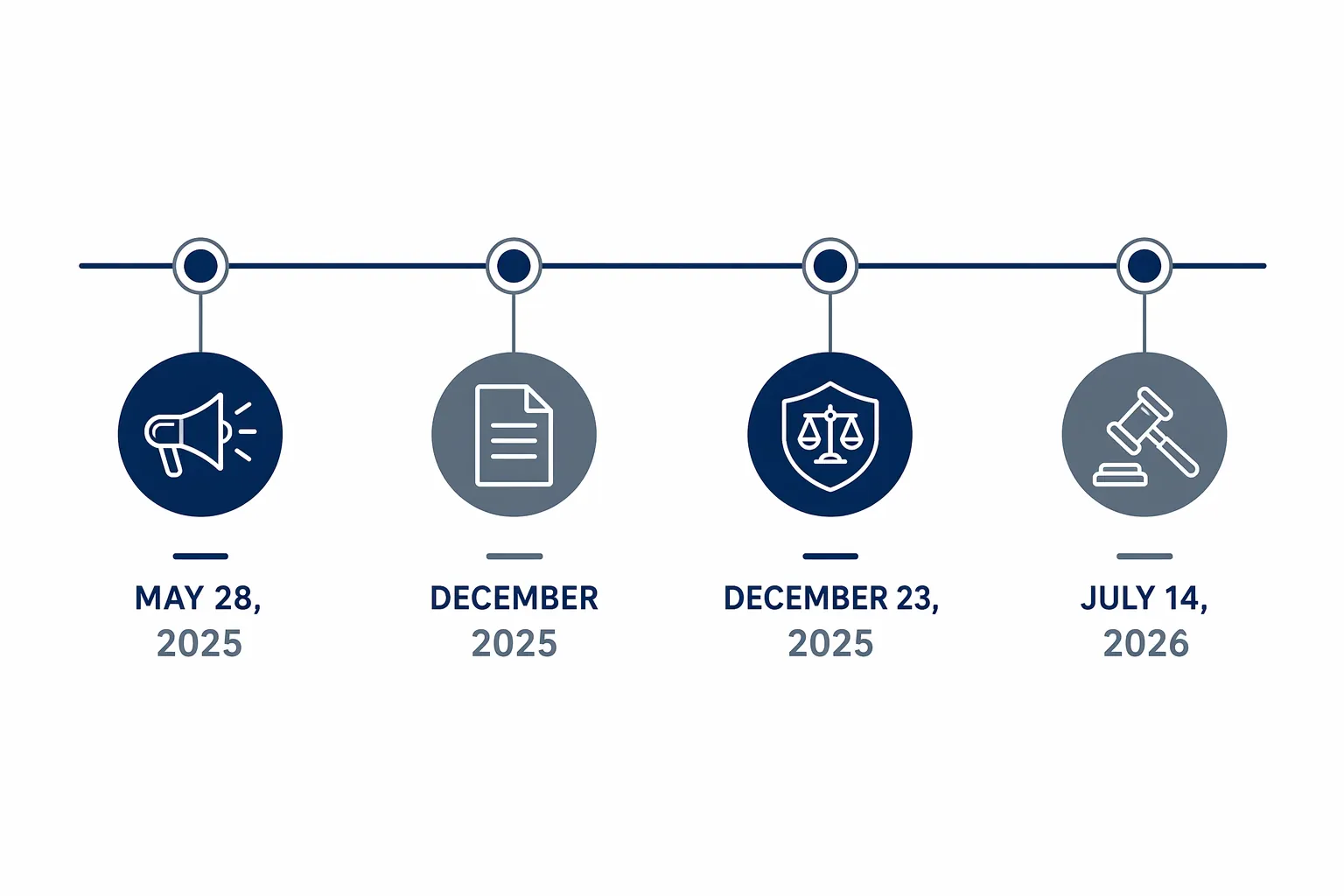
How the Visa Policy Became a First Amendment Case
The useful chronology begins before the complaint. On May 28, 2025, Secretary of State Marco Rubio announced visa restrictions directed at foreign officials accused of censoring Americans. That announcement framed the policy as a response to foreign pressure over online speech, but the later record did not stop at officials or formal censorship regimes.[1]
By December 2025, an internal State Department memo had expanded scrutiny to H-1B applicants working in fact-checking, content moderation, and trust-and-safety roles. NPR reported on that memo before the litigation reached the July order, describing the administration’s move toward visa consequences for people associated with online-speech governance work.[5] This is the step that changes the exposure analysis: the policy moved from a public announcement about foreign officials into a screening mechanism touching researchers and professionals whose work can be characterized by their position in a contested speech debate.
On December 23, 2025, the policy was enforced against five named Europeans: Imran Ahmed of the Center for Countering Digital Hate, Clare Melford of the Global Disinformation Index, Thierry Breton, a former European commissioner, and Josephine Ballon and Anna-Lena von Hodenberg of HateAid.[1][4] The named-enforcement record matters because the case is not built only on a feared policy in the abstract. The government had identified real people associated with advocacy, research, or regulatory work favoring stronger platform accountability or moderation.
The complaint followed on March 9, 2026. CITR described the policy as government retaliation against disinformation and online-safety researchers and said it chilled research and advocacy activity.[6] That is a plaintiff-side characterization, not a judicial holding, but it supplied the litigation theory that Boasberg later tested against the administrative sequence and declarations.
The Viewpoint-Discrimination Theory
Boasberg’s July 14 order treated the policy as likely unconstitutional because it put an “enforcement thumb on one side of the scale” in the public debate over content moderation.[1] That phrase is the operative point. The concern was not merely that immigration authority affects speech, or that technology research is politically contentious. The court’s analysis focused on the government favoring one side of a live debate: speakers who oppose moderation were not treated the same way as speakers who support more moderation, fact-checking, or trust-and-safety intervention.[1][3]
Courthouse News reported that the order opened from the premise that the “town square moved online,” then examined the government’s use of visa authority against people working in that online-speech environment.[4] The line is rhetorically memorable, but the legal pressure comes from selection. If the government’s visa scrutiny turns on whether a researcher’s work favors one side of a policy debate, the immigration label does not eliminate the First Amendment problem.
That does not make the order a population-wide rule for every noncitizen researcher or every visa category. The court addressed the challenged State Department policy and the record before it. Counsel should be careful not to convert a likely-success finding at the stay stage into a final merits rule, or to describe the case as invalidating all government attention to foreign influence, platform regulation, or immigration screening.
The Chilling-Effect Record Did Real Work
The declarations are the part of the record that changes advice given in a hallway. The order credited evidence that CITR members and associated researchers withdrew from conferences, avoided travel, shifted research topics, and stepped back from coalition affiliation because they feared visa denial or denial of reentry.[1] Those are not abstract ideological injuries; they are changes in professional conduct by people who need border crossings, institutional sponsorship, and predictable reentry to do their work.
There is no verified statistic in the available materials for how many noncitizen researchers are affected. The record is qualitative. That makes it less useful for estimating population-wide probability and more useful for identifying the kind of conduct that creates practical exposure: accepting a conference invitation, joining a research coalition, appearing on a public panel, coauthoring a trust-and-safety paper, or traveling after work has been publicly associated with moderation advocacy.
Amicus filings described the same operational concern from outside the named plaintiffs. TechPolicy.Press reported on May 12, 2026 that amicus briefs argued the immigration policy chilled researchers’ speech and participation in online-safety work.[7] Those briefs do not prove the merits by themselves, but they show why the case moved beyond the five named Europeans: institutions were warning that the policy was already influencing research behavior before final judgment.
For a university, research nonprofit, or law firm, that is the practical litigation-risk takeaway. The interim remedy matters because the conduct being chilled is often time-sensitive. A withdrawn conference presentation cannot be fully restored months later; a researcher who avoids a topic for a grant cycle may not recover the same collaboration; a noncitizen employee who declines travel may protect status while losing professional visibility.
Named Enforcement Without Overreading the Names
The December 23 enforcement actions identify the clearest concrete targets in the record: Imran Ahmed, Clare Melford, Thierry Breton, Josephine Ballon, and Anna-Lena von Hodenberg.[1][4] Their organizations and public roles help explain why the policy was understood as directed at the pro-moderation side of the debate. But the legal relevance is not that each person’s biography proves a separate constitutional violation. The relevance is that the government’s enforcement choices lined up with one viewpoint in the moderation controversy.
The Global Disinformation Index later described the July 14 order as a milestone for free speech, reflecting the view of an organization connected to one of the named individuals.[8] That statement is useful for source transparency and affected-party context. It should not be mistaken for independent verification of the order’s scope; the operative legal source remains the court order, checked against the docket and independent reporting.
What the Stay Does Not Decide
An APA § 705 stay preserves the status quo while judicial review proceeds. Here, that means the challenged policy is frozen, not erased from legal history. The government may seek appellate relief, and later merits proceedings could alter the injunction, narrow it, or revive some version of the policy.[1][2]
- The order does not create a verified estimate of how many researchers face visa risk.
- The order does not resolve every First Amendment question involving noncitizens and immigration screening.
- The order does not address all Trump administration immigration policies.
- The order does not make every content-moderation dispute a constitutional injury.
- The order does provide a court-tested warning that viewpoint-selective visa consequences can trigger immediate judicial intervention.
Boasberg’s broader visibility in Trump-era immigration litigation may explain why the ruling travels quickly in political coverage. It is not the best way to assess exposure. The safer reading begins with the administrative chain: announcement, memo, named enforcement, declarations of changed conduct, and a stay based on likely viewpoint discrimination.
Exposure Note for Q3 2026
As of Q3 2026, counsel can safely say that the challenged State Department visa policy is stayed by the District Court for the District of Columbia, that Chief Judge Boasberg found the plaintiffs likely to succeed on a viewpoint-discrimination theory, and that the court credited concrete chilling effects on conferences, travel, research topics, and coalition participation.[1] Counsel should not say that the policy has been finally invalidated or that all noncitizen technology researchers now face, or no longer face, the same level of visa risk.
For active matters, the near-term checklist is simple: confirm whether the person’s work is publicly associated with fact-checking, content moderation, trust-and-safety, platform accountability, or disinformation research; identify any planned international travel; preserve records of canceled or changed professional activity; and monitor the Knight docket for appellate activity or modification of the stay.[2] The shorter Risk Digest entry, Court Halts Travel Ban on Social Media Researchers, remains useful as the earlier news treatment; this record is the longer docket-oriented companion.
References
- Boasberg CITR free speech order, U.S. District Court for the District of Columbia, July 14, 2026
- CITR v. Rubio, Knight First Amendment Institute
- Court Pauses Trump Policy Targeting Visas Over Social Media Work, Bloomberg Law, July 14, 2026
- Judge freezes travel ban on foreign misinformation researchers, Courthouse News Service, July 14, 2026
- Trump content moderation visas censorship, NPR, December 4, 2025
- CITR Challenges Censorship Policy, Coalition for Independent Technology Research, March 9, 2026
- Amicus briefs say Trump immigration policy chills researchers’ speech, TechPolicy.Press, May 12, 2026
- A milestone for GDI free speech, Global Disinformation Index, July 14, 2026
Related records
Tool profile
Browse tool evaluations →Governing regulation
Browse the obligations tracker →Preventive workflow
Browse verification workflows →
Report a correction or tip
Spotted an outdated figure, a misstated fact, or a ruling this case record should reflect? Public comments are disabled for this content given the professional cost of a misreported case outcome, penalty amount, or rule text — use the structured correction channel instead.
Report a correction or tip for this record →