
Claude outages in 2026 create compound ethics and privilege risk
Claude's 2026 reliability record—50+ incidents, two-tier uptime, and an 84% actual uptime claim—creates exposure patterns most law firms have not modeled: a single outage during deadline week can simultaneously trigger privilege waiver under United States v. Heppner, violate ABA Formal Opinion 512 competence requirements, and breach Texas Opinion 705's independent verification mandate.
Lex Machina Review is an independent risk-tracking and reference resource. Nothing on this site is legal advice, and using it does not create an attorney-client relationship. Every record is reviewed against primary sources but may not reflect the most current status of a matter — always verify directly against the cited court order, rule text, or a licensed attorney before relying on it.
Companion explanation — secondary to the source document above
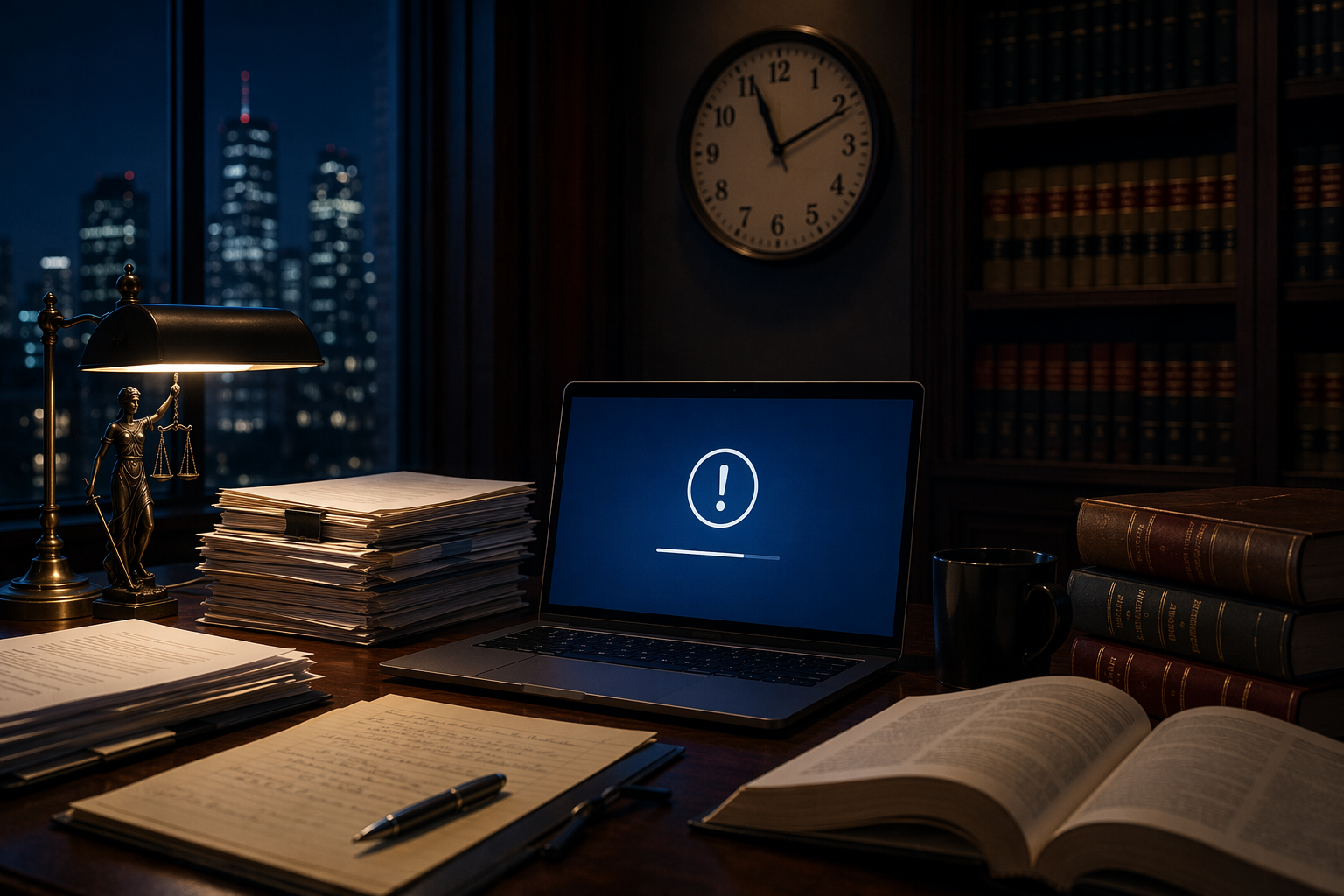
At 11:40 p.m., the approved Claude workflow is not a technology question anymore. The brief is due in the morning. The litigation team has already used Claude to organize deposition excerpts, test a few research paths, and draft a first-pass chronology inside the firm’s approved environment. Then authentication fails, or the service becomes intermittent, or the model simply stops responding. The associate does not have the luxury of studying an incident postmortem. Someone is waiting for a filing-ready answer.
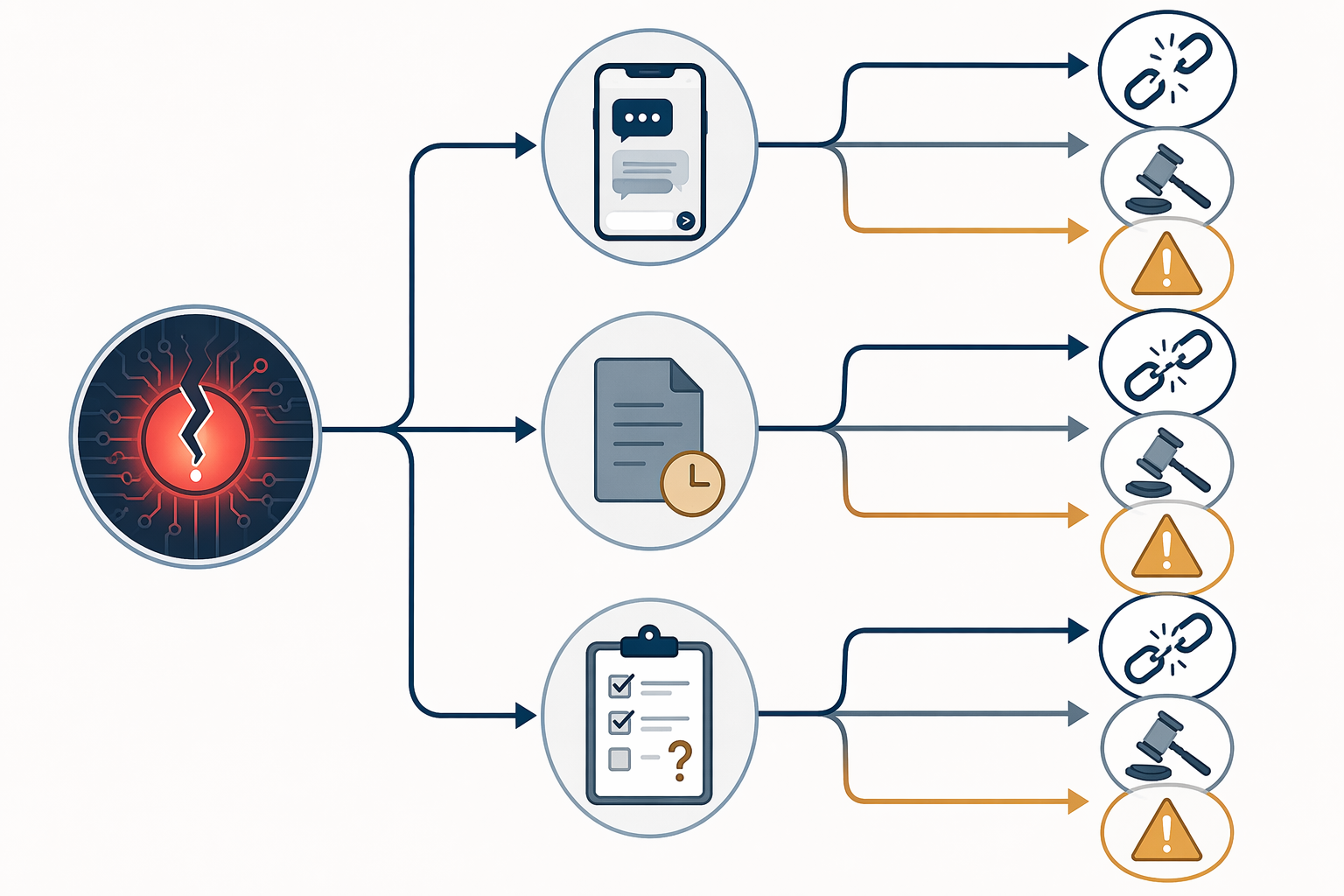
Three workarounds tend to appear quickly. A lawyer opens a consumer-tier chat because the enterprise route is down. Another lawyer relies on cached AI output from earlier in the week because the research trail cannot be rerun. A third compresses verification because the tool outage has eaten the review window. Each move can look practical in the moment. Together, they define the real impact on legal work and law firms: not only lost time, but a chain of privilege, competence, supervision, and verification problems set in motion before anyone has labeled the night an incident.
The Outage Record Is Ordinary Enough To Plan Around
Anthropic’s own status information deserves attention, but not as a talisman. A 99.12% rolling uptime figure for claude.ai over a 90-day window, as reported as of June 23, 2026, still leaves room for the kind of interruption that matters most in legal practice: the one that lands inside a filing, signing, closing, or board-delivery window.[1] Separate incident analysis counted more than 50 Claude status-page incidents in 2026, with 24 classified as major or critical.[2] Those figures do not prove that Claude is unusable for legal work. They do make it hard to treat an outage during deadline week as unforeseeable.
April is the month risk committees should linger over. The reported pattern included eight outages, a 10-hour event on April 6, and a 78-minute authentication failure that generated more than 12,000 Downdetector reports.[3] Authentication failures are especially awkward for law firms because the approved system can be intact in theory while inaccessible in practice. That is exactly when users are tempted to reach for the nearest working version of the same tool, often without pausing over the difference between enterprise controls and consumer terms.
The tier distinction is not cosmetic. Available uptime comparisons show a 90-day gap between Claude for Government at 99.93% and claude.ai at 99.1%, roughly a 19-hour difference over the window.[1] A Forbes report also attributed an approximately 84% actual uptime figure for Claude Max to independent monitoring, in contrast with a claimed 99%; Anthropic did not confirm that third-party figure in the materials reviewed here.[4] Those numbers belong in different evidentiary buckets, but both point toward the same operational question: which version of the tool has the firm approved for privileged work, and what happens when that version is not the one available at midnight?
| Outage Pressure | Likely Workaround | Legal Exposure That Can Follow |
|---|---|---|
| Approved Claude environment unavailable | Lawyer moves to consumer-tier chat | Confidentiality and privilege challenge |
| Research cannot be rerun before filing | Team relies on cached AI output | Competence and supervision challenge |
| Downtime consumes review window | Verification is shortened or skipped | Independent verification and malpractice exposure |
The Consumer-Tier Workaround Is Where Privilege Gets Fragile
United States v. Heppner is not an outage case. It is also not binding nationwide. It is a Southern District of New York decision, and other courts may evaluate AI-assisted legal work differently. Its importance for outage planning is narrower and more useful: it shows how a court may analyze whether communications involving Claude remain privileged when the tool is used outside a carefully controlled, counsel-directed arrangement.
In Heppner, Judge Rakoff’s February 17, 2026 ruling rejected privilege over Claude exchanges on three grounds reported in the available coverage: Claude was not an attorney, consumer terms undermined confidentiality, and the use was not directed by counsel in a way that preserved the legal-advice function. The case later proceeded to a May 7, 2026 conviction on all counts, with Claude exchanges admitted in evidence.[5] The ruling should not be inflated into a universal rule that all AI-assisted work product is unprivileged. But it is a sharp warning about the casual consumer-chat fallback.
The consumer-policy fact matters because outage improvisation often changes terms before it changes substance. Anthropic’s August 2025 consumer policy shift included opt-in data sharing for model training with five-year retention, as referenced in the Heppner materials.[5] If a lawyer pastes privileged facts into a consumer Claude session because the approved enterprise workflow is down, the firm has not merely switched interfaces. It may have switched confidentiality assumptions, retention posture, administrative controls, and the factual record a court later examines.
Heppner’s preserved path is just as important as its adverse holding. The court’s reasoning left room for a Kovel-style arrangement: AI use structured as an aid to counsel, under counsel’s direction, in service of legal advice. That path is narrow because it depends on facts the firm can show later. Who authorized the use? Which environment was used? Were client confidences exposed to terms inconsistent with confidentiality? Was the tool functioning as a counsel-directed assistant, or as an independent destination for client facts?
Outages make those facts messy. A policy that says “use the approved AI platform” is thin protection if the platform is unavailable and no one has written down the fallback rule. In a later privilege dispute, the firm may not get credit for the tool it meant lawyers to use. It may have to defend the tool the lawyer actually used under pressure.
Cached Output Creates A Different Problem
The second workaround is quieter. Nobody pastes new privileged facts into the wrong channel. Instead, the team uses old Claude output because the system is unavailable when someone tries to reconstruct the research. That output may be a draft argument, a case list, a chronology, or a deposition summary. It may even be mostly right. The problem is that the outage has interrupted the ability to test how it was generated, rerun the query sequence, inspect the underlying sources, or reproduce the answer for a supervising lawyer.
ABA Formal Opinion 512, issued in July 2024, frames AI use through familiar duties rather than special AI exceptionalism. Lawyers must understand the benefits and risks of generative AI under Rule 1.1 competence, protect client confidences under Rule 1.6, and supervise AI-assisted work as they would work delegated to a junior lawyer or nonlawyer assistant.[6] Reliability characteristics fit naturally inside that competence inquiry. A lawyer does not need to be a systems engineer, but a firm that builds a deadline workflow around Claude should know whether the workflow remains auditable when Claude is unavailable.
This is where reliability stops being an IT dashboard and becomes a supervision record. If the partner reviewing the brief cannot see whether the AI-generated case discussion was checked against primary authority, the partner is not supervising an AI tool in any meaningful professional sense. If the associate cannot reconstruct which documents were summarized and which were merely inferred, the issue is no longer that Claude went down. The issue is that the firm permitted an unreviewable artifact to become part of client work.
Verification Is The Step Downtime Eats First
The third workaround is often the most defensible-sounding in the room: keep moving, file on time, and clean up what can be cleaned up. In ordinary litigation triage, lawyers make time judgments constantly. But generative AI changes the cost of shaving the wrong hour. The verification step is not clerical polish. It is the part of the workflow that separates a useful AI-assisted draft from an unsupported representation to a court or client.
Texas Ethics Opinion 705 makes that point directly for Texas lawyers by requiring independent verification of AI outputs before they are used in client work.[7] The opinion is jurisdiction-specific, not a national command. Still, it identifies the pressure point other ethics regimes will recognize: a lawyer remains responsible for the work product, even when a machine helped produce it. An outage does not excuse the lawyer from knowing whether a cited case exists, whether a quotation is accurate, or whether a factual summary is supported by the record.
The malpractice theory in a compressed-verification scenario would not have to sound futuristic. Imagine a hypothetical filing in which an AI-assisted section contains an unsupported authority or a mischaracterized record fact. The tool outage consumed the time reserved for checking that section. The team filed anyway. If the error harms the client, the uncomfortable question is not whether Claude is generally reliable. It is whether the lawyers had a reasonable process for preserving verification time when a known workflow dependency failed.
Why The Compound Scenario Is Worse Than Three Separate Risks
A firm can usually manage these risks one at a time. Consumer-tier AI use can be prohibited or technically blocked. Cached output can be labeled and versioned. Verification can be built into checklists and staffing models. The harder scenario is the one that arrives as a single operational event: the approved system goes down, the team moves material through an unapproved channel, cached work product becomes impossible to reconstruct, and the verification window collapses.
That sequence matters because each workaround supplies evidence for a different allegation. The consumer session supports the confidentiality and privilege attack. The unreviewable cached output supports the competence and supervision attack. The shortened verification supports the ethics and malpractice attack. The same outage gives the story coherence: the firm knew Claude was a material part of the workflow, knew outages had occurred with meaningful frequency, and had not prepared a legally safe fallback.
No court has yet decided this exact outage-triggered privilege-waiver or ethics-violation fact pattern based on the materials reviewed here. That limit should stay visible. The point is not that a missed Claude session automatically waives privilege or proves malpractice. The point is that the facts a court or disciplinary authority would ask about are created during the workaround, not during the later investigation.
The June Incidents Underscore The Need For Fallback Architecture
The later 2026 incidents add texture to the planning problem. Reported June events included a June 2 sub-agent infinite-loop bug and a June 12 export-control takedown of Fable 5 and Mythos 5 within 90 minutes.[8] Those incidents are not all the same kind of failure. Some affect access, some affect model behavior, and some affect availability of specific models or features. For legal operations, that distinction is useful because the fallback cannot be one sentence long.
A privilege-sensitive fallback for full outage conditions is different from a fallback for degraded performance, authentication trouble, export-control unavailability, or an unreliable sub-agent. Cross-provider failover may be architecturally sound when one vendor’s pattern is frequent brief incidents and another’s is fewer longer outages, as incident-taxonomy analysis has suggested.[2] But failover only helps if the alternate provider has already been vetted for confidentiality, retention, logging, conflicts with client restrictions, and verification support. Otherwise, failover is just a faster route to the same privilege problem.
What A Sophisticated Firm Should Have Ready Before The Outage
The practical answer is not to ban Claude or pretend AI-assisted legal work will disappear from deadline practice. It is to treat AI business continuity as part of professional responsibility. The plan should be boring, written, and available to the people who will need it when the approved tool fails.
- Define which Claude tier is approved for privileged work, and prohibit fallback to consumer-tier accounts for client confidences unless ethics counsel has approved a specific use case.
- Preserve a counsel-directed AI workflow record: matter authorization, tool version, user, prompt category, source set, output location, and review status.
- Separate outage types in the playbook, because authentication failure, degraded output, model takedown, and total unavailability call for different legal and technical responses.
- Reserve verification time in deadline schedules instead of treating verification as the buffer that disappears when technology fails.
- Pre-approve any alternate AI provider or non-AI workflow for confidentiality terms, retention, auditability, and client-specific restrictions before it is needed.
- Require escalation to a designated ethics or risk lawyer when a team proposes to move privileged material outside the approved environment during an outage.
The most important part of that list is not the vendor name. It is the preservation of judgment under pressure. A firm that has already decided what lawyers may do when Claude is down has a chance to keep the privilege analysis, competence record, and verification process aligned. A firm that leaves the decision to the person closest to the deadline should expect the workaround to become the evidence.
The Risk-Management Conclusion
Claude’s 2026 reliability record does not make Claude categorically unsuitable for law firms. It does justify enterprise-tier deployment analysis, documented AI business continuity procedures, counsel-directed use rules, and protected verification reserves. The danger is not downtime alone. It is the legally significant improvisation downtime induces: the wrong account, the wrong terms, the unreviewable output, and the missing verification step, all created in the same hour and all later described as if they were separate accidents.
References
- Claude Status, Anthropic, https://status.claude.com
- Claude 2026 incident analysis, sanj.dev, https://sanj.dev
- Claude outage analysis, ThousandEyes Blog, https://www.thousandeyes.com/blog
- Claude Max uptime report, Forbes, May 5, 2026, https://www.forbes.com
- United States v. Heppner coverage, The Texas Lawbook, February 17, 2026, https://texaslawbook.net
- Formal Opinion 512, American Bar Association, July 2024, https://www.americanbar.org
- Texas Ethics Opinion 705, Texas Center for Legal Ethics, https://www.legalethicstexas.com
- Claude incident coverage, TechTimes, https://www.techtimes.com
Related records
Tool profile
Browse tool evaluations →Governing regulation
Browse the obligations tracker →Preventive workflow
Browse verification workflows →
Report a correction or tip
Spotted an outdated figure, a misstated fact, or a ruling this case record should reflect? Public comments are disabled for this content given the professional cost of a misreported case outcome, penalty amount, or rule text — use the structured correction channel instead.
Report a correction or tip for this record →