
The Legal Reason Colt Gray's Mother Wasn't Charged
Explains why the Barrow County DA charged Colin Gray but not Marcee Gray in the Apalachee High School shooting, under Georgia's proximate-cause limits on parental liability. Includes the DA's custody, proximity, and firearms calculus, plus the post-offense jail-call conduct that did not meet the charging test.
- Jurisdiction
- Barrow County, Georgia
- Court
- Barrow County Superior Court
- Judge
- Nicholas Primm
- AI tool named
- No AI tool implicated
- Ruling date
- Jul 30, 2026
- Source document
- View primary court order ↗
- Last verified
- Aug 3, 2026
Lex Machina Review is an independent risk-tracking and reference resource. Nothing on this site is legal advice, and using it does not create an attorney-client relationship. Every record is reviewed against primary sources but may not reflect the most current status of a matter — always verify directly against the cited court order, rule text, or a licensed attorney before relying on it.
Companion explanation — secondary to the source document above
The short legal answer is this: Barrow County prosecutors charged Colin Gray because they said they could connect him to the gun, access to the gun, warnings before the shooting, and the mechanism that produced the deaths. They did not charge Colt Gray’s mother, Marcee Gray, because District Attorney Brad Smith concluded that her conduct was too remote under Georgia proximate-cause law: she did not have custody of Colt, did not have proximity to him, did not provide the firearms, and had taken at least some steps before the shooting to have guns removed from the home.[1]
That answer is unsatisfying if the question is moral judgment. It is also the answer that matters if the question is why one parent was charged and the other was not. The legal line in this case was not drawn around who now appears most contemptible. It was drawn around whether Georgia prosecutors could prove that a parent’s pre-offense acts were a proximate cause of the killings at Apalachee High School.

Record posture
- Jurisdiction: Barrow County, Georgia.
- Court: Barrow County Superior Court, Winder, Georgia.
- Judge identified in the record materials: Nicholas Primm.
- Shooting date: Sept. 4, 2024, at Apalachee High School.[1]
- Colin Gray conviction date: March 3, 2026.[1]
- Colt Gray sentence: life without parole plus 20 years on July 28, 2026.[1]
- Colin Gray sentence: 15 years on July 30, 2026.[1]
- Charging status addressed here: Marcee Gray was not charged by the Barrow County district attorney in connection with the shooting, based on the DA’s stated proximate-cause assessment.[1]
- This article is a legal-risk explanation, not legal advice.

The DA’s charging distinction starts with three concrete facts
Smith’s explanation is the spine of the charging decision. As reported by CNN, he said of Marcee Gray: “She did not have custody of Colt, she did not have proximity to Colt, and she was not the one that provided him the firearms.” He also said prosecutors could not establish, under “the proximate cause law of Georgia,” that she could be charged, and noted that she “took some steps — not many — but some steps” to have guns removed.[1]
Those are not character references. They are charging variables. Custody matters because it can show a parent’s ability to supervise, restrict, observe, or intervene. Proximity matters because it can show practical opportunity to stop or reduce a known danger. Providing firearms matters because it connects the parent’s act to the instrumentality of the crime. Steps to remove guns matter because they complicate the allegation that the parent’s conduct consisted only of enabling access.
Taken together, those facts explain why the legal question is narrower than the public one. The public can ask whether a mother failed her child, the school community, or the victims’ families. A prosecutor deciding whether to bring a homicide charge has to ask whether the parent’s conduct can be pleaded and proved as a legally sufficient cause of the deaths.
No custody
The absence of custody does not make a parent blameless. It does, however, weaken the legal bridge between omission and homicide. A parent who does not have custody generally has less day-to-day control over where the child lives, what property is available in the home, how weapons are stored, and what immediate restrictions can be imposed.
That distinction matters in a charging memo. Prosecutors do not get to say, in the abstract, that a parent should have done more. They have to identify what the parent had the legal and practical ability to do, when the parent could have done it, and how the failure to do it moved the case from risk to death.
No proximity
Proximity is not just geography. In this context, it also means closeness to the chain of events. A parent who is nearby, receiving warnings, controlling the home, or controlling the weapons sits differently in a causation analysis than a parent whose failures occurred farther from the operational path of the shooting.
That does not make distance morally cleansing. It makes it legally important. Homicide liability for a parent requires more than a showing that the parent was part of the child’s troubled background. It requires proof that the parent’s own conduct was close enough to the harm to be treated as a proximate cause.
Not the firearms provider
The firearms point is the most direct. The state’s theory against Colin Gray rested on the allegation that he supplied the weapon and controlled access despite warning signs. That is the kind of fact prosecutors can connect to the mechanism of harm: weapon provided, access available, risk known, deaths follow.
Smith’s statement that Marcee Gray was not the one who provided the firearms moved her to the other side of that line.[1] A prosecutor can despise a parent’s judgment and still lack the act that ties the parent to the killing instrument in a way Georgia law will sustain.
Why Colin Gray was chargeable
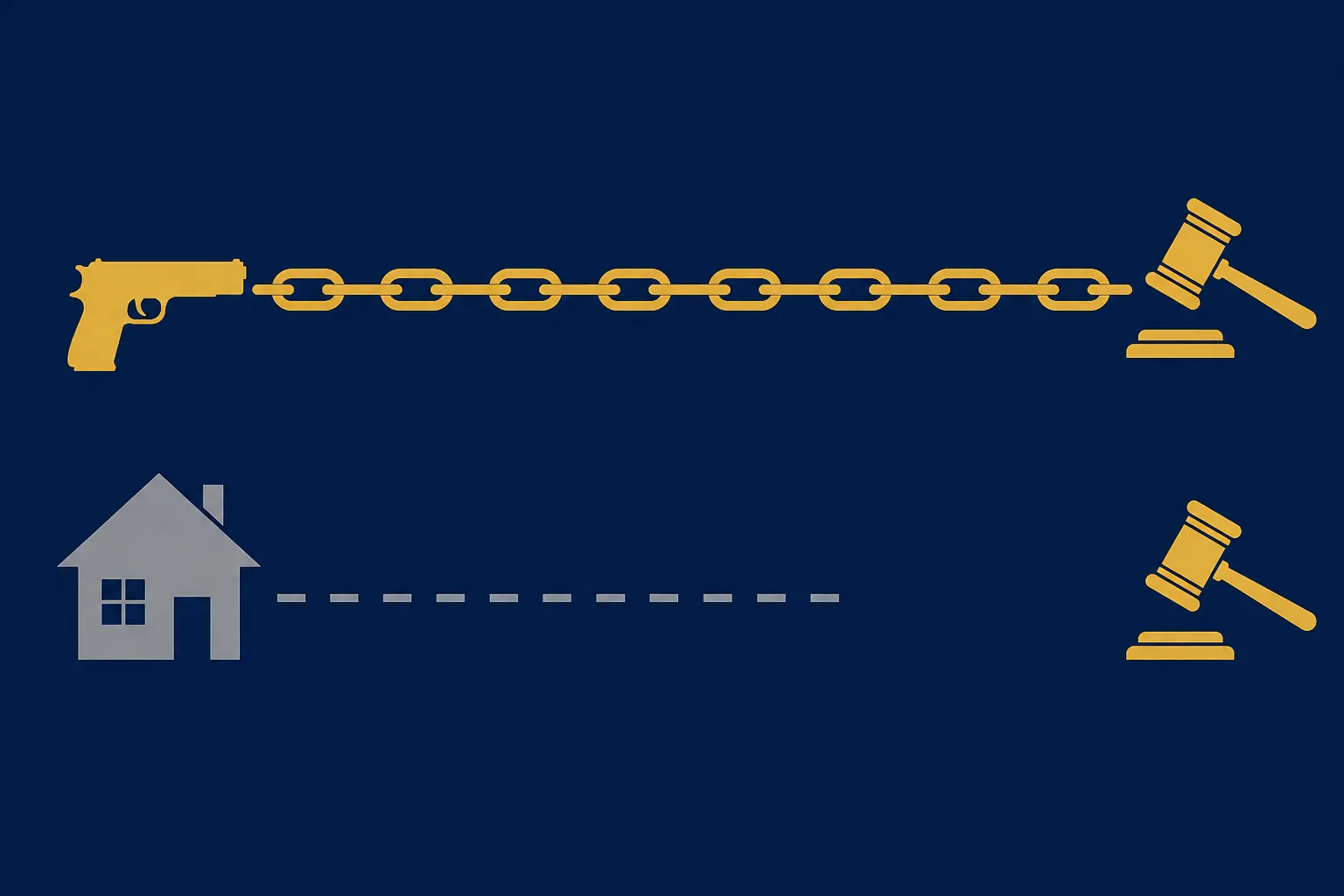
The father’s case is the comparison that gives the mother’s non-charge decision its legal shape. Colin Gray was convicted on March 3, 2026, and sentenced to 15 years on July 30, 2026.[1] The distinction was not that prosecutors found one parent sympathetic and the other offensive. It was that the state could place Colin Gray closer to the weapon, access, warnings, and resulting deaths.
Supplying the weapon and controlling access do legal work that general parental failure does not. They give prosecutors a concrete act to charge, a pathway to causation, and an answer to the obvious defense argument that the shooter’s own criminal act broke the chain. If the parent’s conduct made the weapon available despite known danger, the state has a tighter causal theory.
That is why the father-mother comparison should not be reduced to “both parents failed.” Many people can fail a child before a catastrophe. Criminal homicide liability asks a harsher and narrower question: whose act or omission was close enough to the deaths to be treated as legally causal?
The jail-call material is ugly, but it is not the charging bridge
The jail-call revelations understandably changed how many readers saw Marcee Gray. CNN reported that she helped Colt Gray reach online “fans” from prison, that the material included “fan art” placing him beside Columbine and Parkland shooters, and that she called him “a celebrity.”[1] After four deaths, that language is grotesque. It is not a small public-relations problem. It is a serious display of judgment after a school community had already been shattered.
But post-offense conduct does not travel backward in time and create proximate cause for the killings. A parent’s behavior after the shooting can be relevant to public understanding, professional consequences, family-court questions, institutional review, or moral condemnation. It can also explain why the non-charge decision feels intolerable to people who are seeing the jail-call excerpts first.
For a murder charge tied to the Apalachee deaths, the prosecutor still has to return to the pre-offense chain. Did the parent provide the weapon? Did the parent control access? Did the parent have custody or proximity? Did the parent’s act or omission sit close enough to the shooting that Georgia law would treat it as a proximate cause? Smith’s answer for Marcee Gray was no.[1]
That distinction is hard to hold when the later conduct is this repellent. The jail-call material may make the non-charge decision harder to accept emotionally because it shows, at minimum, a catastrophic failure to center the victims and the harm done. But if the calls occurred after the shooting, they are evidence of what she did after the deaths, not proof that she caused them before they occurred.
Proximate cause keeps the case from becoming a general indictment of bad parenting
Georgia proximate-cause analysis, as invoked by Smith, does not ask whether a parent’s life choices look defensible in hindsight. It asks whether the parent’s conduct is legally close enough to the criminal result. That limit is especially important in school-shooting cases because the public record often contains many alarming facts: family dysfunction, warning signs, school contacts, mental-health concerns, weapons in the home, online behavior, and post-offense statements.
Some of those facts may matter deeply and still not support a homicide charge against a particular person. A charging decision has to sort them by legal function. A warning sign may establish foreseeability. A gun purchase may establish access. Custody may establish control. A post-offense call may establish attitude. Those are not interchangeable categories.
| Fact type | What it can help prove | Why it mattered here |
|---|---|---|
| Custody | Ability to supervise or restrict the child before the offense | Smith said Marcee Gray did not have custody of Colt.[1] |
| Proximity | Practical closeness to the risk and opportunity to intervene | Smith said she did not have proximity to Colt.[1] |
| Providing firearms | Connection to the instrumentality of the killings | Smith said she was not the one who provided the firearms.[1] |
| Steps to remove guns | Evidence cutting against a pure access-enabling theory | Smith said she took “some steps — not many — but some steps” to have guns removed.[1] |
| Post-offense jail calls | Judgment, attitude, and public understanding after the deaths | They do not establish pre-offense proximate cause for the killings. |
The last row is the one that will bother people, and it should. There is no reason to sanitize the jail-call conduct. The point is not that it is irrelevant to every form of accountability. The point is that it answers a different question from the one a homicide indictment has to answer.
The legal reason she was not charged
The legal reason Colt Gray’s mother was not charged is that the Barrow County district attorney did not believe Georgia law allowed him to connect her conduct to the killings as a proximate cause. His stated reasons were specific: no custody, no proximity, no provision of the firearms, and some pre-offense effort to have guns removed.[1]
The father’s conviction sits on the other side of that line because prosecutors could tie him to the weapon-access theory. The mother’s jail-call conduct sits outside that line because it occurred after the offense and speaks to judgment, not causation. The same record can justify public condemnation of Marcee Gray and still leave prosecutors without the legal bridge Georgia requires for a homicide charge.
References
- A school shooter's mother helped him reach his “fans” from prison. Here's why she wasn't charged — CNN, Aug. 2, 2026.
Related records
Tool profile
How Meta's AI Spending Reshapes Law Firm ProfitabilityGoverning regulation
Browse the obligations tracker →Preventive workflow
Browse verification workflows →
Report a correction or tip
Spotted an outdated figure, a misstated fact, or a ruling this case record should reflect? Public comments are disabled for this content given the professional cost of a misreported case outcome, penalty amount, or rule text — use the structured correction channel instead.
Report a correction or tip for this record →